



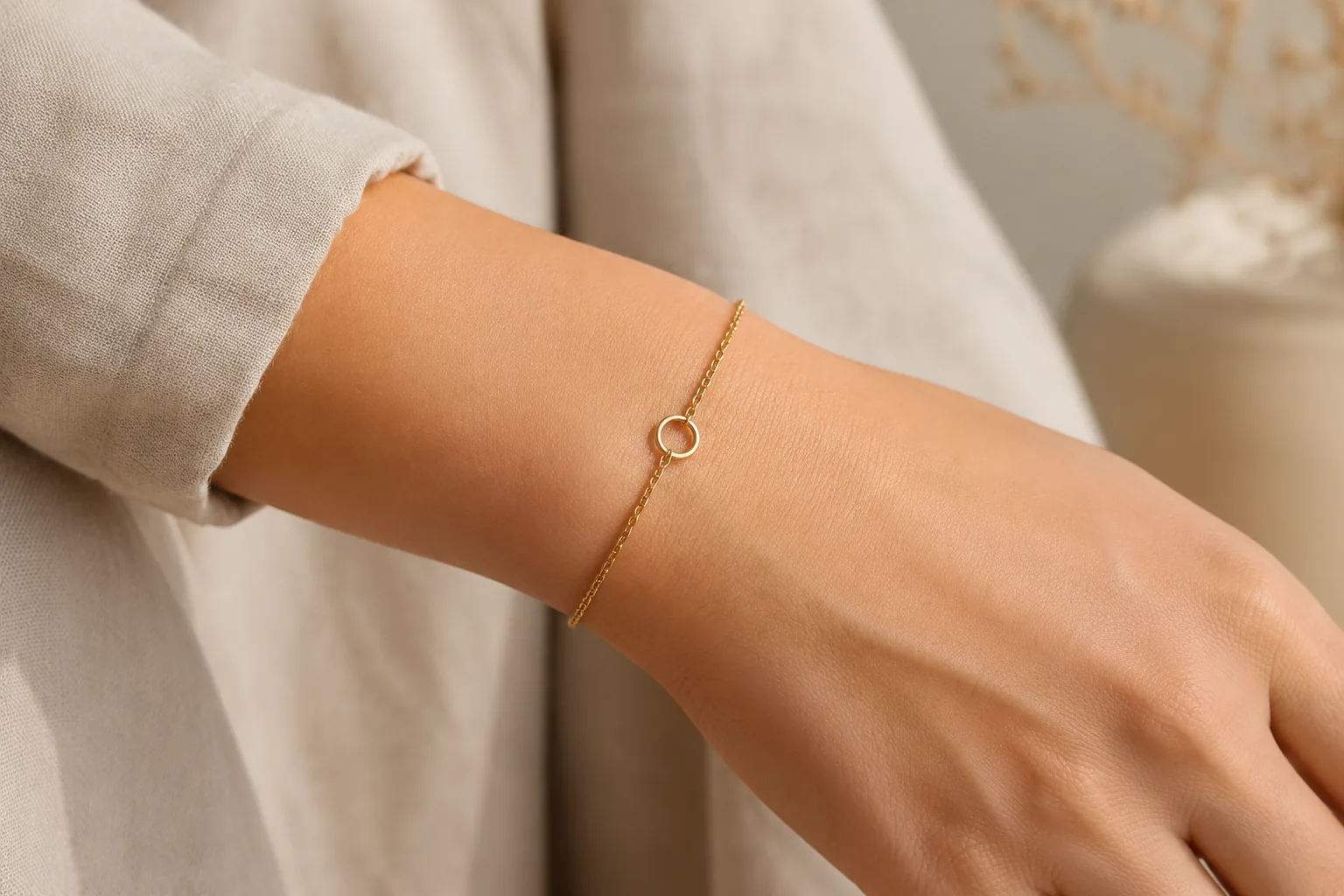
Astrid & Miyu says its welded jewelry uses solid 9K gold, and that matters because 9K is a lower-karat alloy than 14K or 18K. On the brand’s jewellery care page, 9K is defined as 37.5% pure gold, while the FTC’s jewelry buying guide explains how karat markings relate to gold content and how to check for a quality mark. The practical takeaway is simple: this is solid gold jewelry, but not high-karat gold, and the commitment comes with service limits that matter before you book.
Quick Answer: What 9K Gold Means in Astrid & Miyu Welded Jewelry
Astrid & Miyu’s official description is straightforward: its welded pieces use solid 9K yellow, white, or rose gold. The World Gold Council’s gold jewellery guide notes that 9K gold is 37.5% gold, compared with about 58.3% for 14K and 75% for 18K. That puts 9K at the lower-gold, higher-alloy end of the gold spectrum.
The most useful way to read that is as a material choice, not a marketing shorthand. You are getting solid gold, but with less gold content than 14K or 18K. For permanent-style jewelry, that tradeoff is the point.
Why brands use 9K in welded pieces
The brand describes 9K as strong and hard wearing. The broader material logic also fits the category: gold is commonly alloyed with other metals to increase hardness and durability, according to the FTC and World Gold Council. For a welded bracelet or anklet, that alloy balance is part of the appeal.
What 9K does not mean
It does not mean the piece is scratch-proof, maintenance-free, or equivalent to 14K or 18K in gold content. Those are different claims, and the sources here do not support them.
What Astrid & Miyu Says Its Welded Jewelry Is
Astrid & Miyu’s welding-studio page says permanent jewelry is offered as bracelets, rings, and anklets, with customers measured by a jeweler and welded to fit. It also says customers can choose solid 9K yellow and white gold chains, and that mixed-metal appointments can combine solid yellow and white gold chains.
The service is built around made-to-measure wear, but the brand is careful enough in the fine print to show that “permanent” is a service style, not a physics claim.
Bracelets, anklets, and rings are not treated the same
Astrid & Miyu says permanent rings are not permanent in the same way as anklets and bracelets, and lost permanent rings are not replaced. That distinction matters because many readers hear “permanent jewelry” and assume one uniform policy across all pieces. That is not how the brand frames it.
The permanent label still has removal and service limits
The brand says welded bracelets and anklets can be permanently removed with sharp scissors, and it offers optional clasps for people who cannot wear welded jewelry. It also says permanent jewelry is not refundable because it is personalized and made to measure.
In other words, the commitment is real, but it is not absolute. That is the right way to think about it before booking.
9K vs 14K vs 18K: Gold Content and Practical Tradeoffs
The simplest comparison is gold content. 9K is 37.5% gold. 14K is 58.3%. 18K is 75%. The FTC also reminds buyers that gold is mixed with other metals to increase hardness and durability.
For a welded bracelet or anklet, this creates a practical buying choice:
9K
Lower gold content, more alloy metal, and a more budget-conscious permanent-style option. Astrid & Miyu positions it as strong and hard wearing.
14K
Higher gold content than 9K, still widely used for everyday wear, and also described by Astrid & Miyu as durable and hard wearing for all-day wear.
18K
Higher gold content still, with a richer gold share and a different wear profile. The sources here do not say it is better or worse for welded jewelry, only that it contains more gold.
If you are comparing karats more broadly, this guide to choosing between 9K, 14K, and 18K gold jewelry is the most direct adjacent read.
How Durable Is 9K Gold for a Permanent-Style Bracelet or Anklet?
Astrid & Miyu’s strongest durability language is that 9K is “strong” and “hard wearing.” That is useful, but it is also limited. The brand does not publish quantified scratch-resistance, tensile strength, or weld-strength data on the sources provided here.
What the brand supports
It supports the idea that 9K is a practical solid-gold option for everyday wear, and it does say solid gold is not magnetic and will not set off airport alarms. That is a service note, not a durability test, but it helps clarify what the piece is made of.
What the brand does not prove
It does not prove that welded jewelry is damage-proof. It does not prove that the weld will never weaken. It does not prove that 9K performs the same way across all chain styles, link thicknesses, or wear habits.
That is the key analytical distinction: the official material claim is solid, but the performance claim remains broader than the evidence supplied.
Care Rules: What the Brand Says and What It Does Not Say
Astrid & Miyu’s care page says 9K and 14K gold pieces can be cleaned with a polishing cloth or with soap and warm water, then stored in the original box or an airtight jewelry case. The help center also says frequent contact with harsh chemicals such as chlorine may weaken the weld over time.
If you want a broader brand-care comparison point, this guide on what jewelry brands actually warn about when showering is the closest adjacent read.
Cleaning solid gold is not the same as cleaning plated jewelry
The official water, sweat, and perfume warnings on Astrid & Miyu’s care page are written for sterling silver and plated brass, not for solid 9K welded gold. That matters. Care instructions are material-specific, and you should not flatten them into one universal rule.
What is still left unanswered
The brand does not give a full, public policy on showering, swimming, gym use, sleeping, or ocean water for solid 9K welded pieces on the cited pages. So the honest answer is not “yes” or “no” across every use case. The honest answer is that the brand gives some care guidance, flags chlorine as a risk, and leaves the rest to buyer judgment.
For readers who want a caution-first framework around skin contact and metal choice, the sensitive-skin jewelry buying guide is the more useful companion article.
Removal, Resizing, Warranty, and Refund Limits
This is the part many buyers skip, and it is the part that most affects regret.
Astrid & Miyu says welded bracelets and anklets can be permanently removed with sharp scissors. It also says re-welding depends on still having the chain and the chain being in good condition. The help center adds that welded bracelets have a one-year warranty and a one-month loss guarantee.
Why that matters
If the chain is damaged, lost, or altered by someone else, the service path gets narrower. The brand’s general warranty policy also excludes wear and tear, scratches, dents, accidental damage, and external force.
What to assume before you buy
The practical analysis is that you are buying into a service relationship, not just a piece of jewelry. If you think you may want frequent adjustments, easy removal, or broad repair flexibility, welded jewelry is a less forgiving category.
When Welded Jewelry May Be a Poor Fit
Astrid & Miyu offers optional clasps for people who cannot wear welded jewelry, which is already a clue that the format is not universal.
Times to prefer a clasp
If you need easy removal for work, travel, medical procedures, or personal comfort, a clasped bracelet or anklet is usually the lower-risk choice. The Anesthesia Patient Safety Foundation’s guidance on cosmetic enhancements also notes that permanent jewelry should be removed before scheduled surgery and can be cut at the small connecting ring for possible later re-welding.
Times to pause before booking
If you are unsure about fit, expect frequent chemical exposure, or are not close to a re-welding point, permanent-style jewelry becomes a commitment with more friction than a normal bracelet. If you are deciding between welded jewelry and a traditional everyday stack, this starter jewelry wardrobe guide is a useful way to compare flexibility against permanence.
What Astrid & Miyu Does Not Fully Explain
The official sources give enough to understand the concept, but not enough to remove all uncertainty.
The biggest gaps are straightforward: exact alloy composition for the yellow, white, and rose gold versions; whether the white gold includes nickel, palladium, rhodium plating, or something else; chain thickness and link dimensions; whether every component is 9K gold; and market-specific hallmarking or labeling details. The FTC’s gold jewelry guidance is useful here because it explains the value of looking for a karat mark plus the company name or registered trademark.
Why those gaps matter
A cautious buyer does not need every metallurgical detail, but they do need enough information to judge wear, serviceability, and fit risk. On that score, the brand gives a clear service framework and a partial care framework, but not a complete durability dossier.
Conclusion: Who Astrid & Miyu Welded Jewelry Suits
Astrid & Miyu welded jewelry makes sense if you want a made-to-measure solid gold bracelet or anklet, you are comfortable with 9K as the gold content, and you accept that “permanent-style” still comes with removal, warranty, and service limits.
It is a weaker fit if you want easy removal, broader medical flexibility, or a higher-karat gold option. It is also a weaker fit if you want every care scenario spelled out in advance, because the official pages do not fully cover showering, swimming, or all long-term wear conditions.
The practical conclusion is not that 9K welded jewelry is better or worse in the abstract. It is that Astrid & Miyu is offering a specific compromise: solid gold, lower karat, made-to-measure wear, and clear service boundaries. That is a reasonable choice when the format matches your life.
Related Guides
- How to Choose Between 9K, 14K, and 18K Gold Jewelry
- Can You Shower With Jewelry? What Brand Care Pages Actually Warn About
- Sensitive-Skin Jewelry Buying Guide: What to Look for Before You Buy
- A Beginner’s Guide to Buying Everyday Jewelry Materials