



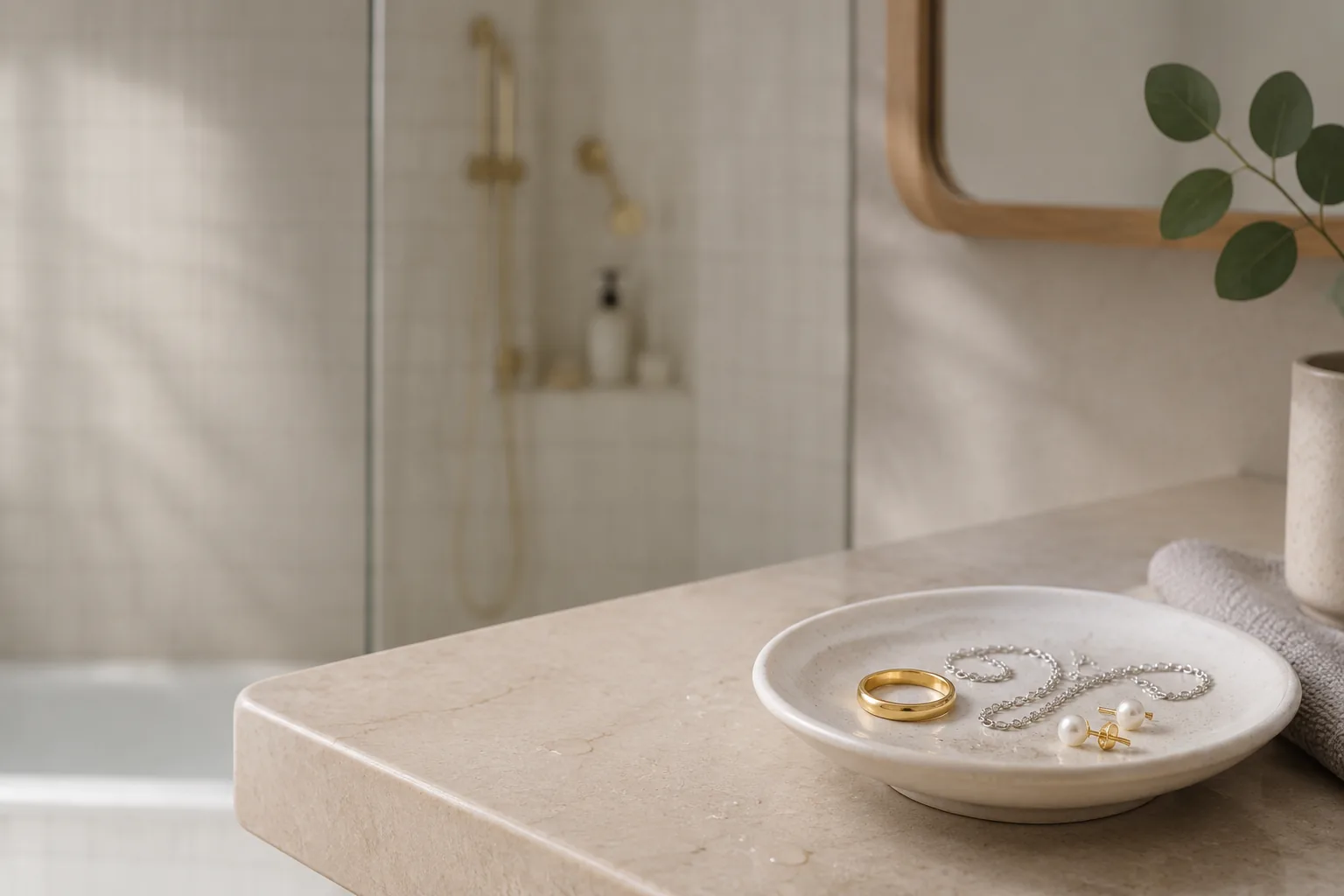
If you are wondering can you shower with jewelry, the practical answer is: remove it first when you can. One accidental shower is different from making showering part of your daily jewelry routine, but official brand care pages generally point in the same direction: water is not the only issue. Soap, shampoo, body wash, chlorine, salt water, sweat, cosmetics, and surface finishes all change the risk.
This guide uses official care guidance from Missoma, Pandora, Monica Vinader, and Astrid & Miyu, plus professional and institutional care sources, to separate the safer everyday habits from the risky ones. Brand care pages are useful because they tell you how the maker wants its jewelry treated. They are not the same as controlled durability testing, and they do not replace the instructions for your exact piece.
Can You Shower With Jewelry? The Short Answer
The safer default is to take jewelry off before showering, especially if it is gold vermeil, gold plated, sterling silver, plated brass, pearl jewelry, gemstone jewelry, or anything with glued parts or delicate settings.
Missoma says it is best to avoid showering with jewelry because soap and water can build up, and shampoo or body-wash chemicals can dull the finish over time. Pandora says to put jewelry on after skincare or cosmetics and take it off before exercise or showering. Monica Vinader’s official care guidance says to remove jewelry when bathing, swimming, or intensely exercising. Jewelers of America also advises not wearing jewelry while showering because films can make pieces appear dull.
The most useful distinction is not “water equals ruin.” It is frequency and material. A quick accidental shower in a simple solid gold ring is usually a different risk profile from wearing a gold-plated necklace through hot showers every day. The first situation calls for calm drying and inspection. The second creates repeated exposure to heat, soap, chemicals, friction, and drying cycles.
As an editorial recommendation, treat showering as avoidable wear. Jewelry is meant to be worn, but not every ordinary daily activity is equally kind to every material.
Why Showering Is Not Just Water Exposure
A shower exposes jewelry to more than clean water. It often includes warm water, surfactants in soap, shampoo residue, conditioner, body wash, exfoliants, shaving products, perfume or lotion already on the skin, and humidity after the shower. If you shower at a gym, pool, spa, or beach accommodation, chlorine or salt water may also be part of the picture.
Missoma specifically warns that soap and water can build up and that shampoo or body-wash chemicals can dull jewelry finishes over time. Monica Vinader advises avoiding perfumes, creams, and liquids on jewelry and keeping pieces away from humidity. Jewelers of America advises wiping jewelry after wear to remove lotions, avoiding chlorine and salt water, and removing jewelry before pools, hot tubs, salt water, sunscreen, lotions, and showering.
Outside brand guidance, the Gemological Institute of America says chemicals can damage or discolor precious metals and harm colored gems. GIA also says jewelry should be removed before chlorinated pools or household cleaners, and warns that chlorine bleach can pit or damage gold alloys. Jewelers of America says chlorine or salt water can damage or discolor metals including gold and platinum and can erode gemstone finish or polish.
So the concern is not that plain water instantly destroys all jewelry. The concern is repeated exposure to substances and conditions that can dull, discolor, loosen, tarnish, or wear down vulnerable materials.
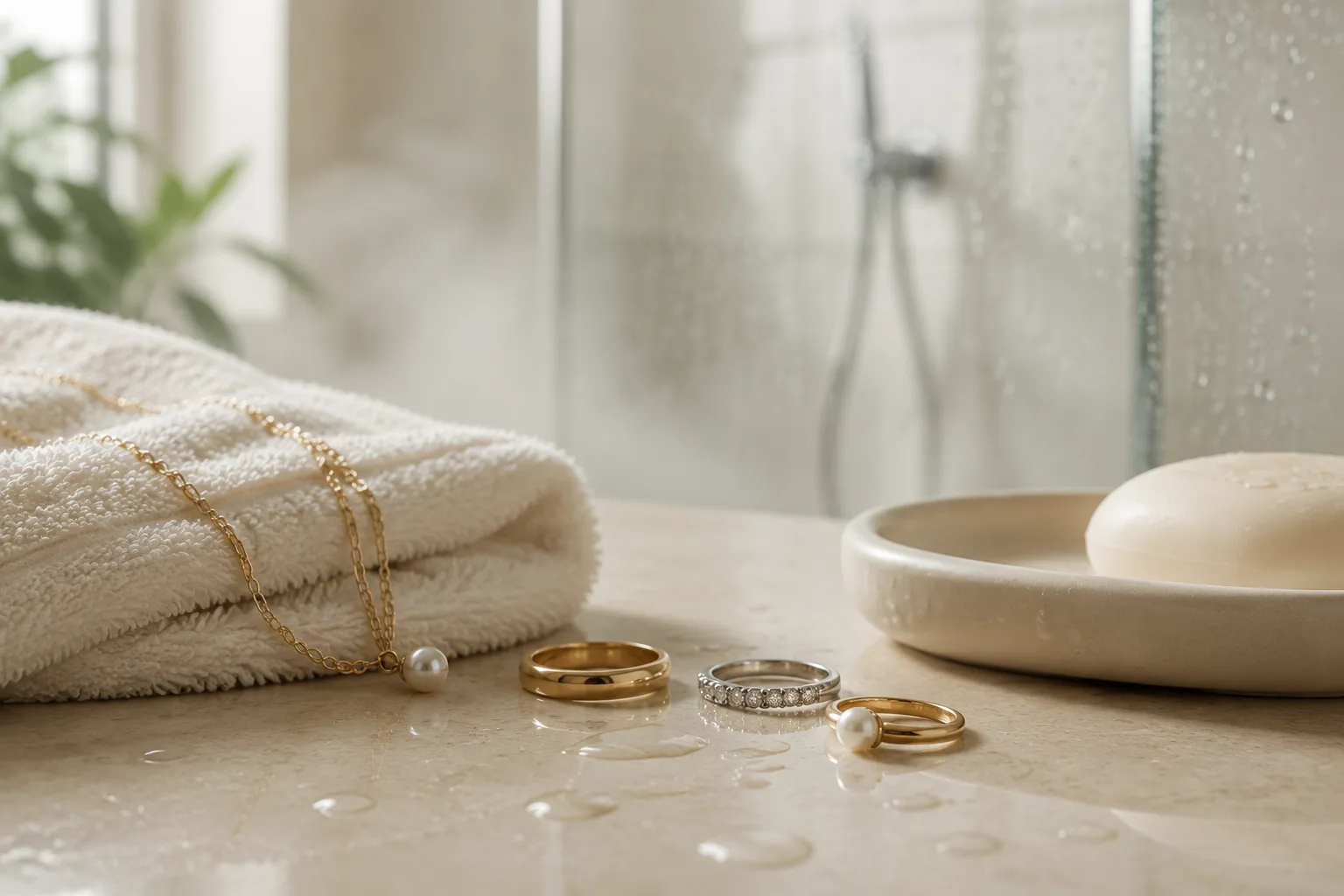
What Missoma, Pandora, Monica Vinader, and Astrid & Miyu Actually Say
The four brand pages mostly agree on the habit: remove jewelry before showering, bathing, swimming, exercise, or heavy exposure to cosmetics and chemicals. Their wording differs because their product ranges and risk tolerance differ.
| Brand source | What the care guidance says | How to read it |
|---|---|---|
| Missoma | Missoma describes itself as a demi-fine and fine jewelry specialist using recycled gold and silver. Its pieces are described as designed for everyday wear, but the brand recommends removing jewelry for sports, swimming, or cleaning because of impact, chemicals, or sweat. It also says it is best to avoid showering because soap, water, shampoo, and body wash can dull the finish over time. | “Everyday wear” does not mean “wear through every wet or chemical exposure.” |
| Pandora | Pandora’s page covers silver, gold, pearls, plated metals, stones, and lab-grown diamond pieces. It says to put jewelry on after skincare or cosmetics and take it off before exercise or showering. It also says rings should be removed before cooking and handwashing. | Pandora gives broad prevention guidance across varied materials, not a single rule for one metal. |
| Monica Vinader help article and official care page | The supplied research notes that browser extraction returned no readable lines from the exact help URL, but search-visible official text advises removing jewelry when showering, bathing, or heavy exercising, especially in the sea or a chlorinated pool. A second official Monica Vinader care page corroborates removing jewelry when bathing, swimming, or intensely exercising. | The shower guidance is supported by official Monica Vinader care material, but the exact help URL should be manually checked before publication. |
| Astrid & Miyu | Astrid & Miyu lists categories including 14k gold, lab-grown diamonds, 9k gold, sterling silver/plated, brass, pearls, gemstones, and storage/care. It describes 14k solid gold as durable and suitable for all-day, everyday wear. It recommends avoiding water, sweat, and perfumes for sterling silver and plated brass because tarnish or oxidation may result. | The brand makes a clearer material distinction: solid gold is positioned as more durable, while silver and plated brass get stronger avoidance guidance. |
The apparent contradiction is usually not a true contradiction. A brand can call a piece everyday-wearable and still ask customers to remove it before showering. In care language, everyday wear often means normal styling and repeated use, not uninterrupted exposure to soap, sweat, pools, hot tubs, salt water, and cosmetics.
Lowest-Risk Materials: Solid Gold and Simple Designs
Simple solid gold pieces are generally the lowest-risk category for occasional shower exposure, especially compared with plated jewelry or delicate pearl and gemstone pieces. Astrid & Miyu describes 14k solid gold as durable and suitable for all-day, everyday wear, and says solid gold can be cleaned with a polishing cloth or soap and warm water.
That does not make every solid gold piece shower-proof. GIA says chemicals can damage or discolor precious metals, and warns that chlorine bleach can pit or damage gold alloys. Jewelers of America says chlorine or salt water can damage or discolor metals including gold and platinum. A solid gold chain with a vulnerable gemstone, delicate setting, enamel, adhesive, or pearl detail is no longer just a simple piece of metal.
As analysis, the lowest-risk shower scenario is a plain, well-made solid gold band or simple solid gold chain exposed accidentally to ordinary water and mild residue, then dried thoroughly. The risk rises if the water is chlorinated or salty, if the piece has stones or glued components, or if showering becomes routine.
Higher-Risk Materials: Vermeil, Plated Jewelry, Sterling Silver, and Plated Brass
Surface-finished jewelry deserves more caution because the visible color depends on a layer over another metal. The Federal Trade Commission says gold electroplate has at least 10k gold applied electrolytically at a minimum thickness of 0.175 microns. The FTC describes vermeil as a special gold-plated product with a sterling silver base coated or plated with gold. It also says gold flashed or gold washed products have very thin electroplatings that wear away faster than gold plate, gold-filled, or gold electroplate.
That does not mean all plated pieces fail quickly, and the supplied research does not support a guaranteed timeline. It does support a practical care recommendation: reduce repeated contact with water, soap, sweat, perfume, lotion, and friction when the surface layer matters to the look of the piece.
Sterling silver has a different issue. The FTC says sterling silver contains 92.5% pure silver. The Canadian Conservation Institute explains that silver tarnish is primarily silver sulfide, formed when silver reacts with sulfur-containing gases in air. It also says sterling silver tarnish can include copper sulfide, and that sterling silver, an alloy of 92.5% silver and 7.5% copper, tarnishes faster than pure silver.
So sterling silver tarnish is not simply dirt, and showering does not remove the underlying tarnish risk. Soap film may make a piece look dull, while air exposure and sulfur-containing gases remain part of tarnish chemistry. Astrid & Miyu specifically recommends avoiding water, sweat, and perfumes for sterling silver and plated brass because tarnish or oxidation may result.
Rhodium-plated jewelry should also be treated cautiously around routine showering, but with an important evidence limit: the four supplied brand pages do not directly cover rhodium-plated pieces in the research package. The practical caution is an editorial inference from general plated-surface care, not a direct quote from those four brand sources.
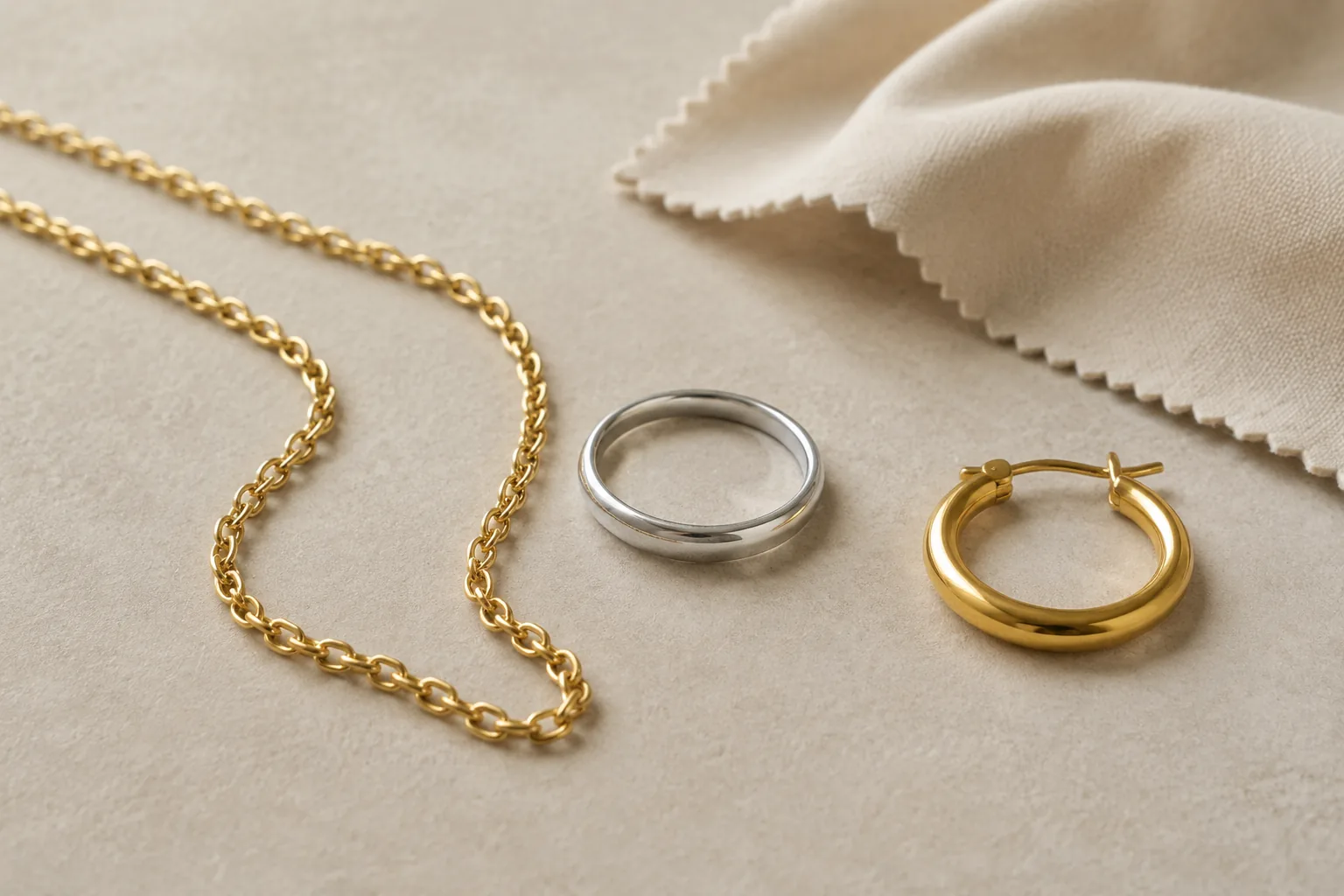
Pieces That Should Stay Out of the Shower
Some jewelry categories should stay out of the shower unless the maker of that exact piece says otherwise.
Pearls are the clearest example. Missoma says pearls should be wiped with a soft damp cloth and not soaked. Pandora says pearls need extra care, should not be soaked or rubbed harshly, should be kept away from acids, solvents, ultrasonic cleaning, high temperatures, and prolonged direct light, and should be cleaned with a soft damp cloth and patted dry. Monica Vinader says pearls should be cleaned with a dry soft cloth. Astrid & Miyu says freshwater pearls should be kept away from water where possible, avoid direct cosmetics contact, be stored in a sealed pouch, and be cleaned with a microfiber cloth.
Porous, delicate, or treated gems also need caution. Monica Vinader says natural gemstones can be delicate and advises avoiding hot water, harsh chemicals, and cleaners. Astrid & Miyu recommends avoiding water and perfumes for gemstones and storing some semi-precious stones away from direct sunlight. GIA says light and heat can affect some gems, pearls, and opals, and that hairspray, lotion, perfume, and cosmetics can damage pearls and delicate or porous gems such as turquoise.
Treated stones and certain settings add another layer of uncertainty. GIA warns that treated gems may be affected by heat, solvents, steam, and ultrasonic cleaners. GIA also says ultrasonic cleaners can loosen stones or chip gems, and that organic gems such as pearls should not be cleaned ultrasonically.
As a practical rule, keep these out of the shower: pearls, opals, porous stones, treated stones, glued stones, foil-backed stones, vintage or unknown-material pieces, delicate pavé or bead-set designs, textile or corded jewelry, plated brass, vermeil, gold-plated pieces, and anything you cannot confidently identify.
What To Do If You Accidentally Showered With Jewelry
An accidental shower is not a reason to panic. The right response depends on the material.
For simple solid gold pieces, Astrid & Miyu says solid gold can be cleaned with a polishing cloth or soap and warm water. Missoma says jewelry can be cleaned with mild dish soap and warm water, followed by drying with a soft cloth. If the piece has no pearls, porous stones, glued components, or delicate settings, a gentle rinse and careful drying may be appropriate.
For pearls, do less. Missoma says pearls should be wiped with a soft damp cloth and not soaked. Pandora says pearls should be cleaned with a soft damp cloth and patted dry, while Monica Vinader says pearls should be cleaned with a dry soft cloth. Because brand instructions differ slightly, follow the instruction for the exact pearl piece when you have it.
For gemstones, plated pieces, and uncertain materials, blot dry with a soft lint-free cloth and let the piece air-dry fully before storing. Avoid harsh cleaners, bleach, abrasive polishing, and ultrasonic cleaning unless the maker specifically allows that method for the material and stones. GIA’s warning about ultrasonic cleaners loosening stones or chipping gems is a useful reason to be conservative.
After drying, check clasps, stone movement, cloudy residue, and any change in surface color. If a stone looks loose or the finish looks changed, stop wearing the piece until a jeweler or the brand’s care team can advise.
A Simple Decision Framework Before You Wear Jewelry in Water
Use this as a quick pre-shower checklist:
| Question | Lower-risk answer | Higher-risk answer |
|---|---|---|
| What is the main material? | Plain solid gold | Gold vermeil, gold plate, gold flash, gold wash, plated brass, sterling silver |
| Is there a surface finish? | No obvious plating or coating | Plated, washed, flashed, rhodium-plated, enamel, coated, unknown finish |
| Are there pearls or delicate gems? | No stones, or stones with maker-approved water care | Pearls, opals, turquoise, porous gems, treated gems, unknown stones |
| Are there glued parts or delicate settings? | Simple metal construction | Glue, pavé, bead settings, foil backs, vintage settings, textile or cord |
| What kind of water exposure? | Accidental brief plain-water exposure | Daily showering, chlorine, salt water, hot tub, pool, steam, body wash |
| What does the brand say? | Maker explicitly permits the exposure | Maker says remove before showering, bathing, swimming, or exercise |
If any higher-risk answer applies, remove the jewelry before showering. If you cannot identify the material, treat it as higher risk. If brand care instructions differ from a general online tip, follow the brand or jeweler instructions for the specific piece.
Conclusion
So, can you shower with jewelry? Sometimes a piece may survive occasional water exposure without obvious damage, but the better care habit is to remove jewelry before showering. That is the direction supported by Missoma, Pandora, Monica Vinader, Jewelers of America, and the cautionary material guidance from GIA.
The material matters. Plain solid gold and simple designs are generally lower risk, but not immune to chemicals, chlorine, stones, or construction issues. Sterling silver can tarnish through chemical reactions with sulfur-containing gases in air. Vermeil, plated jewelry, gold flash, gold wash, and plated brass rely on surface layers that deserve more protection. Pearls, porous gems, treated gems, glued components, and delicate settings should stay out of the shower unless the maker clearly says otherwise.
The most reliable rule is simple: put jewelry on after skincare, perfume, and styling products; take it off before showering, swimming, cleaning, or heavy exercise; dry accidental exposure promptly and gently; and follow the care instructions for the exact piece.
Jewelry care recommendations vary by material, treatment, and setting. Always follow brand or jeweler care instructions for your specific piece. This article provides shopping and educational information, not medical advice. Consult a qualified clinician or dermatologist about persistent irritation or reactions. Return rights, hallmarking, and product-labeling rules vary by country, so check current seller policies and local regulations before purchase.
Sources
- Missoma, “How to Care for Your Jewelry”, retrieved 2026-07-31.
- Pandora US, “How to Clean Jewelry”, retrieved 2026-07-31.
- Monica Vinader, “Jewellery Care Guide”, retrieved 2026-07-31; supplied research notes extraction limitations for this exact URL.
- Monica Vinader, “Jewellery Care”, retrieved 2026-07-31.
- Astrid & Miyu, “Our Materials & Jewellery Care”, retrieved 2026-07-31.
- Jewelers of America, “Jewelry Care”, retrieved 2026-07-31.
- Gemological Institute of America, “Tips on Caring for Jewelry”, retrieved 2026-07-31.
- Canadian Conservation Institute, “Understanding How Silver Objects Tarnish”, retrieved 2026-07-31.
- Federal Trade Commission, “Buying Platinum, Gold, and Silver Jewelry”, retrieved 2026-07-31.