



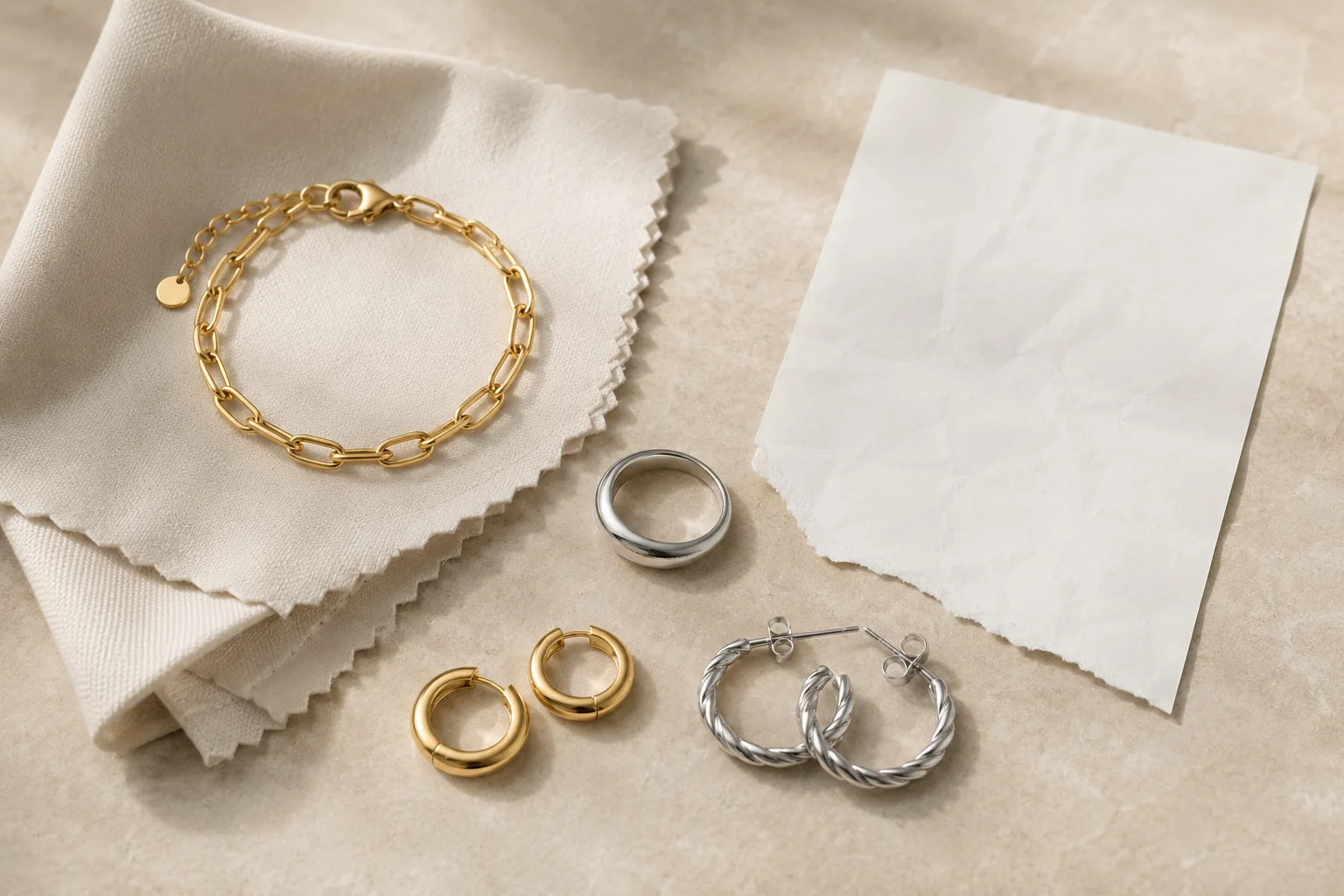
When you compare Monica Vinader and Missoma, style usually gets most of the attention: chain shapes, gemstones, signet rings, sculptural hoops, and everyday gold tones. But for many jewelry buyers, the more important question appears after checkout: what happens if a chain breaks, a vermeil finish loses color, a ring size is wrong, or a piece needs service after the first year?
This Monica Vinader vs Missoma warranty comparison focuses only on the official policy and care information in the research package. It does not claim that one brand is better made, more durable, or better value simply because of warranty length. A warranty is a service promise, not a laboratory durability result.
The short version is clear: Monica Vinader publishes broader official aftercare language, including a 5-year warranty, lifetime repairs after the warranty period where available for a fee, replating language, and ring resizing language with limits. Missoma publishes a 2-year jewelry warranty focused on manufacturing defects, with replacement at no cost for covered defects, plus detailed care and storage responsibilities. For an everyday buyer, that difference matters most if you expect to keep a piece for several years and want a defined route for repairs, replating, or resizing.
Quick Verdict: Which Policy Is More Supportive After Purchase?
For buyers who prioritize post-purchase support, Monica Vinader has the more supportive official policy based on the cited sources. Its official warranty materials describe a 5-year warranty and lifetime repairs. Monica Vinader also states that after 5 years, or where there is no proof of purchase, lifetime repair may be available for a fee.
Missoma’s official U.S. Help & FAQs page says the brand provides a 2-year warranty on all jewelry. It frames covered warranty issues as manufacturing defects, with breakage and tarnishing given as examples, and says covered manufacturing defects are eligible for replacement at no cost.
That makes the practical distinction fairly simple. Monica Vinader appears to be the stronger policy fit if you want a longer brand warranty and explicit aftercare language around repair routes. Missoma may still be adequate if your main concern is a shorter safety net for manufacturing defects and you are comfortable following its care guidance closely.
This is analysis, not a claim about product quality. A longer warranty can improve ownership confidence, but it does not prove that every Monica Vinader piece will outperform every Missoma piece in daily wear.
Warranty Length: Monica Vinader 5 Years vs Missoma 2 Years
The core Monica Vinader vs Missoma warranty difference starts with duration.
Monica Vinader’s official U.S. warranty page is the required source for verifying Monica Vinader warranty and aftercare claims in this research package. The cited Monica Vinader warranty materials describe a 5-year warranty and lifetime repairs. Monica Vinader’s help article also says every hand-crafted Monica Vinader piece has a 5-year warranty.
Missoma’s official U.S. Help & FAQs page is the required source for verifying Missoma warranty claims in this research package. That page says Missoma provides a 2-year warranty on all jewelry.
For a buyer comparing these two brands before purchase, this means Monica Vinader gives a longer official warranty window: 5 years versus Missoma’s 2 years. The difference is not only the number of years. The cited Monica Vinader materials also include more explicit language around repairs, replating, resizing, and after-warranty support, while the cited Missoma materials emphasize manufacturing defects and replacement for covered issues.
The safer interpretation is this: Monica Vinader’s policy is more ownership-service oriented in the official language available here. Missoma’s policy is more narrowly framed around a 2-year manufacturing-defect warranty. That does not mean Missoma has no customer service route for issues, but the research package does not establish a comparable lifetime repair, replating, or ring resizing model for Missoma.
What Monica Vinader Says It Covers
Monica Vinader’s cited official warranty materials include several types of support that matter for everyday jewelry ownership: repair, replacement, discontinued-item voucher language, replating, and ring resizing language.
According to the research package, Monica Vinader’s help article says accidental scratches, resizing, and replating can be repaired free with proof within the 5-year warranty period. This is unusually relevant for everyday jewelry buyers because the most common ownership worries are not always dramatic failures. They can be small but irritating problems: a ring no longer fits comfortably, a finish looks different from when it was purchased, or a piece needs attention after repeated wear.
Monica Vinader’s policy also states that after 5 years, or where there is no proof of purchase, lifetime repair may be available for a fee. The “may be available” and “for a fee” parts matter. The cited sources do not provide a complete U.S. fee table, and the research package does not identify a fixed repair turnaround time in the core warranty sources. Buyers should not assume every repair will be free, fast, or approved.
The official warranty materials also include discontinued-item voucher language. In practical terms, that suggests Monica Vinader has policy language for cases where a direct replacement may not be possible because the item is no longer available. The exact outcome would still depend on the current policy, the claim details, proof requirements, and brand assessment.
Monica Vinader’s official warranty materials include replating language for vermeil that loses color over time. They also include ring resizing language, with style limitations and typical resizing up to two sizes smaller or larger. This is important because ring resizing is not always technically possible for every design. Bands with certain stones, shapes, engraving, texture, plating, or construction details may be more limited than plain bands.
The buyer takeaway: Monica Vinader is the clearer choice if you want a brand whose official aftercare language names several ownership needs beyond a basic defect claim. But it is still a policy with conditions, not open-ended coverage for every kind of damage.
What Missoma Says It Covers
Missoma’s cited U.S. Help & FAQs page says Missoma provides a 2-year warranty on all jewelry. It frames covered warranty issues as manufacturing defects and gives breakage and tarnishing as examples. The same page says covered manufacturing defects are eligible for replacement at no cost.
That language is useful, but it needs careful reading. Missoma’s warranty is not presented in the research package as a general repair program for all post-purchase wear issues. It is framed around manufacturing defects. A broken chain, for example, may be covered if Missoma treats the issue as a manufacturing defect, but the outcome could depend on evidence, cause, and whether the issue appears consistent with the brand’s care expectations.
Missoma’s U.S. Terms & Conditions require proof of receipt and satisfactory evidence of how breakage occurred for breakage warranty claims. That evidence requirement is important for buyers who purchase jewelry as gifts, buy through stockists, or do not keep order records. If you cannot show proof of purchase or explain how the issue happened, the claim may become harder to support.
Missoma’s U.S. care page describes the brand as demi-fine and fine jewelry specialists. For warranty purposes, that brand description should not be stretched into a performance claim. It does not prove a specific level of durability, and it does not expand the warranty beyond the terms stated in Missoma’s Help & FAQs and related policy pages.
The buyer takeaway: Missoma offers a clear 2-year manufacturing-defect warranty in the cited U.S. sources, with no-cost replacement for covered defects. The research package does not establish official Missoma lifetime repairs, paid repair-after-warranty support, replating, or ring resizing.
Repairs, Replating, and Ring Resizing Compared
This is where the two policies become most different for everyday ownership.
Monica Vinader’s cited materials include repair support within the 5-year warranty period and lifetime repair language after that period where available for a fee. They also include replating language for vermeil that loses color over time and ring resizing language with style limitations and typical resizing up to two sizes smaller or larger.
Missoma’s cited materials establish a 2-year warranty for jewelry, framed around manufacturing defects, with replacement at no cost for covered issues. The research package does not identify an official Missoma lifetime repair program, paid repair-after-warranty model, replating service, or ring resizing service in the cited U.S. sources. Missoma’s U.S. returns page also says Missoma no longer accepts exchanges, including for rings and other sizes.
For ring buyers, that distinction can be significant. A ring is one of the highest-fit-risk jewelry purchases because finger size can vary by hand, temperature, season, band width, and stacking style. Monica Vinader’s official resizing language gives buyers a clearer service path, although style limitations still apply. Missoma’s cited U.S. returns page saying exchanges are no longer accepted, including for rings and other sizes, means buyers should be especially careful with size selection before ordering.
For vermeil buyers, Monica Vinader’s official replating language is also relevant. Gold vermeil and plated finishes can change visually over time depending on wear, exposure, storage, and construction. The cited Missoma sources do mention tarnishing as an example under manufacturing defects, but they do not establish a general replating service. That distinction should not be blurred. Tarnishing considered a covered manufacturing defect is not the same as a standing replating program.
For repair-prioritizing buyers, Monica Vinader has the more detailed official aftercare pathway in the research package. For buyers who mainly want a short-to-medium warranty against manufacturing defects, Missoma’s 2-year warranty may be enough, provided they understand the evidence and care responsibilities.
What Can Block a Warranty or Aftercare Claim?
A warranty is useful only if the claim fits the policy. Both brands have limits and practical steps that can affect outcomes.
For Monica Vinader, the cited help article says gifts with purchase and sample-sale items are excluded from the 5-year warranty. Monica Vinader’s after-warranty or no-proof-of-purchase repair language also matters: after 5 years, or where there is no proof of purchase, lifetime repair may be available for a fee. That means proof of purchase can affect whether a repair is free within the warranty period or potentially handled differently.
For Missoma, the cited U.S. Help & FAQs page excludes loss and theft from warranty coverage. Missoma’s U.S. Terms & Conditions require proof of receipt and satisfactory evidence of how breakage occurred for breakage warranty claims. Missoma’s U.S. returns page says faulty item processes require contacting customer service before returning the item. The same returns page says stockist returns are handled by the stockist.
Those details create several practical risks. If a piece is lost or stolen, the cited Missoma warranty language does not cover it. If a Missoma piece was bought from a stockist, the return path may not be the same as a direct purchase from Missoma. If a buyer sends back a faulty item without first contacting customer service, that may conflict with the stated process. If a buyer cannot provide proof of receipt or evidence around breakage, a claim may be harder to approve.
The research package does not establish exact claim approval rates, repair fees, or universal turnaround times for either brand. It also does not clearly name lost stones as a covered or excluded problem in the cited core policies. The safest advice is to document the purchase, photograph the issue, keep order emails, and contact the brand or stockist before attempting repairs or returns.
Care Responsibilities: Why Everyday Wear Still Matters
Warranty language should be read alongside care instructions. Everyday jewelry is still exposed to water, sweat, cosmetics, friction, storage habits, and accidental impact. Whether a brand treats a problem as a covered defect or as wear, misuse, or exposure-related damage may depend on the facts of the situation.
Monica Vinader’s care guidance advises removing jewelry before showering, bathing, heavy exercise, sea swimming, and chlorinated swimming. That matters for buyers who want jewelry they can leave on continuously. Based on the cited care guidance, Monica Vinader does not present those activities as recommended wear conditions.
Missoma’s U.S. care page advises avoiding exposure to perfume, deodorant, hairspray, nail polish remover, sun lotion, body oils, swimming, sports, cleaning, and showering. It also advises storing jewelry somewhere cool, dry, dark, and separated.
Missoma creates a point that can confuse buyers: its warranty page gives tarnishing as an example of a manufacturing defect, while its care guidance also identifies exposures and storage conditions that can contribute to tarnish or damage. The correct way to explain this is not to say Missoma covers all tarnish. The better interpretation is that some tarnishing may be treated as a manufacturing-defect issue within the warranty, but tarnish or finish change linked to care, exposure, or storage may be assessed differently.
Monica Vinader’s official replating language gives buyers a more explicit route for some finish-change concerns, especially for vermeil that loses color over time. Even so, buyers should still follow care guidance. A replating or repair policy does not mean jewelry can be worn through every high-exposure activity without consequences.
For everyday wear, the practical recommendation is conservative: remove demi-fine and plated or vermeil jewelry before showering, swimming, heavy exercise, cleaning, and applying cosmetics or body products, unless a brand’s current instructions clearly say otherwise for that specific piece.
Legal Rights vs Brand Warranty
Brand warranties and consumer legal rights are related, but they are not the same thing.
Missoma’s U.S. Terms & Conditions say the 2-year warranty is in addition to legal rights. The FTC consumer guidance says written warranties do not replace implied warranties and that state law may matter. The FTC also says consumers may have rights beyond a brand warranty.
For U.S. readers, that context is useful but should stay separate from the Monica Vinader and Missoma policy comparison. FTC guidance is general consumer information. It does not predict that either brand must approve a specific jewelry claim, and it does not turn a voluntary 2-year or 5-year brand warranty into a universal legal outcome.
For readers outside the U.S., the distinction becomes even more important. This article is using U.S. official brand pages and U.S. consumer guidance in the cited research package. U.K., EU, Canadian, and other regional consumer rights may differ. A buyer should not assume the U.S. Missoma Help & FAQs page or FTC guidance describes every legal right available in another country.
The cleanest way to think about it is this: the brand warranty tells you what the brand voluntarily publishes as its service promise. Consumer law may give additional rights depending on location, facts, and purchase channel. The two should not be merged into one global rule.
Which Brand Fits Which Buyer?
Choose Monica Vinader if your main concern is long-term ownership support. Based on the official sources in the research package, Monica Vinader is the stronger fit for buyers who value a 5-year warranty, possible paid lifetime repairs after the warranty period, official replating language, and ring resizing language. It is especially relevant if you are buying vermeil, a ring with sizing risk, or a piece you hope to keep in regular rotation for several years.
Choose Missoma if you are comfortable with a shorter manufacturing-defect warranty and your purchase has lower aftercare risk. Missoma’s 2-year warranty may be enough if you mainly want coverage for manufacturing defects, understand that covered defects are eligible for replacement at no cost, and are prepared to follow Missoma’s care and storage guidance. It may be a more straightforward fit for buyers who are less concerned about resizing, replating, or after-warranty repair routes.
Be more cautious with Missoma rings if you are uncertain about size. The cited Missoma returns page says exchanges are no longer accepted, including for rings and other sizes, and the research package does not identify an official Missoma ring resizing service. That does not mean a buyer can never solve a sizing issue, but it does mean the official policy evidence here does not provide the same reassurance as Monica Vinader’s resizing language.
Be more cautious with either brand if you plan to wear jewelry through showering, swimming, gym sessions, cosmetics, cleaning products, or heavy daily friction. Both brands’ care guidance includes avoidance language for common exposures. A warranty may help with eligible issues, but it is not a substitute for care that matches the materials and finish.
This buyer-fit guidance is analysis based on official policy language. It should not be read as a claim that one brand’s jewelry is universally better, longer lasting, or better for every buyer.
Questions to Ask Before You Buy
Before buying from either brand, ask a few practical questions.
First, what is the warranty period? Monica Vinader’s cited materials describe a 5-year warranty. Missoma’s cited U.S. Help & FAQs page says Missoma provides a 2-year warranty on all jewelry.
Second, what happens after the warranty period? Monica Vinader’s policy states that after 5 years, or where there is no proof of purchase, lifetime repair may be available for a fee. The cited Missoma U.S. sources do not establish a comparable lifetime repair or paid repair-after-warranty model.
Third, do you need replating support? Monica Vinader’s official warranty materials include replating language for vermeil that loses color over time. The cited Missoma U.S. sources do not establish an official replating service.
Fourth, are you buying a ring? Monica Vinader’s official materials include ring resizing language, with style limitations and typical resizing up to two sizes smaller or larger. Missoma’s U.S. returns page says exchanges, including for rings and other sizes, are no longer accepted, and the research package does not identify an official Missoma resizing service.
Fifth, can you keep proof of purchase? Monica Vinader’s warranty and repair path may depend on proof within the 5-year warranty period. Missoma’s Terms & Conditions require proof of receipt and satisfactory evidence of how breakage occurred for breakage warranty claims.
Sixth, are you buying direct or from a stockist? Missoma’s U.S. returns page says stockist returns are handled by the stockist. For any brand, stockist purchases can make the service route different from a direct brand purchase, so it is worth checking before checkout.
Seventh, what situations are excluded? Monica Vinader’s cited help article says gifts with purchase and sample-sale items are excluded from the 5-year warranty. Missoma’s cited U.S. Help & FAQs page excludes loss and theft.
Finally, are you willing to follow the care rules? Monica Vinader advises removing jewelry before showering, bathing, heavy exercise, sea swimming, and chlorinated swimming. Missoma advises avoiding exposure to perfume, deodorant, hairspray, nail polish remover, sun lotion, body oils, swimming, sports, cleaning, and showering, and storing jewelry somewhere cool, dry, dark, and separated.
Conclusion: Monica Vinader Has the Stronger Aftercare Policy on the Cited Evidence
Based on the official sources in this research package, Monica Vinader offers the longer and broader aftercare policy for everyday jewelry buyers. Its cited policy language includes a 5-year warranty, lifetime repairs after 5 years or without proof of purchase where available for a fee, replating language, and ring resizing language with limitations.
Missoma offers a 2-year warranty on all jewelry in its cited U.S. Help & FAQs page, framed around manufacturing defects, with replacement at no cost for covered issues. That can be enough for buyers who want a shorter manufacturing-defect safety net and are less concerned about official repair, replating, or resizing routes. But the cited Missoma U.S. sources do not establish lifetime repairs, paid repair-after-warranty support, replating, or ring resizing.
The best choice depends on ownership risk. If aftercare is central to the purchase, especially for vermeil, rings, or pieces you expect to keep for years, Monica Vinader is the clearer policy fit. If your purchase is lower risk and you mainly want coverage for manufacturing defects within 2 years, Missoma may still be a reasonable choice. In both cases, keep proof of purchase, read the current regional policy before checkout, and treat care instructions as part of the ownership cost.