



This article may contain affiliate links. If you buy through these links, we may earn a commission at no extra cost to you.
The Short Answer
Choosing between a minimiser, sports, or everyday bra at Bras N Things is less about finding the single “best” bra and more about matching the category to the problem you are trying to solve.
If you want your bust to look less projected under clothing, start with a minimiser. If you are exercising, running, jumping, or doing anything high-movement, start with a sports bra. If you need comfort, shape, and outfit compatibility for normal daily wear, start with an everyday bra.
You can shop Bras N Things directly, but it is worth narrowing the category first. Bras are fit-sensitive, and the wrong category can feel uncomfortable even if the size looks correct on paper.
Quick Comparison: Which Bras N Things Category Fits Your Goal?
| Category | Best For | Main Benefit | Watch-Out |
|---|---|---|---|
| Minimiser bras | Smoother or smaller-looking bust profile under clothing | Helps reduce projection and create a more contained shape | Not a substitute for a sports bra during exercise |
| Sports bras | Workouts, running, gym classes, jumping, and high-movement activities | Helps control breast movement and improve support during activity | May feel too firm or compressive for all-day wear |
| Everyday bras | Work, errands, casual wear, t-shirts, daily outfits | Balanced comfort, shape, and repeat wear | May not provide enough movement control for sport |
Choose a Minimiser Bra If Your Main Issue Is Bust Projection
A minimiser bra is designed for people who like their size but want a different silhouette under clothing. The goal is usually visual: less forward projection, smoother lines, and a more balanced fit under shirts, dresses, uniforms, or structured tops.
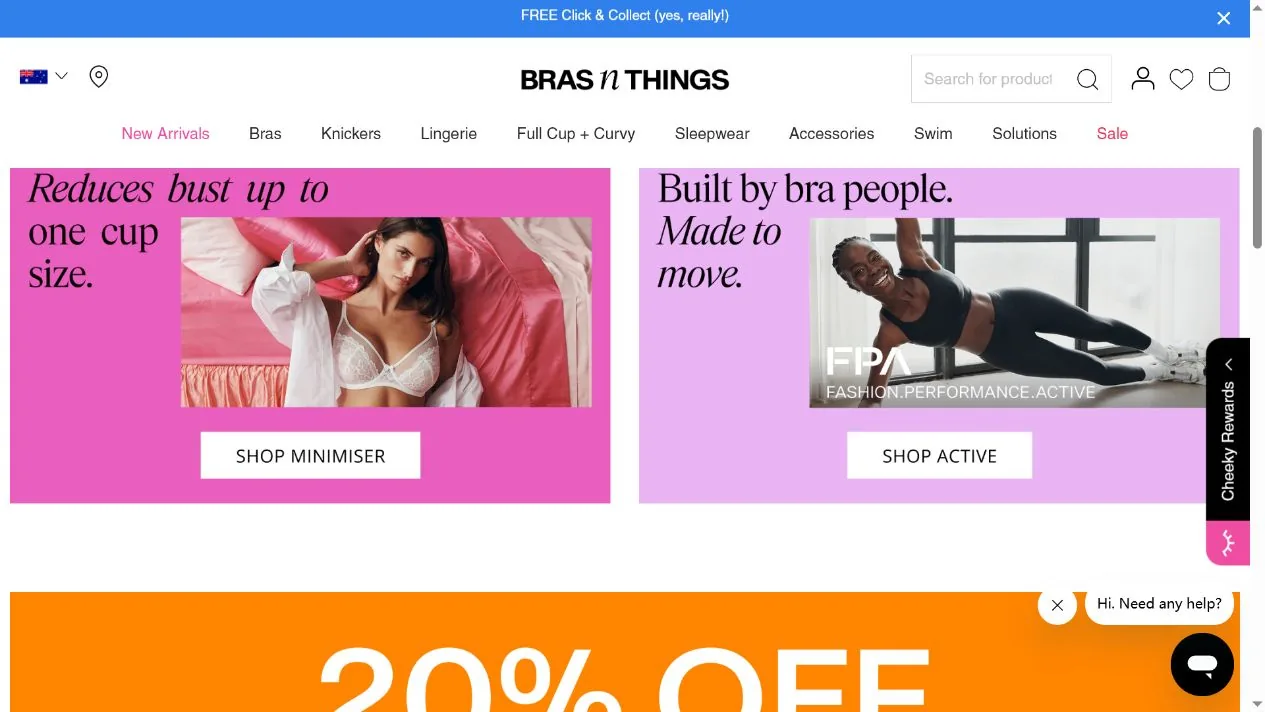
Bras N Things’ site includes minimiser-focused options, and one verified product page describes its Bethany Full Cup Minimiser Bra as designed to minimise bust appearance by up to one cup size. That wording should be treated as product-specific rather than a promise for every minimiser bra on the site.
A Minimiser Makes Sense When
You may want to start with the minimiser category if:
- Button-up shirts pull or gape at the bust.
- Workwear feels too tight across the chest even when it fits elsewhere.
- You want less projection without switching to a sports bra.
- You prefer fuller coverage and a more contained shape.
- You want a smoother profile under fitted tops.
A Minimiser May Not Be the Right First Choice When
A minimiser is not automatically the right answer if your main concern is movement during exercise. Some bras can visually compress the bust, but sports support is a different requirement. For running, jumping, gym classes, or high-impact movement, a dedicated sports bra category is the more relevant place to begin.
You should also avoid assuming that a minimiser will fix every fit issue. Gaping cups, a riding band, digging straps, or underwire sitting on breast tissue usually point to fit or style mismatch, not just the need for a minimising shape.
Choose a Sports Bra If Movement Control Matters
Sports bras are the most practical starting point when your bra needs to work during movement. Bras N Things’ sports bra category highlights support-focused features such as underwire options, contouring, lift, longline shapes, quick-dry and breathable fabrics, moulded cups, and racerback designs.
Outside clinical and sports-health guidance also supports the basic principle: a correctly fitted sports bra can reduce breast movement and discomfort during exercise, and the required support depends on activity type, breast size, and fit.
A Sports Bra Makes Sense When
Choose sports first if you are shopping for:
- Running or jogging.
- HIIT, aerobics, or circuit training.
- Gym classes with jumping or fast changes of direction.
- Field sports or active training sessions.
- Workouts where bounce, rubbing, or distraction is a concern.
- Activewear outfits where the bra may be worn alone or under gym tops.
What “Support” Should Mean in Practice
Support is not just about feeling tight. A sports bra should hold the bust securely while still allowing you to breathe and move. The underband should do much of the support work, the cups should contain breast tissue without spilling or gaping, and the straps should feel secure without carrying all the weight.
For higher-movement activity, look more carefully at:
- Band firmness.
- Cup coverage.
- Strap adjustability.
- Racerback or convertible strap options.
- Fabric that manages sweat and movement.
- Ease of getting the bra on and off.
Sports Bra Limitations to Consider
A sports bra can be worn outside workouts if you find it comfortable, but it may not be the most natural everyday choice. Some sports styles feel compressive, warm, firm at the band, or less compatible with normal clothing necklines.
Underwire sports bras can also be situation-dependent. General sports-health guidance cautions against underwire for contact, collision, or combat sports, and breastfeeding shoppers may need more specific maternity or nursing support rather than choosing a standard wired sports style.
Choose an Everyday Bra If You Need Repeat-Wear Comfort
Everyday bras are for normal daily use: work, commuting, errands, casual outfits, and relaxed wear. Bras N Things has an Everyday category, and its fitting and style guidance also points readers toward common daily styles such as t-shirt bras, full coverage bras, bralettes, strapless bras, and plunge bras.
This is the broadest category, so the best choice depends on what “everyday” means for your wardrobe.
Everyday Bra Styles and When They Help
A t-shirt bra is usually the cleaner choice under smooth or fitted tops because moulded or lightly padded cups can reduce visible cup seams.
A full coverage bra may suit shoppers who want more containment, coverage, and a secure feeling through the day.
A bralette or wirefree style may suit lower-support needs, lounging, or people who prioritize softness and flexibility over structured lift.
A plunge bra can work better under lower necklines where a full coverage cup may show.
A strapless bra is for specific outfits rather than general all-day use, and support usually depends heavily on the underband.
Everyday Bras Are Best When
Start here if you want:
- A bra for work or regular daily outfits.
- A smooth shape under t-shirts.
- A balance of support and comfort.
- A less structured option for relaxed wear.
- A bra that works with specific necklines.
- A fit that feels wearable for long periods.
Everyday Bra Limitations
An everyday bra is not designed to solve every problem. If your priority is reducing bust projection, a minimiser may be more targeted. If your priority is bounce control during exercise, a sports bra is the better category to evaluate first.
The Decision Tree
Use this sequence before browsing individual products.
1. What Will You Be Doing While Wearing It?
If you are exercising, choose sports.
If you are dressing for work, errands, or normal daily wear, choose everyday.
If you are trying to reduce how projected your bust looks under clothing, choose minimiser.
2. What Problem Are You Trying to Fix?
If your shirts gape, your bust feels visually prominent, or you want a neater profile, a minimiser is worth comparing.
If your breasts move painfully or distractingly during activity, look at sports bras.
If your current bra is simply uncomfortable after a few hours, start with fit and everyday style rather than assuming you need more compression.
3. What Clothing Will You Wear Over It?
For fitted t-shirts, a t-shirt bra or smooth everyday style may be the cleanest option.
For structured shirts, a minimiser may help reduce pulling across the bust.
For activewear, a sports bra with the right support and fabric is more suitable.
For low necklines, plunge or outfit-specific everyday styles may work better than full coverage.
4. How Much Structure Do You Like?
If you want lift and shape, look at underwire, contour, moulded, or full coverage styles.
If you want softness and flexibility, consider wirefree or bralette styles.
If you want firm movement control, compare sports bra construction, band firmness, and strap layout.
Fit Checks Before You Keep a Bra
A good category still needs the right fit. Before removing tags or committing to a purchase, check the fit calmly at home with the clothing you plan to wear over it.
The underband should sit level and firm around the body. It should not ride up at the back or feel painfully tight.
The cups should contain the breast tissue without gaping, wrinkling, or spilling over the top or sides.
The centre front should sit comfortably against the body on wired styles where that construction is intended. If it floats away or presses painfully, the cup or band may be wrong.
The straps should stay in place without digging. Straps can refine fit, but they should not be doing all the support work.
The underwire should follow the breast crease and should not sit on breast tissue.
Move around before deciding. Lift your arms, sit down, bend slightly, and try the bra under the outfit you had in mind.
What to Check on Bras N Things Before Buying
Bras N Things provides several resources that can help reduce guesswork, including its Feel Good Fit hub, sizing information, style finder, store information, returns details, Click & Collect, delivery information, and Cheeky Rewards.
Before ordering, check:
- Current size guidance and international sizing notes.
- Product-specific materials and construction.
- Whether the style is wired, wirefree, moulded, padded, unlined, full cup, longline, racerback, or strapless.
- Product-specific care instructions.
- Delivery thresholds and exclusions.
- Return rules for lingerie and sale items.
- Whether promotions apply only to selected styles.
- Store availability if you prefer Click & Collect or in-person fitting help.
Promotions, shipping thresholds, stock, and offer terms can change, so treat homepage banners and sale messages as temporary until you confirm them at checkout.
Common Mistakes to Avoid
Do not buy a minimiser when you actually need exercise support. A minimising shape and sports support are different buying goals.
Do not buy a sports bra only because you want a smaller-looking bust under clothing. Some sports bras compress, but they may not give the smooth everyday silhouette you want.
Do not assume everyday bras are suitable for high-impact activity. Normal daily support is not the same as workout support.
Do not size down to feel more supported. A too-small bra can create spilling, pressure, chafing, and distorted shape.
Do not ignore the band. The band is central to support, especially in sports and strapless styles.
Do not rely only on the product photo. Check the construction, coverage, straps, closure, and intended use.
Who Should Start With Each Category?
Start With Minimiser If
You want a smoother front profile, less projection, more contained coverage, or a better fit under work shirts and structured clothing.
Start With Sports If
You need support for training, running, gym classes, jumping, or any activity where bounce control matters.
Start With Everyday If
You want a repeat-wear bra for normal clothing, comfort, shape, and daily outfit compatibility.
Final Buying Advice
The simplest way to choose is to name the job first.
For silhouette, compare minimisers. For movement, compare sports bras. For normal daily comfort, compare everyday bras. After that, use fit as the deciding layer: band, cups, straps, centre front, underwire placement, and how the bra works under your actual clothing.
Bras N Things gives shoppers a wide enough category structure to narrow the search before picking a style. That matters because a bra can be attractive, discounted, and technically your size but still be the wrong tool for the job.