



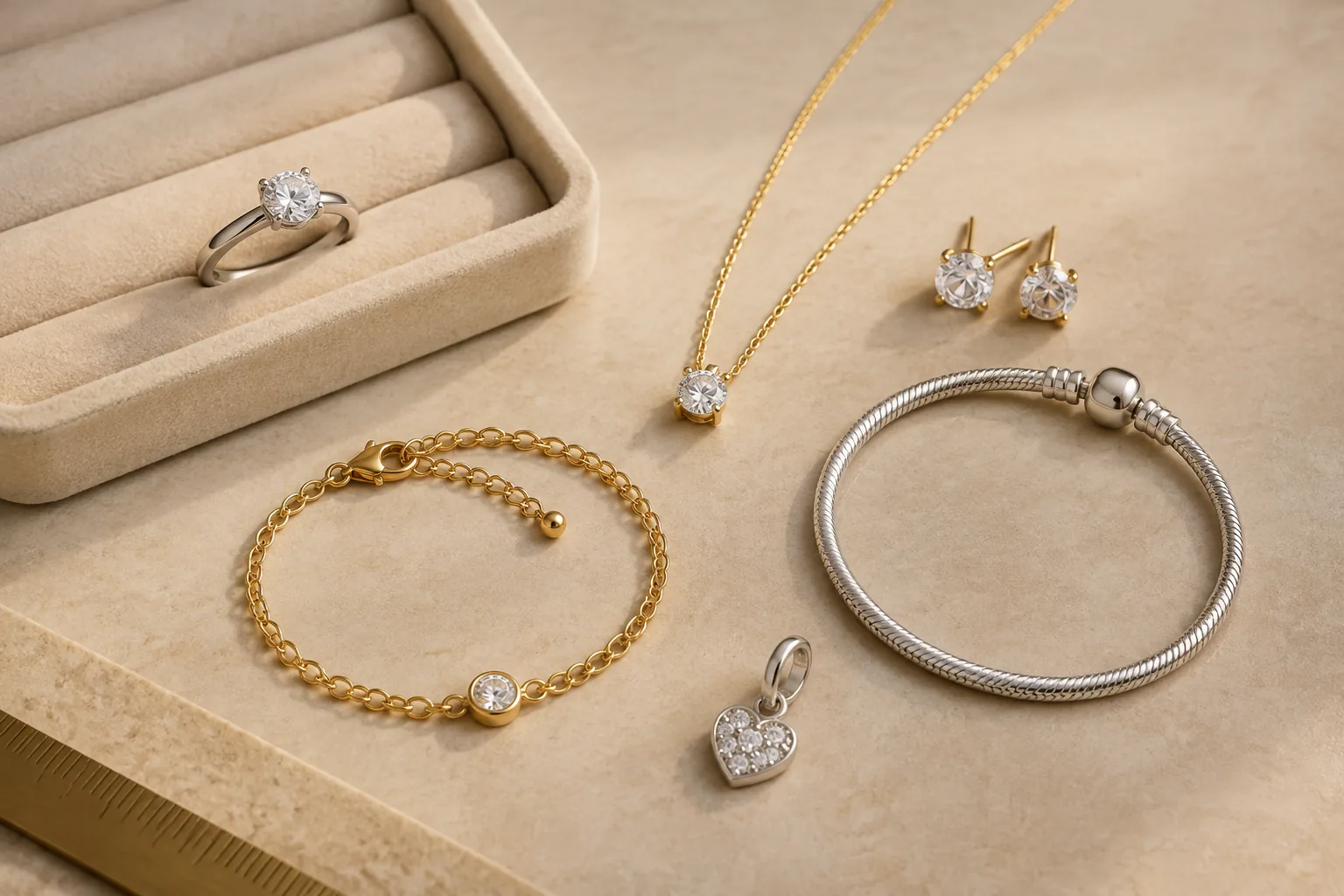
Pandora’s U.S. Lab-Grown Diamonds collection page is a useful place to begin, but it should not be treated as proof that every item shown is a lab-grown diamond piece at the individual product level. A collection page is a browsing surface. The exact product page remains the important source for confirming the item’s materials, stone description, dimensions, and current classification.
For buyers comparing Pandora lab grown diamonds gifts, the practical question is not simply “what is in the collection?” It is “which category creates the least regret if I do not know the recipient’s size, style, or metal preference?” That distinction is especially important when choosing between rings, bracelets, necklaces, earrings, and charms.
This guide organizes the decision around gift risk. It considers sizing uncertainty, wear habits, occasion, recipient fit, and the need for item-level verification. It does not treat every jewelry category as equally easy to buy.
What Pandora Officially Shows
The research package identifies Pandora’s U.S. lab-grown diamonds collection as the official collection source. The page functions as a catalog hub for browsing the range. It may surface charms, bracelets, and other jewelry categories, but the collection listing alone does not necessarily provide every detail a gift buyer needs.
The safest reading is:
- Pandora uses a branded collection page as a starting point for browsing.
- Some visible items may be clearly associated with the lab-grown diamond range.
- Some item names may not explicitly state “lab-grown diamond” in the collection listing.
- The exact product page is needed before treating an item as a confirmed lab-grown diamond gift.
This distinction prevents a common buying mistake: assuming that collection placement replaces product-level research. A piece can appear in a relevant collection and still require separate confirmation of its stone description, metal, measurements, setting, and intended use.
The collection page also does not resolve the personal part of the decision. It cannot tell you whether the recipient prefers a ring, wears bracelets, uses a charm bracelet, or avoids certain metals. Those questions require information about the recipient rather than assumptions based on the brand or category.
For a broader framework, see our lab-grown diamond jewelry buying guide and our overview of Pandora Lab-Grown Diamonds.
Choose by Gift Risk
The best category depends on what you already know. When the recipient’s preferences are well established, a more specific piece can feel personal and intentional. When key information is missing, a category with fewer fit requirements may be the more sensible choice.
Rings: Highest Sizing Risk
Rings are the most sensitive category when the recipient’s size is unknown. Even a visually versatile ring can become a difficult gift if it does not fit. Ring choice can also carry more relationship or occasion-specific meaning than a pair of earrings or a simple necklace.
A ring is most appropriate when:
- You know the recipient’s size with confidence.
- You have seen the recipient wear similar ring styles.
- You understand whether they prefer a single statement ring or stackable pieces.
- You have checked the current exchange or return path before purchasing.
A ring is a weaker first choice when you are guessing the size or trying to infer it from a different piece of jewelry. A recipient may also prefer a particular band width, setting profile, or metal color that is not obvious from casual observation.
Because the risk is concentrated in fit, do not let a strong visual reaction override the practical question. If the ring is intended for a significant occasion, sizing uncertainty becomes even more important. For a wider discussion of fit uncertainty, see how to choose personalized jewelry gifts when you do not know their size.
Bracelets: Moderate Fit Risk
Bracelets avoid the need to guess a finger size, but they still depend on wrist comfort and the recipient’s usual wearing habits. Some people prefer a close fit, while others like movement and visible space around the wrist. Clasp design, bracelet structure, and the possibility of adding charms can also affect whether the piece feels practical.
A bracelet is a reasonable gift when:
- The recipient already wears bracelets.
- You have a reliable sense of their preferred fit.
- The style works on its own or suits pieces they already own.
- You have checked the exact dimensions and closure details on the product page.
Bracelets are not automatically low-risk simply because they are not rings. A piece that is too tight may be uncomfortable, while one that is too loose may be impractical for regular wear. If the bracelet is intended to hold charms, confirm that the recipient already uses a compatible charm system and would enjoy adding to it.
Necklaces: Often Easier, Still Preference-Sensitive
Necklaces usually remove the most obvious sizing problem associated with rings. However, chain length and pendant proportions still matter. Some recipients prefer short necklaces that sit near the collarbone, while others favor longer layers or simple pieces that can be worn with different necklines.
A necklace may be a lower-regret choice when:
- The recipient already wears necklaces.
- You know whether they prefer delicate or more visible designs.
- The chain length is clearly stated and suits their usual clothing.
- The pendant can be worn alone without depending on a particular layering combination.
Necklaces can be especially useful when you want a gift that feels complete without requiring an existing jewelry system. They are less suitable when the recipient rarely wears necklaces or is very particular about chain length.
Earrings: Lower Sizing Risk, Higher Preference Risk
Earrings avoid ring sizing and usually require less information about wrist or chain length. That makes them appealing for gift buyers who know the recipient wears earrings regularly.
The main risk is preference. You need to know whether the recipient has pierced ears, prefers studs or drop styles, and favors minimal or decorative jewelry. Metal preference also matters. A technically wearable pair can still be a poor match if its shape or color does not fit the recipient’s wardrobe.
Earrings are a sensible option when:
- The recipient wears earrings regularly.
- You have observed a consistent preference for similar shapes.
- The design is compatible with their usual level of dressing.
- You do not need the gift to carry the sizing or symbolism of a ring.
They are a weaker choice when you do not know whether the recipient wears earrings at all. This is a category where a small amount of prior observation can substantially reduce the risk of choosing something unusable.
Charms: Low-Risk Only for Existing Collectors
Charms are not a universal shortcut. They work best when the recipient already uses a compatible charm bracelet or jewelry system and enjoys adding individual pieces. Without that context, a charm may be incomplete as a gift or may not fit the recipient’s existing collection.
Before choosing a charm, consider:
- Whether the recipient already owns the relevant bracelet or system.
- Whether they actively add charms or prefer finished jewelry.
- Whether the charm’s theme has personal relevance.
- Whether the exact product page confirms the lab-grown diamond description.
- Whether the recipient prefers symbolic, colorful, or understated pieces.
A charm can be highly personal when it connects to a meaningful occasion, interest, or memory. It can also feel random when the buyer selects one only because it appears smaller or easier to purchase. The category is therefore low-risk only when the collecting habit is already known.
For a comparison of personalization approaches, see engraving vs birthstone vs charm jewelry.
Match the Category to the Occasion
Category choice should reflect both the recipient and the occasion. A gift for a milestone may justify more careful research and a stronger statement. A casual birthday or thank-you gift may be better served by a versatile piece that does not depend on exact sizing.
Milestone and Relationship Gifts
Rings can communicate a strong intention, but that also makes them easy to misread when the occasion or relationship is not clear. If the gift is not meant to carry that level of symbolism, earrings, necklaces, or a suitable bracelet may offer a more neutral alternative.
A charm can work for a milestone when the recipient already collects charms and the selected design connects clearly to the event. Without that existing context, the personalization may be less effective than a complete piece of jewelry.
Birthdays and General Celebrations
For a birthday or general celebration, start with the recipient’s established habits. A person who wears small earrings daily may appreciate a familiar format more than a ring chosen without size information. Someone who routinely layers necklaces may be comfortable with a chain or pendant, while a person who does not wear necklaces may prefer another category.
The occasion does not eliminate the need for product verification. It only helps determine how much symbolic weight the category should carry.
Gifts Bought Under Time Pressure
A timed purchase creates additional risk. The buyer may have less time to confirm sizing, product details, policy boundaries, or delivery conditions. In that situation, avoid relying on a collection label alone.
Check the individual product page, confirm the stated materials and dimensions, and review the current Pandora warranty policy or other applicable support information before checkout. The policy page is not a substitute for checking the product itself, but it can identify questions that need answering before the purchase becomes time-sensitive.
When to Wait for More Information
Some gifts should not be bought on category logic alone. Pause and verify more detail if any of the following apply:
- You do not know the recipient’s ring size.
- You do not know whether they wear bracelets or layered necklaces.
- You are unsure about yellow, white, or mixed metal preference.
- You have not confirmed whether the recipient has pierced ears.
- You do not know whether the recipient owns a compatible charm bracelet.
- You cannot find a product page that explicitly identifies the item as lab-grown diamond jewelry.
- You need policy clarity before a holiday or timed gift purchase.
- The gift is intended to represent a significant relationship or milestone.
Waiting is especially sensible when the uncertainty affects whether the recipient can use the item at all. A beautiful piece is not a low-regret gift if it requires an unknown ring size, an unfamiliar jewelry format, or a system the recipient does not own.
What to Verify on the Exact Product Page
Once you have selected a likely category, move from collection browsing to item-level review. The product page should answer the questions below or make clear which information is still unavailable.
Item Identity
Confirm that the exact item is explicitly described as lab-grown diamond jewelry. Do not infer the stone type solely from the collection name, a product title that uses broad wording, or the appearance of the item in a filtered listing.
If the product description is unclear, treat that uncertainty as unresolved. A collection page can help you find candidates, but it should not be the only evidence supporting the purchase.
Materials and Construction
Check the metal, setting style, dimensions, chain length, clasp type, and any stone details the page actually lists. Do not infer these details from photographs or from another item in the same collection.
The material information also affects recipient fit. Someone who prefers one metal color may not appreciate a piece selected only for its stone or silhouette. Similarly, a delicate item and a more visible design may suit very different wardrobes even if they appear in the same collection.
Fit and Use
Ask whether the piece can be worn in the way the recipient normally wears jewelry. Consider daily wear, occasional wear, layering, stacking, and whether the item depends on a narrow fit window.
For rings, fit is the central question. For bracelets, evaluate wrist comfort and closure details. For necklaces, check length and pendant scale. For earrings, confirm the recipient’s wearing habits. For charms, confirm compatibility and collecting behavior.
Purchase and Policy Boundaries
Review the current Pandora support and policy pages before checkout, especially if the gift is personalized, time-sensitive, or being purchased with a possible exchange in mind. Do not assume that a general policy answer applies identically to every product, country, retailer, or purchase channel.
The official Pandora Help Center and authorized Pandora online retailers information can help identify the correct support route. The available evidence does not provide the complete policy text for every circumstance, so this guide does not settle return timing, worn-item limits, or country-specific exceptions.
A Practical Selection Sequence
A simple sequence can keep the decision focused:
- Start with the recipient’s established jewelry habits.
- Eliminate categories that require information you do not have.
- Use the official Pandora collection page to identify possible items.
- Open the exact product page and verify the lab-grown diamond description.
- Check materials, dimensions, fit details, and the intended wearing context.
- Review the applicable purchase and policy information.
- Choose the item that fits the recipient’s habits, not merely the item that looks most distinctive in the collection.
This sequence is useful because it separates two decisions that are often confused. The first is whether a category suits the recipient. The second is whether a particular item has been sufficiently verified. Passing the first test does not automatically pass the second.
Conclusion
For Pandora lab grown diamonds gifts, the lowest-regret starting points are usually categories that do not depend on exact sizing and that match the recipient’s existing wear habits. In many cases, that means earrings or necklaces first, bracelets when the fit and style are familiar, and rings only after the size is known. Charms are appropriate when the recipient already uses a compatible charm system and the individual item is confirmed at the product level.
The main takeaway is that Pandora’s collection page is a useful index, not final proof. Use it to begin browsing, then verify the exact product before buying. The strongest gift choice is the one that balances category fit, occasion, sizing certainty, and item-level evidence.
Related Guides
- Pandora Lab-Grown Diamond Jewelry Care: What Owners Need to Know After Purchase
- What to Put on an Engraved Jewelry Gift: Initials, Dates, Names, or Symbols?
- Engraving vs Birthstone vs Charm Jewelry: Which Personalized Gift Should You Choose?
- How to Choose Personalized Jewelry Gifts When You Do Not Know Their Size