



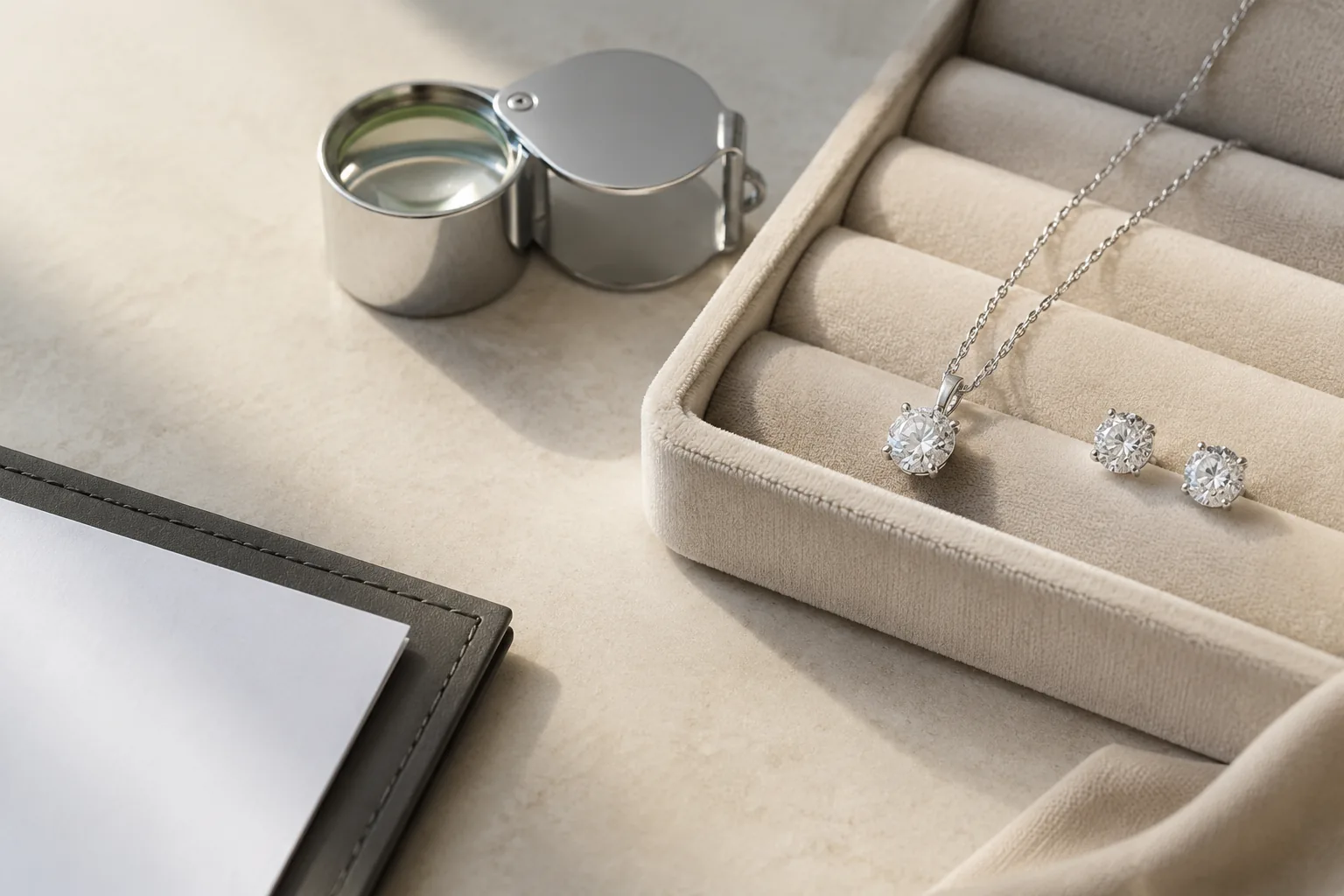
If you are shopping for lab-grown diamond jewelry, the first question is not simply “Is it lab-grown?” The better question is: what kind of jewelry are you buying, and how much purchase risk does that create?
A small lab-grown diamond pendant, a pair of everyday studs, and an engagement ring can all contain laboratory-grown diamonds. They do not need the same shopping process. For some fashion and everyday pieces, the visible design, metal, setting security, care limits, and return policy may matter more than comparing every diamond specification. For an engagement ring, especially one built around a center stone, the 4Cs, independent grading report, report verification, magnified imagery, setting choice, customization terms, and long-term documentation usually deserve more attention.
This lab grown diamond jewelry buying guide separates those decisions. It uses official brand education and materials pages from Mejuri, Astrid & Miyu, Brilliant Earth, Blue Nile, and James Allen, plus diamond authority and regulatory sources from GIA, IGI, and the FTC. The goal is not to rank brands or declare one buying path best. It is to help you decide how much diamond due diligence is appropriate for the piece in front of you.
Start With the Buying Context, Not the Diamond Label
A laboratory-grown diamond is still a diamond in the gemological sense when it is produced through technological processes rather than geological formation, as GIA explains in its laboratory-grown diamond education and services materials (GIA, GIA). Mejuri’s materials page also describes its lab-grown diamonds as having the same physical and chemical properties as natural diamonds and says they are graded using the 4Cs (Mejuri).
That shared identity does not make every purchase equally complex.
For a lower-stakes fashion piece, your practical risk may be concentrated in whether the piece looks good, wears comfortably, uses a metal you are willing to care for, and has settings that seem appropriate for everyday handling. For a major engagement-ring purchase, the risk usually expands: the center diamond’s specifications, report language, report number, setting structure, customization process, documentation, and post-purchase service can all affect confidence.
This is analysis, not a universal rule: the more the purchase depends on one significant diamond, the more the diamond-specific due diligence should rise. The more the purchase depends on the overall design and wearability of a smaller-stone piece, the more your attention can shift toward construction, care, and use case.
What Lab-Grown Diamond Means and What Must Be Disclosed
The FTC’s jewelry advertising guidance states that terms such as “cultured” or “laboratory-created” need clear disclosure that the diamond is not mined when they are used to describe a laboratory-grown diamond (FTC). In plain shopping terms, the seller should make the non-mined origin clear enough that you are not left thinking the diamond was naturally formed underground.
GIA identifies laboratory-grown diamonds as diamonds made through technological processes rather than geological formation, and IGI provides laboratory-grown diamond reports and explains terminology for identifying and documenting them (GIA, IGI). IGI also discusses “cultured diamonds” in its educational materials (IGI).
The terminology can still be confusing. The research materials use or discuss terms including “lab-grown,” “laboratory-grown,” “cultured,” and “synthetic.” Those terms may not carry identical consumer meaning in every sales setting, report format, or jurisdiction. For that reason, do not rely only on a casual product title. Check the product page, receipt, report, and any report-verification page for the exact wording used.
For engagement rings, this matters more because the diamond documentation may be used later for insurance, appraisal discussions, resizing or repair records, or resale conversations. For fashion jewelry, it still matters because disclosure is part of honest selling, but the amount of report-level scrutiny should be proportional to the price, stone size, and importance of the purchase.
Fashion Jewelry and Everyday Pieces: What to Prioritize First
Fashion and everyday lab-grown diamond jewelry often asks a different question from bridal shopping: will this piece look right, wear well, and hold up to your actual habits?
Mejuri’s materials page says its lab-grown diamonds are graded using the 4Cs and discusses CVD growth, traceability, and value in connection with its lab-grown diamonds (Mejuri). The same page states that 14k gold is selected for everyday durability and describes stainless steel as water-resistant and anti-tarnish. Astrid & Miyu’s official care guidance advises proper storage and avoiding water, sweat, perfumes, and cosmetics for certain jewelry materials (Astrid & Miyu US, Astrid & Miyu ROW). The reported Astrid & Miyu brand description presents lab-grown diamond jewelry as 14k solid-gold pieces intended for all-day, everyday wear.
Those statements support a practical point: for everyday jewelry, metal and care are not side details. They are part of the purchase.
Appearance Comes Before Paperwork for Many Small-Stone Pieces
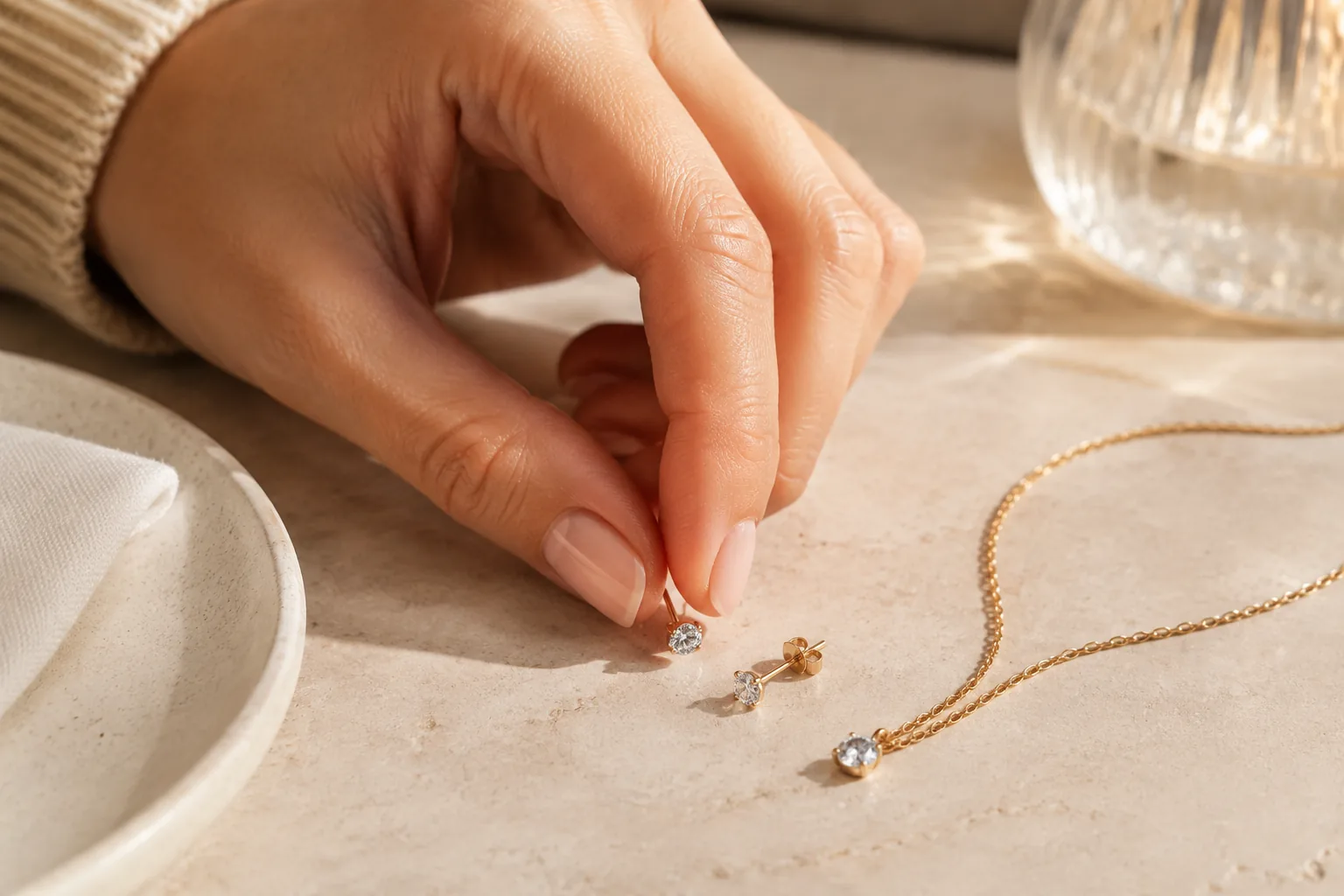
For small diamond studs, fine hoops, station necklaces, petite pendants, and accent rings, the visible effect may matter more than a long technical comparison. Ask whether the diamonds look bright enough in normal lighting, whether the piece sits well on the ear, neck, wrist, or finger, and whether the proportions fit your style.
This is a suggestion, not a sourced gemological rule: if the stones are very small, a minor difference in clarity grade may be less visible to the wearer than poor proportions, awkward scale, or a setting that catches on hair and knitwear. The 4Cs can still help you understand what you are paying for, but they should not distract from the piece as jewelry.
Metal, Setting, and Care Limits Deserve Real Attention
For daily wear, check the metal first. Is it 14k gold, sterling silver, gold vermeil, stainless steel, or another material? If the piece includes plating, coating, adhesives, pearls, enamel, or softer gemstones alongside the diamonds, care may be more restrictive than the diamond itself would suggest.
A diamond can be durable while the jewelry construction around it still requires care. Prongs can snag. Bezel edges can dent. Thin chains can stretch or break. Plated finishes can wear. Brand care instructions can vary by material and region, so follow the seller’s care guidance for the exact piece rather than applying a universal cleaning method.
For fashion jewelry, a useful checklist is:
| Priority | What to Check | Why It Matters |
|---|---|---|
| Disclosure | Is the diamond clearly described as lab-grown or laboratory-grown? | Avoids confusion with mined diamonds. |
| Metal | Is the base metal and finish clearly stated? | Affects wear, care, and value judgment. |
| Setting | Are stones prong-set, bezel-set, pavé-set, or glued/otherwise mounted? | Affects security and care expectations. |
| Wear limits | Does the brand warn against water, sweat, cosmetics, or impact? | Helps match the piece to your habits. |
| Return policy | Can it be returned if scale, fit, or sparkle disappoints? | Especially important for gifts and online purchases. |
Engagement Rings: When the 4Cs and Reports Matter More
Engagement-ring shopping usually concentrates more value and emotion into one piece. It may also involve customization, resizing, insurance paperwork, and long-term service expectations. That is why the diamond-buying process often becomes more detailed.
Brilliant Earth’s official diamond buying guide centers on the 4Cs and states that its guides are reviewed by gemologists (Brilliant Earth). The reported Brilliant Earth guidance directs buyers toward diamond selection and setting choices within a bridal purchasing workflow. Blue Nile’s diamond education and site navigation include diamond education, engagement-ring shopping, and design-your-own workflows (Blue Nile). James Allen’s custom ring design page presents customization in the context of engagement-ring design (James Allen).
These official pages support a limited but useful conclusion: bridal diamond shopping is commonly structured around choosing a diamond, choosing a setting, and understanding the specifications that connect those choices.
What to Verify for a Center Stone
For an engagement ring, especially one with a prominent center stone, ask for the diamond’s report details before you commit. IGI provides laboratory-grown diamond reports and guidance on reading report information (IGI, IGI). GIA also provides laboratory-grown diamond report information and has published updates on descriptive terminology for laboratory-grown diamonds (GIA, GIA).
Before buying, compare the product listing with the report or verification page:
| Report Item | What to Confirm |
|---|---|
| Laboratory | Which lab issued the report? |
| Report number | Does the number match the diamond being sold? |
| Origin wording | Does it clearly identify the diamond as laboratory-grown or non-mined? |
| Shape and measurements | Do these match the listing? |
| Carat weight | Does it match the advertised stone? |
| Color and clarity language | Is the grading terminology clear for that lab and report type? |
| Cut or make details | Are cut, proportions, polish, and symmetry available where relevant? |
| Inscription | If listed, does it match the report information? |
A grading report is not a guarantee of ring craftsmanship, setting security, future repairs, insurance payout, or resale value. It is a document about the diamond according to that laboratory’s reporting system. Treat it as one important part of the file, not the whole purchase.
Setting Choice Is Not Just Style
The setting determines how the diamond is held, how high it sits, how exposed the edges are, and how practical the ring feels. A high solitaire, low bezel, pavé band, hidden halo, cathedral setting, and three-stone ring can all change daily wear.
This is analysis: if you are choosing a ring for frequent wear, setting security and maintenance may be as important as the center stone’s lab report. Ask how the stone is held, whether the design leaves edges exposed, whether side stones are individually set, and whether the ring can be resized. For custom rings, also ask about cancellation, modification, delivery timing, return limitations, warranty scope, and regional policy differences before approving the order.
How to Use the 4Cs Without Overbuying Detail
The 4Cs are carat weight, cut, color, and clarity. They are useful because they give you a structured way to compare diamonds. They can also encourage overbuying if you treat every decimal, grade, or report field as equally visible in every piece of jewelry.
Carat Weight
Carat is a weight measurement, not a direct size measurement. Two diamonds with the same carat weight can face up differently depending on shape and proportions. For engagement rings, carat weight usually deserves careful attention because it strongly affects presence on the hand and may affect price. For small fashion jewelry, total carat weight may be more relevant than any individual stone.
Suggestion: for studs, tennis styles, station necklaces, and pavé pieces, check whether the listed carat weight is per stone, per pair, or total across the piece. The available research package does not provide SKU-level specifications, so this must be checked on the specific product page.
Cut
Cut influences how a diamond handles light. In many buying contexts, especially round brilliant engagement-ring stones, cut quality can matter more visually than chasing a higher color or clarity grade. Brilliant Earth’s diamond buying guide centers on the 4Cs, supporting the use of cut as part of a structured diamond decision (Brilliant Earth).
For fashion jewelry, use cut more practically: do the stones look lively, even, and intentional in the piece? If the diamonds are tiny accents, magnified cut analysis may provide limited value compared with checking whether the entire piece looks balanced.
Color
Color grades can matter more in larger stones, white-metal settings, and minimalist designs where the diamond is visually exposed. In yellow gold or rose gold, some shoppers may be less sensitive to subtle body color because the metal itself adds warmth. That is style analysis, not a universal grading rule.
Do not assume color grades from different laboratories are automatically interchangeable. Report terminology and grading presentation can differ, especially as laboratory-grown diamond reporting language evolves.
Clarity
Clarity describes internal and external characteristics such as inclusions and blemishes. For engagement rings, the practical question is often whether the diamond looks clean to the unaided eye and whether any inclusions affect appearance or durability concerns. For small fashion stones, clarity differences may be difficult to see without magnification.
Suggestion: prioritize clarity scrutiny when the diamond is large, open-set, step-cut, or personally important enough that visible inclusions would bother you. For small accent diamonds, clarity should still be disclosed where available, but it may not deserve the same attention as setting quality and overall appearance.
Reports, Videos, Appraisals, and Insurance: A Practical Priority Ladder
Not every lab-grown diamond purchase needs the same documentation stack. A risk-based ladder is more useful.
Level 1: Basic Disclosure and Product Details
Use this for lower-cost fashion jewelry and small everyday pieces.
Confirm that the diamond is clearly disclosed as lab-grown or laboratory-grown. Check metal, stone count, total carat weight if listed, setting style, care guidance, and return eligibility. If the seller gives only vague diamond language and no clear non-mined disclosure, that is a reason to ask questions or choose a more transparent listing.
Level 2: Clear Specs and Visual Review
Use this for meaningful gifts, larger studs, pendants, tennis bracelets, anniversary jewelry, and pieces you expect to wear often.
Look for stone size or total carat weight, metal purity, setting description, product photos from multiple angles, and care limitations. If the piece has larger visible stones, high-resolution images are more useful. For online shopping, video can help you judge sparkle, tilt, profile height, and whether the setting looks bulky or delicate.
Level 3: Independent Report and Verification
Use this for engagement rings and any purchase where one diamond carries much of the value.
IGI provides laboratory-grown diamond reports, and GIA provides laboratory-grown diamond report services and terminology information (IGI, GIA). For a center stone, confirm the report laboratory, report number, stone measurements, carat weight, shape, origin language, and report-verification details.
This guide cannot state that one specific lab is always required. Seller practices, insurer preferences, and regional norms can vary. The important point is that the report should be relevant, verifiable, and consistent with the diamond being sold.
Level 4: Appraisal and Insurance Paperwork
Consider this for engagement rings and other higher-value jewelry where loss, theft, damage, or replacement would be financially painful.
The available research package does not include independent insurance or appraisal standards, so this guide cannot give a verified rule about when insurance is required or what an appraisal should cost. Practical suggestion: ask the seller what documentation they provide, then check with your chosen insurer or appraiser about what they need before purchase, especially for custom rings or international orders.
Brand Source Examples: What the Official Pages Do and Do Not Prove
The brand pages in the research package are useful, but they do not replace checking a specific product page.
Mejuri
Mejuri’s materials page describes its lab-grown diamonds as having the same physical and chemical properties as natural diamonds and says they are graded using the 4Cs. It also discusses CVD growth, traceability, and value in connection with lab-grown diamonds. The same page states that 14k gold is selected for everyday durability and describes stainless steel as water-resistant and anti-tarnish (Mejuri).
What this supports: discussion of material positioning, lab-grown diamond identity, 4C grading language, and everyday-wear framing for certain materials.
What it does not prove: the exact stone specifications, report lab, report number, setting construction, care limits, or durability of every individual Mejuri product.
Astrid & Miyu
Astrid & Miyu’s care guidance advises storage and avoidance of water, sweat, perfumes, and cosmetics for certain jewelry materials (Astrid & Miyu US, Astrid & Miyu ROW). The reported brand description presents lab-grown diamond jewelry as 14k solid-gold pieces intended for all-day, everyday wear.
What this supports: care limitations matter even for jewelry positioned for everyday use.
What it does not prove: that every piece is suitable for showering, sleeping, swimming, exercise, high-impact work, or all regional care conditions. Regional pages and policies may also differ.
Brilliant Earth
Brilliant Earth’s diamond buying guide centers on the 4Cs and states that its guides are reviewed by gemologists (Brilliant Earth). The reported guidance directs buyers toward diamond selection and setting choices within a bridal workflow.
What this supports: engagement-ring shoppers can reasonably use the 4Cs and setting choice as core decision tools.
What it does not prove: any specific Brilliant Earth diamond’s quality, price position, report details, warranty coverage, return eligibility, or insurance suitability without checking the actual listing and policy pages.
Blue Nile
Blue Nile’s official diamond education and navigation include diamond education, engagement-ring shopping, and design-your-own workflows (Blue Nile).
What this supports: Blue Nile presents diamond education and ring-building as part of the engagement-ring shopping process.
What it does not prove: the specifications, imagery, report lab, verification process, services, or terms for every individual product.
James Allen
James Allen’s custom ring design page presents customization in the context of engagement-ring design (James Allen).
What this supports: custom ring design should be treated as a workflow, not a simple cart add-on.
What it does not prove: exact customization restrictions, return rights, production timing, warranty coverage, resizing terms, or regional policies for a specific order.
Questions to Ask Before You Buy
Use these questions as a final filter.
For Fashion and Everyday Lab-Grown Diamond Jewelry
- Is the diamond clearly disclosed as lab-grown, laboratory-grown, or otherwise non-mined?
- Is the metal clearly identified, including whether it is solid gold, sterling silver, gold vermeil, plated, stainless steel, or another material?
- Does the product page state total carat weight, stone count, and stone size where relevant?
- Is the setting style visible and appropriate for your wear habits?
- Does the brand give care limits involving water, sweat, perfume, cosmetics, storage, or cleaning?
- Is the piece returnable if the scale, sparkle, fit, or comfort is not right?
- If it is a gift, is the sizing risk low enough, or would a necklace, earrings, or bracelet be safer than a ring?
For Engagement Rings
- Is the center stone clearly identified as laboratory-grown or non-mined?
- Is there an independent grading report, and can the report number be verified?
- Do the report details match the listing: shape, measurements, carat weight, origin language, and grading fields?
- Are high-resolution images or magnified video available for the actual stone?
- Does the setting protect the stone in a way that fits the wearer’s lifestyle?
- Are side stones, pavé, halos, or hidden details described clearly enough to understand future maintenance?
- Is the ring custom, made to order, engraved, resized, or otherwise subject to return limitations?
- What documents will you receive for appraisal, insurance, repair, or future service?
- Do regional policies affect taxes, delivery, returns, warranty, resizing, or consumer rights?
What This Guide Cannot Confirm From the Available Sources
The available sources do not include individual product pages for specific SKUs. That means this guide cannot confirm exact stone weights, cut parameters, color grades, clarity grades, treatments, report laboratories, report numbers, inscriptions, setting measurements, or origin disclosures for any specific piece.
It also cannot compare the full return, warranty, repair, exchange, resizing, customization, delivery, or regional policy terms of Mejuri, Astrid & Miyu, Brilliant Earth, Blue Nile, and James Allen. Official education pages can show how a brand explains materials or shopping workflows, but they do not prove that one brand has better pricing, quality, service, or aftercare for a specific order.
The research package also does not include independent appraisal or insurance-source standards. For engagement rings and higher-value jewelry, ask the seller what documentation is provided, then confirm requirements with the insurer, appraiser, or local professional you plan to use.
Finally, terminology is not perfectly simple. FTC guidance emphasizes clear disclosure that laboratory-grown diamonds are not mined. GIA and IGI materials discuss laboratory-grown diamond services, reports, and terminology, and GIA has published updates on descriptive terminology for laboratory-grown diamonds. Because wording can differ by report system and market, always rely on the specific report, seller disclosure, and regional rules that apply to your purchase.
Conclusion: Match the Due Diligence to the Jewelry
Lab-grown diamond jewelry does not need one universal buying process. For fashion jewelry and everyday pieces, start with clear lab-grown disclosure, visible design, metal quality, setting security, care limits, and return practicality. Use the 4Cs where they help you compare value and appearance, but do not let report minutiae overwhelm the real question of whether the piece suits your daily wear.
For engagement rings, raise the standard. A center stone usually deserves a verifiable grading report, careful review of the 4Cs, magnified imagery where available, clear setting details, customization terms, and documentation planning. The report helps you understand the diamond, but it does not replace evaluating the ring, seller policies, care expectations, and long-term service needs.
Jewelry care recommendations vary by material, treatment, and setting. Always follow brand or jeweler care instructions for your specific piece. This content provides shopping and educational information, not medical advice; consult a qualified clinician or dermatologist about persistent irritation or reactions. Return rights, hallmarking, and product-labeling rules vary by country, so check current seller policies and local regulations before purchase.

2 Comments
Pingback: Pandora Lab-Grown Diamond Gifts: What to Buy
Pingback: Pandora vs Brilliant Earth Lab-Grown Diamonds