



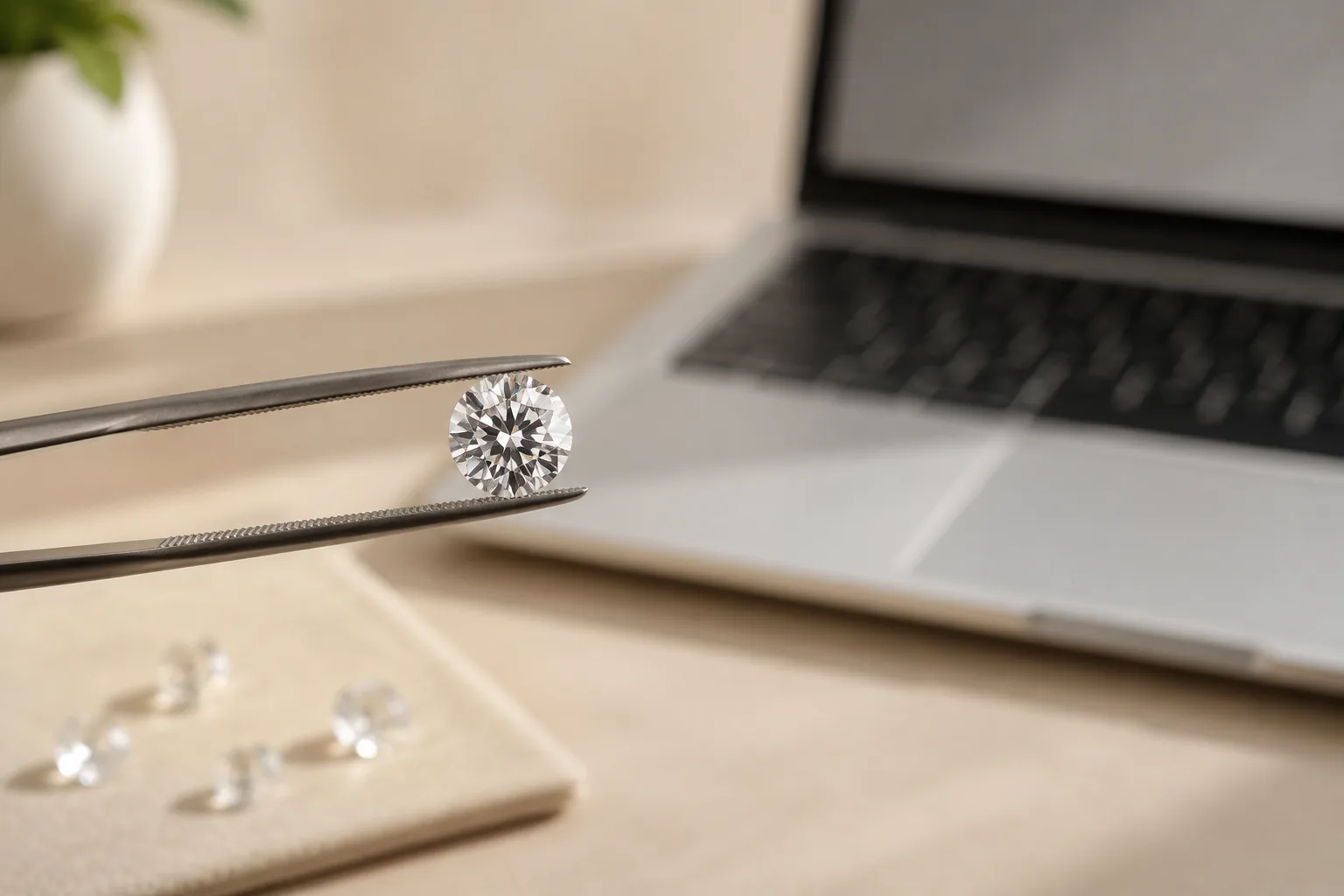
A James Allen 360 diamond viewer can make online loose-diamond shopping feel much less abstract. Instead of judging a stone from a static stock-style image, you can inspect the diamond from multiple angles, compare visible inclusions, notice shape personality, and decide whether a stone is worth deeper review.
That does not mean the viewer proves everything that matters. A 360-degree video or magnified image can support shortlisting, but it cannot fully prove real-life sparkle, exact eye-clean appearance to your eyes, color in every lighting condition, or how the diamond will look once it is mounted in a ring.
This guide explains how to use James Allen’s visual shopping workflow carefully: what to look for in the viewer, what to verify in a GIA or IGI report, how natural and laboratory-grown diamonds should be treated differently, and which policy details should be rechecked before ordering.
What James Allen’s 360-Degree Diamond Shopping Is
The official source for James Allen loose-diamond shopping is the brand’s loose diamonds page, which the research crawl treated as the main brand and product-page reference. During the reported crawl, that URL redirected to a Blue Nile diamond finder with jaRedirect=true, so any publication or purchase decision should treat the current shopping experience as something to recheck directly before relying on page-level claims.
That redirect matters because the article topic is James Allen’s 360-degree diamond shopping, while the observed experience may now overlap with a Blue Nile-hosted finder. The safest way to describe this is not “James Allen currently operates a fully separate diamond finder” but “the official James Allen loose-diamond URL should be checked for the current experience, and the reported crawl observed a redirect to Blue Nile.”
What the Observed Finder Included
The crawled loose-diamond experience presented loose diamonds as a searchable category with Natural and Lab-Grown tabs. It also described shopping tools such as gemologist-level tools, advanced filters, and 100x magnification for a natural diamond assortment. The page stated that diamonds are photographed in consistent lighting conditions for more objective comparison.
Those are useful shopping features. Consistent presentation can make side-by-side comparison easier than mixed seller photos, and magnification can reveal inclusions or facet patterns that would be hard to see in a normal product image. Still, the right interpretation is “comparison support,” not “proof of beauty.”
What “360-Degree” Should Mean to a Buyer
For a buyer, 360-degree inspection is best understood as a visual screening tool. It helps you decide whether a diamond deserves a report review, a setting mockup, or a support question. It is not a replacement for the grading report, and it is not a guarantee that every visual impression online will match how the stone appears under daylight, office lighting, warm indoor light, or once mounted.
If you are comparing several similar stones, the viewer is especially helpful for rejecting obvious mismatches: visible black inclusions near the table, an outline you dislike, a bow-tie pattern that seems too dominant in an elongated shape, or a facet pattern that looks less balanced than another stone at a similar grade.
How to Use the 360 Viewer Without Overreading It
GIA defines the diamond 4Cs as Color, Clarity, Cut, and Carat Weight. GIA describes color as the absence of color, clarity as considering inclusions and blemishes, cut as relating to fire, brilliance, and proportions, and carat weight as measuring weight. The James Allen viewer can help you visually investigate parts of those categories, but it does not replace them.
Use It for Visible Clarity Clues
Start with clarity. Rotate the diamond slowly and look for inclusions that stay visible from multiple angles, especially under the table or near the center of the stone. A small inclusion near an edge may be less visually bothersome than a dark crystal near the center, but that depends on the stone, the setting, and your tolerance.
Magnification can make inclusions look more dramatic than they will appear in normal wear. That is useful for finding them, but it can also make a diamond seem worse than it will look in person. The practical question is not “can I find an inclusion at 100x?” It is “does the inclusion appear obvious enough that I would keep noticing it without magnification?”
Use It for Shape, Facet Pattern, and Face-Up Appeal
The viewer is also useful for comparing shape outline and facet personality. A round brilliant may be judged partly by symmetry and overall brightness pattern; an emerald cut will show step facets and larger open areas; an oval, pear, marquise, or radiant may show a more noticeable bow-tie effect.
This is where images can be more useful than numbers alone. Two diamonds with similar carat, color, clarity, and even measurements can have different face-up character. The viewer helps you choose the stone whose outline and pattern you actually prefer.
Do Not Treat It as a Full Light-Performance Test
The reported page’s consistent lighting claim helps comparison, but consistent lighting is still controlled lighting. It does not prove how the diamond will perform in every real environment. Fire, brilliance, and scintillation are experienced through movement, lighting, proportions, and observer perception. A rotating video can suggest visual behavior, but it should not be described as a complete light-performance assessment.
For a deeper grounding in how reports fit into diamond buying, see our guide to diamond certification, reports, supplier standards, and brand claims.
What to Check in the Diamond Finder Before Shortlisting
The crawled diamond finder exposed filters including shape, price, carat, color, clarity, cut, sale status, fast shipping, shipping date, and sorting. It also included shape navigation for round, princess, cushion, emerald, oval, radiant, asscher, marquise, heart, and pear diamonds.
The best workflow is to use filters to create a reasonable pool, then use the 360 viewer to remove stones that do not look right to you. Avoid starting with the video alone. A beautiful-looking stone still needs a credible report, suitable measurements, and a setting plan.
Start With Shape and Use Case
Shape should come first because it affects the entire purchase. Round diamonds have the broadest conventional cut-grade language, while fancy shapes such as oval, pear, emerald, radiant, cushion, marquise, asscher, heart, and princess require more visual judgment.
If this is an engagement ring, think about hand shape, setting style, and wear habits. Pointed or cornered shapes may need protective prongs or a setting that shields vulnerable areas. Step cuts such as emerald and asscher can make clarity characteristics easier to notice because their facets are broader and less busy than many brilliant-style cuts.
Narrow by Carat, Color, Clarity, and Cut
After shape, use carat, color, clarity, and cut filters to define your search. Carat is weight, not face-up size, so compare measurements rather than relying only on the carat number. A lower-carat diamond with favorable spread may look larger than expected, while a deeper stone may carry more weight without looking much bigger from above.
Color should be judged with the metal and setting in mind. A near-colorless diamond may look different in white metal than in yellow or rose gold. Clarity should be interpreted with the viewer and report together. Cut is especially important for round diamonds, but proportions and visual balance still matter for fancy shapes even when a simple cut grade is not the whole story.
Use Shipping and Sorting Filters Carefully
The finder included shipping-related filters, but availability and delivery timing are volatile. Use those filters for planning, not as evergreen facts. If a date matters, verify it at checkout and against current shipping terms.
This is also where comparison shopping can be helpful. Our guide to James Allen vs Blue Nile vs Brilliant Earth engagement-ring buying processes can help you decide whether the workflow itself fits how you want to shop.
What the GIA or IGI Report Should Confirm
James Allen’s diamond grading certificate page says loose diamonds are analyzed and graded by laboratories such as GIA or IGI. The same page also says laboratories do not all grade the same way and that systems, protocols, and nomenclature can vary. That is a key point: a grading report is not just a decorative attachment. It is the structured document that lets you verify what the listing claims.
Verify the Report Identity
First, confirm the laboratory name and report number. James Allen’s certificate education page advises reviewing the GIA Diamond Grading Report or Diamond Dossier and checking the laboratory report number. If the listing provides a report image or PDF, match the report number to the listing and, where available, to the lab’s report-check system.
Also confirm whether the diamond is natural or laboratory-grown. Do not assume based on price, category placement, or casual product wording. Origin should be stated clearly.
Verify the Diamond Details
Check shape, measurements, carat weight, color, clarity, cut where applicable, polish, symmetry, fluorescence, comments, and any inscription information. Measurements are especially important for face-up appearance and setting compatibility. Fluorescence should be noted because it can affect buyer perception, even though online imagery alone does not reliably prove its real-world effect.
For laboratory-grown diamonds, IGI’s lab-grown diamond report page says center stones can include shape, cutting style, measurements, and 4Cs assessments as mounting permits. IGI also says laboratory-grown diamond color is graded in a standardized viewing environment and clarity is assessed at 10x magnification. Those details are useful, but they should still be read as laboratory grading information, not a promise that the diamond will look identical in every setting or lighting condition.
Treat “Certified” Language Carefully
Many shoppers use “certified diamond” casually, but the more precise term is a diamond with a grading report. The report supports identity and grading information; it does not guarantee beauty, resale value, ethical sourcing, or personal satisfaction.
For smaller stones, pavé, or pieces where individual reports may not be the deciding factor, see our guide on when to prioritize a diamond grading report.
Natural vs Laboratory-Grown Diamonds: Report Language Matters
Natural and laboratory-grown diamonds should be explained separately. They can both be diamonds, but they are not the same product category, and report language is changing.
The FTC says laboratory-created diamonds should be described so consumers know they are not mined diamonds. FTC guidance also says terms such as laboratory-grown or laboratory-created should immediately precede the word diamond and be equally conspicuous. It further says those terms should not be used unless the product has essentially the same optical, physical, and chemical properties as mined diamond.
What GIA’s 2025 Update Changes
GIA announced on June 2, 2025 that later in 2025 it would stop using its natural-diamond color and clarity nomenclature for laboratory-grown diamonds and instead use descriptive categories for laboratory-grown diamonds. GIA also stated that existing GIA laboratory-grown diamond reports remain valid.
For buyers, the practical effect is that older and newer GIA laboratory-grown diamond documentation may not look the same. A shopper expecting every report to use the familiar D-to-Z color scale and standard clarity grades may need to slow down and read the exact report language.
How IGI Fits Into the Comparison
IGI’s lab-grown diamond report page still describes report contents that can include 4Cs assessments as mounting permits. That does not make IGI and GIA laboratory-grown reporting interchangeable. It means buyers should read each report according to the issuing lab’s stated system.
If you are shopping laboratory-grown diamonds more broadly, our lab-grown diamond jewelry buying guide explains how engagement-ring shopping differs from fashion-jewelry shopping.
How to Label Laboratory-Grown Diamonds Clearly
Use “laboratory-grown diamond” or “laboratory-created diamond” directly before the word diamond. Avoid wording that implies a laboratory-grown diamond is mined, or that natural and laboratory-grown diamonds have identical market behavior. This article does not make investment claims about either category.
What Online Imagery Still Cannot Prove
A James Allen 360 diamond viewer can reduce uncertainty, but it cannot remove it. The most useful buyer mindset is to treat the video as one evidence layer: stronger than a static image, weaker than a full in-person comparison under varied lighting.
Sparkle and Light Performance
Online imagery can suggest brightness and contrast, but it cannot fully prove brilliance, fire, scintillation, or overall light performance. Controlled lighting may help compare stones within the same presentation, but real-life lighting is variable.
If you are sensitive to sparkle differences, ask for additional guidance, compare proportions carefully, and consider whether an in-person comparison would make you more comfortable before committing.
Color in Real Environments
Diamond color can appear different depending on lighting, background, metal color, and neighboring stones. A white-metal solitaire may make warmth more noticeable than a yellow-gold setting for some buyers. A video may show a color impression, but it does not prove how the diamond will look in every environment.
Eye-Clean Threshold
“Eye-clean” is not a single universal threshold. It depends on viewing distance, eyesight, lighting, inclusion type, inclusion placement, diamond size, and personal tolerance. A diamond that looks clean enough to one buyer may bother another buyer once they know where the inclusion is.
Use magnification to identify inclusions, then ask whether they are likely to be visible without magnification. For borderline stones, support input or an in-person comparison may be worth the time.
Fluorescence, Durability, and Mounted Appearance
The online viewer cannot reliably prove fluorescence impact in varied conditions. It also cannot fully assess durability risk from every inclusion, thin area, or setting interaction. Once mounted, prongs, bezel edges, halos, basket height, and metal color can all change the visual impression.
This is why the report, measurements, setting choice, and return terms matter together.
Pairing the Diamond With a Setting
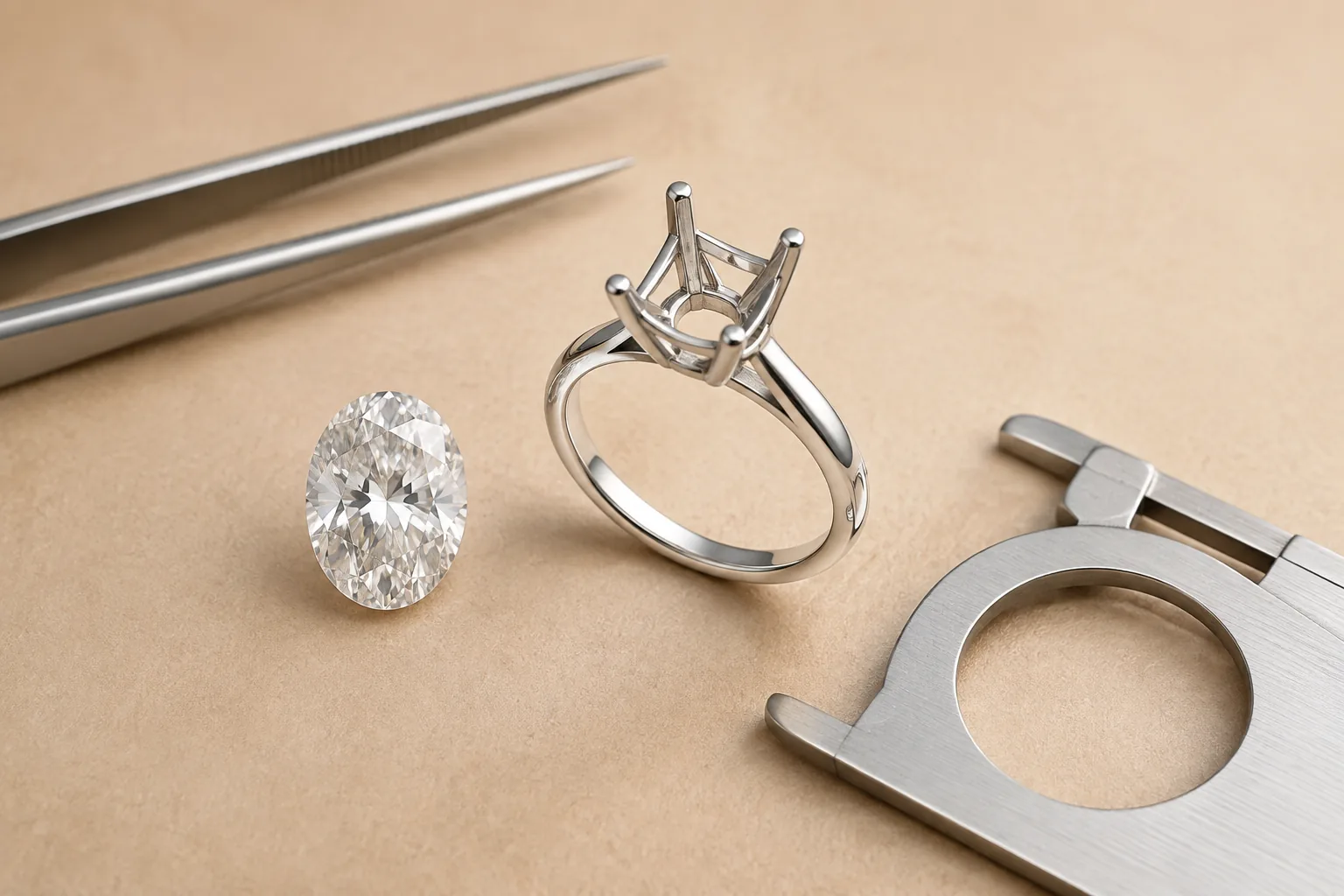
The crawled navigation supported Design Your Own Ring, Start With A Diamond, and Start With A Setting workflows. That flexibility is useful, but it also means the diamond decision and setting decision should not be treated as separate purchases.
Start With the Diamond When the Stone Is the Priority
Starting with the diamond makes sense when you care most about a specific shape, size, report, or visual character. This is common for buyers comparing oval bow-ties, emerald-cut clarity, round cut quality, or a particular carat spread.
Once you choose the stone, confirm that the setting accepts that shape and measurement range. Do not assume every oval, pear, princess, or emerald cut will fit every setting labeled for that shape. Measurements, not just carat weight, determine fit.
Start With the Setting When the Ring Design Is the Priority
Starting with the setting makes sense when the ring style is non-negotiable. A low-profile solitaire, hidden halo, three-stone setting, vintage-style ring, or protective bezel may limit the diamond shapes and measurements that work well.
Metal color also matters. White gold or platinum may emphasize a cooler diamond appearance, while yellow or rose gold can visually soften some warmth. That is a style consideration, not a universal rule.
Watch Prong Coverage, Shape Corners, and Height
Pointed and cornered shapes need special attention. Princess, marquise, pear, and heart shapes often depend on prong placement for protection. Emerald, radiant, and cushion cuts can vary in corner shape, which affects how secure and balanced a setting looks.
Setting height is practical as well as aesthetic. A high setting may create a more elevated look but can catch more easily during daily wear. A lower setting may feel more wearable, but it can affect wedding-band fit or side-stone visibility.
The James Allen free shipping page says shipment date depends on the item with the longest lead time. If the diamond is available quickly but the setting takes longer, the ring timeline may follow the slower component.
Policies to Recheck Before Ordering
Policy details directly affect purchase risk, and they should be checked close to purchase because terms can change. The reported James Allen FAQ crawl stated free shipping, a 30-day money-back guarantee, and one free ring resizing within the first year. It also stated that returns require original condition, packaging, and documentation, including a grading report if any.
Shipping and Delivery Limits
James Allen’s shipping page says free shipping is offered on every order. It also says U.S. orders over $500 ship overnight via secure carrier, orders under $500 ship two-day, international orders estimate 2-5 business days subject to customs, orders over $500 require signature, and packages cannot be rerouted once shipped.
That means logistics are part of the buying decision. If you are ordering for a proposal date, travel schedule, or international delivery, confirm the current lead time, signature requirement, customs exposure, and rerouting limits before purchase.
Returns, Resizing, and Documentation
The reported FAQ crawl stated that returns may require original condition, packaging, and documentation. It also stated that loose diamonds must include the original grading report or a $150 charge may be assessed.
The same crawl listed exclusions from returns or related guarantees including personalized jewelry, custom orders, engraved items, items resized after initial purchase, Diamond Upgrade program purchases, Clearance, and Final Sale items. Treat those exclusions as details to verify before ordering, especially if you plan engraving, resizing, or a customized setting.
Upgrade Terms
The reported FAQ crawl stated that natural diamonds can be exchanged for 100% credit toward a new natural diamond at least 2x the original amount, and laboratory-grown diamonds can be exchanged for 100% credit toward a new laboratory-grown diamond at least 2x the original amount.
That is a policy claim to recheck at the time of purchase. It should not be treated as a resale-value guarantee or as evidence that natural and laboratory-grown diamonds behave similarly in the market.
When James Allen’s Online Inspection May Be Enough
A James Allen 360 diamond workflow may be enough for an online purchase when the viewer, report, setting fit, and policy comfort all point in the same direction. It is more convincing when the diamond has a clear grading report, the inclusions do not appear visually troubling, the measurements suit the setting, and you are comfortable with current return terms.
When the Online Workflow Is Strongest
The workflow is strongest for buyers who know their priorities and can compare tradeoffs. For example, you may decide that a slightly smaller stone with a cleaner center is better than a larger stone with an obvious inclusion. Or you may choose an oval with a less distracting bow-tie over one with a higher color grade but a visual pattern you dislike.
It is also useful when comparing several diamonds within the same shape and budget range. Consistent visual presentation can help you notice differences that table data alone may not show.
When to Ask for Help
Ask support for help when a diamond is borderline: visible inclusions near the center, fluorescence questions, a fancy shape with a strong dark band, an unusually deep or shallow measurement profile, or uncertainty about whether a setting protects the stone well.
The reported James Allen FAQ crawl stated that GIA Graduate Gemologists are on staff. That support claim should be verified on the current site, but the broader recommendation remains: use qualified support when the report and image leave you unsure.
When an In-Person Comparison Still Helps
An in-person comparison may still be useful if you are highly sensitive to color, sparkle, size perception, or inclusions. It may also help if this is a high-budget purchase and you have not seen similar diamond sizes or shapes on the hand before.
Online imagery can make you a better shopper, but it does not require you to ignore your own uncertainty. If the purchase depends on a subtle visual preference, seeing comparable stones locally can make the online shortlist more meaningful.
Conclusion
James Allen’s 360-degree diamond shopping is best used as a visual shortlisting system, not as a final proof of diamond quality. The viewer can help you compare inclusions, shape outline, facet pattern, bow-tie visibility, apparent color, and overall face-up appeal. The grading report should then confirm the laboratory, report number, origin, measurements, 4Cs information, polish, symmetry, fluorescence, comments, and inscriptions where available.
For natural and laboratory-grown diamonds, read the report language carefully. GIA’s 2025 laboratory-grown terminology update and FTC labeling guidance make it especially important not to blur mined and laboratory-grown diamond categories. Finally, connect the stone to the setting before ordering: shape, measurements, prongs, metal color, setting height, lead time, return terms, resizing, documentation, and exclusions all affect purchase risk.
A James Allen 360 diamond viewer can give many buyers enough confidence to shortlist and potentially buy online, but only when it is paired with a credible report, current policy checks, and realistic expectations about what online imagery can and cannot prove.
Related Guides
- Diamond Certification Explained: Reports, Supplier Standards, and Brand Claims
- James Allen vs Blue Nile vs Brilliant Earth: Which Engagement Ring Buying Process Fits You?
- When to Prioritize a Diamond Grading Report: Loose Stones, Pavé, and Petite Jewelry
- Blue Nile’s Lab-Grown Diamond FAQ, Translated for First-Time Buyers