



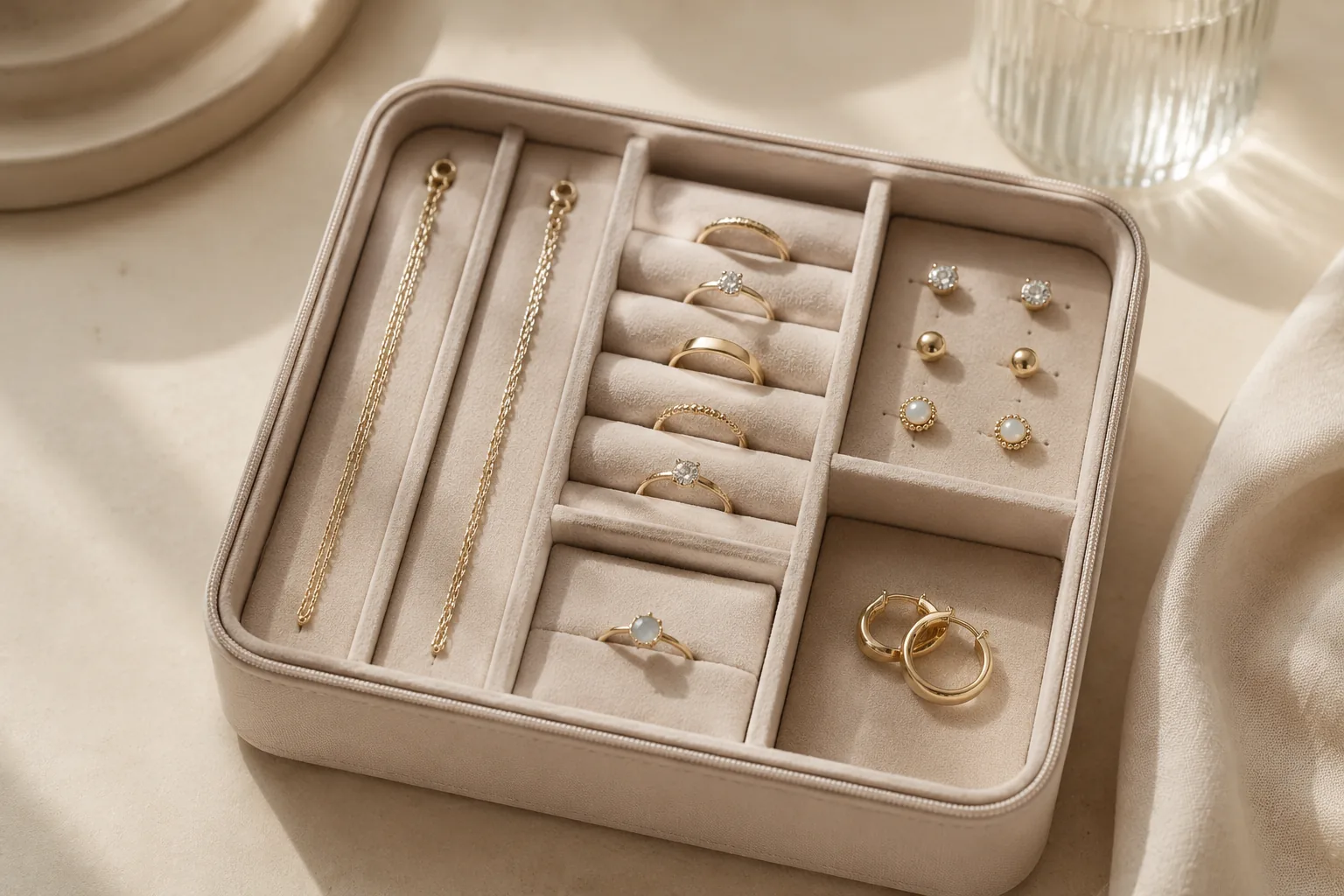
A mixed jewelry collection is difficult to store because chains, rings, earrings, gemstones, and plated finishes create different problems. A necklace can tangle around an earring post, a ring can rub against a polished surface, and several pieces in one open compartment can knock into each other when the box is moved.
The most practical starting point is a soft-lined jewelry box with separate spaces for different shapes. This approach is consistent with guidance from GIA on jewelry storage and protection, which recommends padded compartments, ring slots or posts, and hanging areas for necklaces and bracelets. Jewelers of America also recommends fabric-lined boxes with dividers, hooks for necklaces, and one-pair storage for earrings.
This does not guarantee that jewelry will never scratch or tangle. The available guidance supports separation as a way to reduce contact, friction, and avoidable handling damage. It does not provide controlled long-term comparisons proving that one box design, lining, or pouch will outperform every other option.
The Best Starting System for a Mixed Jewelry Collection
For most collections, begin with three features:
- Separate compartments so pieces do not share one loose space.
- A soft lining or pouch between jewelry and the storage surface.
- Shape-specific sections for chains, rings, earrings, and delicate pieces.
Missoma explicitly recommends storing jewelry separately and using a soft-lined box or soft pouch to reduce friction, scratching, and tangling. That makes a divided, soft-lined organizer a reasonable baseline for a collection containing several jewelry types.
Choose a system for your collection size
A small collection may only need a compact tray with a few ring slots, earring sections, and one or two longer compartments. Keep the pieces you wear most often near the top or in a small daily-use tray. Jewelers of America identifies a smaller tray or jewelry box as a practical option for frequently worn jewelry.
A larger collection benefits from more defined zones. Use one section for chains, another for rings, and separate areas for earrings and pieces with exposed stones or fine settings. The purpose is not to create a complex catalog. It is to limit the number of times one piece moves across another when you search for something.
Choose a system for travel
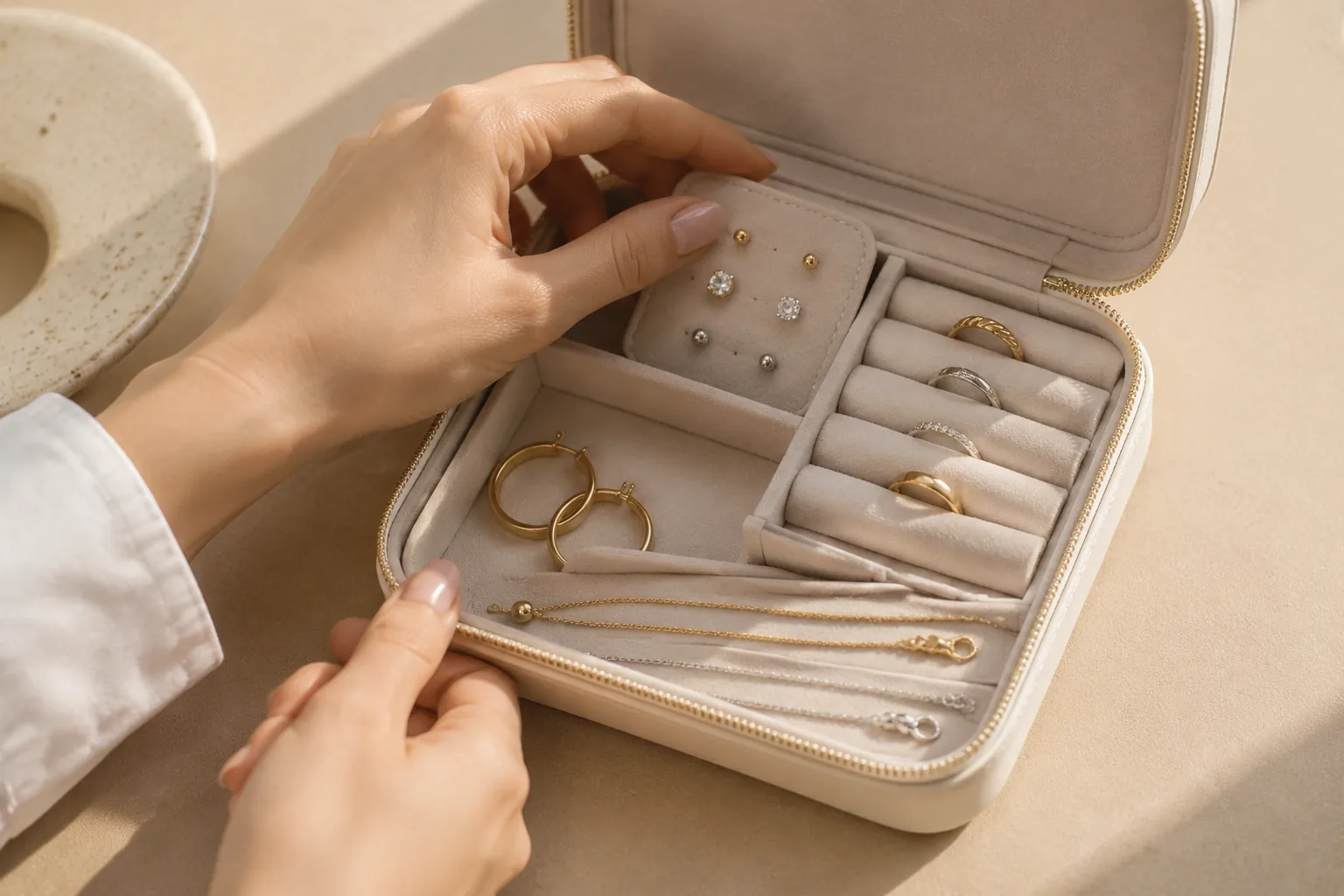
Travel creates more movement, so individual protection becomes more important. Mejuri recommends using a jewelry case with separate compartments when traveling. GIA similarly advises giving each piece its own box or protected space during travel when pieces could scratch or damage each other.
A semi-hard travel case with ring slots, earring sections, and individual spaces for chains is therefore a practical choice. Small soft pouches can work for selected pieces, but a pouch should not become one shared bag for several necklaces and earrings. The pieces can still move together and catch on one another.
Match Storage to Jewelry Shape
Storage works better when the compartment matches the way a piece moves. A chain needs containment along its length, while a ring needs a stable slot and earrings need a way to remain paired.
Chains and bracelets
Chains should be stored in a long compartment, individual pouch, or on a hook designed to keep the chain from forming a loose pile. A hanging hook or post can reduce the amount of chain-to-chain contact, while a separate long slot is useful when a hanging system is not available.
Close the clasp before storing a necklace or bracelet. This is a practical handling recommendation because a closed clasp is less likely to catch on another chain, earring post, or pouch seam. Avoid placing several fine chains in the same unstructured pocket.
For travel, keep each chain in its own protected space. Rolling or loosely coiling multiple necklaces together may save room, but it also increases the opportunities for clasps and links to catch.
Rings
Use ring slots, posts, or individual padded sections for rings. GIA specifically identifies ring posts or slots as useful storage features. This is especially relevant for rings with raised settings, exposed stones, pointed shoulders, or prominent bands that can contact neighboring pieces.
Do not stack rings loosely in one compartment simply because they fit. Even when the lining is soft, movement can bring metal edges or stone settings into contact. If a ring has a delicate setting, give it more space than a plain band.
Studs and hoops
Store earrings as pairs in earring holes, an earring board, a divided tray, or individual small pouches. Jewelers of America recommends storing earrings one pair per bag, which also helps keep backs and matching pieces together.
Small hoops should not be placed under heavier rings or bangles. Their shape can deform under pressure, and their closures may catch on fabric or other jewelry. Larger hoops need a compartment wide enough to prevent them from being compressed against the box lid.
Delicate settings and exposed stones
Pieces with fine prongs, open settings, dangling elements, or fragile-looking components should have a separate padded section. Avoid placing them beneath heavier jewelry or beside pieces with sharp edges.
This is an editorial adaptation of the separation principle in the available guidance, not a proven guarantee of longer setting life. The aim is to reduce contact and snagging opportunities during storage and retrieval.
How Mejuri, Missoma, and Astrid & Miyu Recommend Storing Jewelry
The three brands agree on several basic principles, but they do not describe separation with exactly the same level of detail.
Mejuri’s material-based storage advice
Mejuri organizes its care guidance by material and links to separate pages for gold, gold vermeil, and sterling silver. Its gold jewelry care guidance recommends storing gold in a safe, dry place and using a jewelry case with separate compartments when traveling.
For gold vermeil, Mejuri recommends a safe, dry location such as a tarnish-resistant pouch or jewelry box, along with the anti-tarnish strip supplied with the product. Its jewelry boxes are described as having a tarnish-resistant microsuede lining. Mejuri also cautions that a polishing cloth may be abrasive on gold vermeil and should be used gently; its care guidance does not recommend steam or ultrasonic cleaners for gold vermeil.
For sterling silver, Mejuri recommends a safe, dry place and use of the supplied anti-tarnish strip. These instructions address environmental care and discoloration, while separate compartments address contact between pieces.
Missoma’s explicit separation advice
Missoma is the most direct of the three brands about storing pieces separately. Its official Help & FAQs care guidance recommends individual storage and prioritizing its soft-lined boxes or soft pouches to reduce friction, scratches, and tangling.
Missoma advises storing gold vermeil and silver jewelry in a cool, dark, and dry place. It also states that its sterling silver jewelry has a rhodium coating, which it says helps reduce the silver’s exposure to the outside environment and long-term tarnishing. That statement should not be interpreted as meaning the finish cannot scratch or change with use.
Astrid & Miyu’s box, pouch, and material cautions
Astrid & Miyu recommends storing jewelry in the original box or a sealed jewelry box. For gemstones, it recommends using the supplied box or pouch and notes that direct sunlight may affect the color of some semi-precious stones.
Its guidance also recommends storing freshwater pearls in a sealed brand pouch and using a microfiber cloth for gemstones and pearls. For plated jewelry, Astrid & Miyu advises avoiding contact with water, sweat, and perfume. These instructions make material identification important before choosing a single storage method for an entire collection.
Taken together, the brands support separate, protected, dry storage. Missoma explicitly connects individual storage with reduced friction, scratches, and tangling. Mejuri is especially specific about separate compartments for travel and anti-tarnish protection for vermeil and silver. Astrid & Miyu emphasizes original packaging, sealed storage, and material-specific care, but does not clearly require every metal piece to occupy its own compartment.
Material-Specific Storage Cautions
Storage should follow the most sensitive material in a piece, not just its visible color or metal tone.
Gold vermeil, plated jewelry, and sterling silver
Gold vermeil and plated jewelry have surface finishes that can be affected by repeated contact, moisture, and chemicals. Store these pieces separately in a dry location, preferably in a soft-lined compartment or pouch. Do not assume that a soft lining eliminates friction between multiple pieces sharing one space.
Astrid & Miyu specifically advises avoiding water, sweat, and perfume with plated jewelry. Storage cannot reverse exposure that has already occurred, so allow pieces to dry fully before putting them away.
Sterling silver can tarnish, which is why Mejuri recommends a dry storage location and an anti-tarnish strip. Missoma also recommends a cool, dark, dry place for silver and describes a rhodium coating on its sterling silver jewelry. Anti-tarnish protection is useful for discoloration risk, but it does not replace physical separation.
Gold and other metal pieces
Mejuri’s gold guidance recommends a safe, dry storage location. Gold pieces should still be separated when they have different shapes, polished surfaces, stones, or protruding settings. A plain gold band and a textured ring may not create the same contact pattern, so grouping them solely by metal can overlook mechanical rubbing.
Pearls, opals, and gemstones
Pearls and opals require a more cautious approach. GIA advises that pearls and opals should not be kept in excessively dry conditions. It recommends a soft or breathable bag for pearls and warns against storing pearls in ordinary plastic bags.
This creates an important qualification to sealed-storage advice. Astrid & Miyu recommends a sealed pouch for freshwater pearls, while GIA emphasizes avoiding excessive dryness and using a soft or breathable bag. The correct choice should follow the care instructions for the specific pearl or opal, including any brand guidance, rather than applying a sealed container rule to every gemstone.
For gemstones, use the supplied box or pouch where the brand provides one, keep pieces separated, and avoid direct sunlight when the care guidance warns that color may be affected. Do not assume that every gemstone tolerates the same storage environment.
Separation, Anti-Tarnish Protection, and Scratch Prevention Are Different Jobs
These three ideas are often combined in product descriptions, but they address different risks.
- Separation reduces direct contact, rubbing, snagging, and chain entanglement.
- Soft lining creates a buffer between the piece and the storage surface.
- Anti-tarnish strips or linings address environmental discoloration risk for applicable materials.
- Dry storage limits exposure to moisture, but must be adapted for materials such as pearls and opals.
Mejuri’s anti-tarnish strips and microsuede lining illustrate this distinction. The strip is intended for tarnish protection, while the lining provides a surface between the jewelry and the box. Neither should be treated as a complete solution for scratching, tangling, prong damage, or plating wear.
Missoma’s recommendation to store pieces separately is more directly relevant to reducing friction and contact. GIA’s padded compartments, ring slots, and hanging posts translate that general principle into storage features.
Where Storage Advice Conflicts
The main apparent conflict is between sealed storage and breathable storage.
Astrid & Miyu recommends an original or sealed jewelry box and a sealed brand pouch for freshwater pearls. GIA, however, cautions against excessive dryness for pearls and opals and recommends a soft or breathable bag for pearls. These instructions may be compatible in some product-specific contexts, but they should not be treated as universal equivalents.
The practical resolution is to separate materials by care requirement:
- Use dry, protected, separated storage for gold, gold vermeil, plated jewelry, and sterling silver when the brand recommends it.
- Use the supplied packaging for pearls and gemstones when available.
- Check whether pearl or opal guidance calls for breathability or warns against excessive dryness.
- Avoid ordinary plastic bags for pearls.
- Keep pieces physically separated regardless of whether the container is sealed or breathable.
There is no evidence in the research package establishing one universal humidity range or proving that sealed boxes are superior for every metal and gemstone. Material-specific instructions take priority over a single collection-wide rule.
A Daily and Travel Storage Routine
A workable routine should be easy enough to repeat.
Daily routine
Before putting a piece away, close its clasp and remove visible moisture from the surface with an appropriate soft cloth if the brand’s instructions permit it. Place chains in their own long compartment, rings in slots, and earrings together as pairs.
Keep high-frequency pieces in a small divided tray so they are not repeatedly pulled from a crowded box. Separate pieces with exposed stones, raised settings, sharp edges, or fine chains from heavier items.
Review the care page for the brand and material before using polishing products. This matters particularly for gold vermeil, where Mejuri warns that polishing cloths can be abrasive and advises against steam or ultrasonic cleaning.
Travel routine
For travel, give each item an individual compartment, pouch, or protected space. Use the case’s ring slots, earring sections, and chain compartments rather than placing everything in the largest open pocket.
Pack the case so heavier pieces do not press against delicate settings or hoops. Keep pearls and opals in the storage format specified by their care guidance. A travel system that protects against movement may still be unsuitable for a material that requires different environmental conditions.
What the Evidence Does Not Prove
The current sources support separation, soft protection, dry storage for applicable materials, and shape-specific compartments. They do not provide controlled long-term data comparing scratch rates across jewelry boxes, pouches, hooks, or lining materials.
They also do not establish a specific lifespan for gold vermeil or other plating under different storage conditions. No source gives a universal duration for anti-tarnish strips, proves that microsuede is better than every other lining, or defines one precise humidity range for all jewelry materials.
The most defensible recommendation is therefore practical rather than absolute: reduce unnecessary contact, keep shapes organized, follow the material-specific care instructions, and treat anti-tarnish protection as separate from scratch prevention.
Frequently Asked Questions
What is the best way to store chains without tangling?
Store each chain in its own long compartment, pouch, or hanging section, and close the clasp before putting it away. Avoid placing several loose necklaces in one shared pocket.
Can rings and earrings share a compartment?
They can, but individual sections are preferable when the pieces have raised settings, sharp edges, exposed stones, or delicate finishes. A soft lining alone does not prevent multiple pieces from rubbing against each other.
Should gold vermeil be stored in a sealed box?
Follow the brand’s instructions. Mejuri recommends a safe, dry place such as a tarnish-resistant pouch or jewelry box and suggests using the supplied anti-tarnish strip. Sealed storage should not automatically be applied to pearls, opals, or every gemstone.
Do anti-tarnish strips prevent scratches?
No. They are intended to address tarnishing or discoloration risk for applicable materials. They do not prevent mechanical contact, chain tangling, snagging, or setting damage.
Is a soft pouch enough for a large collection?
A pouch can be suitable for an individual piece, but a large mixed collection is easier to protect with a divided box or case. Separate pouches should not be treated as one shared container.
How should pearls be stored?
Use the product’s care instructions and avoid excessive dryness. GIA recommends a soft or breathable bag for pearls and warns against ordinary plastic bags. Brand-specific sealed-pouch guidance should be considered alongside that material-specific caution.
Conclusion
The most useful answer to “how to store jewelry” is a separated system organized by both shape and material. Use hooks or long compartments for chains, slots for rings, paired sections for earrings, and padded spaces for delicate settings. Keep vermeil, plated jewelry, and sterling silver dry when their care instructions call for it, while treating pearls, opals, and other gemstones as separate cases that may need different storage conditions.
This approach is supported by official guidance from Mejuri, Missoma, and Astrid & Miyu, as well as recommendations from GIA and Jewelers of America. It reduces avoidable contact and makes daily handling easier, but it should be understood as risk reduction rather than a guarantee against every scratch, tangle, finish change, or storage-related problem.
Related Guides
- How to Prevent Jewelry Tarnish: Storage, Chemicals, and Daily Wear Habits
- Can You Shower With Jewelry? What Brand Care Pages Actually Warn About
- Mejuri Materials Explained: When 10K Gold, Sterling Silver, Platinum, and Stainless Steel Make Sense
- Missoma Metal Guide: 18K Gold Vermeil, Gold Plating, Sterling Silver, and Solid Gold Explained