



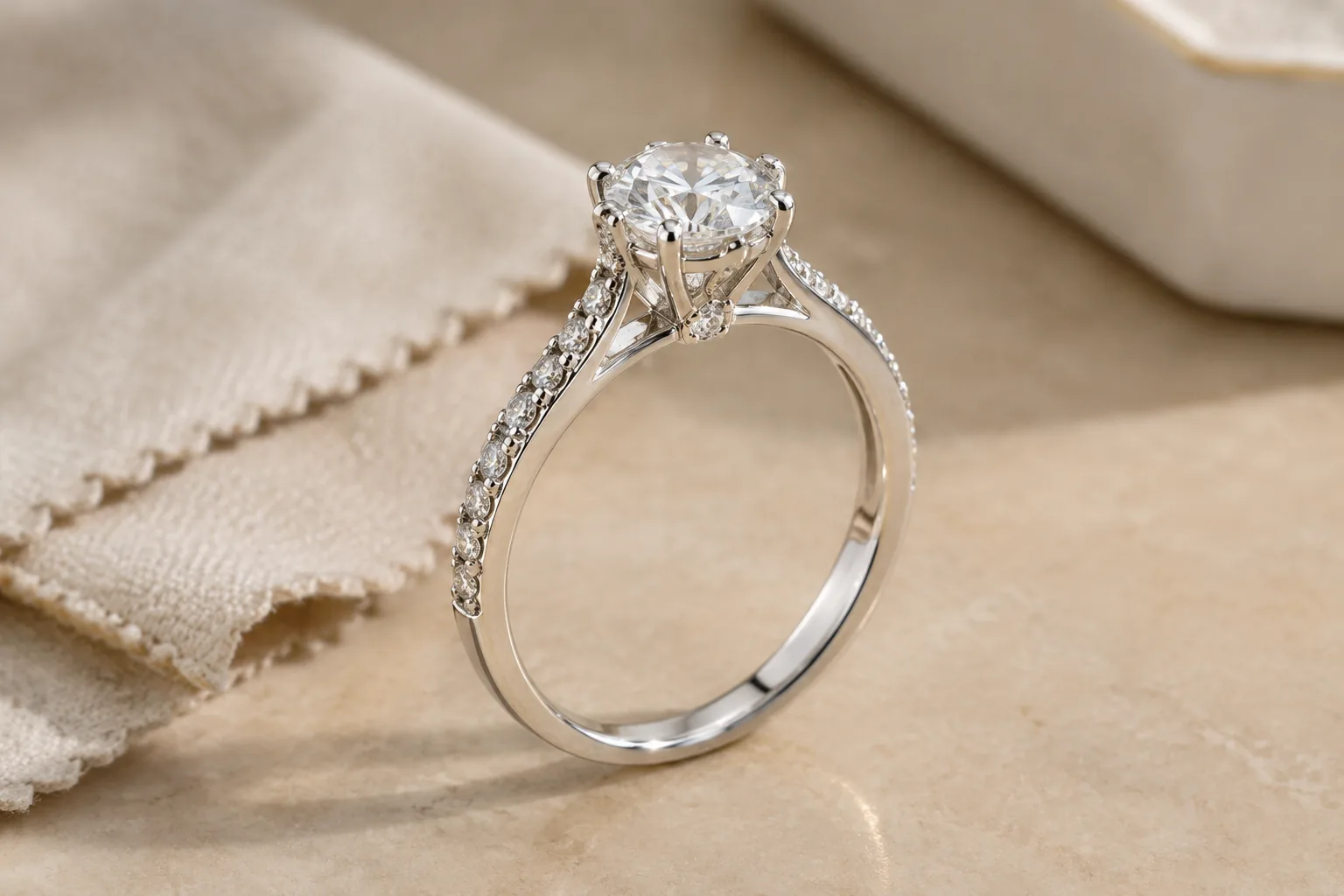
A diamond ring can be made with durable stones and still require careful handling because the setting holds every stone in place. This matters especially when a ring combines small pavé diamonds with a basket structure beneath the center stone.
The central point in James Allen diamond setting care is not that every pavé or basket-setting ring must never be soaked. The brand’s reported guidance is narrower: soaking may increase the possibility of stones becoming loose in pavé and basket settings. That warning should change how you assess the ring before cleaning, particularly if it has been worn daily, struck recently, or repaired in the past.
This guide explains how to identify the setting, what to inspect before cleaning, how James Allen’s general cleaning guidance differs from its setting-specific caution, and when to stop home care and arrange an inspection.
What James Allen Actually Warns About Pavé and Basket Settings
James Allen’s official Diamond Care guidance discusses cleaning methods and specifically identifies pavé and basket settings as structures requiring additional caution. According to the research record for that page, the warning is that soaking a ring in these settings may increase the possibility of stones becoming loose.
That is a risk warning, not a universal prohibition. It does not establish that every pavé or basket ring will lose a stone after soaking, nor does it provide one safe soaking duration for every design. The page reportedly includes different cleaning references, including a solution involving dish soap and water for up to 30 minutes in connection with prong and cathedral settings, while also describing shorter or more cautious cleaning approaches elsewhere. The available evidence does not support treating 30 minutes as a safe parameter for pavé or basket settings.
Why the warning is setting-specific
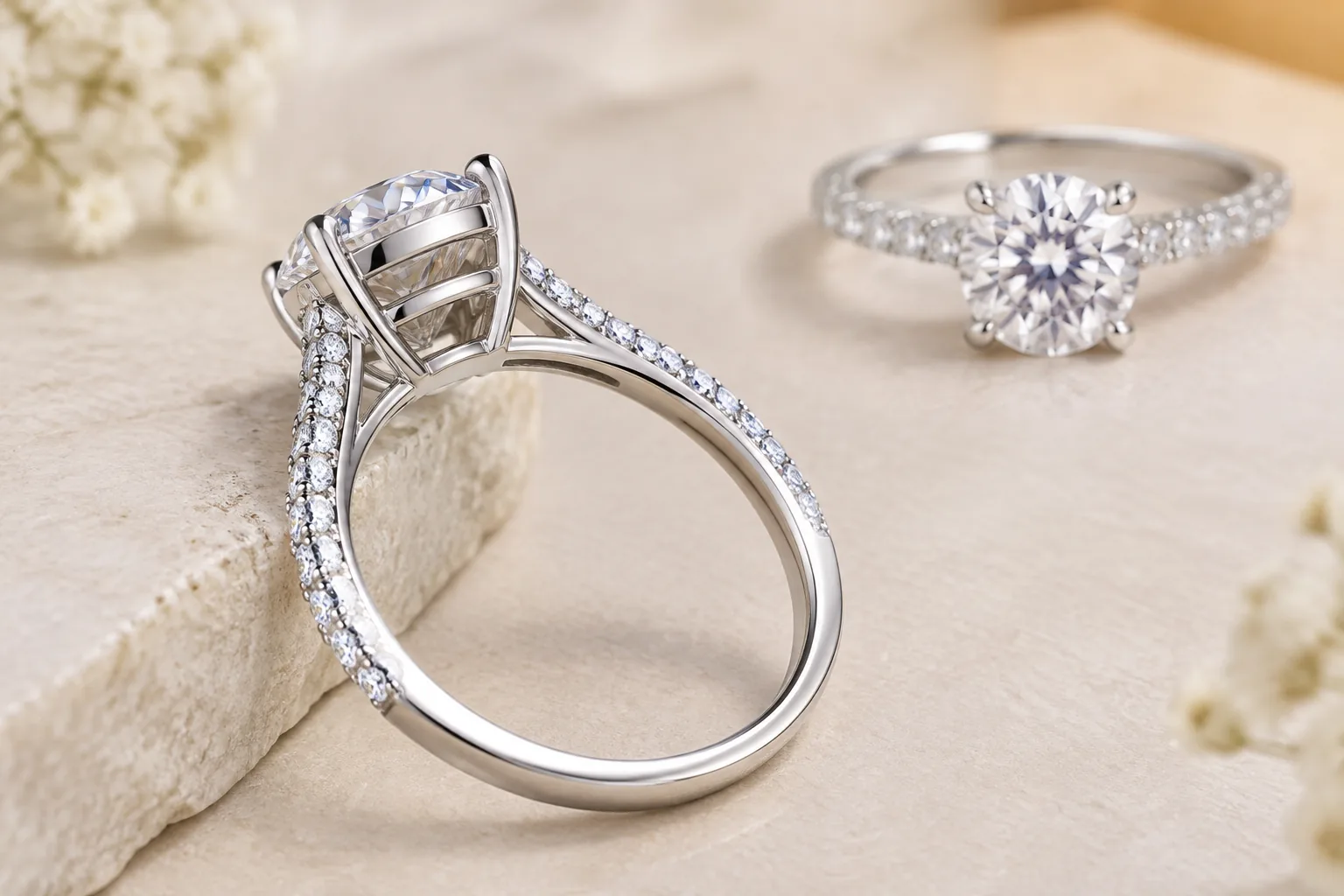
Pavé uses small stones set close together, often secured by small metal beads or prongs. Basket construction usually supports the center stone from below with horizontal metal bars and prongs. These structures can have more small contact points and recesses than a simple solitaire design.
The issue is therefore not only the diamond material. A diamond may be durable, but the ring’s security depends on the condition and geometry of the metal holding it. Water or cleaning solution may also make it harder to notice a developing problem if the ring is cleaned before the setting is visually checked.
James Allen’s reported guidance also mentions warm water, mild dish soap, brief soaking, a soft cloth or cotton swab for the metal, rinsing, and repeating the process when necessary. However, the research record does not establish a complete formula for every cleaning solution, a universal water-temperature limit, or a fixed frequency for every ring.
What the warning does not establish
The available material does not establish that:
- All pavé rings are unsuitable for any soaking.
- All basket settings should be treated identically.
- A short soak is automatically safe.
- Every James Allen ring has the same metal, side stones, surface finish, or repair history.
- A product name alone reveals every setting structure.
- General diamond-care guidance overrides the instructions for a specific ring.
Because the official care page was reported as difficult to access directly during research, its current wording and availability should be rechecked before publication or before relying on a disputed detail. For a specific ring, the product page and James Allen support remain more relevant than a generalized interpretation.
How to Tell Whether Your Ring Has Pavé, Basket, or Both
A top-down view can suggest pavé, but it may not reveal how each small stone is secured or what lies below the center stone. The most reliable identification process combines the original product description, order information, underside photographs, and the visible structure of the ring.
Recognizing pavé
GIA describes pavé and related side-stone settings as arrangements in which small stones sit close together and are held by small metal beads or prongs. From above, the effect is usually a continuous field of small diamonds along the band, halo, or another surface.
Do not assume that every row of small diamonds uses identical construction. French pavé, shared-prong, channel, and other layouts can look similar from a distance but differ in how the stones are secured. A clear product description may identify the intended style, but a product name should not be treated as a complete technical diagram.
Recognizing a basket
GIA’s guide to engagement ring settings describes a basket as a support structure commonly located beneath the center stone. Horizontal metal supports and prongs create a basket-like framework.
To inspect this area, look at the ring from the side and underneath in good light. Do not push the center stone, bend a prong, or use a fingernail to test movement. Those actions are not reliable security tests and could interfere with an already compromised setting.
How both structures can appear on one ring
A ring may have pavé on the shank and a pavé-covered basket beneath the center stone. James Allen’s official product material includes a description using both “pavé” and “Classic Basket Head,” showing that the two terms can describe different parts of the same design. The listed product page is useful as an example of how product descriptions can combine setting terms.
For your own ring, check:
- The order confirmation and product page.
- The SKU or item number.
- Any setting or customization details.
- Photos of the ring from the side and underside.
- The original grading or purchase documents.
- Records of resizing, repair, or stone replacement.
If the records and the physical ring appear inconsistent, ask James Allen or a qualified professional to confirm the structure before choosing a more intensive cleaning method.
Pre-Cleaning Checks: When to Stop and Arrange an Inspection
Cleaning should come after a basic visual assessment. The purpose is not to prove that every stone is secure at home. It is to identify visible signs that make cleaning less important than inspection.
Signs that call for caution
Under bright, diffuse light, look for:
- A missing small diamond.
- A stone that appears tilted, raised, or out of line with neighboring stones.
- A prong that looks bent, broken, unusually thin, or displaced.
- A crack, dent, or impact deformation in the metal.
- Repeated snagging on clothing or hair.
- A new rattle, click, or other sound after cleaning.
- A stone that appears to have changed position after cleaning.
These observations are consistent with the inspection concerns recorded in the research package. They do not diagnose the cause. A ring can also have an issue that is not visible in a casual inspection.
When to stop wearing the ring
If a stone is visibly loose, missing, raised, or surrounded by a damaged prong, pause wearing the ring and avoid home cleaning until it has been assessed. The same applies after a significant impact or when the ring repeatedly catches on fabric.
James Allen’s warranty information reportedly recommends cleaning and inspection every six months, or inspection after an impact, and lists services such as cleaning, inspection, and prong tightening. That information does not establish that every service is free, automatically covered, or available for every repair situation. Confirm eligibility directly before sending the ring.
Choosing a Cleaning Method Without Overgeneralizing
The safest choice depends on the ring’s setting, metal, surface finish, side stones, treatments, and condition. A diamond-only assumption is not enough.
Mild soap and water
When the setting appears intact and the product-specific instructions permit it, James Allen’s reported general guidance includes warm water, mild dish soap, a soft cloth or cotton swab, rinsing, and repeating the process if needed.
For a pavé or basket ring, treat soaking as the point requiring extra caution. The official warning concerns the possibility that soaking may increase the chance of loose stones. Do not convert general prong or cathedral-setting guidance into a universal instruction for pavé or basket designs.
A cautious approach is to minimize immersion, avoid vigorous handling, and stop immediately if you notice movement, a new sound, or a change in the stone’s position. These are conservative recommendations based on the documented setting risk, not a James Allen-published universal protocol.
Glass cleaner
The research record says James Allen’s page mentions soaking a diamond in glass cleaner for no more than one minute, while excluding rhodium surfaces and directing the user to rinse again with mild soap solution afterward.
That statement should not be treated as approval for every ring. It does not resolve the compatibility of a particular side stone, treatment, plating, or repair. If the ring includes rhodium-finished metal, non-diamond stones, treated gems, or an unknown surface, confirm the method first.
Ultrasonic cleaning and steam
GIA warns that ultrasonic and steam cleaning can loosen stones in a setting and recommends that a professional check whether the stones are secure before using those methods. Its ultrasonic cleaning guidance is useful general context, but it is not a James Allen product-specific instruction.
Do not assume that a diamond ring is automatically suitable for ultrasonic or steam cleaning. Pavé, basket structures, previous impacts, loose prongs, treated stones, and repairs can all change the decision. When the setting condition is uncertain, professional assessment is the appropriate next step.
How Metal, Plating, Side Stones, and Treatments Change the Decision
The same cleaning method can have different implications for different rings. The center diamond is only one part of the care decision.
Metal and surface finish
GIA notes that chemicals can damage or discolor precious metals. Chlorine-containing cleaners may corrode gold alloys, while household cleaners, perfume, and hairspray may affect some stones or surfaces. James Allen’s reported care guidance specifically excludes rhodium surfaces from its glass-cleaner reference.
Because the research package does not confirm the metal or finish of a particular James Allen ring, do not infer these details from appearance alone. White-looking metal may have a surface finish, and the product page may contain information that is not visible in a photograph.
Non-diamond side stones
A ring described as a diamond ring may still include stones or accents that require different care. The available evidence does not provide a universal rule for every side stone. Confirm the stone list and any treatment information before using glass cleaner, ultrasonic cleaning, steam, or prolonged soaking.
Treated gems
GIA’s general care material notes that gems treated with oil, resin, wax, glass filling, or coatings may be affected by heat, solvents, steam, or ultrasonic cleaning. This is why the correct question is not simply “Is the stone a diamond?” It is “Which stones, treatments, metals, finishes, and setting structures are present in this specific ring?”
What to Do If the Ring Is Dirty, Loose, or Recently Hit
Use the ring’s condition to select the next step:
- Only light buildup, with no visible damage: Review the product-specific instructions and use the least aggressive compatible method. Avoid assuming that a longer soak produces a better result.
- Uncertain setting structure: Locate the product page, order details, SKU, and underside images before cleaning. Ask James Allen to confirm the setting and compatible care method.
- Suspected loose stone or damaged prong: Stop wearing the ring and arrange a brand or professional inspection.
- Recent impact: Do not treat cleaning as the priority. James Allen’s warranty material reportedly recommends inspection after an impact.
- New sound or stone movement after cleaning: Stop handling the ring, keep it separate from other jewelry, and request an assessment.
- Missing stone: Preserve the ring and purchase records, avoid further wear, and contact James Allen or a qualified professional about inspection and repair options.
James Allen lists customer-service channels including phone, international contact options, WhatsApp, online chat, and email or message support in the research record. Because contact details and service hours can change, verify them through the current James Allen customer service page rather than relying on an old order email.
Questions to Ask James Allen or a Professional
Before cleaning or sending the ring for service, ask:
- Does the ring have pavé, basket, or both, and where is each structure located?
- What metal and surface finish does the ring use?
- Does it contain any non-diamond side stones or treated gems?
- Is soaking appropriate for this exact SKU and current setting condition?
- Are glass cleaner, ultrasonic cleaning, or steam compatible with this ring?
- Should the ring be inspected after its most recent impact or repair?
- What inspection, cleaning, or prong service is available for this order?
- What service eligibility, fees, shipping steps, and responsibility limits apply?
Have the order number, SKU, product URL, purchase date, grading documentation, photographs, and any repair or resizing history ready. A clear description of when the problem appeared is also more useful than a general statement that the ring “feels loose.”
Conclusion
James Allen diamond setting care begins with the setting, not just the diamond. Pavé and basket structures may coexist, and James Allen’s reported warning is that soaking may increase the possibility of stones becoming loose in those settings. That is a reason for caution, not evidence of an absolute ban or a universal safe soaking time.
Check the product records and structure, inspect for missing stones or damaged prongs, and choose the least aggressive compatible care method. If the ring has been hit, catches repeatedly, makes a new sound, or shows movement or damage, pause home cleaning and arrange an inspection.
Related Guides
- Pandora Lab-Grown Diamond Jewelry Care: What Owners Need to Know After Purchase
- Brilliant Earth vs Blue Nile vs James Allen: Resizing, Repairs, and Upgrade Programs Compared
- When to Prioritize a Diamond Grading Report: Loose Stones, Pavé, and Petite Jewelry
- James Allen’s 360-Degree Diamond Shopping Explained