



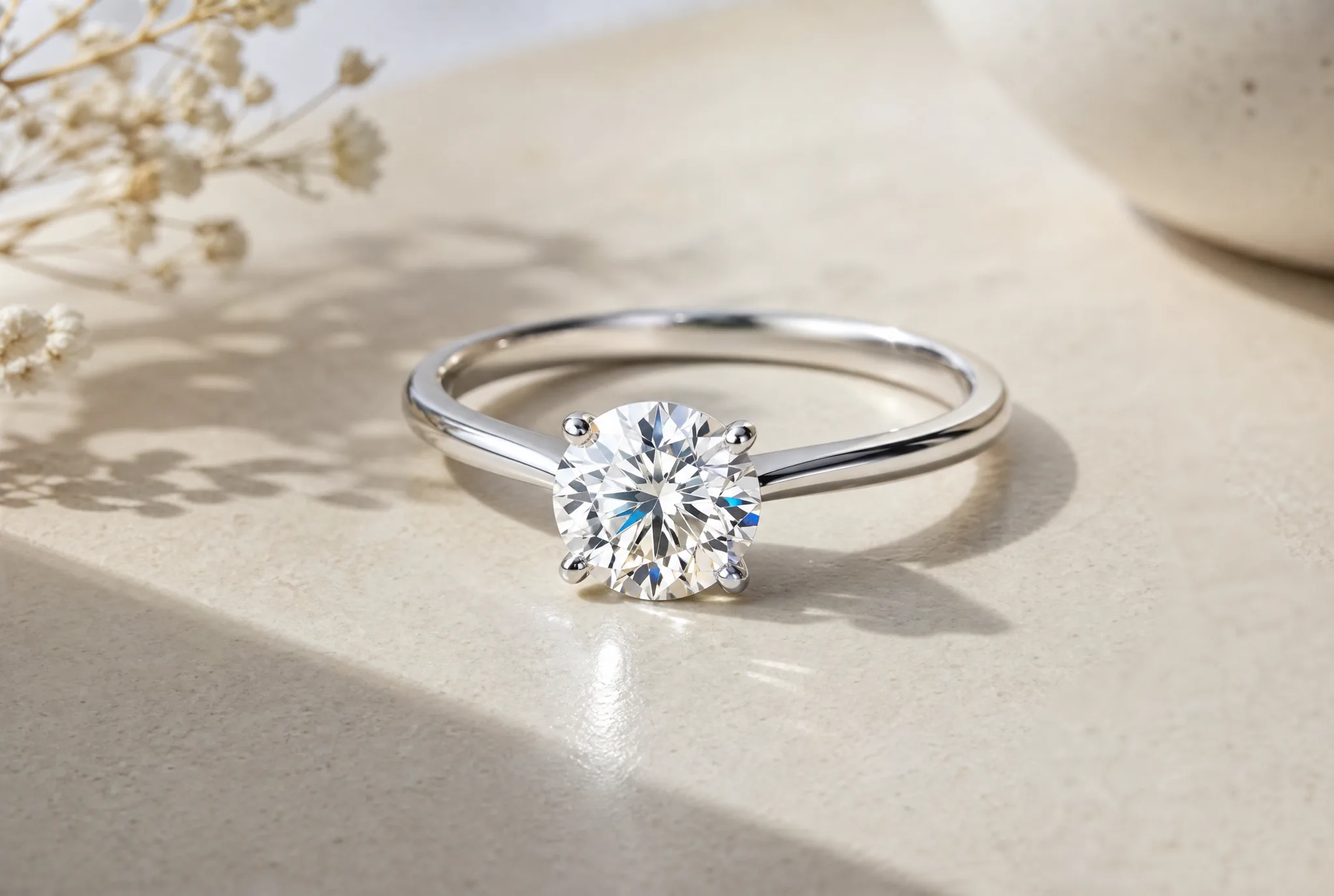
Blue Nile’s official lab-grown diamonds education page says lab-grown diamonds are real diamonds, made of pure carbon in the same crystal structure as natural diamonds. That is the core message, but it is not the whole buying story. For shoppers in the U.S. and other English-speaking markets, the practical questions are less about slogan-level equivalence and more about disclosure, report format, growth method, and resale expectations. The FTC’s diamond advertising guidance also matters here, because lab-grown or laboratory-created disclosure must appear immediately before the word diamond and be equally conspicuous.
What Blue Nile Means by Lab-Grown Diamond
Real diamond, different origin
Blue Nile’s claim is straightforward: lab-grown diamonds are diamonds. The brand says they are chemically and structurally identical to natural diamonds, and that the main difference is origin. In plain language, that means a lab-grown diamond is not a diamond simulant like cubic zirconia or moissanite. It is still diamond material.
That distinction is useful because it tells a beginner what should not be a concern. If you are worried that “lab-grown” means fake, Blue Nile’s education page is trying to correct that misunderstanding. The point of the page is not to argue that lab-grown stones are identical to natural diamonds in every market sense. It is saying they are diamond in composition and structure, while differing in how they formed.
What “same” does and does not mean
The word “same” is where buyers can get misled if they stop reading too early. Blue Nile’s page uses broad comparison language about physical, chemical, optical, and durability characteristics. That is directionally consistent with mainstream gemological descriptions, but it does not mean every buying decision should be made as if origin never matters.
For a first-time buyer, the useful takeaway is narrower: if you want the look and basic material behavior of diamond, lab-grown diamonds belong in the diamond category. If you care about origin, resale, or how a stone is described on paper, those are separate questions.
CVD vs HPHT, in Plain English
How each process forms the stone
Blue Nile says lab-grown diamonds are produced by either Chemical Vapor Deposition, or CVD, or High Pressure High Temperature, or HPHT, over weeks or months. GIA’s lab-grown diamond overview and HPHT and CVD growth explainer describe those same two routes in more technical terms. GIA explains CVD as growth in a vacuum chamber using carbon-containing gas, and HPHT as a process that mimics natural diamond-forming conditions.
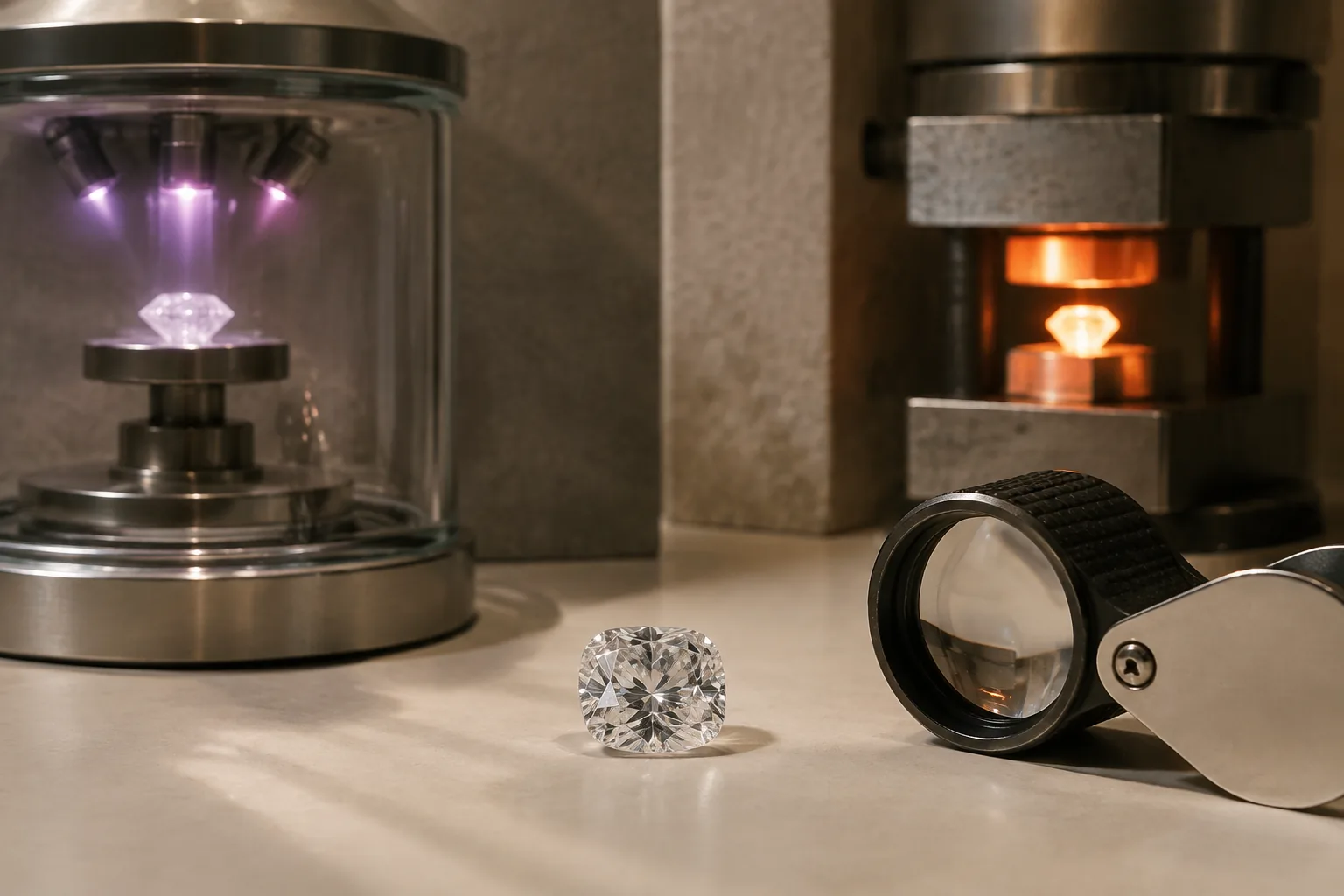
For most first-time buyers, the technical difference matters less than it seems. CVD and HPHT are useful to know because they explain how the stone was grown and may appear on a grading report. But they are not a shortcut to “better” or “worse” by themselves. A good stone can come from either process, and a weak stone can also come from either process. The report still has to do the real work.
What matters to a buyer versus what is background
The buyer-level questions are simpler than the machinery behind growth:
- Does the report clearly identify the stone as lab-grown?
- Is the report from a lab format I can actually compare?
- Do the 4Cs look balanced for the way I will wear the stone?
- Are there any treatments or notes I need to understand?
If you are choosing between CVD and HPHT based only on a brand page, that is usually too thin a basis. The growth method is background context. The report, stone appearance, and pricing are the practical decision points.
How to Evaluate a Lab-Grown Stone
Start with the report, not the label
Blue Nile says lab-grown diamonds can be evaluated using the same 4Cs used for natural diamonds and that independent certifications can help buyers compare stones. That is a reasonable starting framework, but it needs a little correction in practice. Different labs do not always present lab-grown diamonds in exactly the same format.
GIA’s current lab-grown reporting approach can differ from natural-diamond-style 4Cs nomenclature, and may use colorless-to-near-colorless quality language such as Premium or Standard instead. IGI’s lab-grown diamond report can include 4Cs assessments for center stones and also notes growth process and treatments. Those differences matter because a buyer comparing two stones by “the 4Cs” may be comparing two reports that do not use the same vocabulary.
For that reason, I would treat the report format as part of the product, not just paperwork. If the report is vague, the comparison is weaker.
Use the 4Cs as a tradeoff tool
For a first-time buyer, the 4Cs are most useful when they are treated as tradeoffs rather than scorekeeping. That is true for natural diamonds and still true for lab-grown diamonds.
A practical order of attention is often:
- Cut or overall visual performance.
- Color and clarity, depending on shape and setting.
- Carat, once the appearance basics are acceptable.
- Report language and any notes on growth or treatment.
That order is analysis, not a universal rule. Some buyers prioritize size first, especially in lab-grown stones where the upfront price is often lower. Others prefer a smaller stone with stronger visual quality. The key point is that lab-grown does not remove the need to think about proportion and appearance.
Compare lab formats before you compare prices
This is where many beginners get tripped up. Two stones can look similar online but be harder to compare if the labs use different wording, different quality scales, or different disclosure language. If one report gives full 4Cs detail and another uses a simplified quality category, the second may be easier to read but harder to compare line by line.
A good reference point is Diamond Certification Explained: Reports, Supplier Standards, and Brand Claims, which is useful if you want a wider framework for reading grading reports before you decide what matters most in a lab-grown purchase.
Price, Resale, and Value Expectations
Lower upfront cost is the clearest expectation
Blue Nile says lab-grown diamonds are priced significantly lower than natural diamonds. That is the most dependable consumer-level message in the whole FAQ. If your goal is to maximize visible size or get a certain look within a set budget, lab-grown diamonds can make that easier.
But “lower upfront cost” is not the same thing as “better long-term value.” Those are different measurements. The first is a purchase-price claim. The second is a market question.
Be careful with resale assumptions
Blue Nile also says lab-grown diamonds generally do not hold long-term resale value the way natural diamonds can. That is a fair warning to read cautiously, because it is broad and does not give a resale benchmark, a time horizon, or a defined market. In other words, it signals that buyers should not assume strong resale, but it does not prove a precise depreciation rate.
That matters because many first-time buyers overestimate resale for jewelry in general. A lab-grown diamond is best approached as a personal-use purchase, not as a store of value. If long-term resale is important to you, you should ask about trade-in, upgrade, or buyback policies before purchase, since those program terms can affect ownership value more than a generic brand-page statement.
For buyers trying to decide whether the budget advantage fits their use case, Lab-Grown Diamond Jewelry Buying Guide: Fashion Jewelry vs Engagement Ring Shopping is the better next read, because it separates casual wear, bridal buying, and budget logic.
What Blue Nile Explains Well, and What It Leaves Out
Where the page lines up with FTC and GIA
Blue Nile does several useful things correctly at a beginner level. It says lab-grown diamonds are real diamonds. It distinguishes CVD and HPHT. It encourages shoppers to look at quality, not just the fact of being lab-grown. And its general disclosure language is broadly in step with FTC rules that require “laboratory-grown” or “laboratory-created” to appear immediately before “diamond” and to be equally conspicuous.
It also lines up with GIA’s basic framing that lab-grown diamonds are diamonds with different origin, even though GIA’s reporting language may differ from the familiar natural-diamond presentation. That is the right mental model for a cautious buyer: same material category, different origin, and sometimes different report style.
What still needs verification before purchase
Blue Nile’s education page leaves out several things a buyer still needs to verify:
- Which lab report format is attached to the stone.
- Whether the report includes growth method and treatment notes.
- How the seller compares stones when report formats differ.
- What the after-sale policy is, including resizing, returns, upgrades, or trade-in terms.
- What exact resale language the seller is willing to stand behind.
That is not a criticism of the page so much as a reminder of what education content is not designed to do. Brand education pages are meant to orient you. They are not a substitute for the specific report on the stone you plan to buy.
If you are comparing sellers rather than just learning the category, Blue Nile vs Brilliant Earth: Which Is Better for Diamond Certification Needs? is the most direct adjacent comparison. If you are weighing shopping flow and selection style across retailers, James Allen vs Blue Nile vs Brilliant Earth: Which Engagement Ring Buying Process Fits You? is the better process-level comparison.
Conclusion
Blue Nile’s lab-grown diamond FAQ does a solid job of explaining the category at a beginner level. Its strongest points are simple: lab-grown diamonds are real diamonds, they can be made by CVD or HPHT, and buyers should still judge them by quality and documentation rather than by the label alone.
The caution is equally simple. The page is not a complete buying manual. It does not tell you which report format to prefer, how to compare labs, or how to think about resale in a precise way. For a first-time buyer, the safest reading is this: use Blue Nile’s page to understand the category, then use the actual grading report, disclosure language, and seller policies to make the purchase decision.
Related Guides
- Diamond Certification Explained: Reports, Supplier Standards, and Brand Claims
- Lab-Grown Diamond Jewelry Buying Guide: Fashion Jewelry vs Engagement Ring Shopping
- James Allen vs Blue Nile vs Brilliant Earth: Which Engagement Ring Buying Process Fits You?