



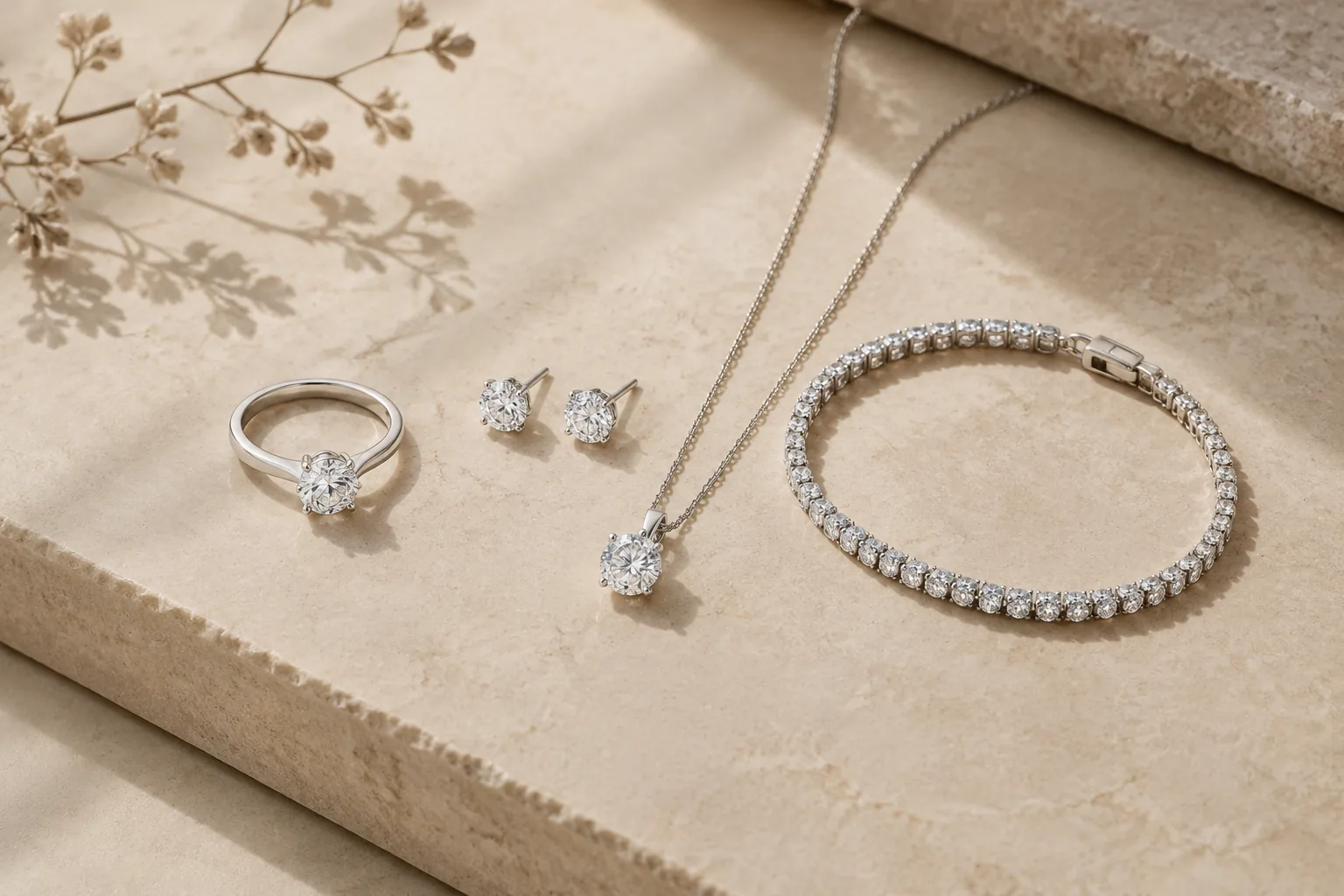
If you are considering Pandora lab grown diamonds, the main question is not simply whether lab-grown diamonds are “real” diamonds. It is whether Pandora’s specific US line gives you the materials, documentation, design range, service terms, and claim transparency you want for the way you plan to wear or gift the jewelry.
Pandora is best known by many shoppers for charms, but its current US lab-grown diamond range extends into rings, earrings, necklaces, bracelets, tennis styles, and more. That makes it worth evaluating as accessible diamond jewelry, not just as an add-on to a charm bracelet. At the same time, buyers should read Pandora’s 4Cs, certification, renewable-electricity, and recycled-metal language closely, because the strongest buying decision comes from separating official brand-sourced facts from editorial interpretation.
This guide uses Pandora’s US pages, Pandora Group sustainability information, GIA diamond terminology, and FTC advertising guidance to explain what is documented, what remains unclear, and who the line appears to fit best.
What Pandora Lab-Grown Diamonds Is on the US Site
Pandora’s reviewed US collection page officially presents the line as “Pandora Lab-Grown Diamonds.” The official US collection URL reviewed for this article is Pandora’s Pandora Lab-Grown Diamonds collection page, retrieved July 30, 2026.
That naming matters because older or regional wording can cause confusion. The research package notes that older official material and marketplace discussion may use names such as Pandora Brilliance or Diamonds by Pandora, while the current reviewed US collection page uses Pandora Lab-Grown Diamonds. Because that naming-history note has lower confidence, it should be treated as context rather than a full rebranding timeline.
It is also important not to merge US and UK claims. Pandora’s UK lab-grown diamonds page is materially different from the reviewed US pages because it states that stones at 0.50 carats and above are IGI-certified and accompanied by a certificate. That UK statement is useful as a regional contrast, but it should not be applied to US buyers unless a current US product page says the same thing for the exact item.
For US shoppers, the practical rule is simple: use the current US product page as the controlling source for the exact piece you are buying.
What the Range Includes Beyond Charms
The reviewed Pandora US collection page showed product types beyond charms, including rings, earrings, necklaces, bracelets, tennis bracelets, charms, Disney charms, gift sets, petite diamond pieces, solid 14k gold essentials, and an “Engagement” category link.
That range is broader than Pandora’s traditional charm identity. Based on the reviewed US sources, the line appears to cover several use cases:
| Product Area | What Buyers Should Check |
|---|---|
| Rings | Metal, size availability, stone size, setting height, resizing limits, and whether the ring is fashion, promise, anniversary, or engagement-oriented |
| Earrings | Post material, backing type, diamond size, total carat weight, and comfort for frequent wear |
| Necklaces | Chain length, pendant size, metal, carat weight, clasp style, and whether the chain is included |
| Bracelets and Tennis Styles | Bracelet length, clasp security, total carat weight, flexibility, and service terms |
| Charms and Disney Charms | Compatibility with the intended bracelet or styling system |
| Gift Sets | Return eligibility, packaging details, and whether each component has its own material and stone information |
The reviewed US collection-page pricing was recorded from a $95 member-exclusive dangle charm to a $2,050 1-carat 14k white gold pendant necklace. Those prices are date-sensitive ecommerce observations from the reviewed page, not permanent price claims. Always recheck the live Pandora US page before purchase.
How Pandora Describes the Diamonds
Pandora’s US education page, What Are Lab-Grown Diamonds?, states that Pandora uses the CVD method for its lab-grown diamonds. CVD means chemical vapor deposition, a laboratory growth process used to create diamond crystal material.
The same Pandora education page describes lab-grown diamonds generally as being made by either HPHT or CVD. HPHT means high pressure high temperature, another laboratory diamond growth method.
There is one additional detail buyers should not overlook. A reviewed Pandora US product example for the Pandora Era lab-grown diamond tennis bracelet states that its lab-grown diamonds are heat and pressure treated. The research package does not establish whether that treatment language applies to every Pandora lab-grown diamond product or only to some product pages. So the careful interpretation is this: Pandora’s US education page says Pandora uses CVD, while at least one reviewed product page also includes heat-and-pressure treatment wording.
Independent terminology helps keep the discussion grounded. GIA explains that lab-grown diamonds have essentially the same crystal structure and nearly the same chemical, optical, and physical properties as natural diamonds, while having different growth histories that laboratories can detect. In plain buyer language: lab-grown diamonds are diamonds, but their origin is laboratory-created rather than geological.
FTC guidance is also relevant for US readers. The FTC has cautioned that lab-created diamond disclosures should be clear and conspicuous, and that using terms in a way that implies a lab-grown diamond is not an actual diamond can be deceptive. The better question is not “real or fake?” but “what origin, quality, documentation, and setting am I buying?”
4Cs, Quality Language, and Documentation
The 4Cs are cut, color, clarity, and carat weight. Cut describes how the diamond is fashioned and how it handles light. Color grades describe body color, with many jewelry diamonds falling in ranges rather than being completely colorless. Clarity describes internal and surface features. Carat weight describes diamond weight, not visual size by itself.
Pandora’s US education page states collection-level quality language for stones 0.10 carat and above: round brilliant or square princess excellent cut reflecting IGI standards, clarity VS+ or above, color G-J near colorless, and carat weight that meets or exceeds the stated weight.
A reviewed Pandora Era tennis bracelet product page disclosed item-level specifications including 1.40 ct TW, VS+, G-J, Very Good cut, Round Brilliant shape, and 17.7 kg CO2e. “ct TW” means total carat weight, which is the combined diamond weight in a piece rather than the weight of one individual diamond.
There is a tension buyers should notice. Pandora’s US education page gives collection-level language that includes excellent cut for stones 0.10 carat and above, reflecting IGI standards. The reviewed tennis bracelet product page lists Very Good cut. That does not automatically mean one page is wrong, but it does mean buyers should prioritize the exact product page when deciding.
Documentation language needs similar care. The reviewed Pandora US pages used broad wording such as “certified in accordance with the 4Cs” and “reflecting IGI standards,” but the research did not find a current US collection-level claim that every piece comes with a named third-party lab report from IGI, GIA, GCAL, or another lab.
That is different from the reviewed Pandora UK page, which states that stones at 0.50 carats and above are IGI-certified and accompanied by a certificate. For US buyers, do not assume that UK certificate language applies. If a named report matters to you, ask Pandora or check the exact US product page before purchase.
Metals, Settings, and Everyday Wear Considerations
The reviewed Pandora US collection and product pages showed metals including sterling silver, 14k gold, 14k white gold, and 14k gold plating.
Those materials create different everyday-wear considerations:
| Material or Finish | Practical Buyer Consideration |
|---|---|
| Sterling silver | Can suit accessible diamond jewelry, but silver can tarnish and may need more routine care than solid gold |
| 14k gold | A common fine-jewelry alloy for everyday pieces, though durability still depends on setting, stone size, and wear habits |
| 14k white gold | Often rhodium-coated for a bright white appearance; the coating can be affected by wear and chemicals |
| 14k gold plating | Has a surface layer over another material, so finish wear is a practical consideration over time |
Pandora’s US collection page gives care guidance for Pandora Lab-Grown Diamonds. It says to use Pandora Jewelry Care Kit liquid cleaner and polishing cloth, rinse with lukewarm water, pat dry, buff with the correct cloth side, and not use the cleaning brush on Pandora Lab-Grown Diamonds.
Pandora’s US page also advises removing jewelry before showering, swimming, or sleeping. It specifically says to keep white-gold pieces away from sanitizer, perfume, and creams to protect the rhodium coating.
Editorially, this makes Pandora Lab-Grown Diamonds feel better suited to buyers who are willing to follow brand care instructions rather than treat the pieces as maintenance-free. Jewelry care recommendations vary by material, treatment, and setting. Always follow Pandora’s care instructions for your specific piece.
Pandora’s Sustainability Claims and Their Boundaries
Pandora Group states that since August 2022 all Pandora Lab-Grown Diamonds have been grown, cut, and polished using renewable electricity and set in 100% recycled silver and gold, while noting that older select Pandora Infinite inventory may have different inputs.
Pandora Group ties the 100% renewable electricity claim to diamond growth, cutting, and polishing. It says this is supported by RECs or equivalent instruments under the market-based GHG Protocol method. That boundary matters. The reviewed research does not establish that the claim applies to every downstream step such as setting, retail operations, packaging, shipping, or all corporate operations.
Pandora Group also gives carbon-footprint examples, including 12.58 kg CO2e for a one-carat polished Pandora lab-grown diamond and 14.5 kg CO2e for a 14k gold Pandora Infinite 1-carat ring. Those are official Pandora Group examples, not independent comparative proof that Pandora lab-grown diamond jewelry is environmentally superior to every natural-diamond or alternative jewelry option.
Pandora Group states that it knows the origin of its diamonds and that suppliers participate in its Responsible Sourcing Programme. However, the reviewed US consumer pages did not name countries, facilities, growers, cutters, polishers, setters, or supply-chain partners. That means buyers can note Pandora’s official known-origin claim while also recognizing that the reviewed pages do not provide full public traceability details.
FTC Green Guides context supports treating renewable, recycled, carbon-footprint, and similar environmental language as specific claims with substantiation and boundaries, not as blanket proof that a product is sustainable in every respect.
Returns, Warranty, and Service Limits to Check Before Buying
Pandora US says unused items in original condition bought from the US online store can be returned within 30 days with the original invoice. Pandora US also says sale items are final sale with no returns or exchanges.
Pandora Cares states that standard Pandora jewelry has a one-year warranty, while Pandora Lab-Grown Diamond items include a two-year warranty from the purchase date.
Pandora Cares is described as a paid protection plan with repair or replacement coverage after the manufacturer warranty period. The research package notes that it may cover stone resetting and ring resizing, but does not include the primary stone and does not cover initial ring sizing or sizing that could damage the piece.
Before buying, check the current policy details for:
| Policy Area | Why It Matters |
|---|---|
| Return window | Diamond jewelry can look different in scale once worn, especially rings and pendants |
| Final-sale status | Sale items may not be returnable or exchangeable |
| Warranty term | Pandora Lab-Grown Diamond items have a different stated warranty term from standard Pandora jewelry |
| Ring resizing | Not every ring can be resized without risk, and initial sizing may be excluded from protection-plan coverage |
| Stone coverage | The research package notes a primary-stone exclusion in Pandora Cares |
| Engraved or personalized items | Personalized-goods rules and seller exclusions can affect returns |
Return rights, hallmarking, and product-labeling rules vary by country. This article focuses on the reviewed US sources, so international buyers should check their regional Pandora site and local rules.
Who Pandora Lab-Grown Diamonds Fits Best
The following buyer-fit guidance is editorial analysis based on the documented product range, materials, pricing observed on the reviewed date, Pandora’s official 4Cs language, care guidance, return terms, and warranty information. It is not a Pandora claim.
Pandora Lab-Grown Diamonds may be a good fit for shoppers who want accessible diamond jewelry from a familiar brand and are comfortable checking product-level details before buying. The range appears especially relevant for everyday self-purchasers, gift buyers, first diamond buyers, Pandora fans, stackable-ring shoppers, and people comparing lab-grown diamond jewelry with other accessible fine-jewelry options.
It may also fit buyers who want non-engagement diamond pieces. The reviewed US range includes necklaces, earrings, bracelets, tennis bracelets, charms, gift sets, petite diamond pieces, and solid 14k gold essentials, so the line is not limited to bridal-looking rings.
For gift buyers, Pandora’s broader brand familiarity may reduce some style risk, especially if the recipient already wears Pandora. But gift buyers should still check ring size, necklace length, bracelet length, return eligibility, and final-sale status.
For values-led shoppers, Pandora’s recycled-metal and renewable-electricity claims may be relevant, but they should be read narrowly. The strongest supported statement is not “this is the most sustainable choice.” It is that Pandora Group makes specific claims about recycled silver and gold, renewable electricity for growth/cutting/polishing, carbon-footprint examples, and known origin within the boundaries stated by Pandora.
For first diamond buyers, the line may feel approachable because Pandora provides 4Cs language and familiar product categories. The tradeoff is that the reviewed US materials did not establish a named independent lab report for every item.
Who Should Compare Other Options
Some shoppers should compare Pandora Lab-Grown Diamonds against other diamond or jewelry options before committing. This is editorial analysis based on the evidence gaps and policy details in the research package.
Compare other options if you want a named third-party grading report for the exact stone as a non-negotiable requirement. The reviewed US pages did not confirm that every US Pandora lab-grown diamond item includes an IGI, GIA, GCAL, or other named independent lab report.
Compare other options if you want full public traceability. Pandora Group states that it knows the origin of its diamonds and that suppliers participate in its Responsible Sourcing Programme, but the reviewed US consumer pages did not name the countries, facilities, growers, cutters, polishers, setters, or supply-chain partners.
Compare other options if you are shopping for a traditional engagement ring and expect extensive bridal services, customization, long-term resizing, center-stone replacement options, or detailed stone documentation. The reviewed US collection includes an “Engagement” category link, and some rings may look engagement-style, but this article does not treat those pieces as full-service engagement rings unless the exact current US product page and service terms support that use.
Compare other options if you specifically want natural diamonds, moissanite, cubic zirconia, Swarovski crystal, or another material for reasons of budget, appearance, origin, documentation, or personal preference. Lab-grown diamonds and natural diamonds each have different origin histories; neither should be treated as universally better for every buyer.
Also compare carefully if you plan to frame ordinary consumer jewelry as an investment. This article does not make resale, appreciation, or investment claims for Pandora Lab-Grown Diamonds.
Final Buying Checklist
Before buying Pandora Lab-Grown Diamonds on the US site, use this checklist:
- Verify the exact current US product page, not only the collection page.
- Confirm the product name, metal, finish, stone shape, carat weight, total carat weight, and available sizes.
- Read the 4Cs details for the exact item, especially if the product page differs from collection-level education language.
- Ask whether the exact US item includes a named independent grading report if that matters to you.
- Do not apply Pandora UK certificate language to a US purchase unless the US page confirms it.
- Match the piece to the use case: everyday wear, gift, stackable style, special occasion, or engagement-style purchase.
- Check care instructions for the metal and finish, especially white gold rhodium coating and plated pieces.
- Review Pandora US return terms, including the 30-day unused/original-condition rule and final-sale exclusions.
- Check the two-year warranty language for Pandora Lab-Grown Diamond items and any paid protection-plan limits.
- Treat recycled-metal, renewable-electricity, carbon-footprint, and known-origin statements as official Pandora-sourced claims with stated boundaries.
Conclusion
Pandora Lab-Grown Diamonds is the current official US line name on the reviewed Pandora US collection page, and the range goes well beyond charms into rings, earrings, necklaces, bracelets, tennis styles, gift sets, and more. Pandora provides useful brand-sourced information about CVD, 4Cs quality language, metals, care, returns, warranty, recycled metals, renewable electricity, and carbon-footprint examples.
The main caution is documentation. The reviewed US sources used broad language such as “certified in accordance with the 4Cs” and “reflecting IGI standards,” but they did not establish that every US item comes with a named third-party lab report. The UK page’s IGI certificate language should not be imported into US buying advice.
For the right buyer, Pandora Lab-Grown Diamonds may be a practical way to buy accessible lab-grown diamond jewelry from a familiar brand. For buyers who need named lab reports, full public traceability, traditional bridal customization, or extensive long-term service assurances, the better move is to compare alternatives before purchasing.
Sources
- Pandora US, Pandora Lab-Grown Diamonds collection page, retrieved July 30, 2026.
- Pandora US, What Are Lab-Grown Diamonds?, retrieved July 30, 2026.
- Pandora US, Pandora Era Lab-grown Diamond Tennis Bracelet, retrieved July 30, 2026.
- Pandora US, Pandora Lab-Grown Diamonds rings category, retrieved July 30, 2026.
- Pandora US, Pandora Lab-Grown Diamonds earrings category, retrieved July 30, 2026.
- Pandora US, Pandora Lab-Grown Diamonds stud earrings category, retrieved July 30, 2026.
- Pandora US, Lab-grown diamond bracelets category, retrieved July 30, 2026.
- Pandora Group, Lab-grown diamonds, retrieved July 30, 2026.
- Pandora UK, Lab-grown diamonds, retrieved July 30, 2026.
- Pandora US, Returns, retrieved July 30, 2026.
- Pandora US, Pandora Cares, retrieved July 30, 2026.
- FTC, Jewelry Guides, retrieved July 30, 2026.
- FTC, Jewelry Guides: Statement of Basis and Purpose for Final Guides, retrieved July 30, 2026.
- GIA, Simulants, Moissanite and Lab-Grown Diamonds, retrieved July 30, 2026.
- FTC, Environmental Claims: Summary of the Green Guides, retrieved July 30, 2026.