



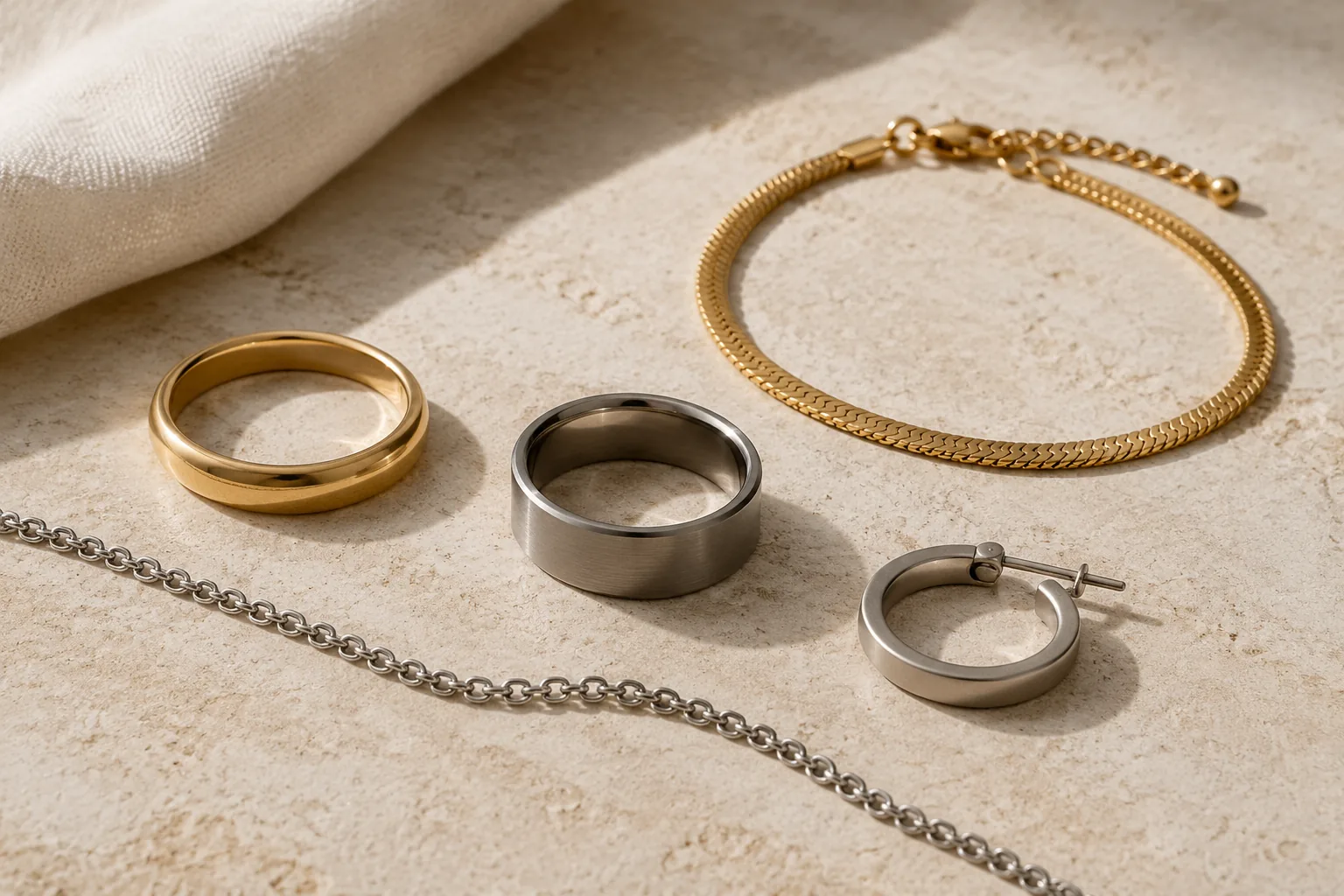
If you are deciding between solid gold, sterling silver, stainless steel, vermeil, and gold-plated brass, the real question is not which material is “best.” It is which one fits how you actually wear jewelry.
A piece that stays on through showers, workouts, and sleep needs different materials than a necklace you wear for dinners and weekends. Budget matters too, as does how much care you want to do later. Brand pages can help, but they do not tell the whole durability story on their own. Official disclosures describe what a brand says it uses; they do not prove universal wear results for every buyer or every product.
This guide turns those material labels into a practical buying framework for daily wear.
Start With How You Actually Wear Jewelry
Before comparing metals, start with the use case.
If you wear the same ring or chain most days, friction, moisture, sweat, perfume, and storage matter more than the logo on the product page. If you switch pieces often, you may care more about design and price than long-term maintenance. If you buy gifts, the question becomes lower regret: which material is easiest for the recipient to live with?
For everyday jewelry materials, the main decision points are usually:
- How often you will wear it
- Whether it will meet water, sweat, and perfume
- How much scratching, denting, tarnish, or plating wear you can tolerate
- Whether you want low maintenance or do not mind routine care
- Whether you want to avoid frequent replating or polishing
- Whether skin sensitivity is part of the decision
That framework matters because durability depends on construction, plating thickness, alloy mix, chemicals, humidity, and storage, not just on the broad material name.
Quick Comparison Table: Everyday Jewelry Materials
| Material | Daily-wear suitability | Tarnish risk | Plating wear risk | Care level | Best-fit buyer |
|---|---|---|---|---|---|
| Solid gold | High for frequent wear, depending on alloy and design | Low | None | Low to moderate | Buyer who wants a long-term daily piece and accepts higher upfront cost |
| Sterling silver | Good for regular wear, but care matters | Moderate | None | Moderate | Buyer who wants precious metal at a lower entry point and will store and clean pieces regularly |
| Rhodium-plated sterling silver | Good short term, but finish may change with wear | Moderate beneath the plating | Finish wear can happen over time | Moderate | Buyer who wants a brighter surface and accepts eventual maintenance |
| Stainless steel | Often practical for low-maintenance wear | Low | None | Low | Buyer who wants a sturdy, lower-maintenance everyday option |
| Titanium | Often practical for low-maintenance wear | Low | None | Low | Buyer who wants a light, corrosion-resistant option and simple care |
| Gold vermeil | Better than generic light plating for many buyers, but not maintenance-free | Low to moderate | Yes | Moderate | Buyer who wants the look of gold with a sterling-silver base and understands finish wear |
| Gold-plated brass | Often suited to trend, occasional, or budget-driven purchases | Low to moderate depending on finish | Yes | Moderate to high | Buyer who wants style variety and accepts shorter finish life |
| Other base-metal jewelry | Usually best for occasional wear unless the product disclosure says otherwise | Variable | Yes if plated | Variable | Buyer comparing price first and willing to check disclosures carefully |
This is a buying framework, not a lab test. A well-made piece can outperform a weak piece in the same material category, and a thin coating can wear faster than a thicker one even when the base metal is similar.
Solid Gold: Best for High-Frequency Wear, With Karat Tradeoffs
Solid gold means the metal itself is gold, not a thin gold layer over another base. For daily wear, that usually makes it appealing because there is no plating to wear through.
The tradeoff is karat. Higher-karat gold contains a greater proportion of gold and may be softer than lower-karat alloys. Lower-karat gold can be more practical for some pieces because alloy metals can change hardness, color, and wear behavior. The exact result depends on the alloy and the design.
For shoppers, the useful point is this: solid gold is usually the category to consider if you want a piece you can wear often with less concern about surface finish disappearing. Astrid & Miyu’s care guidance says 14k solid gold pieces are meant for all-day wear, which is a brand-specific statement, not a universal rule for every solid gold item in the market.
Sterling Silver: Precious, Wearable, and Care-Dependent
Sterling silver is a standard jewelry material and, in FTC guidance, 925 sterling silver means 92.5% silver. That makes it a useful middle ground for buyers who want a precious metal without moving into solid gold pricing.
For everyday wear, sterling silver is attractive because it is versatile and widely used. The practical catch is care. Silver can tarnish, especially when exposed to air, humidity, chemicals, or infrequent wear. If a piece is stored loosely in a humid bathroom or worn around products like perfume and lotion, it may need more attention.
Some brands add rhodium plating to sterling silver. Missoma says its sterling silver is rhodium plated, and that is worth reading as a surface treatment, not a guarantee of permanent behavior. Rhodium can help with appearance and surface protection, but the finish is still subject to wear over time.
Astrid & Miyu’s care guidance says sterling silver should avoid water, sweat, and perfumes, and it recommends airtight storage. That is a concrete example of how brand care instructions can be stricter than a broad “silver is fine” assumption.
For a buyer, sterling silver works best when you want a classic look and are willing to clean and store pieces properly.
Gold Vermeil vs Gold-Plated Brass
This is where a lot of beginner confusion starts.
Vermeil is not the same thing as generic gold plating. The FTC guides define vermeil as sterling silver coated on significant surfaces with gold, with a minimum gold thickness of 2.5 microns and at least 10-karat gold. Mejuri says its vermeil uses a thick layer of solid gold over sterling silver, 2.5 microns, and never brass. Missoma says its vermeil is 2.5 microns of 18k gold on sterling silver.
That matters because the base metal changes the buying picture. If the base is sterling silver, the piece is built on a precious-metal foundation. If the base is brass, the piece is a different category even if the top layer is gold-colored.
Missoma says its gold-plated pieces use brass as the base metal. Astrid & Miyu says sterling silver and plated brass should avoid water, sweat, and perfumes. That is a useful reminder that plated brass can be a valid choice, especially for trend-led or lower-budget purchases, but it is usually a more maintenance-sensitive choice than solid gold or sterling silver.
For buyers, the practical distinction is this:
- Vermeil is generally a stronger category than very light generic plating because the FTC definition and brand disclosures specify a thicker gold layer and sterling-silver base.
- Gold-plated brass can be reasonable for fashion-focused pieces, but the finish is more likely to be the part you are managing over time.
- Neither category should be treated as “bad.” They just suit different budgets and wear patterns.
Stainless Steel, Titanium, Brass, and Base Metals
Non-precious metals belong in the conversation because many shoppers want low-maintenance daily jewelry, not only precious metals.
Mejuri says its stainless steel is surgical-grade and hypoallergenic, and it says its titanium is implant-grade and corrosion-resistant. Those are brand claims, so they are useful for understanding what the brand intends to signal, not for making universal promises about every wearer.
The safest reading is that stainless steel and titanium often fit buyers who want sturdy, lower-maintenance jewelry. They are common choices when the goal is simple wear rather than frequent polishing or replating. Titanium also has a reputation for being light, which may matter in earrings and larger pieces.
Brass and other base metals are different. They can work well in fashion jewelry and can make design-led pieces more accessible. The downside is usually not the idea of brass itself; it is that the finish, coating, and wear conditions matter a lot more. A plated brass piece worn occasionally may be perfectly sensible. The same piece worn in water and sweat every day is a harder fit.
What Mejuri, Missoma, Astrid & Miyu, and Pandora Officially Say
The four brand pages in the research package do not use a single shared vocabulary.
Mejuri says its vermeil is 2.5 microns over sterling silver and never brass. It also says its titanium is implant-grade and corrosion-resistant, and its stainless steel is surgical-grade and hypoallergenic.
Missoma says its vermeil is 2.5 microns of 18k gold on sterling silver, its gold-plated pieces use brass as the base, its sterling silver is rhodium plated, and it recommends avoiding water, perfumes, and chemicals.
Astrid & Miyu says 14k solid gold pieces are meant for all-day wear, while sterling silver and plated brass should avoid water, sweat, and perfumes. It also recommends airtight storage.
Pandora’s public materials page emphasizes solid sterling silver and 14k or 18k gold, plus stones, pearls, glass, and other materials. The source set here does not support forcing Pandora into the same plated-brass or vermeil framing used by some demi-fine brands, so comparisons should stay faithful to what the brand actually says.
The main takeaway is not that one brand is right and another is wrong. It is that material terminology is not perfectly standardized at the marketing level. Readers need to look at the actual construction, not just the headline material name.
Skin Sensitivity and Nickel: Use Qualified Language
Nickel deserves a careful, limited explanation.
GOV.UK states that nickel exposure can cause skin irritation and allergic contact dermatitis. That is a factual basis for saying nickel is worth checking if you have reacted to jewelry before. It is not a basis for diagnosing the cause of someone’s symptoms, and it is not a reason to claim that any material is safe for all wearers.
That means the best language is qualified: some materials may be better tolerated by some wearers, and some product lines disclose nickel-free or nickel-aware construction more clearly than others. But if you have persistent irritation, stop wearing the piece and speak with a qualified clinician or dermatologist.
Mejuri’s stainless steel disclosure is an example of how brands may present materials to address sensitivity concerns. Still, brand wording should not be treated as a medical guarantee.
Labeling, Hallmarking, and Regional Rules
Material labels can be marketing language, but they can also carry legal meaning.
In the UK, precious metal items described as gold, silver, platinum, or palladium generally must be hallmarked. UK fineness guidance recognizes marks such as 925 sterling silver, 750 or 18ct gold, 585 or 14ct gold, and 375 or 9ct gold. That does not mean every product page will look the same as a US jewelry page.
In Canada, the Competition Bureau says precious-metals quality marks must be truthful and recognizes terms including gold plate, silver plate, sterling silver, 9K through 24K gold, and .925 silver. In the US, the FTC Jewelry Guides provide definitions that matter for vermeil and sterling silver.
The practical buying lesson is simple: do not assume all “gold” or “silver” language means the same thing across borders. If you are shopping internationally, check the seller’s country-specific labeling, hallmarking, and return information before you buy.
Buying Checklist Before You Choose a Material
Use this checklist when a product page is vague or when you are comparing pieces across brands.
- What is the base metal?
- Is the piece solid metal, plated, or layered?
- If it is vermeil, what is the base metal and gold thickness?
- If it is plated, what is the plating thickness and what metal is under it?
- Does the brand mention rhodium plating, and if so, on what material?
- Does the product page mention nickel, or only use broad sensitivity language?
- What does the care guidance say about water, sweat, perfume, lotions, and chemicals?
- Does the brand recommend airtight storage or another specific storage method?
- Are there gemstones, pearls, adhesives, or coatings that change the care routine?
- Does the seller offer repair, replating, or other support, and what are the limits?
These questions matter because a piece with stones, coatings, or mixed materials may need different care than a plain chain or plain band. Follow the brand or jeweler instructions for that specific item.
What Brand Material Pages Still Do Not Tell You
Brand material pages are useful, but they leave important gaps.
The research package does not include controlled durability testing comparing these materials under identical wear conditions. It also does not include live prices, warranties, repair services, replating terms, or full return policy details. In other words, you can see what a brand says its piece is made of, but not always how that piece behaves in every real-world setting.
There is also a terminology gap. Official pages often use different frameworks for similar buyer-facing categories, such as vermeil, gold-plated brass, rhodium-plated sterling silver, stainless steel, titanium, and solid gold. That makes direct comparison possible, but only if you translate the brand language carefully.
So the right question is not “Which material is universally best?” The better question is “Which material fits my wear pattern, upkeep tolerance, and budget, and what exactly is the seller promising about construction and care?”
Conclusion
For everyday jewelry materials, the best choice is the one that matches how you wear the piece.
Solid gold is the most straightforward option for frequent wear if you want to avoid plating concerns. Sterling silver is a strong middle option if you are comfortable with tarnish care and storage. Stainless steel and titanium fit lower-maintenance shoppers. Vermeil gives you a more structured gold-over-silver category than generic plating. Gold-plated brass can still make sense for trend pieces or gift buys, as long as you understand the finish may need more care.
The useful habit is to read material pages as construction disclosures, not as durability guarantees. Check the base metal, coating, care guidance, and regional labeling rules before you buy. That is the quickest way to turn a confusing material list into a practical decision.