



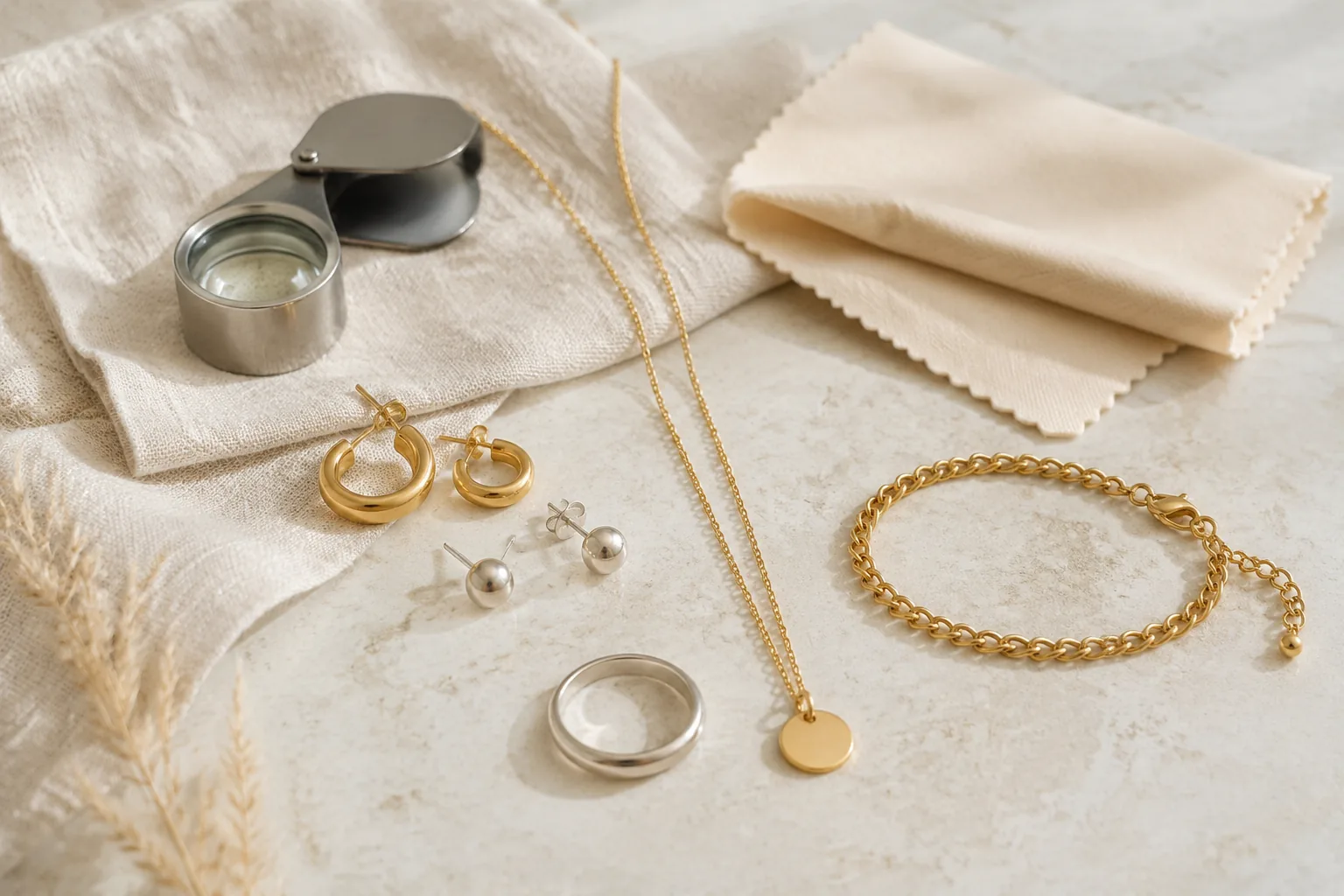
If your skin often reacts to earrings, necklaces, rings, or bracelets, the main question is not “Which metal is always safe?” It is “Which materials, construction details, and seller disclosures may reduce the odds of irritation for me?”
That distinction matters. In jewelry shopping, terms like hypoallergenic, stainless steel, sterling silver, vermeil, titanium, and gold-filled can sound reassuring, but they do not mean the same thing. None should be treated as a universal promise. Jewelry care recommendations also vary by material, treatment, and setting, so brand or jeweler instructions still matter for the specific piece you buy.
This guide stays in shopping territory: it helps you compare materials, read product listings more carefully, and decide when a reaction is a medical issue rather than a product-selection issue. It does not diagnose allergy or offer treatment advice.
What “Sensitive Skin” Means When You Shop for Jewelry
In a shopping context, “sensitive skin” is a practical shorthand, not a diagnosis. It usually means a wearer has noticed redness, itching, rash, stinging, darkening, or general discomfort after contact with certain jewelry. That experience may come from different causes, and the label alone does not tell you which one.
The important distinction is between ordinary irritation, suspected metal sensitivity, and a diagnosed allergy. Those are not interchangeable. Nickel is the best-known concern in this space, and official and medical sources note that jewelry is a common source of nickel exposure. ATSDR states that nickel exposure from jewelry can sensitize people and that later contact may cause rash or dermatitis in sensitized individuals. StatPearls also describes nickel allergy as allergic contact dermatitis and identifies jewelry as a common exposure source. Patch testing may be used in clinical evaluation of suspected nickel allergy.
That is why the shopping question should stay modest: what may be better tolerated by some wearers, not what is universally safe.
If reactions are persistent, severe, recurring, or spreading, shopping strategy is no longer the right frame. Consult a qualified clinician or dermatologist. This article is not medical advice.
Why “Hypoallergenic” Is Not a Guarantee
The word hypoallergenic is often used as a marketing signal, but it should be treated as a claim to evaluate, not a guarantee.
The U.S. FDA says there are no federal standards or definitions governing the use of the term hypoallergenic in cosmetics, and it also states that hypoallergenic, fragrance-free, and for sensitive skin are not federal standards in that context. Jewelry is not cosmetics, so those FDA pages are not jewelry regulations. Still, they are a useful reminder that reassuring language does not automatically have a strict legal meaning.
The FTC’s Jewelry Guides also matter because they address jewelry marketing claims and how those claims should avoid deception. In practical terms, a piece described as hypoallergenic should prompt you to ask: what exactly is being claimed, for which material, and with what evidence?
A careful way to read the term is this: a hypoallergenic label may suggest the seller believes the item is less likely to bother many wearers. It does not mean the item cannot cause irritation or allergy, and it should not be the only reason to buy.
Nickel: Focus on Release and Contact, Not Just the Metal List
Nickel is the metal most shoppers think about first, and that instinct is reasonable. But the useful question is not just whether nickel appears somewhere in the alloy list. It is how much nickel may be released at the skin surface, and under what conditions.
ATSDR explicitly notes that nickel content in an item is not the same thing as the amount of nickel released from that item. That matters because skin contact is what drives the shopping concern. UKHSA similarly states that jewelry, stainless steel, and coins can release trace nickel on skin contact, and the UK Health and Safety Executive links nickel with skin sensitization and dermatitis.
A good product description gives you enough information to judge likely contact risk. A weak description hides behind a material name without explaining the actual wearing surface.
For earrings, the issue is especially direct because posts and backs sit in or against pierced skin. For necklaces, bracelets, and rings, repeated friction, sweat, moisture, and clasp contact can matter even if the headline metal sounds reassuring.
How to Compare Common Jewelry Materials
There is no universal ranking that works for every wearer, but there is a practical way to compare materials: look at what the seller discloses, how much of the piece contacts skin, and whether the surface layer can wear away.
Stainless steel
Stainless steel is a family of alloys, not one fixed formula. That means the term alone does not tell you everything. UKHSA notes that stainless steel can release trace nickel on skin contact, so it should not be assumed to be nickel-free or automatically suitable for every nickel-sensitive wearer.
If a brand discloses a specific grade, that may help you compare products more precisely. Even then, the grade is not a guarantee. For sensitive-skin shopping, stainless steel is best treated as a material to evaluate, not a blanket answer.
Sterling silver
Sterling silver is usually understood as silver alloyed with other metals for strength. In shopping terms, that means the wearer is not only contacting silver. If you are highly reactive, the alloying metals, finish, and any plating or coating matter too.
Sterling silver can be a reasonable option for some people, but it should not be described as automatically safe for sensitive skin. Tarnish, polish wear, and contact with other components may change what touches the skin over time.
Vermeil
Vermeil is a gold layer over sterling silver. That construction can be useful because the wearer is starting with a precious-metal base and a gold surface, but the surface is still a surface. Once wear exposes what is underneath, the contact picture changes.
For vermeil, the key questions are coating durability, care instructions, and how the piece is used. A vermeil chain worn daily in heat and moisture is not the same thing as a low-friction occasional ring.
Plated jewelry
Plated jewelry is the broad category where a thin metal layer sits over another base metal. The practical issue is not the decorative top layer alone. It is what happens after that layer wears, scratches, or thins at high-friction points.
If a listing does not clearly explain the base metal, plating type, or maintenance expectations, that is a reason to pause. For irritation-conscious shoppers, plated jewelry may be fine in some cases, but it deserves more scrutiny than solid or more fully disclosed constructions.
Titanium
Titanium is often discussed in sensitive-skin conversations because it is associated with low reactivity in many jewelry discussions. That said, the supplied research does not establish a universal guarantee, and you should not read titanium as a promise that every wearer will tolerate every piece.
The useful question is still the same: what else is in the item, especially for earrings with posts, backs, or hidden hardware? A titanium headline does not erase construction details.
Gold-filled
Gold-filled jewelry is different from gold plating. In shopping terms, that difference matters because the gold layer is typically described differently from a thin plated surface, and the construction may affect wear. Even so, gold-filled is not an automatic answer for every sensitive-skin shopper.
Ask what the seller discloses about the core metal, contact parts, and care. The main value of gold-filled lies in how the piece is made, not in a universal skin-safety promise.
Using brand pages carefully
Official brand pages can help verify what a brand says about its own materials or care, but they do not prove that a piece is suitable for every sensitive wearer. Mejuri, Missoma, Astrid & Miyu, and Pandora each have official materials or care pages that are useful for confirming brand-specific descriptions. They are not evidence that any particular item is best for sensitive skin unless the brand explicitly makes and supports that claim.
Construction Details That Matter Beyond the Headline Metal
The most useful sensitive-skin check is often not the headline metal. It is the hidden hardware.
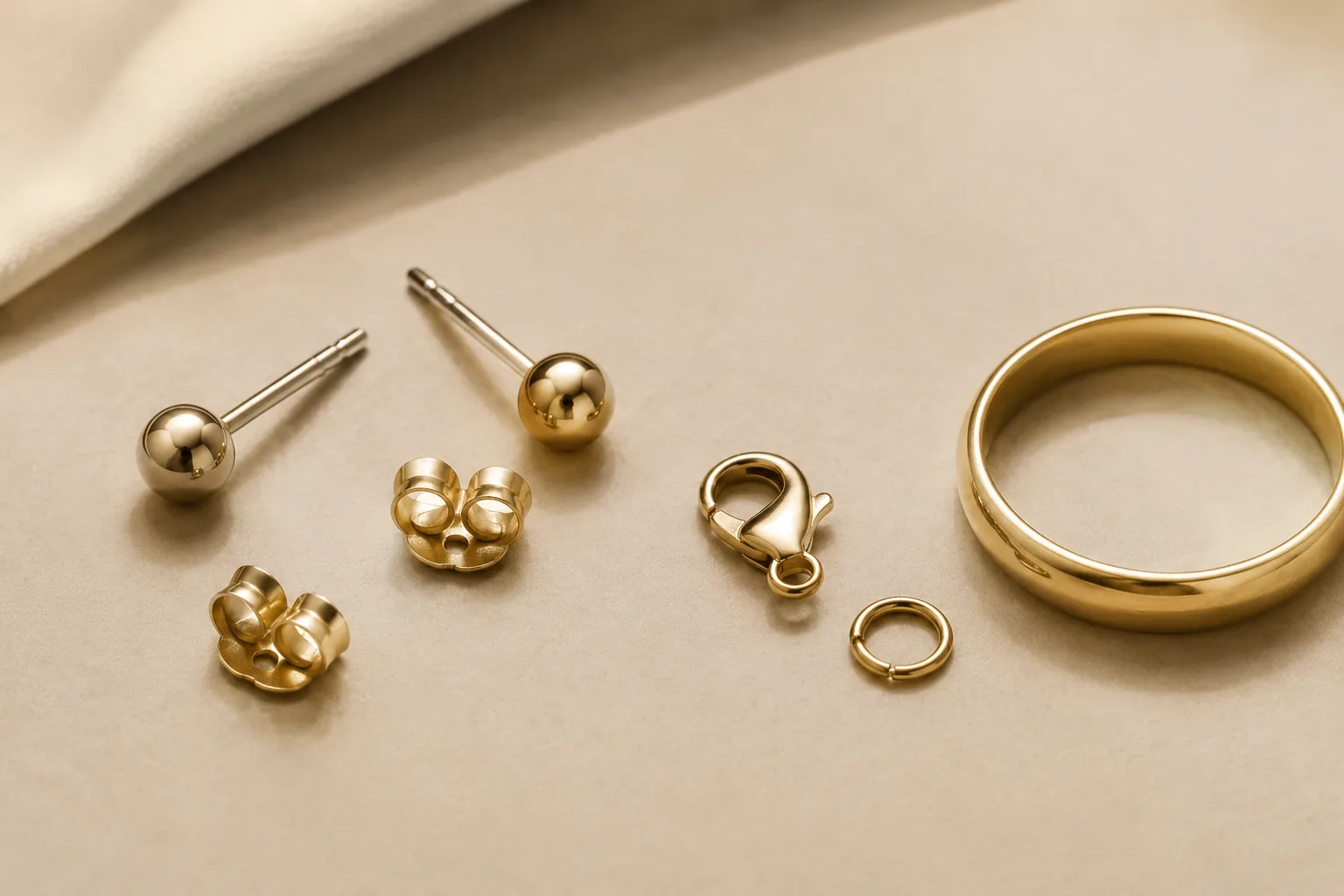
For earrings, look at posts, backs, solder points, and any decorative component that touches the ear. A comfortable front design can still be paired with a less suitable back. The same logic applies to hoops and huggies where the closure sits against skin for long periods.
For necklaces and bracelets, examine clasps, extender chains, jump rings, solder joints, and any tag or charm that may touch the skin. Areas where sweat, lotion, and friction accumulate deserve extra attention because coating wear can happen there first.
For rings, the interior surface matters. A ring that spins, traps moisture, or has a rough inner edge may feel more irritating even if the visible metal seems fine. Settings can matter too, especially where the inside of the band or the underside of a stone setting comes into contact with skin.
EU REACH also gives useful consumer-protection context here. It includes nickel release limits for post assemblies inserted into pierced ears and other pierced parts of the body, and it covers articles intended for direct and prolonged skin contact such as earrings, necklaces, bracelets, chains, rings, anklets, and watch components. It also includes a durability condition for coated articles in direct and prolonged contact with skin. That is not U.S. law, but it shows why hidden contact points and coating wear are not minor details.
What to Check for Earrings, Necklaces, Rings, and Bracelets
A category-by-category check is usually more useful than a single material rule.
Earrings
Earrings deserve the most careful review because pierced skin is involved. Ask what the post and backing are made of, whether the brand discloses the full metal composition, and whether any plating is on the skin-contact parts. If the listing only describes the visible front of the earring, the most relevant information may still be missing.
Necklaces
For necklaces, focus on the chain, clasp, extender, and pendant bail. A chain that feels fine at first may still cause issues if a clasp sits at the back of the neck all day or if plating wears where the chain rubs against clothing and skin.
Rings
For rings, consider the band interior, sizing, and how much the ring moves. A spinning ring can increase friction and concentrate moisture. If the ring has a stone setting, inspect the underside and any lower profile that touches the finger.
Bracelets
Bracelets often combine several contact points: clasp, links, charms, and wear at the wrist. Because wrists move constantly, plating wear and friction can become relevant sooner than a shopper expects.
How U.S., UK, and EU Nickel Rules Differ
Regulatory context is not the same as medical advice, and it is not the same as product quality.
The supplied research gives the clearest jewelry-specific regulatory evidence from the EU. REACH Annex XVII includes nickel release restrictions for post assemblies inserted into pierced ears and other pierced parts of the body. It also includes restrictions for articles intended to come into direct and prolonged skin contact, including earrings, necklaces, bracelets, chains, anklets, finger rings, wrist-watch cases, watch straps, rivet buttons, tighteners, rivets, zippers, and metal marks used in garments. It further includes a durability condition for coated articles that come into direct and prolonged contact with skin.
For the U.S., the supplied evidence supports a consumer-safety and advertising lens through FDA and FTC guidance, plus medical-context evidence from ATSDR and StatPearls. It does not establish a jewelry-specific federal nickel release limit in the same way the EU regulation does.
For the UK, UKHSA and HSE both support the basic point that nickel exposure from consumer products and jewelry can matter for sensitization and dermatitis, but the supplied research does not turn that into a universal purchase rule.
The safest summary is simple: do not assume U.S., UK, and EU rules are identical. Check current seller policies and local regulations before purchase, especially if you are buying across borders.
A Pre-Purchase Checklist for Irritation-Conscious Shoppers
Use this checklist before you buy:
- Read the full material description, not just the headline metal.
- Look for disclosure of posts, backs, clasps, chains, solder, and other skin-contact parts.
- Treat
hypoallergenicas a marketing claim, not a guarantee. - Ask whether plating, coating, or vermeil is likely to wear at the contact points.
- Prefer pieces where the seller explains the base metal and finish clearly.
- For earrings, confirm what touches pierced skin directly.
- For rings and bracelets, inspect areas exposed to friction, moisture, and movement.
- Check care instructions and follow the jeweler’s guidance for the specific piece.
- Review return terms before purchase, especially for items you are buying to test tolerance.
- If your reactions are persistent or severe, stop treating the issue as a shopping problem and speak with a qualified clinician or dermatologist.
Brand pages can help you verify what a company says about its own materials. That is useful, but limited. It does not replace product-level disclosure, and it does not prove skin compatibility for every wearer.
FAQ
Is stainless steel safe for sensitive skin?
Sometimes it may be better tolerated by some wearers, but it should not be treated as universally safe. UKHSA notes that stainless steel can release trace nickel on skin contact, so the material name alone is not enough.
Does “hypoallergenic” mean a piece cannot cause a reaction?
No. The term should be treated as a claim to investigate, not a guarantee. The FDA does not treat hypoallergenic as a federal standard in cosmetics, and jewelry marketing should still be read carefully under FTC guidance.
Are plated, vermeil, sterling silver, titanium, or gold-filled pieces better choices?
Any of them may be reasonable depending on the exact construction and your own tolerance, but none is automatically safe for all sensitive-skin shoppers. The base metal, coating wear, and skin-contact hardware matter.
Is nickel the main metal to look out for?
It is one of the most important ones to check, especially if you have reacted before. But the more precise issue is nickel release at the skin surface, not just whether nickel appears somewhere in the alloy description.
When should a jewelry reaction be treated as a medical issue rather than a shopping issue?
If the reaction is persistent, severe, recurring, or spreading, stop using the piece and consult a qualified clinician or dermatologist. This guide is for shopping decisions, not diagnosis or treatment.
Conclusion
For sensitive-skin jewelry shopping, the best approach is cautious and specific. Do not buy on the strength of one reassuring word. Read the full materials disclosure, inspect the parts that actually touch skin, and treat hypoallergenic as a claim to verify rather than a promise to trust.
Nickel remains an important concern, but nickel content alone is not the whole story. Release, contact time, coating wear, and hidden hardware often matter more in practice. EU REACH provides a clear example of why those details count, while U.S. and UK sources reinforce the broader point that jewelry can contribute to sensitization or dermatitis in some wearers.
Use brand materials pages to confirm what a company says about its own products, but keep the final decision grounded in your own tolerance, the piece’s construction, and the seller’s disclosure. When reactions are ongoing or serious, the right next step is medical, not commercial.