



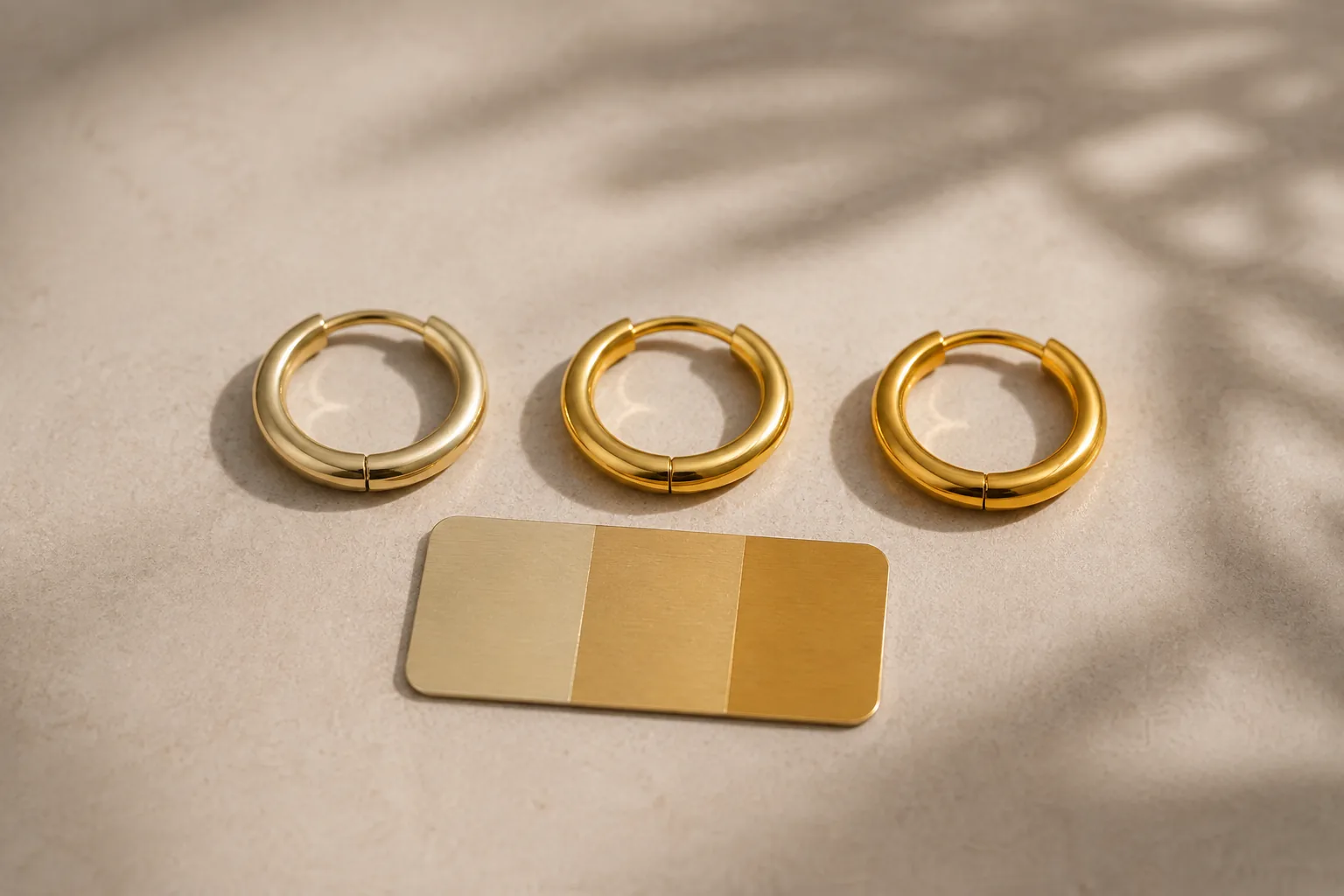
Choosing between 9K, 14K, and 18K gold jewelry is not just a question of which number sounds more luxurious. Karat affects gold content, alloy content, color, cost, and how a piece may fit into daily life. It also affects how you should read brand descriptions, because “18K gold” can refer to solid gold in one context and a surface layer in another.
The practical answer is this: 9K can be a sensible lower-cost solid-gold option where it is sold and properly disclosed; 14K is often the easiest middle ground for everyday jewelry; and 18K is best for buyers who want higher gold content and a richer gold look, while accepting the cost and wear tradeoffs. None of these choices is automatically right for everyone.
This guide explains what 9K, 14K, and 18K mean, how to compare them by jewelry type, and how to avoid confusing solid gold with 18K gold vermeil or gold plating.
Quick Answer: Which Gold Karat Should You Choose?
If you want a simple starting point for 9K 14K 18K gold jewelry, use the piece’s job as your first filter.
Choose 9K gold if you want solid gold at a lower entry point, you are shopping in a market where 9K is recognized and clearly disclosed, and you are comfortable with a less gold-rich alloy.
Choose 14K gold if you want the most practical default for many daily pieces: rings, studs, hoops, simple chains, bracelets, and pieces you plan to wear often. This is an editorial recommendation, not a laboratory test result. It is supported by the way some brands position their materials: Mejuri describes 14K gold as chosen for everyday durability and says it has superior strength compared with 18K and 22K.
Choose 18K gold if your priority is higher gold content and a richer gold tone, especially for pieces worn less roughly, such as earrings, pendants, special-occasion jewelry, or heirloom-minded gifts.
A useful rule: pick 14K when you are unsure, move down to 9K when budget matters more than gold richness, and move up to 18K when color and gold content matter more than cost or maximum everyday resilience.
For a deeper purity breakdown across common karats, see our guide to what 10K, 14K, 18K, and 9K gold numbers mean.
What 9K, 14K, and 18K Actually Mean
Gold karat is a purity framework. It tells you how much of the alloy is gold, out of 24 parts. Pure gold is 24K, while lower karats mix gold with other metals. Those other metals can affect color, hardness, strength, and price.
| Karat | Gold-content position | Alloy-content position |
|---|---|---|
| 9K | Lowest gold content of the three | Highest alloy content of the three |
| 14K | Middle gold content | Middle alloy content |
| 18K | Highest gold content of the three | Lowest alloy content of the three |
Lower Karat Does Not Mean Fake Gold
A lower karat means the piece contains less gold and more alloy. It does not automatically mean the piece is fake. In markets where 9K gold is recognized and sold as gold, it can be a legitimate solid-gold category. The more useful question is whether the seller clearly discloses the karat and whether the item is solid gold rather than plated.
A karat stamp also does not tell you the full alloy recipe. Unless a brand gives item-level metal details, you usually do not know the exact blend of other metals. If you have known metal sensitivities, treat the karat as one clue, not a medical safety guarantee.
Alloy Content Is Part of the Design
Gold is malleable. Alloying makes gold more durable and can change its color. That is why lower-karat gold is not simply “lesser” in every practical sense: it may be less gold-rich, but the alloy mix is part of how jewelers create yellow, rose, and white gold, and part of how they manage wearability.
This is also why two pieces with the same karat can feel different in use. Chain thickness, clasp design, hollow versus solid forms, ring profile, prong structure, stone setting, and wearer habits all matter.
Comparison Table: 9K vs 14K vs 18K Gold Jewelry
Use this table as a buyer’s shortcut. The durability notes are practical guidance based on gold content, alloy logic, and brand material disclosures, not independent wear testing.
| Factor | 9K gold | 14K gold | 18K gold |
|---|---|---|---|
| Gold content | Lower | Middle | Higher |
| Alloy content | Higher | Middle | Lower than 9K or 14K |
| Color expectation | Usually more muted than higher-karat gold, depending on alloy | Balanced yellow-gold look in many modern brands | Richer, more saturated gold tone |
| Practical durability logic | More alloy-heavy, often chosen for cost-conscious solid gold | Strong everyday middle ground for many buyers | More gold-rich, but not automatically best for rough daily wear |
| Typical buyer fit | Lower-cost solid gold, simple everyday pieces, gifts with budget limits | Daily rings, hoops, studs, chains, bracelets, repeat-wear jewelry | Higher-gold-content gifts, occasional pieces, pendants, earrings, richer color preference |
| Main caveat | Check that it is recognized and clearly disclosed where you are buying | Still can scratch, dent, or bend depending on design | Higher cost; softness and wear tradeoffs matter by piece |
Missoma says its solid yellow gold pieces are 9K or 14K solid gold, while Astrid & Miyu says its 14K and 9K solid gold pieces are designed to be worn all day, every day, while still needing care. Those disclosures support a practical point: many contemporary brands use 9K and 14K solid gold for everyday categories, not only for occasional jewelry.
That does not mean a 9K chain is always stronger than an 18K chain, or that a 14K ring cannot scratch. Construction still matters.
Is 9K Real Gold?
Yes, 9K can be real gold in markets where it is recognized and properly described. The important nuance is jurisdiction. A buyer should not assume that every market uses identical rules for what may be called gold.
The better buyer question is not “Is 9K fake?” but “Is this seller accurately disclosing 9K solid gold in a market where that description is allowed?”
What to Check on a 9K Listing
Look for clear language such as “9K solid gold” rather than vague gold-tone wording. Also check whether the product page distinguishes solid gold from gold vermeil, gold plating, or gold-plated brass.
If the product is described only as “gold” in a collection title, read the material section before treating it as solid gold. A yellow finish is not enough information.
What Not to Generalize
Do not assume that one country’s marking or labeling system applies everywhere. Brand disclosures, product-page details, and local rules all matter. For buyers, the takeaway is simple: use karat as a material fact, then check the seller’s disclosure and marking context.
Is 18K Always Better Than 14K or 9K?
No. 18K is more gold-rich than 14K or 9K, but “more gold” is not the same as “better for every piece.”
18K is attractive if you want a richer gold color, higher precious-metal content, or a more traditional fine-jewelry feel. It can be a strong choice for earrings, pendants, occasional rings, sentimental gifts, and pieces where color matters more than cost control.
But 18K is not automatically the most practical option for every daily ring or bracelet. Mejuri’s material page says its 14K yellow and white gold is chosen for everyday durability and has superior strength compared with 18K and 22K. That is a brand disclosure rather than independent lab testing, but it reflects a common buying logic: higher gold content can mean a more gold-rich piece, while a slightly lower karat can be positioned for everyday strength.
The right question is not “Which karat is best?” It is “Which karat fits this jewelry type, my budget, my color preference, and my wear habits?”
Why 14K Is Often the Practical Middle Ground
For many buyers, 14K is the safest default choice because it balances meaningful gold content with everyday practicality. It is more gold-rich than 9K, but less gold-rich and often less costly than 18K.
This makes 14K especially useful when you want one piece to do many jobs: a ring you wear most days, hoops that do not feel too precious to reach for, a pendant chain that can handle regular rotation, or a bracelet that will see more knocks than a necklace.
What Brand Disclosures Support
Mejuri explicitly positions 14K gold for everyday durability. Missoma says its solid yellow gold pieces are 9K or 14K solid gold. Monica Vinader’s material pages group products by material, including gold vermeil, sterling silver, and 14K solid gold categories. Astrid & Miyu lists products with material labels including 14K recycled gold and 18K gold plated, and says 14K and 9K solid gold pieces are designed to be worn all day, every day, while still needing care.
Together, those disclosures show that 14K is widely used in contemporary everyday jewelry ranges. They do not prove that every 14K item is more durable than every 18K item, because construction and alloy recipe still matter.
Who Should Still Choose 9K or 18K Instead
Choose 9K instead if you are prioritizing a lower solid-gold price point and the seller’s disclosure is clear. It may be especially practical for simple earrings, uncomplicated bands, or gifts where solid gold matters but 14K stretches the budget.
Choose 18K instead if you want richer gold color and higher gold content, and the piece is less exposed to hard wear. For some buyers, the visual warmth and material richness of 18K are worth the tradeoff.
Solid Gold vs 18K Gold Vermeil vs Gold Plating
This is where many buyers get tripped up. “18K” can describe the karat of solid gold, but it can also describe the karat of a surface layer used in gold vermeil or gold plating. Those are not the same thing.
Solid 18K gold means the gold alloy runs throughout the piece. Gold vermeil and gold plating use a gold layer over another base metal. The surface may be 18K gold, but the item is not solid 18K gold.
What Brand Material Pages Disclose
Mejuri describes its 18K gold vermeil as a gold layer over sterling silver, not brass, designed to mirror the warm tone of 14K gold. Missoma describes 18K gold vermeil as sterling silver electroplated with gold. Monica Vinader describes its 18ct gold vermeil as a layer of 18ct gold on recycled silver.
Those descriptions are useful because they separate vermeil from solid gold. The gold layer has an 18K identity, but the core material is silver. For more on this distinction, see our guide to what to look for when buying gold vermeil jewelry.
How Gold Plating Differs
Missoma distinguishes 18K gold plating on brass from vermeil and says plated jewelry is more affordable but less durable than vermeil. Astrid & Miyu separately advises sterling silver and plated brass owners to avoid water, sweat, and perfumes, and says plated jewelry should be last on and first off.
That does not mean plating is always a bad purchase. It means it serves a different purpose. Plated jewelry can make sense for trend-led pieces, occasional wear, or lower-cost styling experiments. But it should not be priced or evaluated like solid gold.
For a closer comparison, read Gold Vermeil vs Gold Plated: What the Base Metal Changes.
How to Choose by Jewelry Type
A gold karat decision becomes easier when you match the metal to the object. A tiny pendant does not face the same stress as a ring shank. Stud earrings do not experience the same impact as a bracelet clasp.
Rings
For everyday rings, 14K is often the practical default. Rings take more contact than most jewelry: keyboards, bags, gym equipment, sinks, handles, and accidental knocks. A higher-karat ring may still be appropriate, especially for a design you wear carefully, but 18K should not be chosen only because it sounds more premium.
9K can also make sense for simpler bands or lower-cost solid-gold rings, especially in markets where it is common. Before buying, check whether the ring is solid gold, vermeil, or plated, and whether resizing is possible. Some vermeil or plated rings may not be suitable for the same long-term expectations as solid gold.
Earrings
Earrings are often easier candidates for 18K because they usually receive less abrasion than rings and bracelets. If richer color is your priority, 18K studs, small hoops, or drops can be a good fit. 14K remains a strong everyday option, especially for pieces worn frequently.
For piercing jewelry, be more cautious with material disclosures. Karat alone does not tell you the full alloy recipe or whether a piece may be tolerated by a specific wearer. If you are comparing materials for piercings, our guide to buying piercing jewelry across titanium, solid gold, and plated metals covers the material checks in more detail.
Necklaces
Necklaces depend heavily on chain construction. A delicate 18K chain may feel beautiful but should be treated differently from a sturdier 14K chain. Pendants are often safer places to choose 18K if you want richer color, because the pendant may receive less mechanical stress than a ring or bracelet.
For everyday layering, 14K is a useful balance. If your budget is limited and the seller is clear, 9K can also work for simple chains or charms. Vermeil and plated necklaces can be good styling choices, but they need more care around moisture, sweat, perfume, and friction. Styling can also affect wear, especially when chains rub against each other; see our guide to layering necklaces for everyday wear for more on building a practical stack.
Bracelets
Bracelets usually face more wear than necklaces because they move against desks, sleeves, bags, and hard surfaces. For daily bracelets, 14K is often the practical starting point. 9K may work for lower-cost solid-gold bracelets, depending on construction. 18K can be lovely, but buyers should be realistic about knocks and abrasion.
If the bracelet is vermeil or plated, treat it as a different category. The surface layer can wear over time, and the reviewed sources do not provide enough evidence to predict a precise lifespan.
Gifts
For gifts, 14K is often the lowest-regret option when budget allows because it communicates fine-jewelry value without forcing the recipient into especially delicate wear habits. 9K can be a smart choice where solid gold matters and budget is tighter. 18K is a stronger choice when the gift is meant to feel more elevated, color-rich, or sentimental.
When buying a gift, prioritize clear material language over impressive-sounding karat language. “18K gold plated” and “solid 18K gold” are very different gifts.
What to Check Before Buying
Before you buy, slow down and verify the material description. A short checklist can prevent most karat confusion.
First, confirm whether the piece is solid gold, gold vermeil, gold plated, or sterling silver. If the page says 18K but also says vermeil, plated, or layered over silver or brass, it is not solid 18K gold.
Second, check the karat. For solid gold, look for terms such as 9K, 14K, or 18K. If the wording is vague, do not assume the piece is solid gold.
Third, read the brand’s material page and the specific product page. Brand-level pages can explain categories, but they may not give every item-level alloy detail.
Fourth, look for care instructions. Missoma advises cleaning jewelry with a soft dry cloth and avoiding water, perfumes, and chemicals. Astrid & Miyu gives different care guidance for solid gold, sterling silver, and plated brass, which is a reminder that care depends on the material category.
Fifth, consider what is missing. If nickel content, full alloy recipe, coating thickness, repair policy, or replating options matter to you, look for product-specific answers before purchasing.
Care Expectations and Limits
Care advice should follow the material, not just the color. Yellow metal jewelry may be solid gold, gold vermeil, gold plated brass, gold plated silver, or another gold-tone material. These categories do not age the same way.
Astrid & Miyu says 14K and 9K solid gold pieces are designed to be worn all day, every day, while still needing care. That last phrase matters. Solid gold is not indestructible. It can still scratch, dent, bend, collect residue, or be affected by design weaknesses.
Missoma advises cleaning jewelry with a soft dry cloth and avoiding water, perfumes, and chemicals. Astrid & Miyu separately advises sterling silver and plated brass owners to avoid water, sweat, and perfumes, with plated jewelry last on and first off. That distinction is important: vermeil and plating involve a surface layer, so friction and exposure habits can matter more than they do for solid gold.
Avoid universal cleaning rules. A plain solid-gold band, a vermeil chain, a pearl pendant, and a stone-set plated ring should not all be treated the same way. When in doubt, follow the brand’s care instructions for that exact item and be especially cautious with plated finishes, vermeil, delicate settings, pearls, opals, and treated stones.
Evidence Gaps and Buyer Caveats
The reviewed sources are useful, but they do not answer every buyer question.
They do not provide complete item-level alloy recipes for every 9K, 14K, or 18K product. That means you usually cannot know the exact mix of other metals unless the product page says so.
They do not prove that one karat will always outperform another in scratch resistance, denting, bending, clasp strength, or chain breakage. Brand claims about everyday wear are useful shopping signals, but they are not the same as independent laboratory durability testing.
They do not provide real-time price comparisons. Gold prices and brand pricing can change, and the value question depends on weight, construction, design, labor, stones, finish, warranty, repair options, and return terms.
They do not let us predict the lifespan of vermeil or plating with precision. Thickness, base metal, wearer habits, friction, water exposure, perfumes, sweat, storage, and replating options all matter. A brand’s coating description is helpful, but it is not a guaranteed wear timeline.
Finally, none of these sources supports a universal hypoallergenic claim for 9K, 14K, or 18K gold. Some wearers may tolerate certain alloys better than others, but nickel content and individual sensitivity cannot be assumed from karat alone.
Conclusion: The Best Karat Is the One That Fits the Job
9K, 14K, and 18K gold jewelry each has a legitimate place. 9K is not automatically fake; it is a lower-gold, higher-alloy option recognized in some markets. 18K is more gold-rich and often more color-saturated, but it is not automatically better for every daily-wear piece. 14K is often the most practical middle ground for buyers who want solid gold, everyday usability, and a balanced budget.
The smartest buying decision starts with material clarity. Confirm whether the piece is solid gold, vermeil, or plated. Check the karat. Read the product page, not just the collection name. Treat legal marking and labeling rules as jurisdiction-specific. Then match the karat to the jewelry type and how often the piece will be worn.
For most everyday buyers, 14K is the easiest default. For lower-cost solid gold, consider 9K where it is clearly disclosed and appropriate. For richer gold content and color, choose 18K with realistic expectations about cost, care, and wear.
Related Guides
- 10k, 14k, 18k, and 9k Gold: What the Karat Numbers Mean
- What to Look for When Buying Gold Vermeil Jewelry: Replating, Storage, and Wear Limits
- Gold Vermeil vs Gold Plated: What the Base Metal Changes
- What to Look for When Buying Piercing Jewelry: Titanium, Solid Gold, and Plated Metals

2 Comments
Pingback: Astrid & Miyu Welded Jewelry: What 9K Gold Means
Pingback: Missoma Metals Explained: Vermeil, Silver, Gold