



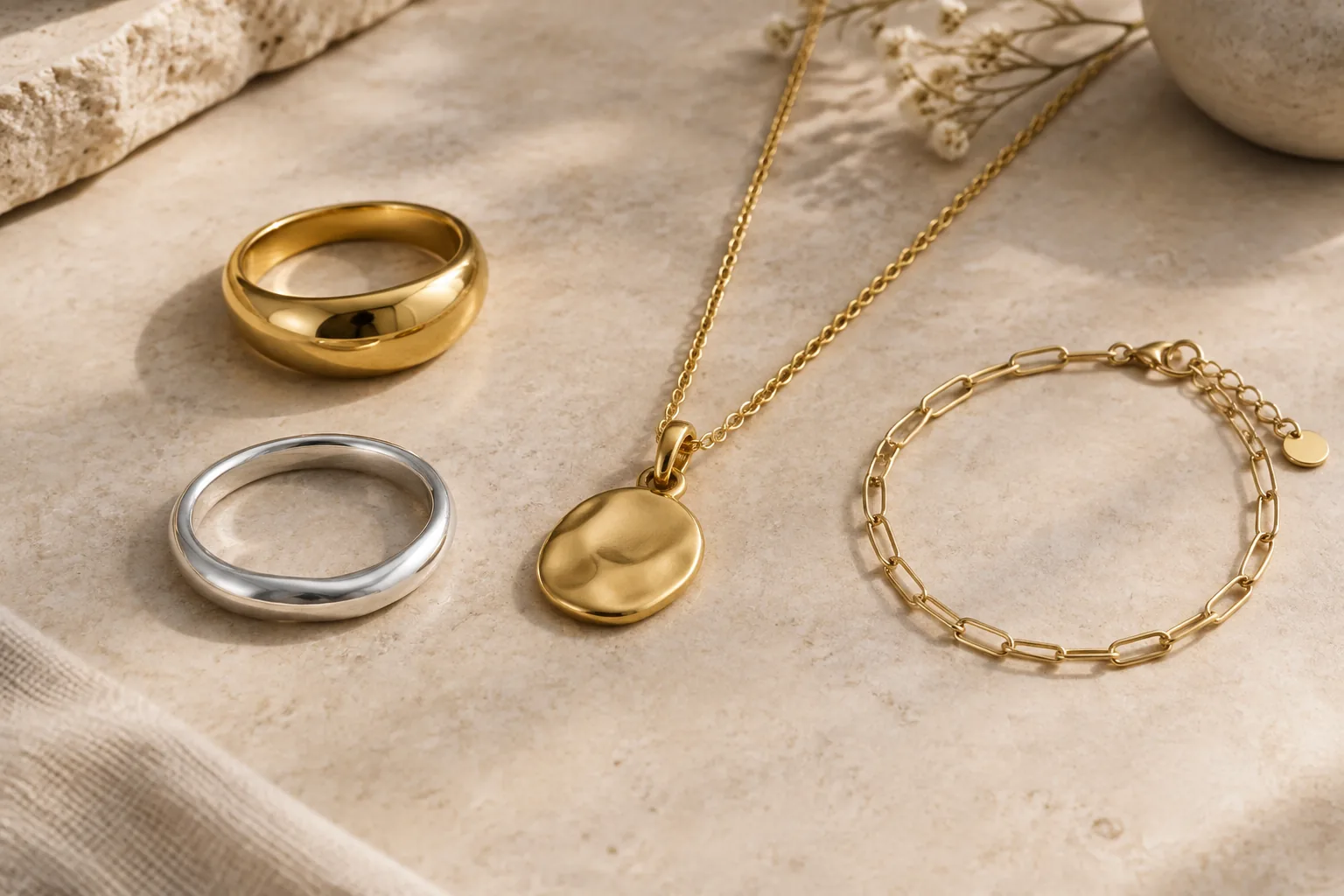
Missoma’s official Our Metals page is the best starting point for reading the brand’s material language, but the terminology still needs unpacking. Gold vermeil, gold plating, sterling silver, rhodium plating, and solid gold all sound close enough to blur together, especially when product titles and short descriptions compress several material details into one line.
For U.S. shoppers, the FTC’s Buying Platinum, Gold, and Silver Jewelry page and the federal jewelry guides in the eCFR help frame how these terms are supposed to work. The practical question is not just what a piece looks like, but what sits underneath the surface finish.
Missoma’s Metal Hierarchy
Missoma’s metals are easiest to understand as a ladder.
At the top are the solid gold pieces. Missoma describes solid yellow gold as “forever pieces” made from 9K or 14K solid gold, and says its solid white gold is made from 9K or 14K solid gold and 100% certified recycled solid gold. Below that sit the demi-fine and plated categories:
- 18K gold vermeil
- sterling silver
- 18K gold plated
- silver plated
- 316L stainless steel
- mixed metals
That order matters because it tells you what is structural and what is surface treatment. Solid gold is the entire piece. Vermeil, plating, and silver plating are finish systems applied to another base metal. Mixed metals is not a single construction standard; it is a styling category in Missoma’s catalog language.
If you want a broader karat primer while reading the brand’s product pages, How to Choose Between 9K, 14K, and 18K Gold Jewelry and 10k, 14k, 18k, and 9k Gold: What the Karat Numbers Mean are useful companion guides.
How to read the labels
The cleanest way to parse a Missoma product page is to separate three layers of information: the named metal, the base metal, and the finish. Product titles often emphasize the first layer, while the technical details hide the other two. That is why a quick scan can make vermeil, plating, and solid gold look more interchangeable than they are.
A careful read also helps when a product page uses several descriptors in one place. If the wording is crowded, the safest reference point is the metals page rather than the color name or the hero title alone.
What 18K Gold Vermeil Means at Missoma
Missoma describes 18K gold vermeil as its signature demi-fine gold-plating technique. In plain language, that means a sterling silver base with 2.5 microns of solid gold on top. The thickness matters. It is the detail that separates vermeil from thinner or looser gold-plated language.
That distinction also lines up with broader U.S. guidance. FTC and jewelry-guide language generally treats vermeil as a sterling silver base with a minimum gold thickness standard on the significant surfaces. The useful point for a buyer is not memorizing the regulatory wording. It is knowing that “vermeil” is meant to say something specific about both the base metal and the finish layer.
Why the base metal matters
Vermeil is not just “gold-colored silver.” It is a silver core with a heavier gold layer than ordinary plating. That gives it a different structure from brass-based plating, even when the surface color looks similar in a product photo.
That does not make vermeil permanent. It is still a finish on top of another metal. But it does make the material stack more substantial than vague gold-tone labeling, and it gives the buyer a clearer expectation of what the piece is made from.
Why the wording can feel repetitive
Missoma’s catalog language can be dense, especially when recycled-metal wording is added to the material description. A phrase like “18k Recycled Gold Vermeil on Recycled Sterling Silver” is long, but the core message remains straightforward: the piece is vermeil, the base is sterling silver, and the gold layer is the visible finish.
The practical takeaway is to read the construction, not just the headline. If a page says vermeil, confirm that the base metal is sterling silver and that the finish is identified clearly. For a broader comparison, Gold Vermeil vs Gold Plated: What the Base Metal Changes and What to Look for When Buying Gold Vermeil Jewelry: Replating, Storage, and Wear Limits are the most relevant references.
Gold Plating Versus Vermeil
Missoma’s standard 18K gold plated jewelry is different from vermeil because the base metal changes. The metals page says the plated pieces are 18K gold over brass, with 2 microns on rings, pendant necklaces, and bracelets, and 1 micron on earrings.
Base metal first, finish second
The most important difference is not the shade of gold. It is what the gold sits on. Vermeil uses sterling silver; standard gold plating uses brass. That difference matters because it changes the construction, even when the visual effect feels close at first glance.
This is why gold vermeil and gold-plated jewelry should not be treated as equivalent categories. They can sit in the same style family, but they are not built the same way.
What to check before buying
Missoma does not present plated jewelry as solid gold, and the metals page does not try to promise a lifespan. That is the right level of caution. Surface finishes can be a good fit for style-led buying, but they should be read as surface finishes.
The same logic applies to silver-plated pieces. Missoma notes that silver plating may tarnish as the silver layer reacts with air and moisture. That is not a defect statement; it is a reminder that plated surfaces and solid metal age differently and should be evaluated on different terms.
Sterling Silver and Rhodium Plating
Missoma defines sterling silver as 92.5% pure silver and 7.5% copper, rhodium plated for durability and high shine, and stamped 925. That is a standard sterling-silver explanation, but the rhodium detail matters because it changes the look and the care expectations.
What 925 tells you
“925” is the usual sterling-silver marker. It means the alloy is mostly silver, with copper added for strength. Missoma’s use of that stamp fits the conventional definition and signals that the piece belongs in the sterling-silver category rather than in a plated imitation category.
If you want a fuller primer on the material itself, A Beginner’s Guide to 925 Sterling Silver Jewelry is the most direct companion guide.
Why rhodium is part of the story
Rhodium plating is a surface finish added to sterling silver. In Missoma’s materials language, it is associated with durability and a brighter sheen. That means the visible appearance of a silver piece is not just about the silver alloy itself. The top layer also shapes how the piece looks and wears.
For shoppers, the key point is to check the full product description rather than assume every silver item uses the same finish. If the exact wording matters to you, the metals page should be treated as the main reference, and the product page should be checked for the final specification.
Missoma’s Solid Gold Options
Solid gold sits at the top of Missoma’s hierarchy. The brand uses both 9K and 14K wording across the official metals page and product-level labels, which is enough to identify the category but not enough to turn one karat into a universal answer for every buyer.
9K and 14K at Missoma
Missoma says its solid yellow gold is handcrafted from 9K or 14K solid gold. It also says its solid white gold is made from 9K or 14K solid gold and is 100% certified recycled solid gold. Those are the central facts the metals page gives you.
Product-level wording follows the same pattern. Some pieces are labeled 9K solid gold, while others use 14CT or 14K solid gold language. The difference in notation is a labeling issue, not a separate material class.
How to read the karat labels
The karat number tells you how the gold content is balanced within the alloy. Missoma does not use the metals page to rank 9K and 14K for you, and that is reasonable. The better approach is to read the karat as a material signal, then weigh it against how you plan to wear the piece and how much you value solid construction over a surface finish.
If you are comparing gold-karat options more broadly, How to Choose Between 9K, 14K, and 18K Gold Jewelry is the most useful buying guide, while Recycled, Repurposed, and Certified Recycled Metals in Jewelry: What the Words Mean helps decode the recycled-metal language.
What Missoma Does Not Fully Spell Out
Missoma’s metals page is useful, but it does not answer every practical question a buyer might ask.
It does not identify the exact brass alloy used for plated pieces. It does not state whether a nickel barrier layer is used under vermeil or plating. It does not specify rhodium thickness or confirm that rhodium is applied in exactly the same way across every sterling-silver style. It also does not give wear-life estimates or replating guidance by category.
That gap matters because similar-looking pieces are not always built the same way. Two gold-toned items can sit in different material families, and two silver-looking items can rely on different finishes. Missoma’s own page helps separate the categories, but the product page still needs a close read before you treat any label as final.
The broader lesson is simple: read the metals page for the hierarchy, then read the individual product page for the exact build. That is the cleanest way to avoid assuming that all gold-toned jewelry is vermeil or that every silver piece is the same under the surface.
Conclusion
Missoma’s metals are easiest to understand as a structure ladder. Solid gold sits at the top, followed by 18K gold vermeil, sterling silver, 18K gold plated, silver plated, stainless steel, and mixed metals. The main buying difference is usually the base metal under the finish: sterling silver for vermeil, brass for standard plating, and solid gold when the whole piece is made from a gold alloy.
The practical takeaway is to read beyond color. Use the official metals page first, then verify the product page when the wording is crowded or inconsistent. That is the most reliable way to keep vermeil, plating, silver, rhodium, and solid gold in separate buckets instead of treating them as the same thing with different labels.
Related Guides
- Gold Vermeil vs Gold Plated: What the Base Metal Changes
- A Beginner’s Guide to 925 Sterling Silver Jewelry
- What to Look for When Buying Gold Vermeil Jewelry: Replating, Storage, and Wear Limits
- Recycled, Repurposed, and Certified Recycled Metals in Jewelry: What the Words Mean