




When a jewelry page says a ring is made with recycled gold, repurposed precious metals, or certified recycled silver, the real question is not whether the phrase sounds responsible. It is whether the claim is specific enough to help you make a buying decision.
A useful recycled-metal claim should tell you what metal is being discussed, how much of it is recycled, whether the wording applies to the exact product or only to the brand generally, what components are included, and whether any independent certification or chain-of-custody system is named. Without those details, sustainability language can still be interesting, but it should not be treated as proof of complete traceability, ethical certainty, or reduced mining impact.
This guide explains the practical meaning of recycled metals in jewelry, how recycled differs from repurposed, reclaimed, vintage, estate, and upcycled language, and how to read brand claims from Brilliant Earth, Monica Vinader, Missoma, Mejuri, Astrid & Miyu, and Pandora without giving broader meaning to the evidence than it supports.
Start With the Claim You Are Being Asked to Trust
Before comparing brands, look at the exact sentence in front of you. A product page that says “this necklace is made with 100% recycled sterling silver, excluding the clasp” is a different kind of claim from a brand page that says “we use recycled metals.”
The U.S. Federal Trade Commission’s Green Guides summary says broad environmental benefit claims should be qualified to avoid deception, and recycled-content claims should be qualified when a product or package is only partly made from recycled material. That guidance is U.S.-focused, not universal legal advice, but it gives shoppers a practical reading rule: broad claims need boundaries.
For jewelry, those boundaries matter because a single piece can include a main metal body, solder, posts, chains, clasps, jump rings, peg heads, plating layers, coatings, stones, adhesives, and packaging. A recycled-metal statement may apply to all, some, or only one of those elements.
The strongest wording is product-level, dated, and specific. The weakest wording is broad brand language that sounds values-led but does not say which item, metal, percentage, or component scope it covers.
What Recycled Metals in Jewelry Usually Means
In plain language, recycled metals in jewelry generally means metal recovered from a previous use or diverted from a waste stream, then returned to production. The FTC Green Guides summary describes recycled-content claims in terms of materials recovered or diverted from the waste stream either during manufacturing or after consumer use.
That definition can include different sources depending on the claim or standard being used. Some recycled metal may come from manufacturing scrap. Some may come from post-consumer sources. Some claims may be verified under a certification system; others may be brand statements without a named certifier.
Recycled silver should still be silver when properly described as silver, and recycled gold should still be gold alloy when properly described as gold. However, this article is not using the provided evidence to make a technical metallurgy claim about whether a specific recycled alloy has identical purity, durability, or appearance to newly mined metal of the same description. For those details, shoppers should look for the metal standard, karat, fineness, hallmarking information where relevant, and the seller’s material description.
Recycled, Repurposed, Reclaimed, Vintage, Estate, and Upcycled Are Not the Same
These terms often appear near each other, but they do not mean the same thing.
Recycled metal usually refers to recovered metal that has been returned to the material supply chain. It may have been refined, recast, or otherwise processed before becoming new jewelry.
Repurposed metal can be a brand-specific term. Brilliant Earth’s official 2025 Mission Report uses “repurposed precious metals” terminology and reports repurposed gold and repurposed silver figures for fine jewelry collections. Those are Brilliant Earth’s own claims from its official report, not independent proof of environmental impact.
Reclaimed metal is often used similarly to recovered or reused material, but shoppers should still ask what the seller means. The word alone does not identify percentage, component scope, or verification.
Vintage jewelry usually means an existing older piece. Estate jewelry generally means previously owned jewelry, which may or may not be old enough to be described as vintage. A vintage ring is not automatically a recycled-metal ring; it may simply be an existing ring being resold.
Upcycled jewelry usually suggests redesigning, reworking, or reusing existing components. It may involve old chains, charms, stones, or settings, but upcycled is not the same as certified recycled metal content unless the seller provides that specific evidence.
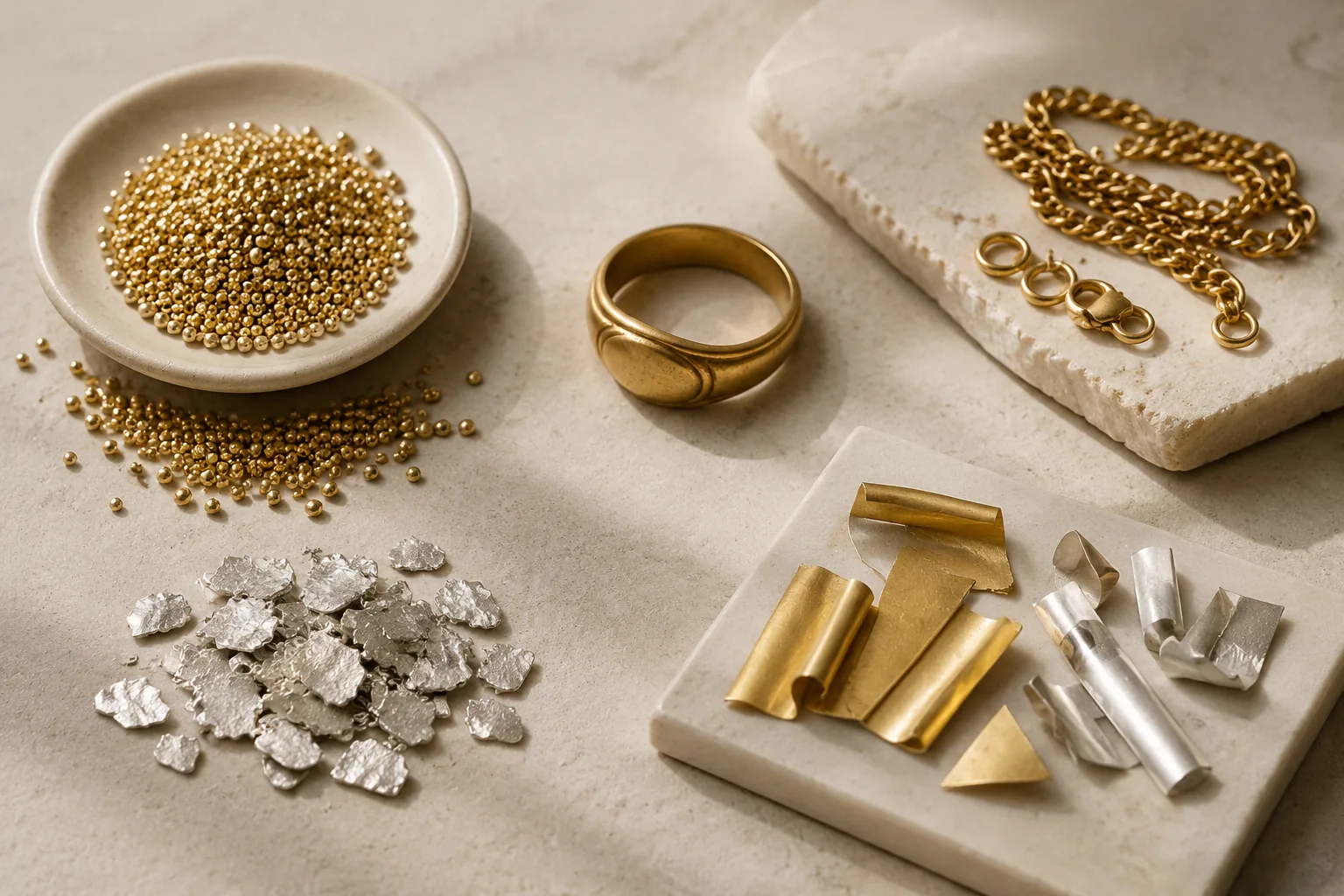
Broad Brand Claim vs Product-Level Recycled-Metal Claim
A broad brand claim can be useful context, but it is not the same as a product-level claim. “We use recycled metals” does not automatically mean every ring, chain, clasp, earring post, plating layer, and finding is recycled.
A stronger claim usually answers these questions:
| Question | Why It Matters |
|---|---|
| Which metal? | “Recycled metals” is less precise than “recycled sterling silver” or “recycled 14k gold.” |
| What percentage? | A partial claim should be qualified rather than implying total coverage. |
| Which product? | Brand-wide claims may not apply to every item. |
| Which components? | Chains, clasps, posts, peg heads, solder, and plating layers may be excluded. |
| Is there certification? | “Certified recycled” should point to a named standard, body, or certificate scope. |
| When was it checked? | Materials claims, sourcing programs, and certificates can change. |
A precise claim does not automatically prove a product is “ethical” or “sustainable” overall. It simply gives the shopper a clearer basis for evaluating one part of the jewelry’s sourcing story.
What Certified Recycled Can Mean
“Certified recycled” should not be treated as a magic phrase. It should point to an identifiable standard, certification body, chain-of-custody system, audit, or certificate scope.
The Responsible Jewellery Council describes its Chain of Custody standard as a chain-of-custody standard for precious metals in the jewelry and watch supply chain. It is relevant context when reading claims about gold, silver, and platinum-group metals, but a brand should not be described as RJC Chain of Custody certified unless a current source says that exact thing and identifies the scope.
The SCS Recycled Content Standard is also relevant context for third-party recycled-content certification. However, shoppers and publishers should verify the specific certificate scope before applying an SCS-related claim to any brand or product.
The practical test is simple: if a seller says “certified recycled,” look for the certifier, the standard, the certificate holder, the metals covered, the product or facility scope, and the date. If those details are missing, the word “certified” is incomplete for shopping purposes.
The Wording Differences That Matter
Small wording changes can change what a claim appears to cover.
| Wording | What to Ask |
|---|---|
| “Made with recycled gold” | Is all the gold recycled, or only some of it? What karat and components are included? |
| “100% recycled gold” | Does 100% apply to the gold content only, the whole item, or selected components? |
| “Uses recycled metals” | Which metals, which products, and what percentage? |
| “Recycled sterling silver” | Does this apply to the entire silver component, and are findings included? |
| “Recycled brass” | Is the base metal recycled, and is there plating over it? |
| “Recycled precious metals” | Which precious metals are included: gold, silver, platinum-group metals, or something narrower? |
| “Certified recycled gold and silver” | Which certification body, certificate scope, and date support the claim? |
The FTC Green Guides summary says recycled-content claims should be made for materials recovered or diverted from the waste stream, and partial recycled-content claims should be qualified. UK-facing shoppers should also be aware that the UK government has guidance on environmental claims about products and services, including the Green Claims Campaign. Those sources are jurisdiction-specific guidance, not a single global rulebook.
Plated, Vermeil, Gold-Filled, Rhodium-Plated, PVD, and Silver-Plated Pieces Need Extra Questions
Layered jewelry needs especially careful reading because the visible surface may not be the same material as the underlying structure.
Gold vermeil usually refers to a layer of gold over sterling silver, while gold-plated jewelry may use a different base metal. Gold-filled jewelry has a bonded gold layer over a base, but it is still not the same format as solid gold. Rhodium-plated and silver-plated pieces also involve surface layers. PVD, or physical vapor deposition, is a coating process used on some jewelry formats.
The brand sources in the research package show why this matters. Missoma’s official metals page describes formats including solid gold, white gold, vermeil, sterling silver, plated brass, silver-plated brass, stainless steel, and PVD. Mejuri’s materials page distinguishes formats including 14k gold, 10k gold, sterling silver, vermeil, titanium, and platinum. Astrid & Miyu’s jewellery care page distinguishes 14k gold, 9k welded jewelry, silver-based plated pieces, and plated brass. Pandora’s U.S. jewelry materials page describes sterling silver, 14k gold, 18k gold, stones, and links to corporate materials information.
For plated, vermeil, gold-filled, rhodium-plated, PVD, or silver-plated jewelry, ask whether the recycled claim applies to the base metal, the precious-metal layer, the entire item, or selected components. Recycled solid gold should not be treated as equivalent to recycled gold plating or vermeil because solid gold is gold alloy throughout, while plating and vermeil are layered formats.
How the Listed Brands Phrase Their Metal Claims
The table below uses official brand sources only to summarize what each brand says or what the cited page does and does not support. These official pages verify brand wording; they do not independently prove environmental impact, full traceability, or ethical certainty.
| Brand | Official Source | Exact Term or Claim Reported | Metals or Formats Mentioned | Certification or Audit Named If Stated | Date Checked | Key Limitation |
|---|---|---|---|---|---|---|
| Brilliant Earth | Mission Report 2025 | Uses “repurposed precious metals” terminology and reports repurposed gold and repurposed silver figures for fine jewelry collections | Repurposed gold and repurposed silver in fine jewelry collections | Not applied here unless the report states a specific certification scope | 2026-07-30 | The report includes component exclusions or limitations for some chains, peg heads, posts, clasps, and some components, so coverage should not be assumed for every part |
| Monica Vinader | About | Claims 100% recycled gold and sterling silver | Recycled gold, sterling silver; also mentions Product Passport traceability, repairs, recycling scheme, and recyclable packaging | No certification body is identified in the provided facts | 2026-07-30 | The cited page does not fully break down the claim by solid gold, vermeil, findings, or component scope |
| Missoma | Our Metals | Claims pieces are made with 100% certified recycled gold and silver | Solid gold, white gold, vermeil, sterling silver, plated brass, silver-plated brass, stainless steel, and PVD | The provided facts say the page does not clearly name the certification body | 2026-07-30 | “Certified” should be checked against a named certifier and certificate scope before relying on it |
| Mejuri | Materials | Gives product-material percentages including 14k gold at 90% recycled and 10% newly mined, sterling silver at 95% recycled and 5% newly mined, and platinum made with 100% recycled materials with 95% platinum and 5% cobalt | 14k gold, 10k gold, sterling silver, vermeil, titanium, platinum | The crawled page did not show a certification or audit body for the recycled-metal percentages | 2026-07-30 | Percentages are useful, but shoppers should still check product scope, component coverage, and whether any audit applies |
| Astrid & Miyu | Jewellery Care | Claims 14k gold is 100% recycled and that 70% of its jewelry is made from recycled metals | 14k gold, 9k welded jewelry, silver-based plated pieces, plated brass | No certification body is identified in the provided facts | 2026-07-30 | The 70% recycled-metals claim does not identify which individual products are included unless a product page states it |
| Pandora | Jewelry Materials | The cited U.S. jewelry materials page describes materials but did not substantiate recycled silver or recycled gold wording in the research package | Sterling silver, 14k gold, 18k gold, stones, links to corporate materials information | Not substantiated by the cited U.S. materials page | 2026-07-30 | Do not import recycled silver or recycled gold claims from elsewhere without citing the relevant official Pandora source |
What Recycled-Metal Claims Can and Cannot Prove
Precise recycled-content language can help shoppers understand a piece’s material sourcing. It may show that a brand is using recovered or diverted metal rather than describing all metal as newly mined. It may also make a product claim easier to compare across brands.
But a recycled-metal claim cannot prove everything a shopper might care about. It does not, by itself, prove that a piece is completely sustainable, completely ethical, conflict-free in every sense, fully traceable to old jewelry, or guaranteed to directly reduce newly mined metal demand. It also does not automatically cover every component unless the source says so.
Environmental marketing guidance is jurisdiction-specific. The FTC Green Guides are U.S. guidance. UK government environmental-claims resources and the Green Claims Campaign are UK-facing guidance. They are useful for understanding the need for clear, substantiated claims, but this article is not legal advice for any country.
Shopper Checklist Before You Rely on a Recycled-Metal Claim
Use this checklist before giving a recycled-metal phrase much weight in your decision:
| Check | What You Want to See |
|---|---|
| Exact metal | Gold, silver, platinum, brass, stainless steel, or another metal named clearly |
| Percentage | A number such as 90%, 95%, or 100%, with context for what the percentage applies to |
| Product scope | The exact item or collection, not only a general brand statement |
| Component scope | Whether chains, clasps, posts, peg heads, solder, findings, plating layers, coatings, and base metals are included or excluded |
| Jewelry format | Whether the item is solid gold, sterling silver, vermeil, gold-filled, plated, PVD-coated, or another layered format |
| Certification | A named standard, certification body, chain-of-custody system, or certificate scope if “certified” is used |
| Date | When the claim or certificate was current |
| Source type | Whether the claim comes from a brand page, sustainability report, product page, or independent certification record |
| Limits | Any exclusions, unclear wording, or missing details that affect how much confidence you should place in the claim |
If a claim cannot answer most of these questions, it may still be a useful signal of brand priorities, but it is not strong enough to carry a values-led purchase decision on its own.
FAQ: Recycled Metals in Jewelry
Is Recycled Gold Lower Quality?
The provided research does not support a broad quality claim either way. For shopping purposes, look for the gold karat, alloy description, construction, finish, and product-specific details. Do not assume “recycled” means lower quality, but do not rely on the recycled claim alone to judge durability or value.
Is Recycled Silver Real Silver?
When a product is properly described as recycled sterling silver or recycled silver, the claim is about silver content that has been recovered and returned to use. Shoppers should still check the exact silver description, component scope, and whether the recycled percentage applies to the whole piece or only part of it.
Does Recycled Metal Mean the Jewelry Is Vintage?
No. Recycled metal usually refers to material returned to the supply chain, while vintage or estate jewelry refers to an existing piece being resold or reused. A newly made ring can use recycled metal, and an older estate ring may not be described with any recycled-content certification.
Can Plated Jewelry Be Made With Recycled Metal?
Yes, a plated or vermeil piece can include recycled metal in some part of its construction, but the claim needs detail. Ask whether the recycled content applies to the base metal, the surface layer, the whole item, or selected components.
What Does Certified Recycled Mean?
It should mean the recycled-content claim is connected to an identifiable certification, standard, chain-of-custody system, or certificate scope. Relevant context includes systems such as RJC Chain of Custody and SCS Recycled Content Standard, but a brand should not be described as certified under either unless a current source states that exact certification and scope.
When a Brand Says It Uses Recycled Metals, Does That Cover Every Product?
Not necessarily. A brand-wide claim is less specific than a product-level claim. Look for the metal, percentage, product scope, component exclusions, certification body, and date before assuming a claim applies to the exact piece you are considering.
Conclusion: Treat Recycled-Metal Language as a Starting Point
Recycled metals in jewelry can be meaningful, but the wording has to be precise. “Recycled,” “repurposed,” “certified recycled,” “vintage,” “estate,” and “upcycled” point to different ideas, and none of them automatically proves complete sustainability, ethical certainty, full traceability, or coverage of every component.
The best shopper habit is to slow down at the exact claim. A strong recycled-metal statement names the metal, percentage, product, component scope, certification or audit if applicable, and date. A broad brand statement can still be worth noting, but it should not be treated as proof beyond what the official source actually says.