



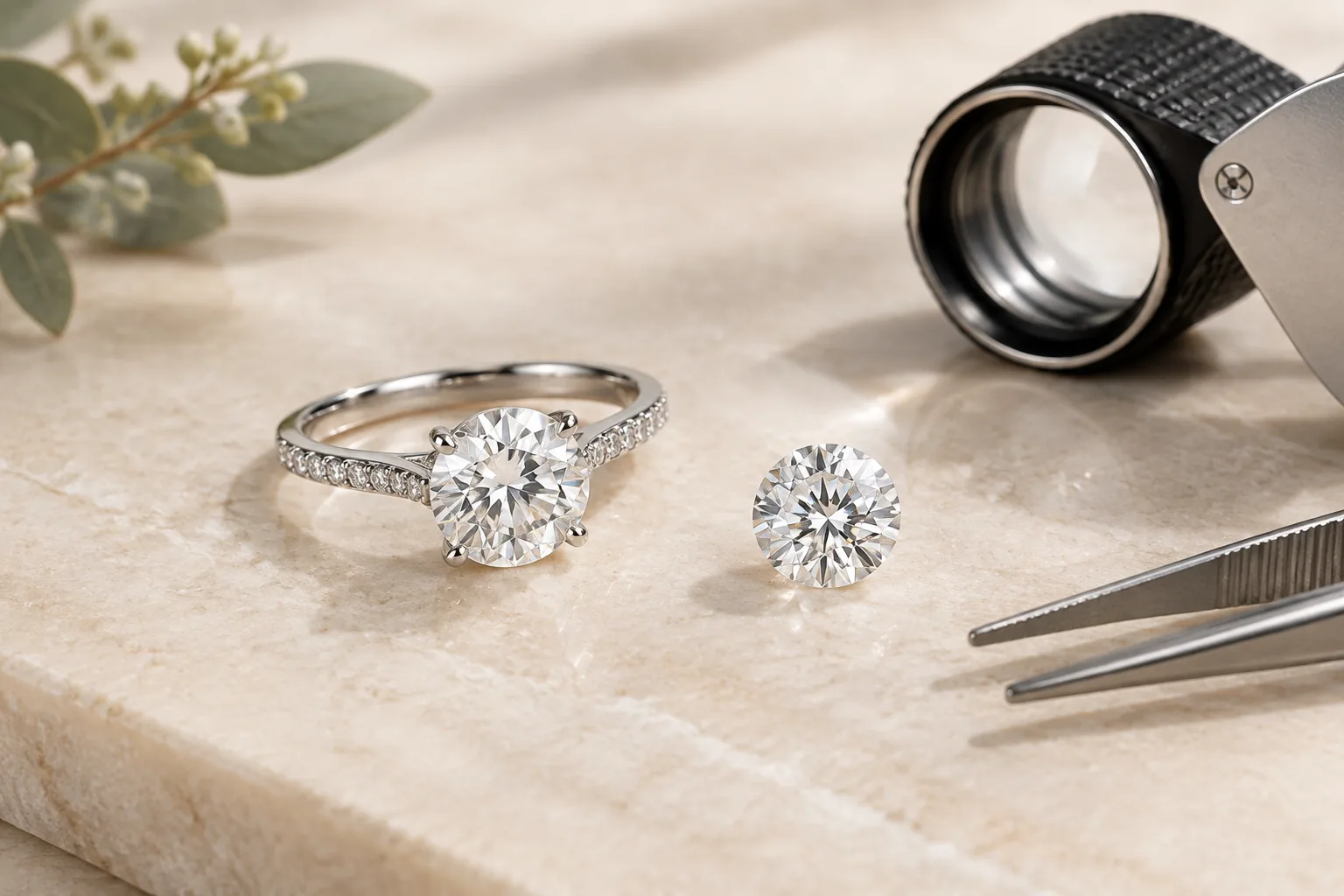
When comparing Pandora vs Brilliant Earth lab grown diamonds, the most important difference is not simply which brand uses the phrase “lab-grown.” Both brands describe diamonds made in a controlled environment rather than extracted from a mine, but they emphasize different parts of the buying story.
Pandora focuses on its lab-grown diamond production method, its stated renewable-energy claim, the 4Cs, and accessible jewelry categories such as rings, earrings, necklaces, and bracelets. Brilliant Earth places more emphasis on its mission-report framework, supplier standards, audits, energy-related metrics, and named collections.
Those statements can help explain each brand’s approach, but they should not automatically be treated as equivalent product-level evidence. A renewable-energy statement may cover one production stage, while a sourcing or certification statement may refer to a collection, supplier group, or company policy rather than one specific diamond.
This comparison separates:
- What Pandora says about its lab-grown diamonds
- What Brilliant Earth says in its 2025 Mission Report
- What independent gemological and regulatory sources explain about diamond identity and disclosure
- Why the brands’ energy claims cannot be ranked directly from the available wording
- What to verify before buying everyday jewelry, an engagement ring, or a custom diamond piece
Pandora 如何解释实验室培育钻石
Pandora’s official Pandora Lab-Grown Diamonds collection page describes these stones as diamonds made by humans rather than obtained through mining. Pandora states that it uses chemical vapor deposition, or CVD, to grow the diamond rough.
The same page also presents the stones through familiar diamond-buying language: the 4Cs—cut, color, clarity, and carat. It shows lab-grown diamond jewelry across categories including rings, earrings, necklaces, and bracelets.
These points are useful for understanding Pandora’s product positioning. They are also brand statements, so the exact product page still matters when a buyer wants to confirm the specifications of an individual piece.
Pandora’s CVD explanation
CVD is a recognized laboratory diamond growth method. The method itself does not mean that a stone is a simulant or imitation. It refers to how the diamond is grown.
The Gemological Institute of America’s explanation of HPHT and CVD growth describes CVD as a process in which carbon-containing gas is placed in a low-pressure environment. Plasma helps carbon deposit onto a diamond seed, allowing the crystal to grow in layers.
That process is different from the geological formation of a natural diamond. However, the distinction is about origin and growth history, not a claim that a CVD stone is made from a different basic material.
Pandora’s renewable-energy wording
Pandora’s specified collection page states that its diamond rough is grown using 100% renewable energy. The wording is important because it refers to the growth of the diamond rough.
Based on the available source, it does not establish that every stage from growth through cutting, polishing, transport, jewelry manufacturing, packaging, and delivery uses renewable energy. It also does not, by itself, explain the relevant suppliers, facilities, accounting method, or whether the claim applies equally to every product available in every market.
The most accurate reading is therefore narrow: Pandora makes a renewable-energy claim about the growth stage of its diamond rough.
Pandora’s 4Cs and jewelry categories
Pandora presents its lab-grown diamonds using the 4Cs framework and displays several jewelry formats. This may be particularly relevant for shoppers seeking a pendant, earrings, bracelet, or everyday ring rather than a traditional engagement-ring purchase.
Still, a 4Cs reference should not be confused with an independent grading report. The specified Pandora page does not establish whether every listed stone is accompanied by a report from GIA, IGI, or another independent grading laboratory. Buyers should check the individual product listing and any documentation supplied with the specific item.
Brilliant Earth 2025 Mission Report 说了什么
Brilliant Earth’s 2025 Mission Report approaches lab-grown diamonds through several connected topics: the relationship between lab-grown and natural diamonds, supplier conduct, workplace audits, energy use, and named collections.
The report states that lab-grown diamonds and natural diamonds have the same chemical, optical, and physical properties, with differences in their origin and the controlled environments in which they grow. This general scientific point is also consistent with GIA’s independent explanation, discussed below.
Properties and origin
Brilliant Earth’s report distinguishes the stone’s material properties from its origin. A lab-grown diamond is not described as a different gemstone simply because it was grown in a laboratory. Instead, the difference is whether the diamond formed through a natural geological process or a controlled manufacturing process.
That distinction matters when reading product descriptions. “Lab-grown diamond” identifies the diamond’s origin. It does not automatically identify the stone’s cut quality, color, clarity, carat weight, treatment history, grading laboratory, energy profile, or supply-chain documentation.
Supplier standards and audits
The report states that new lab-grown diamond suppliers and manufacturers must undergo compliance evaluation against Brilliant Earth’s Supplier Code of Conduct. It also states that 87% of existing lab-grown diamond manufacturers had undergone audits for safe working conditions.
This provides information about Brilliant Earth’s stated supplier-governance framework. It does not mean that every stone has an identical audit record, that every supplier has the same result, or that the report functions as a consumer-auditable file for an individual diamond.
For a buyer, the practical question is whether a particular product can be connected to a specific supplier, manufacturer, audit record, or other supporting document. The mission report alone does not establish that level of product-specific traceability.
Energy-related metric and collections
Brilliant Earth’s report states that 32% of its lab-grown diamonds used renewable energy, renewable-energy certificates, or SCS Sustainably Rated Certification during the cutting and polishing stages.
The report also identifies three lab-grown diamond-related categories:
- Capture Collection
- Renewable Collection
- Sustainably Rated Collection
The report assigns different carbon, energy, or certification explanations to these collections. That makes the collection label relevant, but a collection name should not be treated as a complete life-cycle environmental assessment unless the brand provides that evidence for the specific item.
Brilliant Earth’s official lab-grown diamond jewelry page lists rings, earrings, necklaces, and bracelets. As with Pandora, the product category does not answer every question about the individual diamond’s report, origin documentation, energy coverage, or after-sale terms.
实验室培育钻石、天然钻石与模拟钻石的区别
Before comparing brand claims, it helps to separate three terms that are often confused in product searches: natural diamond, laboratory-grown diamond, and diamond simulant.
Lab-grown and natural diamonds
According to GIA’s guide to the difference between natural and laboratory-grown diamonds, natural and laboratory-grown diamonds have essentially the same chemical, physical, and optical properties.
The important difference is origin:
- A natural diamond forms through geological processes.
- A laboratory-grown diamond is produced in a controlled environment.
- The growth method may be CVD or HPHT.
- The origin should be disclosed clearly in product advertising and documentation.
This means visual appearance alone may not reliably establish whether a diamond is natural or laboratory-grown. GIA notes that identifying the origin may require specialized instruments or laboratory examination.
What CVD means
CVD is a growth process, not a grading category. It does not tell you the diamond’s cut grade, clarity grade, color grade, carat weight, or retail value.
A CVD diamond may still require careful review of:
- Its reported 4Cs
- Any treatments or post-growth processing
- The grading laboratory
- The report number
- Whether the report identifies it as laboratory-grown
- Whether a laser inscription appears on the girdle, if documented
A buyer should therefore avoid treating “CVD” as shorthand for either superior or inferior quality. It explains the manufacturing route, not the complete quality profile.
Lab-grown diamonds and simulants
GIA distinguishes laboratory-grown diamonds from simulants such as moissanite and cubic zirconia. Simulants can resemble diamond visually, but they are not diamond in the same sense and should not be described as laboratory-grown diamonds.
The GIA guide to simulants, moissanite, and lab-grown diamonds explains this distinction and notes that professional instruments or laboratory testing may be needed to identify a stone’s nature and origin.
U.S. shoppers should also understand the disclosure principle summarized by the Federal Trade Commission’s diamond advertising guidance: terms such as laboratory-grown, laboratory-created, simulated, or imitation should be used clearly so consumers are not led to believe that a non-mined or imitation product is a mined diamond.
Pandora 与 Brilliant Earth 的声明能否直接比较
Not directly. The available statements use different scopes, production stages, and evidence categories.
The energy claims cover different stages
Pandora’s statement concerns the growth of its diamond rough using 100% renewable energy. Brilliant Earth’s 32% figure concerns renewable energy, renewable-energy certificates, or SCS Sustainably Rated Certification during cutting and polishing.
In simplified form:
| Brand | Published emphasis | Stage or scope described |
|---|---|---|
| Pandora | 100% renewable energy | Growth of diamond rough |
| Brilliant Earth | 32% using renewable energy, RECs, or SCS certification | Cutting and polishing |
| Both | Brand-level sustainability or sourcing context | Requires product-level clarification |
Because the stages differ, the figures do not answer the same question. Pandora’s percentage and Brilliant Earth’s percentage cannot be placed on one scale to declare an overall environmental winner.
The available information also does not provide a comparable, independent life-cycle assessment for the two brands’ lab-grown diamonds. It does not establish a complete comparison covering electricity sources, manufacturing facilities, cutting, polishing, transport, setting, packaging, and end-of-life considerations.
Environmental wording needs careful reading
The FTC’s Green Guides summary states that environmental marketing claims need reliable support and should avoid broad, unqualified implications of environmental superiority.
That does not mean a brand’s renewable-energy statement is automatically invalid. It means the reader should ask what the statement covers and what evidence supports it.
For either brand, useful follow-up questions include:
- Does the claim cover diamond growth, cutting, polishing, or all three?
- Does it include transport and jewelry manufacturing?
- Does it rely on renewable electricity, RECs, carbon offsets, or certification?
- Does it apply to all products or only a named collection?
- Can the claim be connected to the specific diamond or finished jewelry item?
Until those questions are answered, the responsible conclusion is that the brands use different disclosure frameworks—not that one has been proven categorically more sustainable.
认证、来源与透明度:应核对什么
Brand pages and mission reports provide context, but the lowest-regret buying process moves from company-level language to the exact product.
Confirm the stone identity
The product should clearly identify the stone as a laboratory-grown diamond. Do not assume that a listing for “diamond jewelry” rules out moissanite, cubic zirconia, simulated diamond, or another gemstone.
For an individual diamond, look for:
- A clear laboratory-grown designation
- The stated shape and carat weight
- Color and clarity information
- Cut information where applicable
- Treatment disclosure, if relevant
- A report or certificate reference, if supplied
The term “certified” can be ambiguous in marketing copy. It may refer to a brand’s description, a product specification, or an independent grading document. Ask what exactly is being certified and by whom.
Check the independent grading report
For an engagement ring or a larger center stone, ask whether the diamond has an independent grading report. If it does, verify:
- The laboratory name
- The report number
- The laboratory-grown disclosure
- The reported 4Cs
- Any comments about treatments
- Whether the report number matches the product and paperwork
- Whether a girdle inscription is documented or can be verified
The specified sources do not establish that every Pandora or Brilliant Earth lab-grown diamond carries a report from one particular laboratory. Therefore, do not infer universal GIA, IGI, or other laboratory coverage from a general reference to the 4Cs or from a brand mission report.
Define “origin” and “traceability”
“Origin” can mean different things in jewelry marketing. It may refer to:
- Laboratory-grown rather than mined
- A manufacturing country
- A supplier or manufacturer
- A production facility
- A source or chain-of-custody document
- A named collection with additional sourcing criteria
“Traceability” can also range from a broad company policy to documentation connected to one stone. The available research does not establish that every diamond sold by either brand has a complete, publicly auditable supply-chain record.
Ask the brand whether the claim applies to the specific product and what document supports it.
Clarify the energy claim
Energy language should identify both the stage and the accounting method. Ask whether the statement concerns:
- Diamond growth
- Cutting and polishing
- Jewelry manufacturing
- Transport
- Renewable electricity purchased directly
- Renewable-energy certificates
- Carbon offsets
- A third-party certification
- A named collection only
This distinction is especially important when comparing Pandora’s rough-growth statement with Brilliant Earth’s cutting-and-polishing metric.
按购买场景选择核查重点
The right comparison depends on what you are buying. A daily-wear pendant and a custom engagement ring carry different documentation and service risks.
For everyday jewelry
If your priority is a wearable ring, pair of earrings, necklace, or bracelet, start with the practical product details:
- Is the center stone explicitly identified as laboratory-grown diamond?
- What metal and fineness does the setting use?
- Is the piece solid precious metal, plated, or made with another construction?
- Are the stone specifications listed clearly?
- What care instructions apply to the setting and finish?
- What are the return, repair, warranty, and cleaning terms?
Pandora’s official page emphasizes multiple jewelry categories, which may make its explanation relevant to shoppers seeking fashion-oriented diamond jewelry. Brilliant Earth also lists several categories, so the same product-level checks apply rather than relying only on the brand’s broader mission positioning.
For an engagement ring
An engagement-ring buyer may place more weight on documentation, setting construction, sizing, and future service.
Before ordering, confirm:
- Whether the center diamond has an independent grading report
- Whether the report number is available before purchase
- Whether the report identifies the stone as laboratory-grown
- Whether the listed 4Cs match the selected stone
- Whether the ring can be resized and under what conditions
- Whether customization restricts returns
- What the warranty, repair, inspection, and cleaning policies cover
- Whether the brand can explain the meaning of origin or traceability for that stone
A mission report may help explain a company’s standards, but it should not replace the product documentation needed to evaluate one engagement ring.
For custom diamond jewelry
Custom orders require especially careful confirmation because a collection-level claim may not map neatly to the final piece.
Ask for written clarification on:
- The exact diamond selected
- The independent report and report number
- The metal, setting, and finishing process
- Any treatment or enhancement disclosure
- Whether the stone belongs to Capture, Renewable, or Sustainably Rated Collection
- The specific energy or certification claim attached to that collection
- Return restrictions for customized jewelry
- Sizing, alteration, repair, and warranty options
For a values-led purchase, the goal is not to collect the most sustainability-related labels. It is to understand what each label covers and whether the information is specific enough to support your decision.
哪些结论目前不能确定
The available evidence supports a careful comparison, but not several stronger conclusions that shoppers may encounter in marketing or online discussions.
It does not establish that:
- Pandora’s entire lab-grown diamond life cycle uses 100% renewable energy
- Brilliant Earth’s 32% figure covers growth through finished jewelry
- Every lab-grown diamond from either brand has the same independent grading laboratory
- Every stone has a complete, publicly auditable traceability record
- Either brand’s lab-grown diamonds are categorically more environmentally responsible
- Either brand’s diamonds are free from all environmental or supply-chain concerns
- Lab-grown or natural diamonds guarantee a particular resale result or investment return
These are not minor wording differences. They determine whether a claim describes a product, a supplier group, a production stage, or a corporate program.
结论:比较品牌声明,不替品牌做无证据排名
Pandora and Brilliant Earth explain lab-grown diamonds through different lenses.
Pandora emphasizes that its diamonds are human-made rather than mined, uses CVD as the stated growth method, describes the stones through the 4Cs, and states that its diamond rough is grown using 100% renewable energy. Its page presents rings, earrings, necklaces, and bracelets.
Brilliant Earth’s 2025 Mission Report emphasizes the shared chemical, physical, and optical properties of lab-grown and natural diamonds, supplier-code evaluations, workplace audits, a 32% cutting-and-polishing energy-related metric, and the Capture, Renewable, and Sustainably Rated Collections.
The key comparison is scope. Pandora’s renewable-energy wording addresses diamond rough growth, while Brilliant Earth’s reported 32% figure combines renewable energy, RECs, or SCS certification during cutting and polishing. Those statements cannot be used to rank the brands’ complete environmental performance.
For buyers, the most useful next step is product-level verification: confirm the stone identity, review the independent grading report if available, match the report number and 4Cs, ask what “origin” and “traceability” mean for the specific item, identify the stage covered by any energy claim, and read the return and service terms before ordering.
That approach keeps the comparison neutral. It recognizes the information each brand publishes without turning a collection label, mission report, or partial production metric into proof of complete environmental superiority, universal certification coverage, or guaranteed resale value.
Related Guides
- Lab-Grown Diamond Jewelry Buying Guide: Fashion Jewelry vs Engagement Ring Shopping
- How to Read a Lab-Grown Diamond Product Page Before You Buy
- Pandora Lab-Grown Diamonds: What Buyers Should Know
- Blue Nile vs Brilliant Earth: Which Is Better for Diamond Certification Needs?