



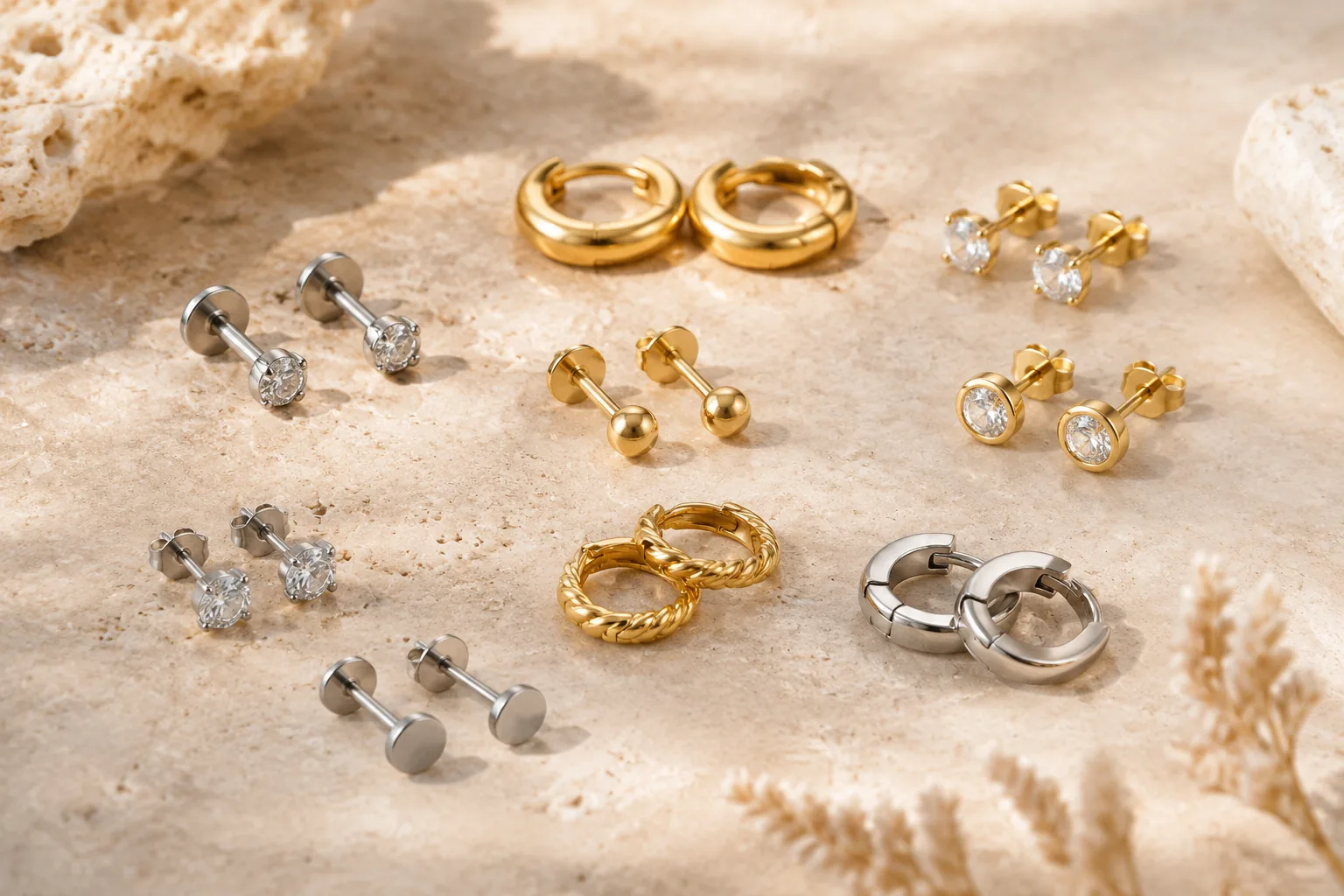
Buying earrings for piercings is not just a style decision. The same gold hoop, flat-back stud, or tiny charm can be a sensible choice for a fully healed lobe and a poor choice for a fresh cartilage piercing. The material, post, backing, finish, plating, and care instructions all matter.
This piercing jewelry buying guide starts with the most important filter: piercing stage. Fresh and still-healing piercings need more conservative body-jewelry standards than healed piercings. Once a piercing is fully healed, you have more room to consider sterling silver, gold vermeil, plated brass, and other fashion earrings, but those choices come with tradeoffs around tarnish, plating wear, moisture, sweat, and individual skin response.
The goal is not to promise that one metal is safe for everyone. It is to help you read product pages carefully, separate brand-level material claims from product-level details, and avoid vague “hypoallergenic” shortcuts when your ears or piercings need more specific information.
Start With the Piercing Stage
The first question is not “Is it cute?” or even “Is it gold?” It is: is the piercing fresh, healing, or fully healed?
For initial piercings, professional body-jewelry guidance is narrower than ordinary fashion-earring advice. The Association of Professional Piercers lists implant-grade titanium standards such as ASTM F136, ASTM F1295, ISO 5832-3, and ASTM F67 among appropriate materials for initial piercing jewelry. It also says gold for initial piercings should be 14k or higher, nickel- and cadmium-free, and alloyed for biocompatibility.
That same guidance excludes plated, gold-filled, gold overlay, and vermeil jewelry for fresh piercings because coatings can wear or chip. This is the key boundary: a material can be attractive, popular, and reasonable for healed piercings without being a conservative choice for a fresh wound channel.
For fully healed piercings, the decision broadens. Sterling silver, gold vermeil, plated sterling silver, and plated brass can be discussed as fashion-jewelry options, especially for occasional wear or lower-budget trend pieces. But they should be treated as tradeoff choices rather than fresh-piercing defaults. If your piercing is still tender, recently downsized, irritated, or not fully settled, ask a reputable piercer before swapping jewelry.
Fresh Piercings Need Body Jewelry Standards
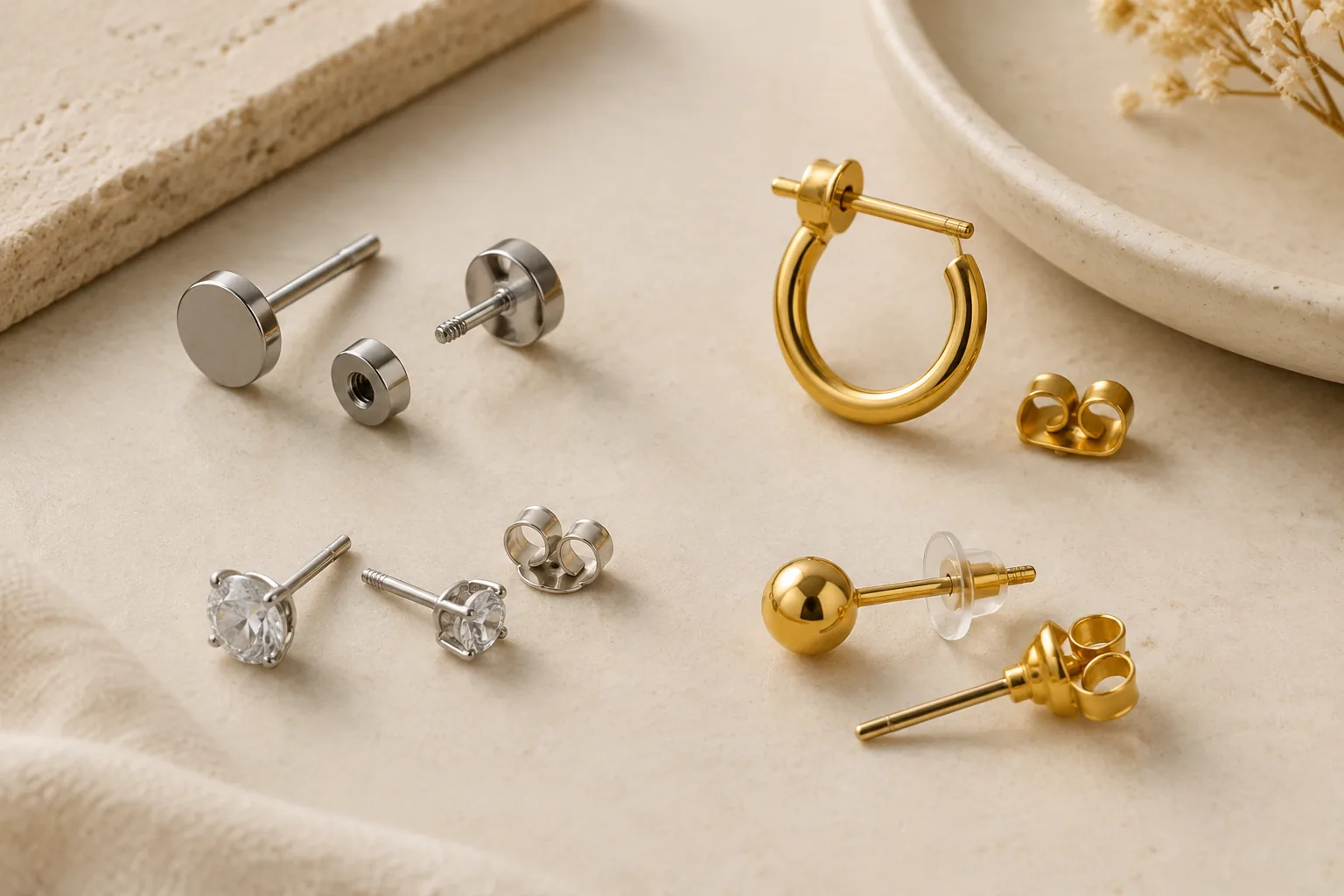
Body jewelry is designed around the part that sits inside the piercing channel. For a fresh piercing, the post or bar, backing, threading, polish, size, and documentation can matter as much as the decorative front. Professional piercing guidance emphasizes finish, fit, threading, and documentation such as mill certificates for initial piercing jewelry.
That means a pretty “earring” product page may not answer the questions a new piercing needs answered. If the listing does not clearly identify the post material, backing material, threading style, gauge, length, and whether it is intended for fresh piercings, treat it as fashion jewelry until proven otherwise.
Healed Piercings Allow More Fashion Tradeoffs
Once a piercing is fully healed and stable, many buyers reasonably choose by style, budget, and wear frequency. That is where huggies, small hoops, vermeil studs, sterling silver charms, and plated statement earrings enter the conversation. For style-specific shopping criteria, A Beginner’s Guide to Buying Huggie Earrings can help with closure, diameter, and everyday proportions.
The important distinction is that healed-piercing flexibility is not the same as universal suitability. If your ears react to certain metals, if a piercing flares after swaps, or if you have a suspected allergy, material disclosure becomes more important, not less.
Quick Buying Checklist for Piercing Jewelry
Use this checklist before buying piercing jewelry online:
- Identify the piercing stage: fresh, healing, or fully healed.
- For a fresh piercing, look for body-jewelry language and implant-grade material documentation, not only “titanium color” or “sensitive skin.”
- For titanium, look for standards such as ASTM F136, ASTM F1295, ISO 5832-3, or ASTM F67.
- For gold in an initial piercing, look for 14k or higher, nickel- and cadmium-free, and alloyed for biocompatibility.
- Confirm the post and backing material, not just the decorative front.
- Avoid plated, vermeil, gold-filled, or coated jewelry in fresh piercings.
- For healed piercings, decide whether the piece is for daily wear, occasional wear, or short-term styling.
- Read care instructions. Avoid assuming “everyday wear” means shower-proof, sweat-proof, or sleep-proof.
- Treat “hypoallergenic” as a clue, not proof that the piece is safe for every wearer.
- Check trademarks, material marks, and return or refund policies.
- If you suspect nickel allergy or have persistent symptoms, seek professional advice.
Titanium: What to Look For
Titanium is often a conservative starting point for initial piercing jewelry, but the wording matters. “Titanium” by itself is not as useful as a specific implant-grade standard.
Professional piercing guidance lists implant-grade titanium standards including ASTM F136, ASTM F1295, ISO 5832-3, and ASTM F67 among materials appropriate for initial piercing jewelry. On a product page, those standard numbers are more meaningful than vague phrases such as “titanium tone,” “titanium steel,” or “titanium finish.” A finish or color description does not necessarily tell you what is touching the piercing channel.
Mejuri’s official materials page states that its flat back studs and piercing styles are implant-grade titanium and describes that titanium as corrosion-resistant, irritation-minimizing, and supportive of faster healing. That is useful brand-level disclosure, but it should still be read at product level. Confirm the exact item, post, backing, gauge, length, and intended use before buying.
Implant-Grade Is a Documentation Question
For fresh piercings, “implant-grade” should lead you to documentation, not just a marketing adjective. Look for a named standard. If the seller cannot identify the titanium standard, the alloy, or the body-jewelry specs, that is a reason to pause, especially for a new piercing.
A polished, properly fitted, internally threaded or threadless piece from a professional piercer may be a better route for an initial piercing than an attractive online fashion stud with incomplete material details. This is a practical recommendation, not a medical conclusion.
Titanium Versus Solid Gold for a New Piercing
Is titanium better than solid gold for a new piercing? Often, implant-grade titanium is the simpler conservative choice because the standards are specific and widely referenced in professional piercing guidance. Solid gold can also be appropriate under narrower conditions: guidance for initial piercings starts at 14k or higher and adds nickel-free, cadmium-free, and biocompatible alloy requirements.
So the better question is: which product gives better documentation for your specific piercing? A clearly specified implant-grade titanium flat back may be easier to evaluate than a gold earring that gives only karat and color but no alloy or body-jewelry details.
Solid Gold: Karat, Alloys, and Fresh-Piercing Limits
Solid gold does not mean pure gold. Karat tells you how much gold is in the alloy, and the remaining metals affect color, hardness, strength, and potentially skin contact.
Mejuri states that its 14k yellow and white gold is selected for everyday durability and that each 14k gold piece is made with 90% recycled gold and 10% newly mined gold. Mejuri also states that alloy metals are used in its gold jewelry to balance color and strength.
Mejuri further states that its 10k gold contains 41.7% pure gold and that the remaining alloy may include metals such as copper, silver, and zinc. Astrid & Miyu’s official jewellery care page states that its 14k solid gold is 58.3% pure gold, 100% recycled, and positioned for all-day, everyday wear. It also states that its 9k gold is used for welded jewelry, is 37.5% pure gold, and is selected for strength, durability, and soft tone.
These brand disclosures are useful, but they do not automatically answer fresh-piercing suitability. Professional guidance for initial piercings starts at 14k or higher and adds nickel-free, cadmium-free, and biocompatible alloy requirements. A 9k or 10k gold fashion piece may still be attractive jewelry, but based on the guidance used here, it should not be framed as a conservative initial-piercing recommendation.
Yellow Gold, White Gold, and Alloy Questions
Gold color can signal different alloy mixes, but color alone is not enough. White gold, for example, is not automatically nickel-free unless the product page says so and the seller can support it. Yellow gold is not automatically allergy-safe either.
The practical move is to look for karat, alloy disclosures, nickel and cadmium statements where relevant, and whether the piece is sold as body jewelry for fresh piercings or as fashion jewelry. For everyday healed-lobe earrings, 14k solid gold may be a strong choice for buyers who want a longer-wearing material and can justify the higher price. For fresh piercings, the post and backing still need body-jewelry specifications.
Budget Logic for Solid Gold
Solid gold usually costs more than plated or vermeil jewelry because the gold is present throughout the piece rather than only on the surface. For healed piercings that you wear constantly, solid gold can make sense as a cost-per-wear choice. For trend pieces, oversized shapes, or styles you may only wear occasionally, vermeil or plated jewelry may be more realistic, as long as you accept the care and wear limits.
For a broader material comparison, What to Look for When Buying Gold Vermeil Jewelry goes deeper on replating, storage, and wear boundaries.
Sterling Silver, Vermeil, and Plated Metals
Sterling silver, vermeil, plated sterling silver, and plated brass are common in fashion earrings. For healed piercings, they can offer good style range and lower entry cost than solid gold. For fresh piercings, they require a much stricter boundary.
Mejuri states that its sterling silver is 92.5% silver and 7.5% copper, with 95% recycled silver. It also states that its 18k gold vermeil is gold over sterling silver, never brass, with a 2.5-micron gold layer. Astrid & Miyu states that its recycled sterling silver pieces are 92.5% pure silver and are plated in 18k yellow gold, 18k rose gold, or rhodium.
These definitions matter because many product pages use similar-sounding terms that are not interchangeable. “Gold vermeil over sterling silver” is different from “gold-plated brass.” “Rhodium-plated sterling silver” is different from unplated sterling silver.
Sterling Silver
Sterling silver is a familiar fashion-jewelry material, but it can tarnish and usually needs more maintenance than solid gold or implant-grade titanium. For fully healed piercings, sterling silver earrings may suit buyers who like silver color, want a lower price than white gold or platinum, and are willing to store and clean pieces carefully.
For fresh piercings, sterling silver should not be treated as a conservative initial-piercing pick based on the guidance used here. The issue is not that sterling silver is always bad for everyone. The issue is that fresh-piercing jewelry has stricter requirements than ordinary earrings.
Gold Vermeil
Gold vermeil is a plated material even when the base is sterling silver. Mejuri’s claim that its vermeil uses a 2.5-micron gold layer over sterling silver is a meaningful disclosure for fashion jewelry. But professional piercing guidance still excludes vermeil from fresh piercings because coatings can wear or chip.
For healed piercings, vermeil may suit buyers who want a gold look at a lower cost than solid gold and prefer sterling silver over brass as the base metal. It is less suitable for people who want jewelry they can wear through showers, workouts, sleep, and constant friction without thinking about plating wear. A helpful comparison point is the broader sensitive-skin jewelry buying guide, which explains why material labels need to be read cautiously rather than as universal guarantees.
Plated Brass and Other Coated Fashion Metals
Astrid & Miyu states that its bolder jewelry uses plated brass, described as more affordable and durable for statement jewelry, and plated in 18k yellow gold, 18k rose gold, or rhodium. Its care guidance advises avoiding water, sweat, and perfumes for plated jewelry and recommends putting jewelry on last and taking it off first.
That is the practical tradeoff: plated brass can make larger, bolder designs more accessible, but the coating is part of the product’s wear limit. As plating wears, the base metal may become more relevant to skin contact. For healed piercings and occasional wear, this may be acceptable to many shoppers. For fresh piercings, plated brass should be avoided under the professional guidance used here.
How to Read Mejuri and Astrid & Miyu Material Claims
Mejuri and Astrid & Miyu are useful examples because both publish material information, but the buyer still has to read carefully.
Mejuri’s materials page covers 14k gold, 10k gold, sterling silver, gold vermeil, stainless steel, and implant-grade titanium piercing styles. Its 14k gold disclosure emphasizes everyday durability and recycled gold content. Its sterling silver disclosure gives the 92.5% silver and 7.5% copper breakdown. Its vermeil disclosure says the gold layer is 2.5 microns over sterling silver, never brass. Its titanium piercing disclosure identifies implant-grade titanium for flat back studs and piercing styles.
Those details are more useful than a generic “quality jewelry” claim. Still, do not assume every Mejuri product has the same piercing use case. A vermeil fashion earring and an implant-grade titanium flat back are different categories for piercing purposes.
Astrid & Miyu’s materials and care page states that its 14k solid gold is 58.3% pure gold, 100% recycled, and positioned for all-day, everyday wear. It also states that 70% of its jewelry is made from recycled metals and that 90% of product comes from Responsible Jewellery Council accredited suppliers. Those are brand-level sourcing and material claims, not proof that every item is appropriate for a fresh piercing.
Astrid & Miyu also states that its recycled sterling silver pieces are 92.5% pure silver and plated in 18k yellow gold, 18k rose gold, or rhodium, and that bolder jewelry uses plated brass. Its care guidance for plated jewelry advises avoiding water, sweat, and perfumes. That makes it important to separate solid gold items from plated sterling silver or plated brass items when shopping.
If you are comparing these two brands for ear styling more broadly, Mejuri vs Astrid & Miyu for minimalist or maximalist ear styling may help you think through design direction. For piercing suitability, however, the exact product’s post, backing, material, and intended use matter more than the brand name.
Hypoallergenic, Nickel, and Sensitive Ears
“Hypoallergenic” is not the same as allergy-proof. Treat it as a clue that deserves follow-up, not a guarantee.
Nickel is commonly discussed in relation to allergic contact dermatitis, and jewelry is a common exposure source. This matters because product pages often use soft language: hypoallergenic, sensitive-skin friendly, nickel-safe, irritation-minimizing, or gentle. Some of those claims may be meaningful when backed by specific material disclosure, but none should be turned into a promise that the jewelry is safe for every person or every piercing.
Mejuri describes its gold vermeil pieces as hypoallergenic and safe for sensitive skin. In this article, that should be understood as Mejuri’s claim, not as a universal allergy guarantee or fresh-piercing approval. Professional piercing guidance still says vermeil is not acceptable for fresh piercings because coatings can wear or chip.
If you suspect nickel allergy or have persistent rash, itching, swelling, discharge, pain, or other symptoms, seek professional advice. A material checklist can reduce avoidable surprises, but it cannot diagnose irritation, infection, allergy, or piercing complications.
Why Everyday Wear Does Not Always Mean Shower-Proof
Brand language can sound contradictory: one section says jewelry is made for everyday wear, while care instructions say to avoid water, sweat, perfumes, or sleeping in it. The contradiction usually comes from the fact that “everyday wear” is not one material standard.
Astrid & Miyu positions its 14k solid gold for all-day, everyday wear. Separately, its care guidance for plated jewelry advises avoiding water, sweat, and perfumes and recommends putting jewelry on last and taking it off first. Those statements can both be true because they refer to different material categories.
Solid gold, plated sterling silver, and plated brass should not be treated as having identical care boundaries. Plated jewelry has a surface layer that can wear over time, especially with moisture, friction, chemicals, sweat, and repeated sleeping or showering. Plated brass statement earrings may be durable enough for their intended fashion use while still being a poor match for a fresh piercing or constant wet wear.
This is why product-page care instructions matter. A piece marketed as “everyday” may mean easy to style every day, not designed for uninterrupted wear through showers, workouts, swimming, perfume, hair products, and sleep.
For buyers building an ear stack with multiple colors and finishes, How to Mix Gold and Silver Jewelry for an Everyday Stack can help with styling. Just keep styling advice separate from piercing-stage and material decisions.
Product Page Checks Before You Buy
Before buying earrings or body jewelry for piercings, read the product page in layers.
First, identify the product category. Is it body jewelry, a flat-back stud, a labret, a hoop intended for healed piercings, or a fashion earring? Fashion earrings may be fine for healed lobes, but they often do not provide the same specs a piercer would want for fresh jewelry.
Second, check the part that goes through the piercing. The decorative front may be solid gold, vermeil, or plated, while the post or backing may be a different material. If the listing only describes the charm, front, or finish, it has not answered the most important skin-contact question.
Third, look for material precision. “14k solid gold” is more useful than “gold.” “ASTM F136 titanium” is more useful than “titanium color.” “Gold vermeil over sterling silver” is different from “gold-plated brass.”
Fourth, read the care instructions. If the brand says to avoid water, sweat, perfume, or sleeping, assume the finish needs gentler treatment. That does not make the piece bad. It simply means it should be bought for the right use case.
Fifth, check return and refund policies, especially if you are buying earrings online. Earrings and body jewelry may have hygiene-related return limits, so review the seller’s policy before checkout.
Finally, look for missing information. The available brand pages discussed here do not provide product-by-product full alloy composition for every item, nickel-release testing for every product, or universal plating thickness across all plated pieces. Brand assortments and materials can also change. When the material details are incomplete, avoid using the product in a fresh or uncertain piercing.
When to Ask a Piercer, Dermatologist, or Clinician
This guide can help you read material claims, but it cannot diagnose irritation, infection, allergy, or piercing complications.
Ask a reputable piercer before changing jewelry in a fresh, healing, irritated, or hard-to-fit piercing. A piercer can assess fit, angle, swelling room, backing style, and whether the jewelry is appropriate for the piercing stage.
Ask a dermatologist or clinician if you suspect nickel allergy or have persistent rash, itching, swelling, discharge, pain, or other symptoms. For a new piercing, do not use this article as a substitute for aftercare instructions from the professional who performed the piercing or from a clinician.
For a healed piercing, use the material checklist to reduce avoidable surprises: know what touches your skin, know whether it is plated, know how the brand says to care for it, and know when your body’s response needs professional attention.
Conclusion
The safest way to shop for piercing jewelry is to start with the piercing stage, then read the material details with discipline. For fresh piercings, prioritize professional body-jewelry standards such as documented implant-grade titanium or properly specified 14k-or-higher gold that meets initial-piercing guidance. Avoid vermeil, plated brass, gold-filled, gold overlay, and other coated fashion pieces in fresh piercings.
For healed piercings, you have more options. Solid gold can make sense for frequent wear. Sterling silver, gold vermeil, plated sterling silver, and plated brass can work as fashion choices when you accept their care limits, plating wear risk, and possible skin-contact tradeoffs. “Hypoallergenic” can be a useful clue, but it is not proof that a piece is allergy-safe for everyone.
The best product pages tell you exactly what the post and backing are made from, whether the piece is plated, what standards or karat marks apply, how to care for it, and what return limits apply. If those details are missing, be especially cautious with new, sensitive, or previously reactive piercings.
Related Guides
- Sensitive-Skin Jewelry Buying Guide: What to Look for Before You Buy
- What to Look for When Buying Gold Vermeil Jewelry: Replating, Storage, and Wear Limits
- A Beginner’s Guide to Buying Huggie Earrings
- Mejuri vs Astrid & Miyu: Which Is Better for Minimalist or Maximalist Ear Styling?