



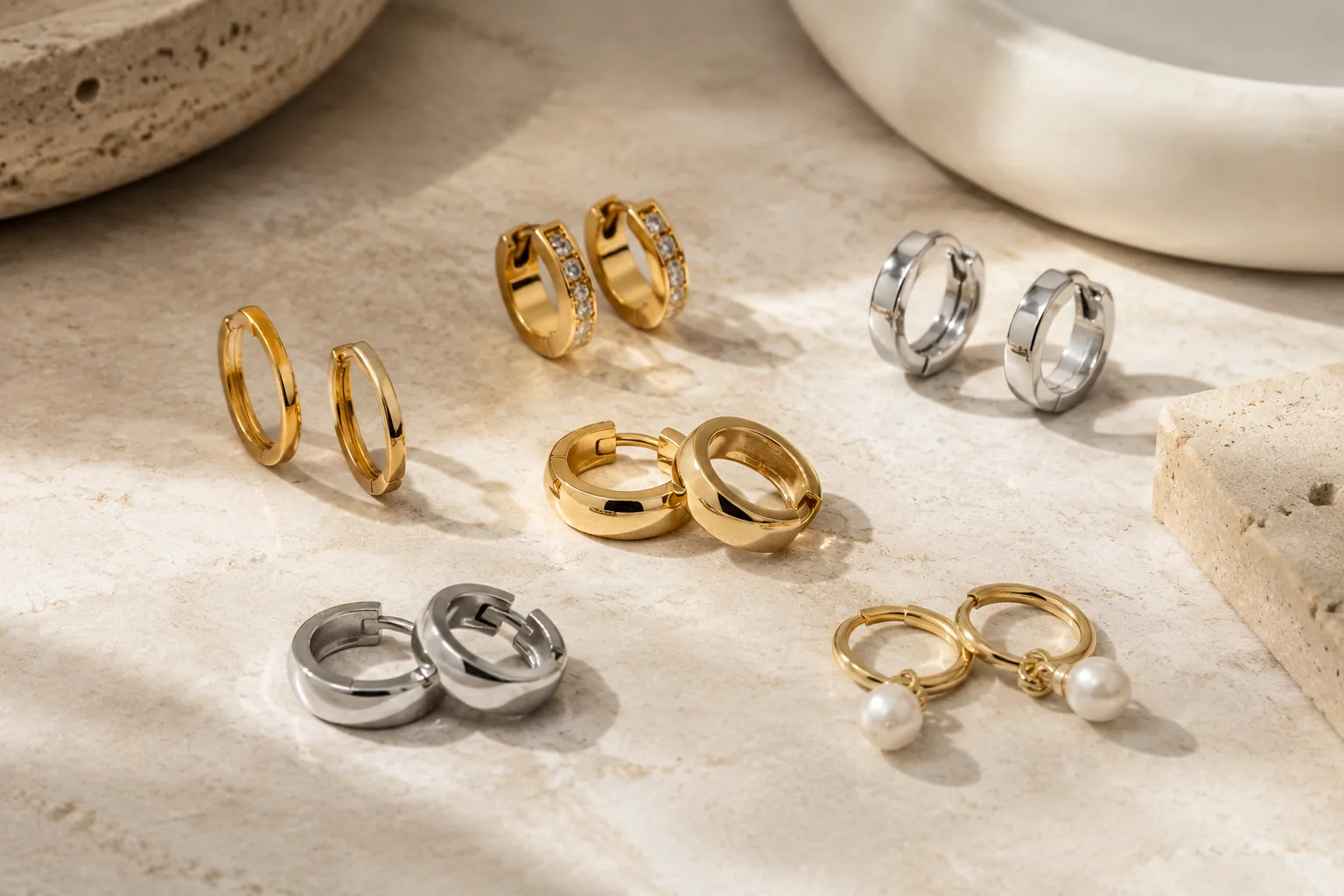
Choosing huggie earrings is mostly a fit and construction decision. The style may look simple, but a pair that works beautifully in a first lobe may feel too tight in a second lobe, too heavy for all-day wear, or too delicate for the way you plan to use it. The safest starting point is not “Which huggie is prettiest?” but “Where will this sit, what is it made from, and what does the product page actually confirm?”
This huggie earrings buying guide uses official brand examples from Mejuri, Monica Vinader, and Astrid & Miyu, plus consumer and health guidance from the FTC and American Academy of Dermatology, to turn common huggie styles into a practical decision framework. The goal is not to rank brands or declare one pair universally best. It is to help you reduce buying risk before you choose minimalist huggies, chunky huggies, charm huggies, pearl accents, or gemstone styles.
Start With Fit: Where the Huggie Will Sit
A huggie is a small hoop designed to sit close to the ear. That close fit is the appeal, but it is also where buying mistakes happen. A small hoop can look polished and feel unobtrusive when the inner diameter suits your piercing placement. If the hoop is too small, the earring may pinch or fail to close. If it is too large, it may read more like a small hoop than a true huggie.
Official merchandising shows why “huggie” and “hoop” language can overlap. Mejuri’s shop-all page lists earrings as a shopping category and included huggie and hoop examples such as Tube Huggie Hoops, Bold Huggie Hoops, Dome Huggies, Chunky Huggie Hoops, pearl hoops, small hoops, medium hoops, and oversized hoops in the research report. Monica Vinader’s shop navigation organizes earrings by huggie, hoop, stud, drop, and single earrings. That tells us these terms are active retail categories, but it does not tell us that every small hoop will fit every ear.
If exact inner diameter is missing, treat the product as higher risk. The inner diameter is the open space inside the hoop. It matters more than the outer diameter because it determines whether the hoop can pass around your lobe with room to close. Post gauge and post length also matter, especially for second lobes, higher lobe placements, and cartilage-style stacks, but those details are not verified in the provided evidence set.
For a beginner, the intended placement should drive the purchase:
| Intended placement | What to check before buying | Practical analysis |
|---|---|---|
| First lobe | Inner diameter, hoop thickness, closure type | Usually the lowest-risk placement, but thick huggies can still feel tight if the piercing sits high on the lobe. |
| Second lobe | Inner diameter and how close the piercing is to the edge | Smaller huggies may work visually, but fit cannot be assumed without measurements. |
| Ear stack | Outer diameter, thickness, and whether adjacent earrings have enough space | A sleek huggie is often easier to stack than a chunky or dangling style. |
| Cartilage-style placement | Post gauge, diameter, and whether the earring is suitable for that piercing | Do not assume a fashion huggie will fit cartilage piercings unless the product page confirms the relevant dimensions and use. |
| Statement wear | Weight, thickness, closure security, and return terms | Larger or bolder huggies may be more about visual impact than low-maintenance daily comfort. |
If you cannot verify fit, buy from a seller with clear current return terms for earrings in your country and order status. Return rights and product-labeling rules vary by country, and pierced earrings may have hygiene or sale-item restrictions, so check the seller’s policy before purchase.
Choose the Huggie Style: Minimal, Bold, Charm, Pearl, or Gemstone
Most huggie decisions fall into five style families. These are not strict technical categories, but they are useful for comparing comfort risk, versatility, and care burden.
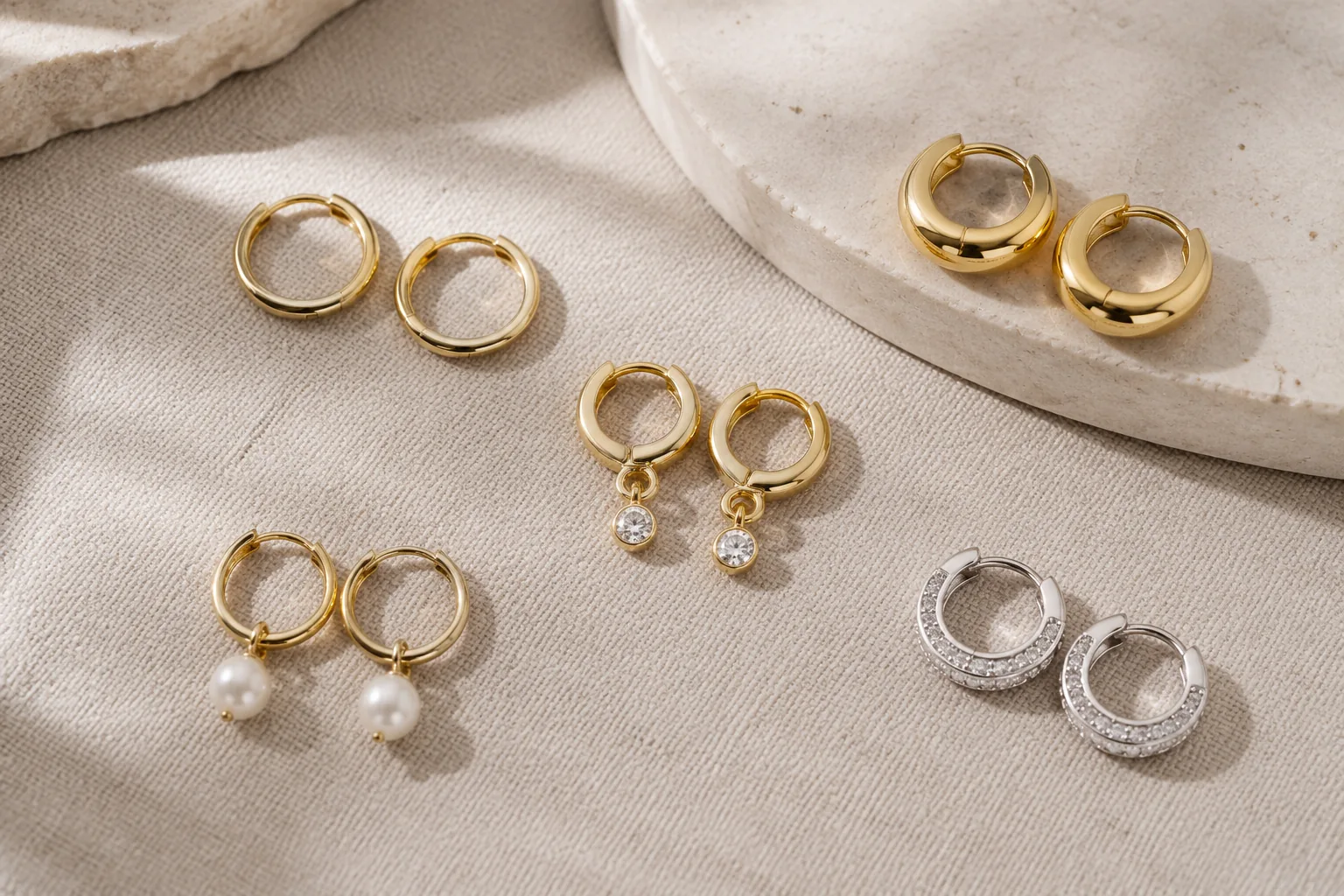
Minimalist Huggies
Minimalist huggies are the small, plain, close-fitting styles many shoppers imagine first. They can be smooth, tubular, domed, textured, or lightly shaped. Mejuri’s reported examples include Tube Huggie Hoops, Dome Huggies, Charlotte Textured Huggie Hoops, and other small hoop or huggie terminology.
Editorial analysis: minimalist huggies are usually the easiest starting point because they have fewer moving parts. A plain metal huggie has no charm to swing, no pearl to protect from cosmetics, and no gemstone setting to inspect. That does not make every pair comfortable or durable, but it does reduce the number of variables to check.
Choose minimalist huggies if you want a repeat-wear pair for work, errands, travel, or a first ear stack. Prioritize confirmed inner diameter, material, and closure construction over decorative details.
Bold or Chunky Huggies
Bold huggies create more visual presence. Mejuri’s reported merchandising included Bold Huggie Hoops and Chunky Huggie Hoops, while Astrid & Miyu’s care guidance says plated brass is used for bolder statement jewelry.
Editorial analysis: chunky huggies can be flattering because they make a small hoop look intentional rather than barely visible. The tradeoff is that thickness may reduce the usable inner space around the lobe. A thick hoop with the same outer diameter as a slim hoop can feel tighter because more of the diameter is occupied by metal. Weight is also a practical concern, but the provided source set does not verify earring weights for chunky examples.
Choose bold huggies when you want the look of a hoop without a large drop. Check weight if listed, avoid assuming “huggie” means lightweight, and be cautious if your lobe piercing sits high or your lobes are sensitive to pressure.
Charm Huggies
Charm huggies add movement. Monica Vinader’s shop page includes a Charm Shop with pendant, initial, gemstone, locket, and engravable charms. That verifies a broader charm context for the brand, but it does not prove that every huggie can hold every charm.
Editorial analysis: charm huggies are best treated as modular only when the product page explicitly says so. A charm needs a compatible loop, jump ring, or opening, and the huggie closure must still shut securely once the charm is attached. Extra movement can also increase snag risk with hair, knitwear, scarves, masks, or headphones.
Choose charm huggies if you like personalization and occasional styling variety. Before buying, confirm whether charms are removable, whether the huggie is sold with or without the charm, and whether the specific charm is approved for that specific earring.
Pearl Huggies
Pearl huggies soften the shape of a hoop and often make a small earring feel dressier. Mejuri’s jewelry care page treats cultured pearls as a separate care category, and Astrid & Miyu’s Icons page positions A&M Icons as London-designed pieces featuring signature mystic, freshwater pearl, and crystal designs. Astrid & Miyu’s care page says pearls should avoid water and cosmetics.
Editorial analysis: pearl huggies are better for shoppers who are willing to be more careful with wear and storage. Pearls are often attached rather than cast as part of the metal structure, and the evidence set does not verify pearl treatment, attachment method, replacement options, or glue or peg construction for specific products.
Choose pearl huggies for polished outfits, bridal-adjacent styling, dinners, and softer daytime looks. Do not treat pearl huggies as equally low-maintenance as plain metal huggies unless the specific jeweler’s instructions support that use.
Gemstone, Crystal, Opal, Enamel, or Pavé Huggies
Gemstone huggies add color, sparkle, or symbolism. Mejuri’s reported examples included Pave Lab Grown Sapphire Huggie Hoops and materials or components such as lab-grown sapphire, natural diamond, opal, pearl, enamel, and dyed jade. Monica Vinader’s shop page lists material or design categories including lab-grown diamonds, diamonds, pearls, and gemstones. Astrid & Miyu’s Icons page included Cosmic Star Huggies in Gold in the research report, described there as 18k gold plated recycled sterling silver, and its Icons positioning includes crystal designs.
Sourced care facts matter here. Mejuri’s care page treats diamonds, gemstones, opals, emeralds, cultured pearls, and enamel as separate care or material categories. Astrid & Miyu’s care page says gemstones should avoid water and perfume, and that some semi-precious stones can be affected by direct sunlight.
Editorial analysis: gemstone and enamel huggies are often more expressive than plain huggies, but they add setting and care questions. Ask whether stones are prong-set, bezel-set, glued, or otherwise attached if the product page explains it. The provided source set does not verify gemstone treatment status or setting construction for the examples, so those details should be checked before purchase.
Understand the Material Tier Before You Buy
Material language can be confusing because retail navigation may group jewelry by color or style, while consumer guidance distinguishes different metal constructions. The FTC explains that karat gold, solid gold, gold plated, gold filled, gold overlay, rolled gold plate, gold electroplate, vermeil, and sterling silver are distinct jewelry terms. It also defines sterling silver or 925 silver as 92.5% pure silver.
Here are the main material tiers a beginner may encounter in the brand examples.
| Material or construction | Sourced fact | Practical buying analysis |
|---|---|---|
| Solid gold | Astrid & Miyu’s care page says 14k solid gold is 58.3% pure gold and 100% recycled. Mejuri’s reported materials included 10k and 14k yellow gold. Monica Vinader’s shop lists 14k solid gold. | Usually the highest material tier among these examples, but karat, construction, stones, and care instructions still matter. |
| Gold vermeil | Mejuri describes gold vermeil as a thick layer of solid gold over sterling silver. Monica Vinader lists gold vermeil and rose gold vermeil categories. | Vermeil is still a plated construction over sterling silver, not the same thing as solid gold. |
| Sterling silver | Mejuri describes sterling silver as 92.5% pure silver plus 7.5% copper, aligning with FTC guidance that sterling or 925 silver is 92.5% pure silver. | A useful baseline material, but it can tarnish and may be plated, finished, or combined with other components. |
| Gold-plated sterling silver | Astrid & Miyu says recycled sterling silver is 92.5% pure silver plated in 18k yellow gold, 18k rose gold, or rhodium. | The underlying silver matters, but the outer finish still needs plating-aware care. |
| Rhodium-plated silver | Astrid & Miyu identifies rhodium as one of the plating options over recycled sterling silver. | Rhodium can change the finish and wear experience, but plating thickness and wear data are not verified here. |
| Plated brass | Astrid & Miyu says plated brass is used for bolder statement jewelry. | Often relevant to fashion-led statement pieces; check plating, weight, and sensitivity information carefully. |
| Pearls, gemstones, enamel | Mejuri treats these as separate care categories, and Astrid & Miyu gives specific cautions for gemstones and pearls. | These components can increase beauty and care burden at the same time. |
A practical rule: buy based on construction, not just color. “Gold” in a menu, finish, or product title may not mean solid gold. Look for the exact wording on the current product page: 14k gold, 10k gold, gold vermeil, gold plated sterling silver, rhodium plated sterling silver, plated brass, or another stated construction.
Everyday Wear Claims Need Material-Specific Limits
“Everyday jewelry” is a useful style idea, but it should not erase material limits. Monica Vinader’s about page positions the brand around everyday jewelry, responsibility, recycled gold and sterling silver, supply-chain transparency, a 5-year warranty, lifetime repairs, a recycling scheme, and Product Passport traceability. Astrid & Miyu’s care page says solid gold is designed for all-day everyday wear but still needs care. Those are brand claims from official sources, and they should be read in their exact scope.
Plated jewelry needs a different expectation. Astrid & Miyu’s care page says plated jewelry should avoid water, sweat, and perfume. The FTC also says gold plating eventually wears away, with wear depending on factors including use and plating thickness. That does not mean plated huggies are a bad choice. It means they should be bought with realistic expectations, especially if you plan to sleep, shower, exercise, or apply fragrance while wearing them.
Pearls and gemstones also need more caution than plain metal. Astrid & Miyu says pearls should avoid water and cosmetics. It also says gemstones should avoid water and perfume, and some semi-precious stones can be affected by direct sunlight. Mejuri’s care page separates diamonds, gemstones, opals, emeralds, cultured pearls, and enamel into different care or material categories, which supports the broader point that not all embellishments should be treated the same way.
Editorial suggestion: if you want the lowest-maintenance huggie for repeat wear, start with a plain metal pair in the highest material tier you can justify, then add charm, pearl, gemstone, or enamel styles as more occasion-specific pieces. If you want the look more than the lowest care burden, a plated or embellished huggie can still make sense, provided you accept the extra care limits.
Jewelry care recommendations vary by material, treatment, and setting. Always follow brand or jeweler care instructions for your specific piece.
Closure, Hinge, and Charm Compatibility Checks
The closure is easy to overlook because many huggies are photographed from the front. For daily use, it matters as much as the visible design. Monica Vinader’s shop navigation separates huggies from hoops, studs, drops, and single earrings, but the category label alone does not tell you hinge quality, post alignment, or closure feel.
Before buying, look for product photos and descriptions that show:
| Check | Why it matters |
|---|---|
| Hinge or clicker mechanism | A huggie usually needs a secure close-fitting closure. If the product page does not show the mechanism, risk is higher. |
| Post alignment | The post should appear to meet the closure cleanly. Misalignment can make earrings harder to close. |
| Closure sound or feel | Some product pages may describe a click closure, but the provided source set does not verify closure performance for specific examples. |
| Inner diameter | Fit depends on the space inside the hoop, not just how it looks on a model. |
| Hoop thickness | Thick huggies can reduce usable space and change comfort. |
| Charm loop or removable charm design | A charm category does not prove every huggie is charm-compatible. |
| Drop movement | More movement can mean more styling impact and more snag risk. |
| Repair or replacement terms | Hinge repair, closure replacement, and warranty scope are not verified in the evidence set for specific huggies. |
Charm compatibility deserves special caution. Monica Vinader’s Charm Shop includes pendant, initial, gemstone, locket, and engravable charms, but that is not the same as a universal compatibility promise. A beginner should look for wording that the exact huggie can be worn with the exact charm, and should check whether the charm changes return eligibility or care instructions.
Sensitive Ears: What You Can and Cannot Infer
Sensitive-ear shopping needs careful language. The American Academy of Dermatology says nickel is a common cause of allergic contact dermatitis and that jewelry, especially earrings and earring backs, can be a source. It advises people with nickel allergy to choose nickel-free or hypoallergenic jewelry or certain metals, and to see a board-certified dermatologist for diagnosis if symptoms persist or worsen.
That guidance supports a cautious shopping approach, not a universal guarantee. You cannot infer from the provided evidence set that any listed huggie is safe for every wearer. Nickel content, nickel release testing, and sensitivity testing are not verified for the listed products. Even terms such as “hypoallergenic” or “nickel-free,” when used by a seller, should be read with the seller’s exact wording and your own history in mind.
Practical suggestions for sensitive-ear shoppers:
| Question | Why it helps |
|---|---|
| Is the post material clearly stated? | The post is in direct contact with the piercing. |
| Is the earring back or closure material stated? | Backs and closures can also contact skin. |
| Is the product solid gold, sterling silver, vermeil, plated silver, or plated brass? | Construction affects both care expectations and sensitivity questions. |
| Does the brand provide nickel-specific language? | If not, do not assume. |
| Have you reacted to similar metals before? | Personal history matters more than broad marketing language. |
| Are symptoms persistent or worsening? | That is a reason to consult a qualified clinician or dermatologist. |
This content provides shopping and educational information, not medical advice. Consult a qualified clinician or dermatologist about persistent irritation or reactions.
How to Use Brand Examples Without Treating This as a Product Ranking
Mejuri, Monica Vinader, and Astrid & Miyu are useful examples because their official pages show how contemporary jewelry brands present huggies, hoops, materials, charms, care, and responsibility language. They should not be used here as a comfort, durability, sustainability, or sensitivity ranking.
Mejuri is included because its official shop-all page is a required source for this title, lists earrings among its shopping categories, and included huggie and hoop examples in the research report. Its jewelry care page also provides material and care definitions, including gold vermeil as a thick layer of solid gold over sterling silver and sterling silver as 92.5% pure silver plus 7.5% copper.
Monica Vinader is included because its official shop page organizes earrings by huggie, hoop, stud, drop, and single earrings, and lists categories such as gold vermeil, sterling silver, 14k solid gold, rose gold vermeil, lab-grown diamonds, diamonds, pearls, and gemstones. Its shop page also includes a Charm Shop with pendant, initial, gemstone, locket, and engravable charms. Its about page positions the brand around everyday jewelry, responsibility, recycled gold and sterling silver, supply-chain transparency, a 5-year warranty, lifetime repairs, a recycling scheme, and Product Passport traceability.
Astrid & Miyu is included because its Icons page positions A&M Icons as London-designed pieces featuring signature mystic, freshwater pearl, and crystal designs. Its care page gives material and care context, including statements that 14k solid gold is 58.3% pure gold and 100% recycled, that 70% of its jewelry is made from recycled metals, and that 90% of its product comes from Responsible Jewellery Council accredited suppliers. The same care page says recycled sterling silver is 92.5% pure silver plated in 18k yellow gold, 18k rose gold, or rhodium, and that plated brass is used for bolder statement jewelry.
Analysis: these claims are useful in their exact form, but they are not directly equivalent. A recycled-metal claim, supplier-accreditation claim, Product Passport traceability claim, repair program, or warranty statement should not be collapsed into a simple “more sustainable” or “better quality” ranking unless the comparison uses matching evidence and current policy details.
A Beginner Buying Checklist
Use this checklist before buying huggie earrings, especially if the pair is final sale, personalized, pierced-ear restricted, or intended as a gift.
- Choose the placement first. Decide whether the huggie is for a first lobe, second lobe, stack, cartilage-style placement, or statement use.
- Look for inner diameter. If only model photos are provided, fit is less certain.
- Check hoop thickness. A thick huggie can look smaller on the ear because it leaves less interior space.
- Verify the material tier. Distinguish solid gold, gold vermeil, sterling silver, gold-plated sterling silver, rhodium-plated silver, and plated brass.
- Treat vermeil and plating realistically. FTC guidance distinguishes these terms from solid gold, and gold plating eventually wears away depending on factors including use and plating thickness.
- Read care instructions by component. Pearls, gemstones, opals, enamel, and plated finishes may have different limits from plain metal.
- Check closure photos. Look for the hinge, post, and how the earring closes.
- Do not assume charm compatibility. A charm shop or charm category does not prove every huggie can carry charms.
- Check sensitivity language carefully. Earrings and backs can be nickel exposure sources, and individual reactions vary.
- Verify return terms before purchase. Return rights, hallmarking, and product-labeling rules vary by country. Check current seller policies and local regulations before purchase.
- Look for missing details. Post gauge, post length, earring weight, plating thickness, hinge repair, gemstone treatment, pearl attachment, and nickel testing are not verified in the provided source set.
- Avoid treating marketing categories as specifications. Product titles and navigation labels help you browse, but the current product page should carry the buying decision.
Conclusion: Buy the Huggie That Matches Your Ear, Material Expectations, and Care Tolerance
The best beginner choice is not always the smallest or most popular-looking huggie. It is the pair whose fit, material, closure, and care requirements match how you actually plan to wear it. Minimalist metal huggies are usually the simplest place to start. Chunky huggies add visual weight but need closer attention to thickness and weight. Charm huggies need explicit compatibility. Pearl, gemstone, opal, enamel, and crystal styles can be beautiful, but they should be treated as more care-sensitive unless the jeweler’s instructions say otherwise.
Use brand examples from Mejuri, Monica Vinader, and Astrid & Miyu as vocabulary and material context, not as automatic rankings. Then make the final decision from the current product page: confirmed dimensions, exact metal construction, closure design, embellishment care, sensitivity disclosures, and return policy. That approach will not guarantee a perfect fit, but it gives a beginner a much clearer way to choose huggie earrings with fewer avoidable surprises.
Sources
- Mejuri, Shop All
- Mejuri, Jewelry Care
- Monica Vinader, Shop
- Monica Vinader, About
- Astrid & Miyu, Icons
- Astrid & Miyu, Jewellery Care
- Federal Trade Commission, Buying Platinum, Gold, and Silver Jewelry
- American Academy of Dermatology, Nickel Allergy