



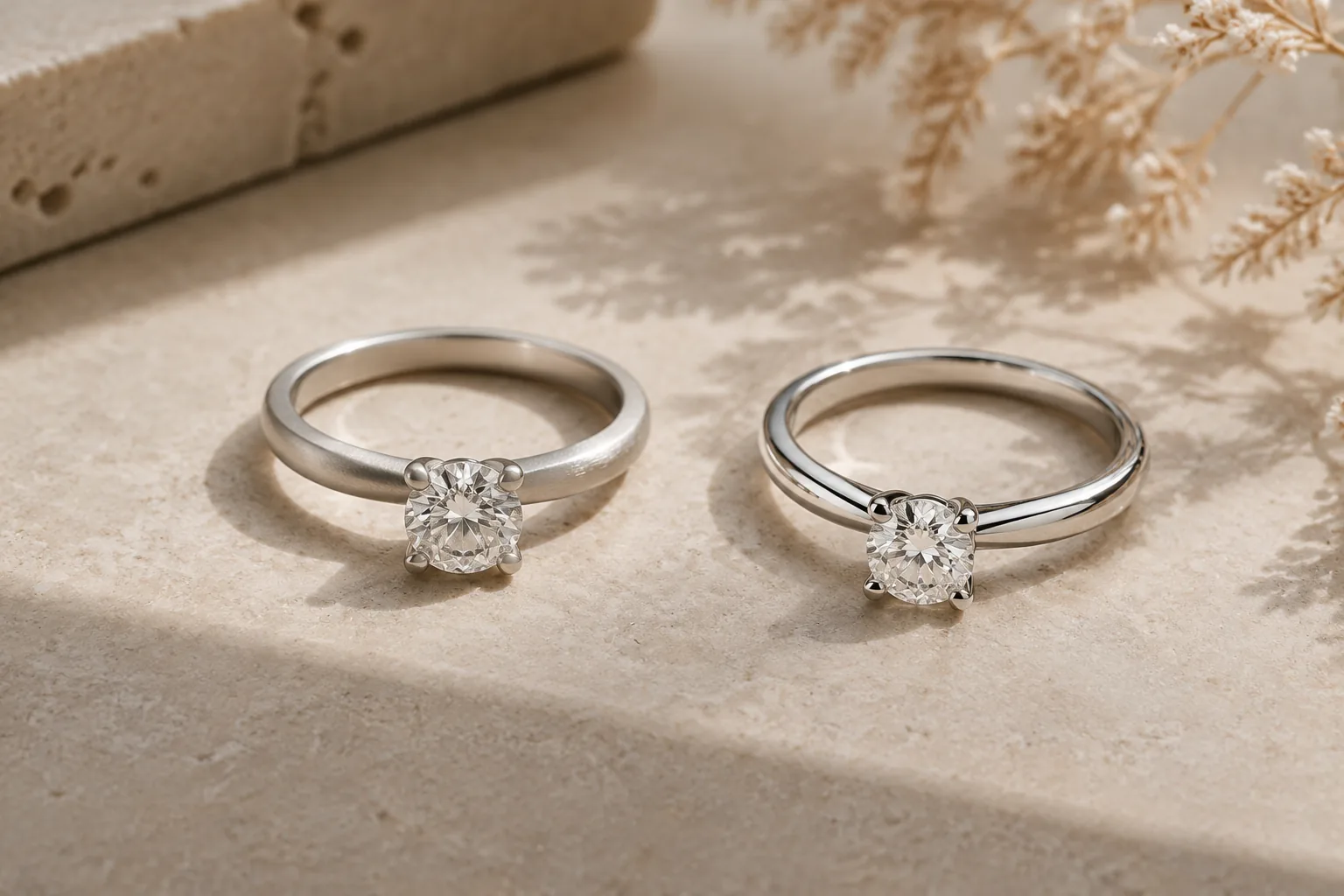
Choosing between platinum and white gold for an engagement ring is not just a question of which one looks whiter in a display case. These two metals can look very similar when new, but they differ in natural color, plating, purity, weight, maintenance, sensitivity considerations, and long-term cost logic.
The short version: platinum is usually the better fit if you want a naturally white, higher-purity, heavier metal and would rather avoid routine rhodium replating. White gold is usually the better fit if you want a bright white look with a lower initial cost logic, a lighter feel, and you are comfortable with periodic jeweler maintenance.
Neither metal is automatically better for every ring. The right choice depends on your setting style, your maintenance tolerance, your skin sensitivity history, your budget priorities, and how you want the ring to age.
Quick Answer: Choose Platinum or White Gold Based on Your Priorities
Choose platinum if your priorities are natural whiteness, high metal purity, a substantial feel, and lower plating maintenance. Jewelry education sources, including Blue Nile and GIA, support describing platinum as naturally white. The Federal Trade Commission also says that unqualified platinum should be at least 95% pure platinum, while platinum jewelry between 50% and 85% platinum requires more specific disclosure.
Choose white gold if your priorities are a bright white surface finish, a lighter ring, and a lower initial cost logic compared with platinum. White gold is gold alloyed with other metals to create a white or near-white alloy, and it is often plated with rhodium to create or maintain a bright white finish, according to GIA and JewelryScience. James Allen’s engagement-ring metal education text also frames white gold as having a platinum-like look and being less expensive than platinum, while describing platinum as more expensive because of rarity and production volume.
That does not mean platinum is maintenance-free or white gold is a poor choice. Platinum can scratch and develop patina. White gold can be durable and long-wearing, but its rhodium finish may need attention over time.
Platinum vs White Gold at a Glance
| Factor | Platinum | White Gold |
|---|---|---|
| Natural color | Naturally white, according to jewelry education sources | Gold alloyed with other metals to create a white or near-white alloy |
| Bright white appearance | White without rhodium being necessary for color | Often rhodium plated for a bright white surface |
| Surface aging | Can scratch and develop patina, a surface texture change | Rhodium plating can wear, revealing the warmer alloy underneath |
| Purity | FTC says unqualified platinum should be at least 95% pure platinum | FTC explains karat as parts out of 24; 14K is 14 parts gold and 10 parts other metal, while 18K is 18 parts gold and 6 parts other metal |
| Weight | Denser than gold and generally heavier than a same-size white-gold ring | Usually lighter than platinum in a similar ring |
| Maintenance | Cleaning, polishing or repolishing, resizing, prong work, and finish restoration may apply | Rhodium replating and periodic prong checks may apply |
| Sensitivity caveat | High-purity platinum may be better tolerated by some sensitive wearers, but no metal is guaranteed reaction-free | White-gold alloy recipes vary and may include nickel, palladium, silver, copper, zinc, or other metals |
| Cost logic | Often higher upfront, partly connected to rarity and production volume in brand education materials | Often chosen for a platinum-like look at a lower initial cost logic |
Color: Naturally White Platinum vs Rhodium-Brightened White Gold
The biggest visible difference is not always obvious on day one. A new platinum ring and a new rhodium-plated white-gold ring can both look clean, bright, and white. The difference is what creates that whiteness.
Platinum can be described as naturally white when that claim is tied to jewelry education sources. Blue Nile states that platinum’s naturally white sheen will not fade or change color. In practical shopping terms, this means platinum’s whiteness is part of the metal itself, not mainly a surface coating.
White gold works differently. GIA and JewelryScience describe white gold as gold alloyed with other metals to create a white or near-white alloy. Because pure gold is yellow, white gold depends on its alloy mix and, commonly, rhodium plating to create the bright white surface many shoppers expect.
Rhodium is a bright, white precious metal used as a surface plating. When white gold is rhodium plated, the ring may appear cooler and brighter than the underlying alloy. As the rhodium wears, the warmer white-gold alloy beneath can become more visible. That is more accurate than saying “white gold turns yellow” as if the metal itself transforms. The visible change is usually about plating wear and the underlying alloy showing through.
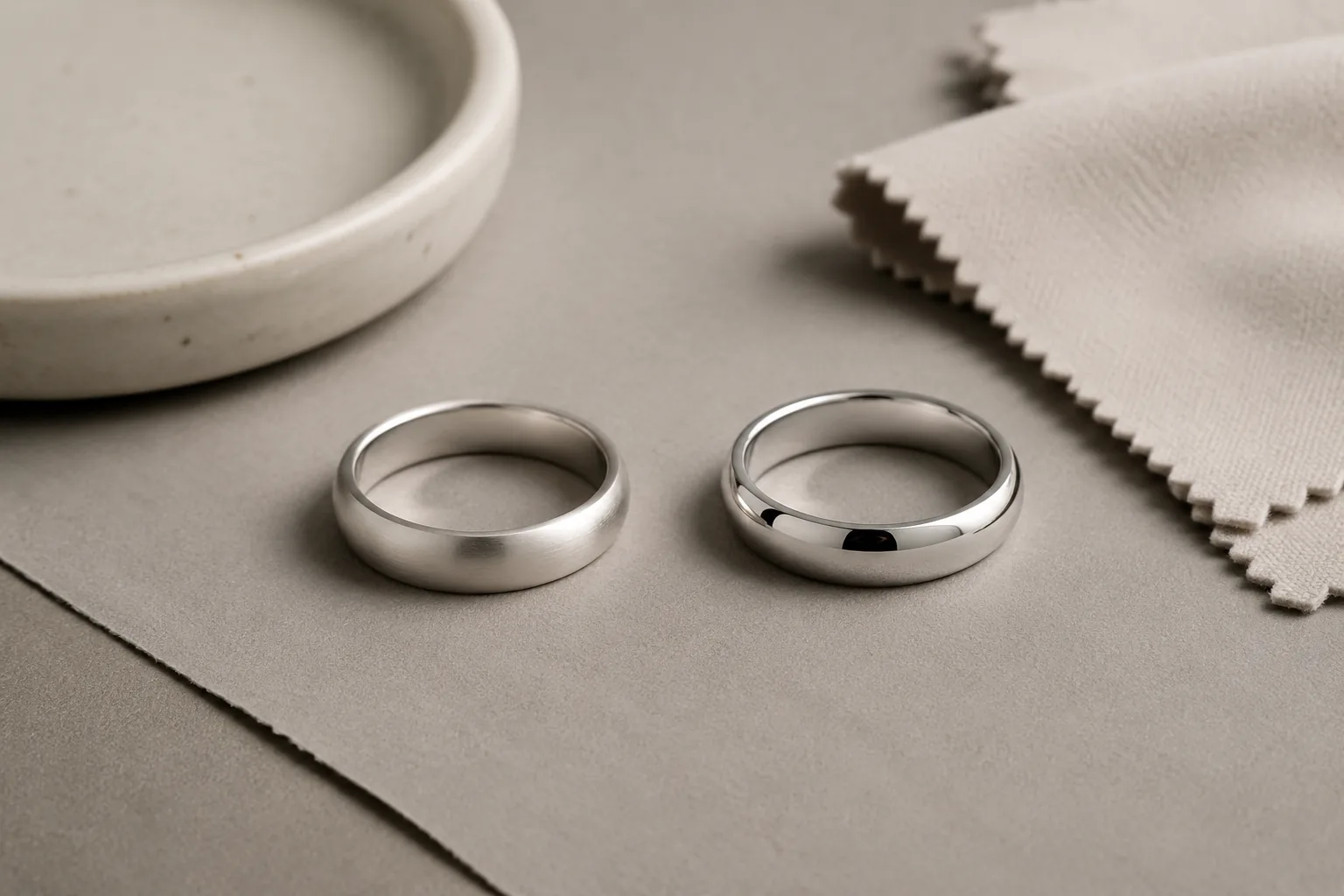
A practical suggestion: if you strongly prefer a crisp, bright white look and are choosing white gold, ask the jeweler how they handle rhodium replating, inspections, and future service. If you prefer a white metal that does not rely on rhodium for its basic color, platinum is the more direct fit.
Maintenance: Replating, Patina, Polishing, and Prong Checks
Maintenance is where many shoppers misunderstand the platinum vs white gold engagement ring decision.
White gold maintenance can include rhodium replating and periodic prong checks. The research sources support describing rhodium plating wear as gradual or occasional, but they do not support a universal fixed replating schedule. Wear depends on the ring, plating thickness, alloy, daily habits, skin chemistry, contact with hard surfaces, and how often the ring is worn.
Platinum maintenance is different. Platinum can scratch and develop patina. Patina is a surface-finish change, often described as a softer, more matte appearance that develops with wear. It should not be described as platinum losing its white color. The metal remains naturally white, but the surface texture changes.
This distinction matters:
| Wear issue | What is happening | Typical implication |
|---|---|---|
| White gold plating wear | Rhodium surface wears and the warmer alloy may show | Replating may restore the bright white surface |
| Platinum patina | Surface texture changes through scratching and wear | Polishing or finish restoration may change the surface appearance |
| Prong wear or movement | Setting components are affected by wear, design, or impact | Jeweler inspection and repair may be needed |
Blue Nile says platinum jewelry can be cleaned with mild warm soapy water and a soft-bristled brush. Still, jewelry care recommendations vary by material, gemstone, treatment, and setting. Always follow the jeweler or brand’s care instructions for your specific piece, especially if the ring includes treated gemstones, delicate settings, pavé, or mixed materials.
Purity and Alloy Differences
Purity is one of the clearest technical differences between platinum and white gold.
The FTC says unqualified platinum should be at least 95% pure platinum. The FTC also says platinum jewelry from 50% to 85% platinum requires more specific disclosure. Blue Nile describes its platinum as 95% pure with 5% iridium, palladium, ruthenium, and other alloys.
Gold is measured differently. The FTC explains gold karat as parts out of 24. Under that framework, 18K gold is 18 parts gold and 6 parts other metal, while 14K gold is 14 parts gold and 10 parts other metal. GIA gives U.S. white-gold examples as 14K at 583 parts pure gold and 18K at 750 parts pure gold.
For white gold, the remaining metal content is not one universal recipe. GIA and JewelryScience explain that white-gold alloy recipes vary by manufacturer and may include nickel, palladium, silver, copper, zinc, or other metals. This is why two 14K white-gold rings from different sellers may not have exactly the same alloy composition, color undertone, or sensitivity profile.
James Allen’s indexed education text distinguishes 14K white gold, 18K white gold, and platinum for engagement rings. Mejuri, on its broader materials page, says it uses 14K yellow and white gold and chose 14K for durability versus 18K or 22K. That Mejuri page is useful for understanding one brand’s material positioning, but it should not be treated as proof of engagement-ring-specific platinum performance.
Durability Is Not One Thing
“Durable” is too broad to settle this comparison. For engagement rings, durability includes several separate questions:
| Durability question | Why it matters |
|---|---|
| Does the metal scratch? | Platinum can scratch, and sources do not support calling it scratch-proof |
| Does the finish change? | Platinum can develop patina; white gold’s rhodium plating can wear |
| Does metal wear away? | Jewelers of America supports the claim that platinum has very little metal loss in wear |
| Does the ring resist impact and corrosion? | GIA describes white gold as durable, long-wearing, corrosion resistant, and impact resistant |
| Are the prongs sturdy? | GIA supports describing platinum as dense, strong, and suitable for sturdy prongs |
| Is the setting well made? | Prong dimensions, stone size, workmanship, and maintenance habits matter alongside metal choice |
This is why “platinum is more durable” can be both directionally useful and too vague. Platinum has advantages in density, high purity, and very little metal loss in wear, according to Jewelers of America. GIA also supports platinum as suitable for sturdy prongs. But platinum still scratches and may need polishing, finish restoration, resizing, or prong work.
White gold should not be dismissed as weak. GIA describes white gold as durable, long-wearing, corrosion resistant, and impact resistant. Its main visible maintenance issue is usually not that the gold itself is failing, but that the rhodium surface can wear and need refreshing.
The practical analysis: for a delicate setting, large center stone, or high-wear lifestyle, metal choice is only one part of durability. Prong thickness, setting architecture, craftsmanship, inspection habits, and resizing history may be just as important.
Weight and Feel on the Finger
Platinum is denser than gold and will generally feel heavier than a same-size white-gold ring. Jewelers of America says a 90% platinum piece weighs 60% more than a similar-size 14K gold piece.
That heavier feel can be a benefit or a drawback. Some wearers like platinum because it feels substantial and secure. Others prefer white gold because it feels lighter and less noticeable during daily wear.
This is one area where trying on rings can help more than reading specifications. If possible, compare similar ring widths and setting styles in platinum and white gold. A slim solitaire may feel comfortable in either metal, while a wider band or larger setting may make platinum’s density more noticeable.
Sensitivity and Nickel Caveats
Sensitivity claims need careful wording. No source in the research package supports saying that any metal is guaranteed reaction-free for every wearer.
White-gold alloy recipes vary and may include nickel, palladium, silver, copper, zinc, or other metals. GIA says people allergic to nickel should avoid white gold alloyed with nickel. JewelryScience describes nickel as skin-sensitizing and capable of causing rash.
High-purity platinum is described by jewelry education sources as hypoallergenic or suitable for some sensitive wearers. A more careful way to say this is: platinum may be better tolerated by some wearers with metal sensitivities, especially compared with nickel-containing white gold. That is not the same as saying platinum is allergy-proof.
If you have known nickel sensitivity, ask the jeweler what alloy is used in the specific white-gold ring, not just whether it is 14K or 18K. Rhodium plating should not be treated as permanent protection for nickel-sensitive wearers, because plating can wear.
This content provides shopping and educational information, not medical advice. Consult a qualified clinician or dermatologist about persistent irritation or reactions.
Price and Long-Term Cost Logic
The sources support a general cost logic, but they do not provide current universal prices. Current retail pricing depends on metal market conditions, ring design, brand, stone setting, labor, promotions, and service policies.
James Allen’s indexed education text says white gold has a platinum-like look and is less expensive than platinum. It also says platinum is more expensive because of rarity and production volume. That supports a common buyer framing: white gold may suit someone who wants the look of a white metal while prioritizing a lower initial spend.
Platinum often carries a higher upfront cost logic because it is denser, commonly used at high purity, and described by brand education materials as rarer with different production volume considerations. However, platinum may reduce one specific type of future maintenance: routine rhodium replating.
White gold may cost less upfront, but buyers should account for possible rhodium replating and periodic prong checks. The exact cost and frequency should be verified with the jeweler before purchase. The research package does not support inventing a fixed replating interval or current service price.
A practical suggestion: ask the seller three service questions before choosing.
- Is rhodium replating included for any period, and what does it cost after that?
- How often do they recommend inspection for the specific setting?
- What polishing, resizing, or prong work policies apply to platinum and white gold?
Return rights, hallmarking, and product-labeling rules vary by country. Check current seller policies and local regulations before purchase.
Sourcing and Sustainability Claims: What the Sources Can and Cannot Prove
Sourcing claims should be narrow and brand-specific. The research package does not support saying either platinum or white gold is universally ethical, sustainable, recycled, repurposed, or traceable.
Mejuri’s official materials page is broader than an engagement-ring metal comparison. It says its 14K collection is 90% recycled gold and 10% newly mined gold. That is useful as a brand-specific material disclosure, not as a general claim about all white gold or all engagement rings.
Brilliant Earth’s 2025 mission report is relevant to sourcing and circularity claims, not to product-performance claims about platinum or white gold engagement rings. Brilliant Earth says it used 99.5% repurposed gold and 96.4% repurposed silver for fine jewelry collections. It also explains that it uses the term “repurposed” rather than “recycled” gold, and says limited supply makes exclusively sourcing repurposed platinum challenging. The same report states that sustainability metrics may be estimates and supplier standards are not guarantees.
The analysis for shoppers: if sourcing is a priority, compare current disclosures from the specific retailer and product, not just the metal name. Ask whether the claim applies to the exact ring, the collection, the brand’s broader fine jewelry line, or only a reporting period.
Who Should Choose Platinum?
Platinum is likely the stronger fit if you want a naturally white metal and do not want the ring’s white appearance to depend on rhodium plating. Blue Nile and GIA support describing platinum as naturally white, and Blue Nile states that platinum’s naturally white sheen will not fade or change color.
It is also a strong fit if you value higher metal purity. The FTC says unqualified platinum should be at least 95% pure platinum, while gold karat is measured as parts out of 24.
Platinum may also fit buyers who like a heavier ring. Because platinum is denser than gold, it generally feels heavier than a same-size white-gold ring. Some wearers interpret that as a premium, grounded feel.
Consider platinum if:
- You want natural whiteness rather than a rhodium-brightened surface.
- You prefer a higher-purity white metal.
- You like a heavier feel on the finger.
- You want to avoid routine rhodium replating.
- You are considering a setting where sturdy prongs and maintenance planning are important.
- You have sensitivity concerns and want to discuss high-purity platinum with a jeweler.
The limitation: platinum is not scratch-proof and does not eliminate maintenance. It can develop patina and may need cleaning, polishing or repolishing, resizing, prong work, or finish restoration over time.
Who Should Choose White Gold?
White gold is likely the stronger fit if you want a bright white look and a lower initial cost logic than platinum. White gold is gold alloyed with other metals, and it is often rhodium plated to create a bright white surface.
It may also suit buyers who prefer a lighter ring. Because platinum is denser, white gold generally feels lighter in a comparable ring.
White gold can be a practical choice if you are comfortable with periodic jeweler maintenance. GIA describes white gold as durable, long-wearing, corrosion resistant, and impact resistant. Its visible upkeep often centers on rhodium plating wear and prong inspections rather than the idea that the metal is inherently weak.
Consider white gold if:
- You want a bright white finish when new.
- You are prioritizing a lower initial budget.
- You prefer a lighter feel.
- You are comfortable asking about rhodium replating and future service.
- You want a familiar engagement-ring metal offered widely across jewelers.
- You have confirmed the alloy is appropriate for your sensitivity needs.
The limitation: white-gold alloy recipes vary. If you have nickel sensitivity, ask whether the specific ring contains nickel. Do not assume rhodium plating permanently solves sensitivity concerns.
FAQs
Is platinum better than white gold for an engagement ring?
Not universally. Platinum is better suited to buyers who prioritize natural whiteness, higher purity, heavier feel, and lower plating maintenance. White gold is better suited to buyers who prioritize a bright rhodium finish, lighter feel, and lower initial cost logic.
Does white gold turn yellow?
A more accurate explanation is that white gold’s rhodium plating can wear, allowing the warmer underlying alloy to become more visible. The metal is not simply transforming from white to yellow.
Does white gold always need rhodium plating?
White gold is often rhodium plated to create or maintain a bright white surface, according to GIA and JewelryScience. Exact practices can vary by jeweler and alloy, so ask about the specific ring.
How often does white gold need replating?
The research sources do not support a universal fixed replating schedule. Rhodium wear varies based on the ring, plating, wear habits, and service history. Ask the jeweler for their maintenance guidance and current service terms.
Does platinum scratch?
Yes. Platinum can scratch and develop patina. The sources do not support describing platinum as scratch-proof.
What is platinum patina?
Platinum patina is a surface-finish change that can develop with wear. It should not be described as platinum losing its white color.
Is platinum hypoallergenic?
Jewelry education sources describe high-purity platinum as hypoallergenic or suitable for some sensitive wearers, but no metal should be described as guaranteed reaction-free for everyone.
Is white gold safe for nickel-sensitive wearers?
GIA says people allergic to nickel should avoid white gold alloyed with nickel. Since white-gold alloy recipes vary, ask the jeweler whether the specific ring contains nickel.
Which metal feels heavier?
Platinum. It is denser than gold and generally feels heavier than a same-size white-gold ring.
Can platinum and white gold rings be resized?
Both metals can be serviced by jewelers, but resizing depends on the specific ring design, alloy, setting, stones, and maker policies. Ask the seller before purchase, especially for pavé, eternity, tension, engraved, or mixed-metal designs.
Conclusion: Match the Metal to the Way You Want the Ring to Age
For most engagement-ring shoppers, the platinum vs white gold decision comes down to aging and maintenance.
Choose platinum if you want a naturally white, higher-purity metal with a heavier feel and no routine dependence on rhodium plating for whiteness. Expect scratches, possible patina, and normal jeweler maintenance over time.
Choose white gold if you want a bright white look, a lighter feel, and a lower initial cost logic, while accepting that rhodium plating may wear and need refreshing. Ask about the exact alloy, especially if nickel sensitivity is a concern.
The best choice is not the metal with the strongest marketing claim. It is the metal whose color, feel, maintenance pattern, and service expectations fit the wearer and the setting.
Sources
- Blue Nile: About Jewelry Metals
- Blue Nile: Platinum Jewelry
- James Allen: Engagement Ring Metal Types
- Mejuri: Materials
- Brilliant Earth: Mission Report 2025
- Federal Trade Commission: Buying Platinum, Gold, and Silver Jewelry
- GIA 4Cs: How to Pick the Right White Metal for an Engagement or Wedding Ring
- JewelryScience: An Introduction to White Gold
- Jewelers of America: Platinum Jewelry Buying Guide