



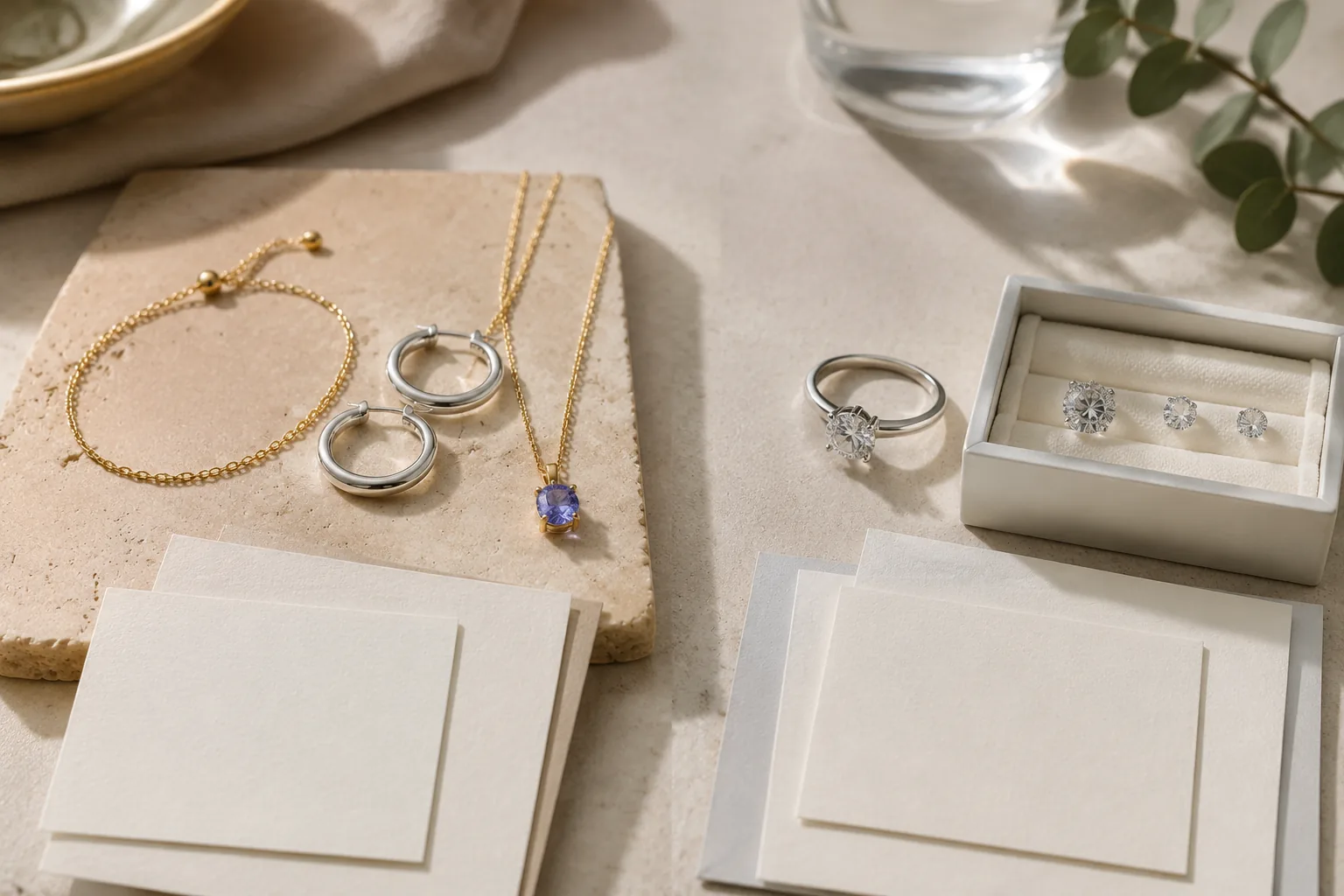
If you are comparing Monica Vinader vs Brilliant Earth because both brands talk about traceability, recycled or repurposed metals, and responsible sourcing, the first thing to know is that they are not making the same kind of claim.
Monica Vinader’s traceability story is mainly built around everyday jewelry transparency: recycled gold and sterling silver, named factory information, materials disclosure, and a Product Passport program for traceable products marked with a “Trace This Item” logo. Brilliant Earth’s traceability story is more diamond- and bridal-centered: its 2025 Mission Report discusses Beyond Conflict Free natural diamonds, supplier audits, lab diamond supplier assessment, blockchain-verified diamonds, repurposed precious metals, and selected sourcing frameworks.
That difference matters. A buyer choosing an everyday gold vermeil-style bracelet, sterling silver hoops, or gemstone pendant is asking a different sourcing question from someone choosing a natural diamond engagement ring. This comparison does not rank either brand as “more ethical.” The available sources do not support that kind of universal conclusion. Instead, this guide explains what each brand’s claims can reasonably help you understand, where independent standards add context, and where marketing language should not be treated as proof.
Quick Answer: These Are Different Traceability Models, Not a Simple Ethical Ranking
Monica Vinader’s Product Passport and Brilliant Earth’s Beyond Conflict Free framework are comparable only in a broad sense: both are brand-owned systems intended to give shoppers more sourcing information. They are not equivalent programs.
Monica Vinader is better understood as an everyday jewelry transparency case. Its official pages discuss recycled gold and sterling silver, Product Passport traceability for products identified by the “Trace This Item” logo, product transparency progress, materials, gemstones, and factory partners. The reviewed sources do not support treating Product Passport as universal coverage across every SKU.
Brilliant Earth is better understood as a diamond, bridal, and fine-jewelry sourcing case. Its 2025 Mission Report says its Beyond Conflict Free diamonds go beyond the Kimberley Process and originate only from specific mine operations meeting labor, trade, and environmental criteria. It also discusses audited natural-diamond suppliers, SMETA/Sedex-based assessment for lab diamond suppliers, blockchain-verified diamonds, and repurposed precious metals. However, the reviewed report does not publish all supplier names, mine names for every diamond, audit reports, audit dates, nonconformance details, blockchain methodology, or stone-by-stone chain-of-custody evidence for every product.
The practical answer is this: Monica Vinader’s disclosures are more relevant if you are shopping for everyday jewelry and want clearer material and supply-chain information for eligible products. Brilliant Earth’s disclosures are more relevant if you are shopping for a natural diamond, lab diamond, or bridal piece and want more structure around diamond sourcing and supplier standards. Neither framework proves complete ethical certainty, complete sustainability, or universal traceability across every item.
What Monica Vinader Says About Product Passport and Recycled Metals
Monica Vinader’s official About page is used here for brand positioning, product categories, recycled metals, and the broad Product Passport overview. Its Product Passport page is used for the mechanics and scope of the program, while its materials, sustainability, and factories pages provide additional claims about materials, gemstones, product transparency, and manufacturing partners.
The clearest brand-wide claim in the reviewed Monica Vinader sources is that the brand says it exclusively uses 100% recycled gold and sterling silver. That is a metal sourcing claim. It can be meaningful for buyers who want to avoid newly mined precious metal in the gold and silver portions of the jewelry, but it should not be expanded into a claim that every finished product is fully sustainable. Finished jewelry can include alloys, findings, plating layers, stones, pearls, leather, ceramics, packaging, transport, manufacturing energy, and other components or impacts that are not resolved by a recycled precious metal statement alone.
Monica Vinader’s Product Passport is more specific. The brand presents it as applying to traceable products identifiable by a “Trace This Item” logo. That is important because it means the Product Passport should be read as a product-level feature for eligible items, not as automatic evidence for everything on the site. Monica Vinader’s sustainability page says traceable products increased by 44% and sets a 2026 goal of reaching 80% product transparency. That future goal conflicts with any simple assumption that every product already has full Product Passport coverage.
The brand also says it is aiming to map every gemstone supply chain, and the reviewed materials source identifies aquamarine and turquoise as two fully traceable gemstone sources. That is useful, but narrow. It does not support saying Monica Vinader provides mine-level origin or full traceability for all gemstones. For a gemstone buyer, the better question is whether the exact product page discloses the stone source and whether the Product Passport is available for that specific item.
Monica Vinader also has a factories page that is relevant to manufacturing transparency. Named factory information can help buyers understand where some production relationships sit, but the reviewed source package does not provide enough detail to establish audit scope, audit frequency, auditor names, findings, or remediation status. That does not make the factory information irrelevant. It simply means it should be treated as disclosure, not as complete independent verification of all labor conditions.
What Brilliant Earth Says About Beyond Conflict Free, Diamonds, and Supplier Traceability
Brilliant Earth’s official 2025 Mission Report is the central source for its claims about Beyond Conflict Free diamonds, blockchain-verified diamonds, lab diamonds, gemstone partnerships, repurposed precious metals, Fairmined gold, emissions, packaging, and supplier standards.
The most important claim is about natural diamonds. Brilliant Earth says its Beyond Conflict Free diamonds go beyond the Kimberley Process and originate only from specific mine operations meeting labor, trade, and environmental criteria. The report also says Beyond Conflict Free diamonds represent less than 1% of the world’s natural diamonds. That latter figure is a brand-reported claim in the reviewed source package; independent substantiation for the percentage was not available in the provided research.
Brilliant Earth also says 100% of natural-diamond suppliers have been audited for safe working conditions. That is a supplier-level claim, not the same as publishing audit reports for every supplier or every diamond. The reviewed Mission Report does not provide all supplier names, mine-operation names, audit dates, nonconformance details, or remediation outcomes.
For lab diamonds, Brilliant Earth’s Mission Report cites SMETA/Sedex-based supplier audits and says 87% of current lab diamond manufacturers were audited for safe working conditions. It also says 32% of lab diamonds were cut or polished with renewable energy, renewable energy certificates, or SCS Sustainably Rated certification. These are not universal claims across every lab diamond attribute. They separate supplier assessment, manufacturing coverage, energy-related claims, and certification-related claims, and a buyer should keep those categories distinct.
The report also discusses repurposed precious metals. Brilliant Earth says 99.5% repurposed gold and 96.4% repurposed silver were used for fine jewelry collections, with exclusions for chains, components, and findings and limited platinum availability. This is a meaningful disclosure because it includes percentages and exclusions. It also means the claim should not be simplified into “all metal in all jewelry is repurposed.” Chains, clasps, posts, peg heads, findings, and other components may matter for the exact item you buy, and the reviewed report does not provide product-level metal documentation for each piece.
Blockchain-verified diamonds are another area where buyers can overread the language. Blockchain can help record or display traceability information for selected diamonds, but the reviewed Mission Report does not provide enough methodology to prove every original data input was complete, accurate, and independently audited at every step. A blockchain record is only as strong as the verification of the data entered into it and the coverage of the chain it records.
Where Independent Standards Help and Where They Do Not
Independent standards and third-party frameworks can improve the quality of a sourcing claim, but they do not automatically turn a brand-owned program into a universal guarantee.
For Monica Vinader, the reviewed sources connect Product Passport material claims with Responsible Jewellery Council Chain of Custody context for metal refineries. RJC Chain of Custody is relevant because it is a recognized framework for chain-of-custody claims involving precious metals. However, the reviewed Monica Vinader pages do not show exact refinery names, certificate numbers, recycled-content calculation methods, mass-balance or segregation rules, or SKU-level metal documentation. The RJC context helps explain the kind of framework being referenced, but it does not by itself prove every detail of every finished item.
For mined diamonds, Monica Vinader cites the Kimberley Process and World Diamond Council System of Warranties. These frameworks are relevant to diamond conflict-risk disclosure, but they should be understood narrowly. The Kimberley Process is focused on stopping rough diamonds that finance violence by rebel movements. It should not be treated as a universal labor-rights, wage, corruption, environmental, community-rights, or human-rights assurance.
Brilliant Earth’s Beyond Conflict Free language explicitly says it goes beyond the Kimberley Process. That can be a useful distinction because the Kimberley Process has a narrower conflict-diamond purpose. Still, “beyond” does not mean “complete.” Unless a source publishes full audit scope, mine-level documentation, chain-of-custody methodology, and product-level evidence, a buyer should not treat the claim as proof that every upstream risk has been independently resolved.
The same caution applies to supplier audits. Audits can be meaningful. They can also vary by standard, frequency, auditor independence, site coverage, worker interview method, nonconformance handling, and remediation transparency. The reviewed Brilliant Earth report provides audit-related claims, but not full audit reports or nonconformance details.
Which Claims Are Brand-Wide and Which Are Product-Specific
A useful Monica Vinader vs Brilliant Earth comparison starts by separating claim scope.
For Monica Vinader, the 100% recycled gold and sterling silver statement is presented broadly in the reviewed sources. Product Passport is narrower: it applies to traceable products identifiable by the “Trace This Item” logo. The sustainability page’s 44% increase in traceable products and 2026 goal of 80% product transparency reinforce that the program should not be read as complete SKU-level coverage today. Gemstone traceability is also not universal in the reviewed sources; the brand says it is aiming to map every gemstone supply chain and identifies aquamarine and turquoise as fully traceable sources.
For Brilliant Earth, Beyond Conflict Free is a natural diamond framework. It should not be automatically applied to lab diamonds, gemstones, metals, settings, chains, or every finished jewelry component. Lab diamond claims are separate: the report discusses SMETA/Sedex-based supplier assessment, 87% audited current lab diamond manufacturers, and 32% of lab diamonds cut or polished with renewable energy, renewable energy certificates, or SCS Sustainably Rated certification. Fine jewelry metal claims are separate again: the report gives 99.5% repurposed gold and 96.4% repurposed silver for fine jewelry collections, with stated exclusions for chains, components, and findings and limited platinum availability.
That is the main buyer mistake to avoid: taking a true claim from one part of the business and applying it to another part of the business. A natural diamond sourcing claim is not a lab diamond energy claim. A repurposed gold percentage is not a gemstone origin claim. A Product Passport logo on one item is not proof that every similar-looking item has the same traceability record.
What Each Framework Can Actually Prove
Monica Vinader’s Product Passport can reasonably help a shopper identify disclosed supply-chain information for eligible everyday jewelry products. If a product is marked with the “Trace This Item” logo, the Product Passport is designed to provide traceability information connected to that item. In analysis, this is most useful for shoppers choosing bracelets, necklaces, rings, earrings, or gemstone pieces where material and manufacturing transparency are part of the purchase decision.
The Monica Vinader framework can also support a cautious conclusion that the brand is making broad recycled gold and sterling silver claims and is publicly setting product transparency goals. It can support the idea that some gemstone sourcing is more traceable than others, especially where the brand names traceable aquamarine and turquoise sources. It cannot, from the reviewed sources alone, prove full supply-chain mapping for every gemstone or every SKU.
Brilliant Earth’s framework can reasonably help a shopper understand the brand’s stated natural diamond sourcing structure. The Beyond Conflict Free claim, as described in the 2025 Mission Report, is tied to specific mine operations meeting labor, trade, and environmental criteria and is positioned as going beyond the Kimberley Process. Its supplier audit claims also provide more structure than a generic “conflict-free” statement, especially for natural diamonds and lab diamond manufacturers.
For lab diamonds, Brilliant Earth’s disclosures can help a buyer ask more precise questions: whether the stone came from an audited manufacturer, whether cutting or polishing involved renewable energy, renewable energy certificates, or SCS Sustainably Rated certification, and whether those claims apply to the exact diamond under consideration. For metals, its repurposed gold and silver percentages can help a buyer evaluate fine jewelry metal sourcing while also watching the stated exclusions.
In short, Monica Vinader’s framework is more directly useful for everyday jewelry traceability, while Brilliant Earth’s framework is more directly useful for diamond and bridal sourcing questions. That is analysis based on the brands’ different disclosed product categories and sourcing claims, not a declaration that one company is more ethical overall.
What Neither Framework Proves
Neither Monica Vinader’s Product Passport nor Brilliant Earth’s Beyond Conflict Free framework proves complete ethical certainty.
Recycled or repurposed metal does not prove full lifecycle sustainability. It may reduce reliance on newly mined precious metal, depending on the sourcing model and chain-of-custody controls, but it does not automatically address every impact connected with alloys, refining, manufacturing, gemstones, transport, packaging, repairs, returns, or end-of-life handling.
Conflict-free language does not prove universal human-rights assurance. The Kimberley Process has a narrower focus on rough diamonds that finance violence by rebel movements. A brand may add stricter criteria, as Brilliant Earth says it does with Beyond Conflict Free, but the reviewed report still does not publish enough evidence to conclude that every labor, wage, community, environmental, corruption, or governance risk has been independently eliminated.
Blockchain verification does not, by itself, prove that all origin data was complete and independently verified at every step. It may improve traceability for selected diamonds, but the methodology matters: who enters the data, who checks it, what events are recorded, what steps are excluded, and whether independent auditors reviewed the underlying evidence.
Product transparency also does not equal full product coverage. Monica Vinader’s Product Passport is linked to traceable products with a “Trace This Item” logo, and its own product transparency goal points to ongoing expansion rather than complete current coverage. Brilliant Earth’s Mission Report provides high-level categories, percentages, and supplier claims, but not stone-by-stone evidence for every product.
Which Brand’s Traceability Is More Useful for Your Purchase
If you are buying everyday jewelry, Monica Vinader’s traceability information is likely more directly relevant. Its Product Passport, recycled gold and sterling silver claims, factory information, and gemstone mapping goals are built around the kinds of products everyday jewelry buyers compare: chains, bracelets, earrings, rings, and colored gemstone pieces. The limitation is that you need to check whether the exact product has the “Trace This Item” logo and whether the Product Passport answers your specific question.
If you are buying a natural diamond engagement ring or diamond jewelry, Brilliant Earth’s framework is likely more directly relevant. Its Beyond Conflict Free claims, natural-diamond supplier audit statement, and diamond sourcing framework speak more directly to diamond-origin and supplier-risk questions. The limitation is that you should not assume every diamond has the same level of traceability, blockchain documentation, or product-level evidence unless it is shown for that exact stone.
If you are buying a lab diamond, Brilliant Earth gives more specific lab-diamond supplier information in the reviewed sources, including SMETA/Sedex-based supplier assessment, the stated 87% audited current lab diamond manufacturer figure, and the 32% cut or polished with renewable energy, renewable energy certificates, or SCS Sustainably Rated certification figure. Still, those claims need to be checked at the individual diamond level if they matter to your purchase.
If you are buying gemstone jewelry, Monica Vinader provides useful disclosure where it identifies traceable gemstone sources such as aquamarine and turquoise, and it states a goal of mapping every gemstone supply chain. But that should not be generalized to all gemstones. Brilliant Earth’s Mission Report also discusses gemstone partnerships, but the reviewed information does not resolve mine-level origin or product-level traceability for every gemstone item.
If your priority is metal sourcing, both brands provide relevant but different claims. Monica Vinader says it exclusively uses 100% recycled gold and sterling silver. Brilliant Earth reports 99.5% repurposed gold and 96.4% repurposed silver for fine jewelry collections, with exclusions for chains, components, and findings and limited platinum availability. Monica Vinader’s claim sounds broader for gold and sterling silver, while Brilliant Earth’s report gives specific percentages and exclusions for fine jewelry collections. The more useful disclosure depends on the exact item and whether you need product-level documentation rather than brand-level language.
Questions to Ask Before Buying From Either Brand
Before buying from Monica Vinader, ask whether the exact item has the “Trace This Item” logo. If it does, review what the Product Passport actually shows: materials, manufacturing steps, gemstone information, and any chain-of-custody references. If it does not, do not assume the same level of traceability applies. For gemstone jewelry, ask whether the stone is one of the sources the brand identifies as fully traceable or whether the origin is less specific.
Before buying from Brilliant Earth, ask which diamond category you are considering. Is it Beyond Conflict Free, Pathway to Beyond Conflict Free, blockchain verified, lab grown, or described by another sourcing category? Ask whether the exact diamond has documentation beyond a general brand claim. For lab diamonds, ask whether the manufacturer audit and energy-related claims apply to the specific stone. For rings and settings, ask whether repurposed metal claims apply to the full item, including chains, components, findings, posts, peg heads, or other parts.
For either brand, ask what evidence is brand-owned and what is independently verified. A brand page can be useful, but it is not the same as a certificate, audit report, grading report, refinery certificate, mine-of-origin document, or publicly available chain-of-custody record. Also ask what is missing: supplier names, audit dates, audit scope, certificate IDs, methodology, exclusions, and whether documentation applies to the exact item you plan to buy.
Conclusion: Use Traceability Claims as Buying Tools, Not Ethical Shortcuts
The most practical way to compare Monica Vinader vs Brilliant Earth is by purchase context.
Monica Vinader’s Product Passport is most useful for everyday jewelry shoppers who want clearer product-level disclosure on eligible items and care about recycled gold, recycled sterling silver, factories, and selected gemstone traceability. Its strongest use is helping you inspect the exact product when Product Passport coverage is present. Its main limitation is that the reviewed sources do not support treating Product Passport as universal coverage across every SKU.
Brilliant Earth’s Beyond Conflict Free and wider traceability framework is most useful for diamond and bridal shoppers who want more structure around natural diamond sourcing, supplier audits, lab diamond supplier assessment, and repurposed precious metals. Its strongest use is helping you ask better diamond-specific questions. Its main limitation is that the reviewed Mission Report does not publish full supplier names, mine names for every diamond, audit reports, blockchain methodology, or stone-by-stone chain-of-custody evidence for every product.
Neither brand’s claims should be reduced to “ethical” or “not ethical.” The better standard is narrower and more useful: does the claim apply to the exact product, does it identify the material or stone category clearly, is there independent context, and are the exclusions visible before you buy?
Sources
- Monica Vinader, “About Monica Vinader,” retrieved 2026-08-02.
- Monica Vinader, “Product Passport,” retrieved 2026-08-02.
- Monica Vinader, “Materials,” retrieved 2026-08-02.
- Monica Vinader, “Monica Vinader’s Sustainable Jewelry,” retrieved 2026-08-02.
- Monica Vinader, “Factories,” retrieved 2026-08-02.
- Brilliant Earth, “2025 Mission Report,” retrieved 2026-08-02.
- Responsible Jewellery Council, “Chain of Custody,” retrieved 2026-08-02.
- Kimberley Process, “What Is The Kimberley Process?” retrieved 2026-08-02.
- World Diamond Council System of Warranties, “About the System of Warranties,” retrieved 2026-08-02.
Internal Linking Suggestions
- Link to a diamond certification explainer for readers comparing natural and lab-grown diamond documentation.
- Link to a recycled gold or precious metals guide for readers evaluating recycled versus newly mined metal claims.
- Link to a brand comparison hub for Monica Vinader, Brilliant Earth, Blue Nile, and James Allen comparisons.