



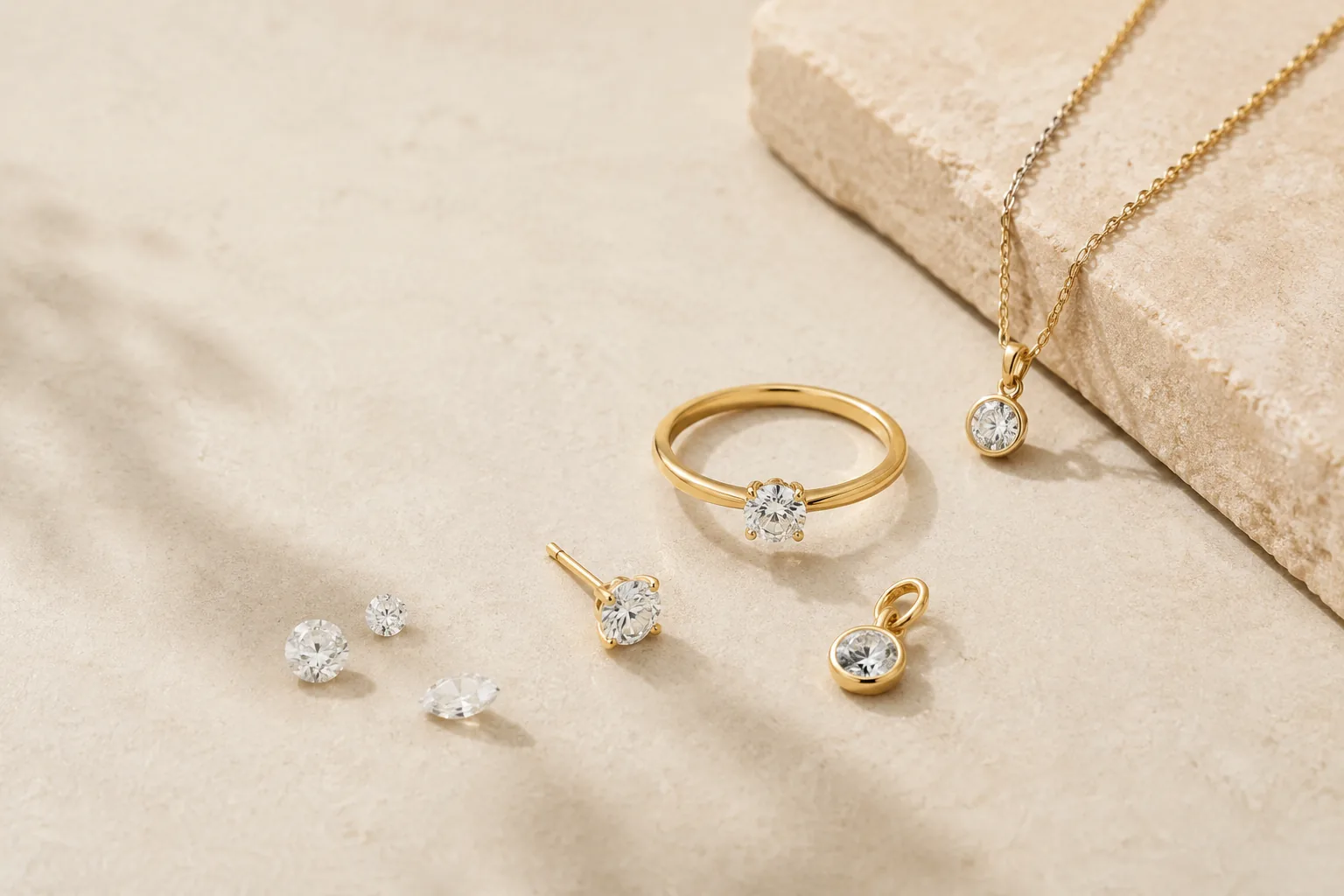
If you are comparing Mejuri, Monica Vinader, Missoma, and Pandora lab-grown diamond jewelry, the hardest part is not finding color and clarity claims. It is working out what those claims actually cover.
A brand may publish a lab-grown diamond standard, but that does not automatically mean every ring, charm, pendant, pavé detail, or tiny accent stone comes with its own grading report. It also does not mean that “certified,” “traceable,” “SCS,” “IGI,” and “renewable electricity” are interchangeable claims.
This comparison focuses on what the checked official sources say about lab-grown diamond color, clarity, cut, growth method, size or carat thresholds, and certification-related language. The analysis is evidence-constrained: where a brand page does not clearly promise an individual report for every finished jewelry item, this article does not assume one exists.
Quick Comparison: Which Brand Gives the Clearest Lab-Grown Diamond Specs?
Based on the checked sources, Pandora gives the most specific cut disclosure, while Missoma gives the clearest caveat about small pavé diamonds not being individually certified.
Pandora states that its lab-grown diamonds are VS+ quality or above for clarity and G-J near-colorless for color. It also says lab-grown diamonds 0.10 carat and above are round brilliant or square princess excellent cut, reflecting IGI standards. That makes Pandora the clearest of the four on formal cut language for a stated stone-size threshold, although the checked sources do not clearly state that every finished jewelry item ships with an individual IGI report.
Missoma discloses G/H color and VS+ clarity for lab-grown diamonds, says color, clarity, and total carat weight appear on individual product pages, and explicitly states that pavé-set jewelry diamonds are much smaller, approximately 0.8 mm each, and are not individually certified. That caveat is useful because pavé and accent stones are common in accessible fine jewelry, and they are easy to over-interpret if a shopper assumes every small stone has separate paperwork.
Mejuri discloses VS clarity grade and FG color grade for lab-grown diamonds on its materials page. It also names CVD as the growth method. The checked Mejuri source does not name IGI, GIA, or another grading laboratory, and does not clearly promise individual grading reports for all lab-grown diamond pieces.
Monica Vinader discloses VS clarity and G/H colour for its lab-grown diamonds, and states that its lab-grown diamonds are 1.1 mm, compared with mined diamonds that are mostly 0.8 mm. It says diamonds are graded for cut, clarity, color, and carat, and says its diamonds are cut for brilliance, but the checked page does not provide a formal cut-grade value such as Excellent or Very Good. It also mentions SCS-007 certified growers and Altr, but the checked page does not clearly promise an individual diamond grading report for each item.
| Brand | Color Disclosure | Clarity Disclosure | Cut Disclosure | Growth Method | Certification-Related Language |
|---|---|---|---|---|---|
| Mejuri | FG | VS | No formal cut-grade value found in checked source | CVD | Checked page does not name IGI, GIA, or promise individual reports for all pieces |
| Monica Vinader | G/H | VS | “Cut for brilliance,” but no formal cut-grade value found in checked source | Not disclosed in checked source | Mentions SCS-007 certified growers and Altr; no clear universal item-level report promise found |
| Missoma | G/H | VS+ | Round Brilliant Cuts; single 16-facet and full 57-facet versions, not a formal cut grade | Not disclosed in checked source | Says pavé-set jewelry diamonds are not individually certified; product pages show color, clarity, and total carat weight |
| Pandora | G-J near-colorless | VS+ quality or above | 0.10 ct and above: round brilliant or square princess excellent cut, reflecting IGI standards | CVD | Says collection features IGI-certified stones; checked pages do not clearly state every finished item ships with an individual IGI report |
How to Read Color, Clarity, Cut, Carat, and Certification Claims
The Gemological Institute of America defines the 4Cs as color, clarity, cut, and carat weight. GIA explains color as measuring absence of color, clarity as considering inclusions and blemishes, cut as describing fire, brilliance, and proportions, and carat as measuring weight.
For a shopper, the important point is that these are separate comparison categories. A diamond can have a strong clarity disclosure and a limited cut disclosure. A brand can describe the shape or facet pattern without giving a formal cut grade. A collection can make a certification-related claim without promising a buyer-facing individual report for every tiny stone.
Color and Clarity Are Easier to Compare Than Cut
Color and clarity are the cleanest comparison points in this research package because all four brands disclose some form of lab-grown diamond color and clarity standard in official sources.
Even here, the comparison is not perfect. “FG,” “G/H,” and “G-J near-colourless” are different ranges. “VS,” “VS+,” and “VS+ quality or above” are also not identical phrases. The practical analysis is that all four brands are presenting lab-grown diamonds in the near-colorless and VS-type clarity territory, but the exact disclosed range differs by brand.
Shape, Cut Style, and Cut Grade Are Not the Same
“Round brilliant” and “princess” describe diamond shape or cut style. Facet count describes how the diamond is arranged physically. A formal cut-quality grade, such as Excellent, is a more specific grading claim.
That distinction matters in this comparison. Pandora provides an excellent-cut claim for lab-grown diamonds 0.10 carat and above, tied to round brilliant or square princess stones and IGI standards. Missoma’s round brilliant and facet-count language is useful product description, but based on the checked source, it should not be treated as a formal cut grade. Monica Vinader’s “cut for brilliance” language is also not the same as a formal cut-grade value.
A Grading Report Is More Specific Than a Brand Standard
GIA’s laboratory-grown diamond report explanation says a report identifies the stone as lab-grown, laser-inscribes the report number and disclosure on the girdle, and provides measurements and 4Cs details. That is different from a general brand page saying a collection uses lab-grown diamonds of a certain color and clarity.
The FTC Jewelry Guides state that it is unfair or deceptive to misrepresent type, grade, quality, weight, cut, color, origin, or other material aspects of jewelry products. They also state that if a grade representation is made, the identity of the grading system should be disclosed. This does not mean every jewelry item must have an individual report; rather, it shows why the scope of grading language matters.
Mejuri Lab-Grown Diamond Specs
Mejuri’s official materials page includes a “Lab Grown Diamonds” section and separates lab-grown diamonds from natural diamonds. Mejuri states that its lab-grown diamonds have the same physical and chemical properties as natural diamonds.
For growth method, Mejuri is one of the clearer brands in this group. Its materials page states that its lab-grown diamonds are created using CVD, describing a diamond seed exposed to carbon-rich gases in a vacuum chamber.
For specs, Mejuri discloses VS clarity grade and FG color grade for lab-grown diamonds on its materials page. For a beginner shopper, that is a useful brand-level baseline: you can see both color and clarity without having to infer them from product imagery.
The limitation is certification scope. The checked Mejuri materials page does not name IGI, GIA, or another grading laboratory and does not promise individual grading reports for all lab-grown diamond pieces. That does not mean no Mejuri product could ever have additional documentation; it means the checked brand-level source should not be read as a universal individual-certificate promise.
Analysis: Mejuri is relatively clear on color, clarity, and CVD growth method. It is less clear, from the checked source, on formal cut grade and item-level report availability. A shopper comparing Mejuri against Pandora or Missoma should open the exact product page and look for whether the specs apply to the whole piece, the main diamond, or a total group of stones.
Monica Vinader Lab-Grown Diamond Specs
Monica Vinader’s official lab-grown diamond guide uses lab-grown diamond terminology and says lab-grown diamonds are physically, chemically, and optically comparable or identical to mined diamonds.
The brand discloses VS clarity and G/H colour for its lab-grown diamonds. It also states that its lab-grown diamonds are 1.1 mm, compared with mined diamonds that are mostly 0.8 mm. That size statement is notable because many accessible jewelry pieces use small diamonds where millimeter size can matter visually as much as headline carat language.
On cut, Monica Vinader says diamonds are graded for cut, clarity, color, and carat, and says its diamonds are cut for brilliance. However, the checked page does not provide a formal cut-grade value such as Excellent or Very Good. For comparison purposes, “cut for brilliance” is a brand description, not a directly comparable cut grade.
On certification-related language, Monica Vinader mentions SCS-007 certified growers and Altr. The checked page does not clearly promise an individual diamond grading report for each item.
Analysis: Monica Vinader gives usable color and clarity standards and a helpful small-stone size disclosure. Its certification language should be read carefully. SCS-007 certified grower language is not the same claim as an IGI or GIA individual diamond grading report, and the checked source does not make a universal item-level report promise.
Missoma Lab-Grown Diamond Specs
Missoma’s official diamonds page covers lab-grown diamonds, natural diamonds, and cubic zirconia. That mixed scope is important: Missoma’s lab-grown diamond specs should not be applied to all Missoma diamond, natural diamond, or diamond-alternative products.
For lab-grown diamonds, Missoma discloses G/H color and VS+ clarity. It separately states that its natural diamonds have G/H color and minimum I2 clarity, so shoppers should keep the lab-grown and natural diamond sections distinct.
Missoma also states that its lab-grown diamonds are “100% traceable” and come from SCS Global or an SCS certified supplier. This is an official brand claim from the checked source; this article does not independently verify the traceability or supplier-certification claim beyond attributing it to Missoma.
On cut language, Missoma says it works with Round Brilliant Cuts in single 16-facet and full 57-facet versions. That is shape and facet-format language. It should not be converted into a formal cut-quality grade unless the product page or grading documentation gives that grade.
Missoma is especially clear on one certification limitation: pavé-set jewelry diamonds are much smaller, approximately 0.8 mm each, and are not individually certified. Missoma also states that color, clarity, and total carat weight appear on individual product pages.
Analysis: Missoma gives one of the most useful practical disclosures for shoppers because it addresses pavé certification directly. Its color and clarity specs are clear for lab-grown diamonds, and its instruction to check product pages for color, clarity, and total carat weight helps prevent overgeneralizing from a brand overview.
Pandora Lab-Grown Diamond Specs
Pandora’s official blog uses the term “Pandora Lab-Grown Diamonds.” Pandora states that its lab-grown diamonds are optically, chemically, thermally, and physically identical to mined diamonds. It also identifies CVD as the process used for Pandora lab-grown diamonds in the checked official blog FAQ.
For color and clarity, Pandora discloses VS+ quality or above for clarity and G-J near-colourless for color. Compared with Mejuri’s FG and Monica Vinader’s or Missoma’s G/H, Pandora’s color range is wider in the checked source.
Pandora gives the most specific formal cut disclosure in this comparison. Its official blog states that lab-grown diamonds 0.10 carat and above are round brilliant or square princess excellent cut, reflecting IGI standards. That matters because the claim is tied to both a carat threshold and cut-quality language.
Pandora’s official collection page includes product listings from 0.007 ct to 1.75 ct and defines petite lab-grown diamonds as stones under 0.10 ct. The same collection page repeats that Pandora uses CVD, knows each stone’s origin, and certifies according to the 4Cs.
On certification language, Pandora’s official blog says the collection features IGI-certified stones. However, the checked page does not clearly state that every finished jewelry item ships with an individual IGI report.
Analysis: Pandora is the strongest of the four on cut specificity for stones 0.10 carat and above. Its weaker point, from a buyer-documentation perspective, is that the checked sources do not clearly turn “features IGI-certified stones” into a universal promise that every finished item arrives with an individual IGI report. For very small stones under 0.10 ct, shoppers should be especially careful to read the individual product page.
Where the Specs Compare Cleanly and Where They Do Not
The cleanest comparison is color and clarity. Mejuri discloses FG color and VS clarity. Monica Vinader discloses G/H colour and VS clarity. Missoma discloses G/H color and VS+ clarity for lab-grown diamonds. Pandora discloses G-J near-colourless color and VS+ quality or above.
Growth method compares less evenly. Mejuri and Pandora name CVD in the checked sources. The checked Monica Vinader and Missoma pages do not disclose CVD or HPHT for their stones.
Cut is the least even comparison. Pandora provides an excellent-cut claim for lab-grown diamonds 0.10 carat and above. Missoma provides round brilliant and facet-count language. Monica Vinader uses cut-for-brilliance language. Mejuri’s checked materials page does not provide a formal cut-grade value in the facts supplied.
Certification-related language is also uneven because the brands are not making the same type of claim. Missoma discusses SCS Global or an SCS certified supplier and says pavé-set jewelry diamonds are not individually certified. Monica Vinader mentions SCS-007 certified growers and Altr. Pandora mentions IGI-certified stones and certifying according to the 4Cs. Mejuri’s checked page does not name a grading lab.
Analysis: these disclosures are useful, but they do not create a simple “highest specs equals best value” ranking. Value also depends on stone size, whether carat weight is total or center-stone weight, metal, setting complexity, design, service policies, return terms, and whether documentation is available for the exact item.
Does Brand-Level Disclosure Mean Every Piece Has a Certificate?
No. A brand-level lab-grown diamond standard does not automatically mean every product includes an individual grading certificate.
A grading report is a specific document for a specific stone. GIA’s laboratory-grown diamond report explanation says a report identifies the stone as lab-grown, includes measurements and 4Cs details, and involves laser inscription of the report number and disclosure on the girdle. That is more specific than a brand saying its lab-grown diamonds meet a color and clarity standard.
In this comparison, Missoma gives the clearest explicit caveat by stating that pavé-set jewelry diamonds are much smaller, approximately 0.8 mm each, and are not individually certified. Mejuri’s checked materials page does not clearly state whether every lab-grown diamond jewelry item includes an individual grading report or certificate. Monica Vinader’s checked page also does not clearly state whether every lab-grown diamond jewelry item includes an individual grading report or certificate. Pandora’s checked blog and collection pages do not clearly state that every finished jewelry item ships with an individual IGI report.
The practical distinction is this:
| Claim Type | What It Can Tell You | What It Does Not Automatically Prove |
|---|---|---|
| Brand-level color and clarity standard | The brand’s stated general quality range | That every stone has an individual report |
| Product-page specs | Specs for that specific item, depending on wording | That each accent stone is separately graded |
| Supplier or grower certification | A claim about supplier or grower standards | A diamond grading report for your exact stone |
| Traceability or renewable-energy claim | A sourcing or production-related claim | Color, clarity, cut grade, or individual report availability |
| IGI or GIA report | A grading document for a specific stone when provided | That all other stones in the piece have the same documentation |
The FTC Jewelry Guides say that if a grade representation is made, the identity of the grading system should be disclosed. For shoppers, the practical suggestion is to look for the grading system, the lab name when relevant, and whether the report applies to the center stone, all stones, or only stones above a certain size.
What to Check on Product Pages Before You Compare Value
Before comparing two lab-grown diamond pieces by price or style, read the exact product pages. Brand-level pages are helpful, but product pages are where the relevant scope often becomes clearer.
First, check whether the color and clarity specs are listed for the individual product. Missoma states that color, clarity, and total carat weight appear on individual product pages. Pandora’s collection page includes product listings from 0.007 ct to 1.75 ct and defines petite lab-grown diamonds as stones under 0.10 ct, which is a reminder that stone size can vary widely within one brand collection.
Second, check whether the carat weight is total carat weight or the weight of a main stone. Total carat weight can include many small stones. A total-weight pavé ring and a single-stone ring are not visually or structurally the same comparison, even if both use lab-grown diamonds.
Third, check whether the specs apply to every diamond, only the principal stone, or only stones above a threshold. This is especially important for pavé, halo, tennis, and cluster styles. The FTC Jewelry Guides warn that “flawless” claims for jewelry with supplementary stones need scope disclosure if only principal diamonds are flawless; the broader shopping lesson is that scope matters whenever a piece has multiple stones.
Fourth, separate cut grade from shape. Round brilliant and princess are not the same as a formal cut grade. Facet count is useful descriptive information, but it should not be treated as a cut-quality grade unless the product documentation says so.
Fifth, check the report language. If a page says “certified,” identify what is certified and by whom. Is it an individual stone report, a collection-level statement, a supplier certification, a grower certification, or a traceability claim? These can all be meaningful, but they answer different questions.
Finally, compare the setting and metal alongside the diamond specs. A higher disclosed clarity range does not automatically make one piece better value if the other piece has more gold weight, a more complex setting, a different total carat structure, or a return policy that better fits the purchase.
Conclusion: The Clearest Specs Depend on Which Disclosure You Care About
If your priority is formal cut disclosure, Pandora is the clearest in the checked sources because it states that lab-grown diamonds 0.10 carat and above are round brilliant or square princess excellent cut, reflecting IGI standards.
If your priority is avoiding certificate assumptions for small stones, Missoma is the clearest because it explicitly says pavé-set jewelry diamonds are not individually certified and directs shoppers to product pages for color, clarity, and total carat weight.
If your priority is a simple brand-level color, clarity, and growth-method baseline, Mejuri is straightforward: VS clarity, FG color, and CVD growth method are disclosed on its official materials page. Monica Vinader also gives usable color and clarity information, plus a stated 1.1 mm lab-grown diamond size, but the checked page does not provide a formal cut-grade value or universal individual-report promise.
The safest buying approach is to use brand-level specs as a starting map, not the final proof. For the exact piece you are considering, check color, clarity, cut or shape language, carat scope, stone size thresholds, metal, setting, return terms, and whether any individual grading report is actually included.
Jewelry care recommendations vary by material, treatment, and setting. Always follow brand or jeweler care instructions for your specific piece. Return rights, hallmarking, and product-labeling rules vary by country. Check current seller policies and local regulations before purchase. Hands-on testing is claimed only when the article documents the testing process and evidence.
Sources
- Jewelry Materials & Quality | Mejuri
- Lab Grown Diamonds: A Guide | Monica Vinader
- Discover Our Diamonds | Missoma US
- What are lab-grown diamonds? | Pandora US
- Certified & Affordable Lab Grown Diamonds | Pandora US
- What are the 4Cs? | GIA
- Laboratory-Grown Diamond Report | GIA
- 16 CFR Part 23: Guides for the Jewelry, Precious Metals, and Pewter Industries | eCFR