



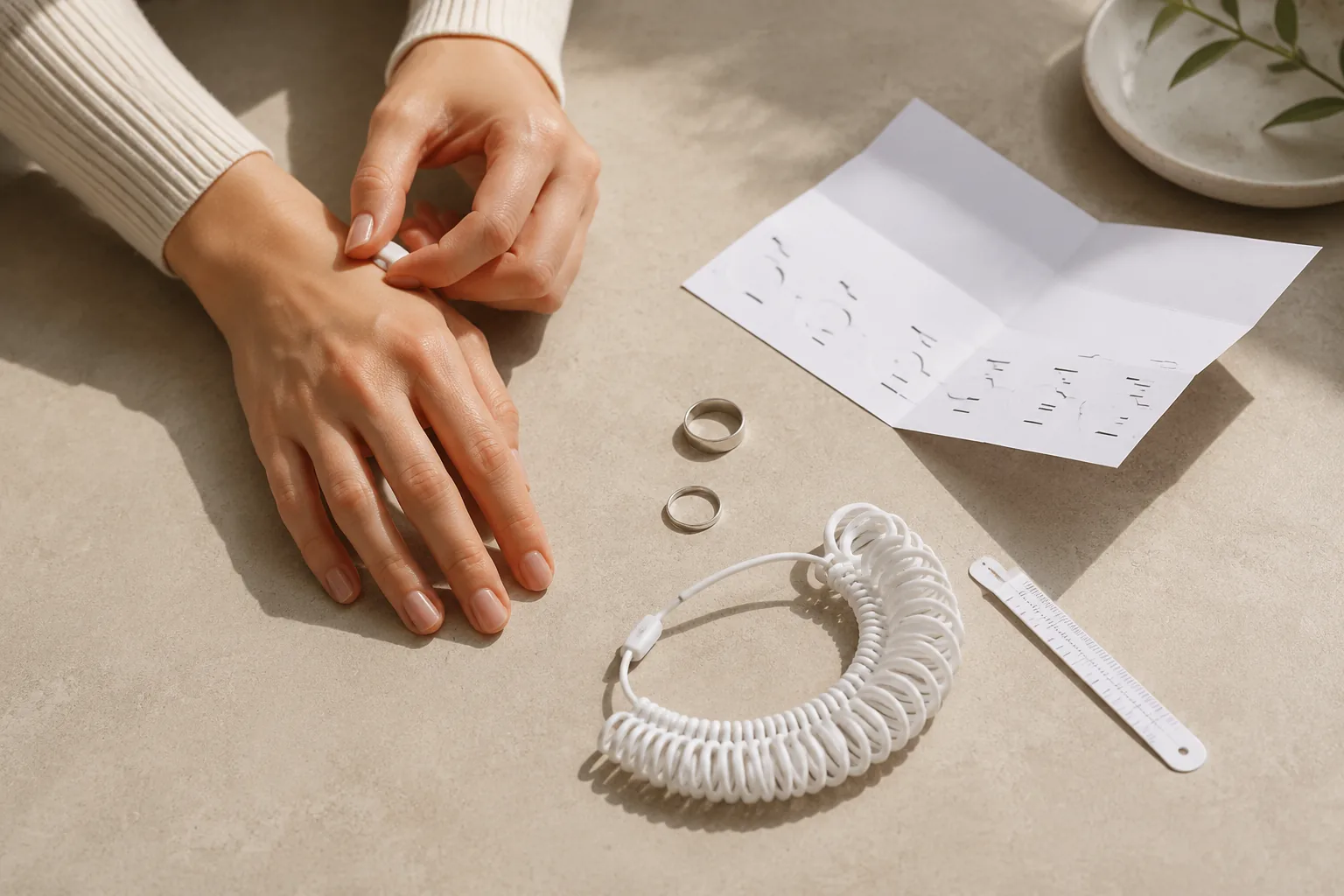
You need a ring size before you order online, but the method you choose should depend on the purchase. A low-cost stackable ring with easy exchanges does not carry the same sizing risk as an engraved wedding band, a wide statement ring, an eternity band, or a surprise engagement ring.
The practical answer is not that one at-home method is always best. A mailed or plastic ring sizer is usually the strongest at-home choice when you have time, especially for your own finger. An existing ring can work well for a secret gift if it fits the exact intended finger and is still round. A printable chart can be useful, but only if the scale is verified. Paper or string wrapping is better treated as a backup method, not the highest-confidence route for a hard-to-resize purchase.
This guide compares how to measure ring size at home using official sizing guidance from Brilliant Earth, Blue Nile, James Allen’s redirected sizing content, Missoma, Pandora, ISO, GIA, and Mayo Clinic. Where this article makes a practical recommendation, it is labeled as analysis or advice rather than presented as a tested accuracy claim.
Quick Answer: Which At-Home Ring Sizing Method Should You Use?
Use the lowest-risk method your timeline allows. The more expensive, customized, wide, or difficult-to-resize the ring is, the more you should favor a physical sizing tool or professional help.
| Buying situation | Best at-home method | Confidence level | Main caution |
|---|---|---|---|
| Buying for yourself and you have several days | Mailed or plastic ring sizer | Higher | Measure the exact finger more than once |
| Buying for yourself today | Printable chart plus repeated finger measurement | Medium | Print at 100% and verify scale |
| Replacing a ring that already fits | Measure the existing ring | Medium to higher | Ring must fit the same finger and be round |
| Secret gift or engagement ring | Borrow an existing ring if possible | Medium | Must be for the intended finger and hand |
| Wide band, eternity band, engraved, final sale, or made-to-order | Physical sizer or local jeweler | Lower risk | Do not assume resizing or returns are available |
| No printer, no existing ring, tight deadline | Paper or string circumference | Backup only | Repeat and check seller policies carefully |
| App or screen-based sizing | Not recommended as a primary method here | Unclear | Reviewed retailer sources do not support it enough |
Brilliant Earth offers a free reusable mailed ring sizer described in the research report as belt-like, while Blue Nile’s ring guide links to free men’s and women’s ring sizers. The crawled James Allen URL content reportedly offered a mailed plastic sizer, printable ring sizer, and conversion chart, although the requested James Allen URL redirected to a Blue Nile page with jaRedirect=true. Pandora links to a Pandora Ring Sizer, and Missoma gives printable/downloadable sizing paths.
For professional context, ISO 8653:2016 is an international standard for jewelry ring-size definition, measurement, and designation, and it specifies ring measurement using a ring stick. GIA supports proper tools and techniques for accurate finger and ring measurement. That does not mean every home sizer is perfect, but it does support the general advice that a physical gauge-style tool is a stronger starting point than guessing from an uncalibrated screen.
Before You Measure: The Fit Rules Most Brands Agree On
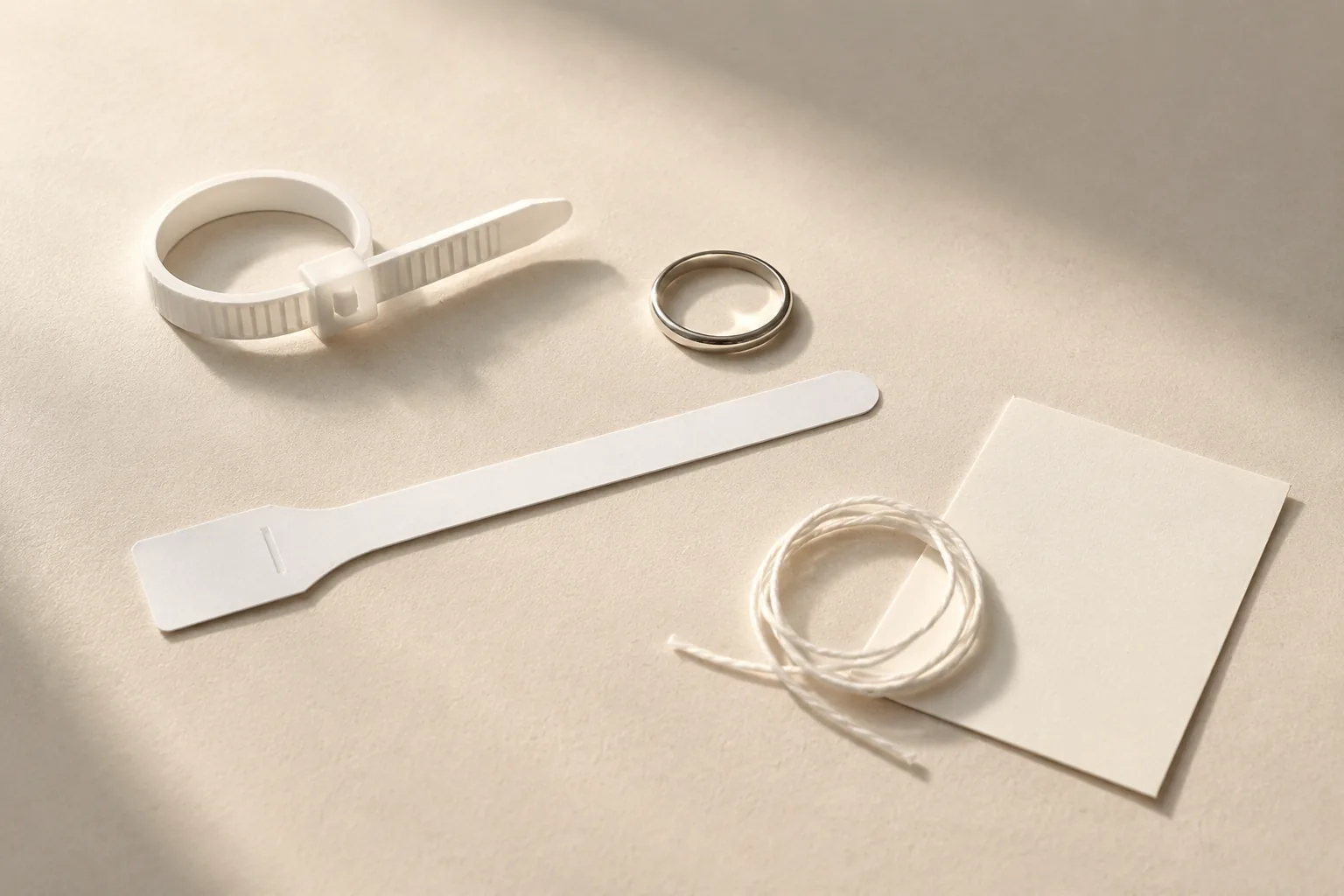
No measurement method works well if the conditions are wrong. The official brand guidance reviewed for this article commonly supports several cautions: measure the intended hand and finger, avoid cold-finger sizing, measure more than once, check the time of day, and choose a larger size when between sizes where the seller’s guide says to do so.
Brilliant Earth specifically recommends measuring the exact intended hand and finger because dominant and nondominant hands can differ. It also recommends measuring more than once at different times, including the middle or end of the day, and accounting for temperature, activity, and hydration.
Missoma advises measuring at the end of the day, says cold weather can shrink fingers by half a size, says hot weather can swell fingers, and recommends choosing the larger size if between sizes. Pandora also recommends choosing the next size up if between sizes.
There is a reasonable physiological basis for some of this advice. Mayo Clinic states that hand swelling during exercise is common, heat regulation can push blood toward the skin and make hands swell, and rings should be removed before exercise. That source is not a jewelry sizing study, so the practical jewelry takeaway is limited: your finger size can change with conditions, and one rushed measurement after cold exposure, heat, or activity may be less representative.
A Good Fit Should Pass Over the Knuckle
Analysis: for most rings, a practical fit should slide over the knuckle with some resistance and sit comfortably at the base of the finger without feeling loose enough to fall off. If your knuckle is much larger than the base of your finger, a single paper measurement around the base may understate the size needed to get the ring on and off.
That is one reason repeated measuring matters. It is also why the method that feels convenient may not be the safest method for a ring that cannot easily be changed later.
Method 1: Mailed or Plastic Ring Sizer
A mailed or plastic ring sizer is the strongest at-home option when time allows, especially if you are measuring your own finger for an online purchase. This is a practical recommendation based on the reviewed sources, not a claim from independent comparative testing.
Brilliant Earth offers a free reusable mailed ring sizer. Blue Nile’s ring guide links to a ring size guide with free men’s and women’s ring sizers. The crawled content from the redirected James Allen URL reportedly offered a free mailed plastic ring sizer. Pandora links to the Pandora Ring Sizer.
The advantage is simple: a physical sizer lets you try sizes on the actual finger instead of inferring size from a screen, ruler, or strip of paper. ISO’s ring-size standard refers to measurement using a ring stick and notes that jeweler-consumer finger sizing uses a finger gauge set with rings matching the ring-stick diameter and tolerance. GIA also supports the use of proper tools and techniques for accurate finger and ring measurement.
There are still limits. The research package does not confirm whether mailed sizers are free in every region or available for every brand, market, or product category. Always check the seller’s current page before depending on delivery timing or availability.
How to Use a Plastic Sizer More Carefully
Analysis and advice:
- Measure the exact finger on the exact hand where the ring will be worn.
- Measure when your hands are at a normal temperature, not immediately after cold exposure, heat, or exercise.
- Try nearby sizes, not just the first one that closes.
- Repeat later in the day or on another day if the purchase has high sizing risk.
- If the ring is wide, thick, stacked, or hard to resize, check the seller’s specific width guidance before ordering.
A physical sizer is still not the same as having a jeweler evaluate ring width, knuckle shape, and ring construction. For high-risk purchases, it is often the best at-home step before either ordering or visiting a local jeweler.
Method 2: Printable Ring Size Chart
A printable ring size chart can be useful when you need speed, but it is calibration-dependent. Do not trust a printed chart unless the scale has been checked.
The crawled content from the redirected James Allen URL instructs users to print at 100% scale and verify a millimeter reference line. Missoma’s finger-measurement method asks users to print or download the guide, confirm scale using marked lines A and B, cut the paper sizer and slit, loop it on the finger, read the letter, and match the table.
That shared instruction matters. If your printer shrinks the page to fit, adds scaling, or prints from a preview mode that changes dimensions, the chart can point you to the wrong size. This article does not have independent measured accuracy data comparing printable charts with physical sizers, so the responsible position is narrower: printable charts are usable only when the seller’s calibration instructions are followed.
When a Printable Chart Is a Reasonable Choice
Analysis: a printable chart is more reasonable when the ring is returnable or exchangeable, the style is not especially wide, the ring is not engraved or final sale, and you can verify the chart scale with a ruler. It is also more useful when you combine it with repeated measurements rather than relying on one result.
It is less appropriate as the only method for a wide band, eternity band, alternative metal ring, heavily personalized ring, or any piece where the seller says resizing may be limited.
Method 3: Measuring an Existing Ring That Already Fits
Measuring an existing ring can be one of the most practical methods for secret gifts, replacements, and surprise engagement-ring research. It is only reliable under specific conditions.
Blue Nile says existing jewelry can help size someone else and recommends visiting local stores for expert help. Missoma gives a sizing path based on measuring a ring the user owns. Its existing-ring method asks users to measure internal diameter and place the ring on the chart to find the UK letter size. Pandora’s US ring guide says users can measure either finger circumference or the diameter of a ring they already own, then use the chart.
GIA adds an important technical caution: inside-ring measurement from a chart requires the ring to be perfectly round. If the ring is bent, out of round, or worn unevenly, its internal diameter may mislead you.
When Existing-Ring Measurement Works Best
Analysis and advice: this method is strongest when the ring already fits the exact same finger on the same hand, has a similar width to the new ring, and can be measured on the inside diameter without distortion.
For a surprise gift, avoid using a ring from the wrong hand unless you have no better option and the seller’s return or exchange policy makes the risk acceptable. Brilliant Earth notes that dominant and nondominant hands can differ, which is why a right-hand ring may not translate cleanly to a left-hand ring.
Existing-ring measurement is weaker for wide bands if the comparison ring is very narrow. GIA distinguishes ring features including narrow, wide, tapered, convex, open-space, and bridal-set features when determining ring size. That means the number on a chart is only part of the decision; the new ring’s shape can change how it feels.
Method 4: Measuring Your Finger With Paper, String, or Circumference
Paper or string wrapping is the backup method: useful when you have no sizer, no existing ring, and no time, but not the highest-confidence option for a high-risk order.
The redirected James Allen crawled content includes string or paper wrapping, inside diameter measurement, end-of-day or warm-finger measurement, and repeated measurements. Missoma’s printable finger method uses a cut paper sizer. Pandora’s guide includes circumference tables, and its ring guide says users can measure finger circumference or the diameter of a ring they already own, then use the chart. Pandora’s tables include diameter and circumference with US, UK, and European sizes.
The limitation is that paper and string can stretch, twist, sit too tightly, or sit too loosely. A string can also compress into the skin more than a ring would. The research package does not provide independent accuracy validation showing that paper or string wrapping is as reliable as a mailed plastic sizer or professional sizing.
How to Reduce Risk If You Must Use String or Paper
Advice:
- Use the seller’s own chart for the ring you are buying.
- Wrap the finger snugly but not tightly.
- Mark the overlap cleanly and measure against a ruler in millimeters if the chart uses millimeters.
- Repeat several times and at a normal hand temperature.
- If between sizes, follow the seller’s guide; Missoma and Pandora both advise choosing the larger size in that situation.
- Check return, exchange, engraving, and resizing terms before ordering.
What Changes the Size You Should Order?
A measured size is not always the size you should order. Ring width, stacking, hand changes, temperature, dominant-hand differences, knuckle size, and construction can all change the fit.
Brilliant Earth says wide bands over 4 mm fit tighter and suggests sizing up at least half a size. It also says very thin designs under 1.3 mm may call for sizing down. Pandora says statement rings fit more snugly and advises considering one size up for wide-band styles. GIA says rings wider than 4 mm should use wide-finger sizing gauges.
These sources do not create a universal rule that every wide ring must be ordered exactly half a size or one full size larger. The more careful interpretation is that wide rings deserve extra caution, and a wide-band gauge or seller-specific guidance is better than applying a fixed adjustment to every ring.
Stacking also matters. Pandora says stacking changes fit and points users to returns, exchanges, and customer service. Analysis: several rings worn together can feel tighter than a single narrow ring because more metal covers the finger.
Temperature and body conditions matter too. Missoma says cold weather can shrink fingers by half a size and hot weather can swell fingers. Brilliant Earth recommends accounting for temperature, activity, and hydration. Mayo Clinic supports the broader point that heat regulation and exercise can be associated with hand swelling.
Special Cases: Wide Bands, Eternity Bands, Engraving, Final Sale, and Tight Deadlines
Some purchases leave less room for sizing mistakes. In those cases, your method should become more conservative.
Blue Nile warns that some ring metals or designs, including eternity bands, may not be resizable. Pandora says statement rings fit more snugly and suggests considering one size up for wide-band styles. GIA recommends wide-finger sizing gauges for rings wider than 4 mm.
Analysis: if you are ordering an eternity band, engraved ring, alternative metal ring, made-to-order ring, final-sale item, or a ring with limited resizing options, a paper or string measurement is usually too much risk unless the seller’s policy makes the possible mistake acceptable to you. A mailed plastic sizer, local jeweler visit, or seller-specific sizing support is more appropriate.
For tight deadlines, the tradeoff changes. A printable chart may be the fastest reasonable method if you can verify scale, repeat the measurement, and accept the seller’s return or exchange terms. If the ring is for a proposal, ceremony, or time-sensitive gift, also consider whether ordering a temporary presentation ring, placeholder size, or returnable style is safer than rushing a final-size custom piece. That is practical buying analysis, not a sourced brand policy.
US, UK, EU, and International Ring Size Charts: What They Can and Cannot Tell You
Ring size charts can help translate between systems, but they should not be treated as universally exact across all sellers unless the seller confirms the applicable chart.
Missoma’s chart includes internal diameter in millimeters plus UK, US, EU, and China conversions. Pandora’s ring guide includes diameter and circumference tables with US, UK, and European sizes. ISO 8653:2016 is an international standard for jewelry ring-size definition, measurement, and designation, and the report says it was confirmed in 2021 and was under systematic review as of July 15, 2026.
The practical caution: use the chart supplied by the brand or retailer selling the ring. If a US size, UK letter, EU number, or millimeter measurement appears slightly different across charts, do not assume one conversion overrides the seller’s sizing system. The research package does not verify tolerance limits or prove that every international conversion table is exact across all brands.
Brand Notes: What the Checked Official Sources Say
Brilliant Earth has an official page titled around its free ring sizer, and the report says the page was updated June 30, 2026. The page offers a free reusable mailed ring sizer and gives fit guidance including exact-finger measurement, repeated measuring, time-of-day considerations, wide-band guidance, and thin-band guidance.
Blue Nile’s provided official URL is a ring buying guide rather than the detailed sizing chart itself. It states that Blue Nile sells ring categories including gemstone rings, diamond and plain bands, stackable rings, signet rings, cocktail rings, fashion rings, men’s rings, customizable rings, engagement rings, and wedding rings. The guide links to a ring size guide with free men’s and women’s ring sizers, warns that some ring metals or designs may not be resizable, and says existing jewelry can help size someone else.
The requested James Allen URL reportedly redirects to a Blue Nile page with jaRedirect=true. The crawled content connected to that URL offered a free mailed plastic ring sizer, printable ring sizer, conversion chart, printable scale verification, existing-ring matching, string or paper wrapping, inside diameter measurement, and repeated measurement instructions. Because of the redirect ambiguity, this article does not treat that URL as a clean standalone James Allen sizing page.
Missoma’s official page is a Ring Size Guide for Missoma rings. It gives two sizing paths: measuring a ring the user owns or measuring the user’s finger with a downloadable guide. Its chart includes internal diameter in millimeters plus UK, US, EU, and China conversions.
Pandora’s US ring guide says users can measure either finger circumference or the diameter of a ring they already own, then use the chart. It includes diameter and circumference tables with US, UK, and European sizes, links to the Pandora Ring Sizer, recommends choosing the next size up if between sizes, and notes that statement rings and stacking can change fit.
What to Check Before You Buy the Ring Online
Before you order, check the current product page and seller policy rather than assuming all rings follow the same rules.
Use this checklist:
- Does the seller recommend a specific chart, downloadable guide, or ring sizer for this ring?
- Is the ring narrow, wide, stacked, convex, tapered, open-space, or part of a bridal set?
- Does the seller say the metal or design may not be resizable?
- Is the ring engraved, made to order, personalized, final sale, or subject to special return terms?
- Does the chart use US, UK, EU, China, diameter, or circumference sizing?
- If you are between sizes, does the seller recommend going up?
- Does the return or exchange policy still apply after engraving or customization?
- Is there enough time to request a physical sizer or visit a local jeweler?
Return rights, hallmarking, product-labeling rules, and seller policies vary by country and retailer. Check current seller policies and local regulations before purchase.
FAQ
Can I Trust an App or Screen-Based Ring Sizer?
Not as a primary method based on the checked evidence. The reviewed official retailer pages do not provide enough support to recommend uncalibrated app or screen-based sizing as the main method. A seller-specific printable chart with verified scale, a physical sizer, or an existing ring measurement is better supported by the sources reviewed here.
Is String Accurate Enough for Ring Sizing?
String can be useful as a backup, but it should not be treated as equal to a mailed plastic sizer or jeweler sizing. It can stretch, twist, or compress the finger. If you use string, repeat the measurement, use the seller’s chart, and avoid relying on it for a ring that is difficult to resize or return.
What Should I Do If I Am Between Sizes?
Follow the seller’s own guidance for the ring. Missoma advises choosing the larger size if between sizes, and Pandora recommends choosing the next size up. Wide, statement, and stacked rings may need extra caution because several official sources note that wider or statement styles can feel tighter.
Why Measure at the End of the Day?
Brand guidance reviewed here commonly supports end-of-day measurement and avoiding cold-finger sizing. Missoma says cold weather can shrink fingers and hot weather can swell fingers. Brilliant Earth recommends accounting for temperature, activity, and hydration. Mayo Clinic also notes that exercise and heat-related blood flow can make hands swell. The practical takeaway is to measure when your hands are closer to normal daily conditions, not at an obvious extreme.
Conclusion
The best way to measure ring size at home depends on the purchase risk. If you are buying for yourself and have time, request a mailed or plastic sizer and measure the intended finger more than once. If you already own a ring that fits the exact finger and hand, existing-ring measurement can be useful, especially for replacements or secret gifts, but the ring should be round and comparable in width. Printable charts can work when printed at 100% scale and checked against the guide’s reference marks. Paper or string is a fallback, not the safest choice for expensive, wide, engraved, final-sale, or hard-to-resize rings.
For the lowest-regret online order, match the method to the ring: the more limited the return, exchange, or resizing options, the more you should favor a physical sizer, seller guidance, or a local jeweler before buying.
Sources
- Brilliant Earth, “Free Ring Sizer”
- Blue Nile, “Rings”
- James Allen, “Online Ring Sizer”
- Missoma, “Ring Size Guide”
- Pandora US, “Ring Size Guide”
- ISO, “ISO 8653:2016”
- GIA, “Accurate Determination of Finger and Ring Size”
- Mayo Clinic, “Hand Swelling During Exercise: A Concern?”