



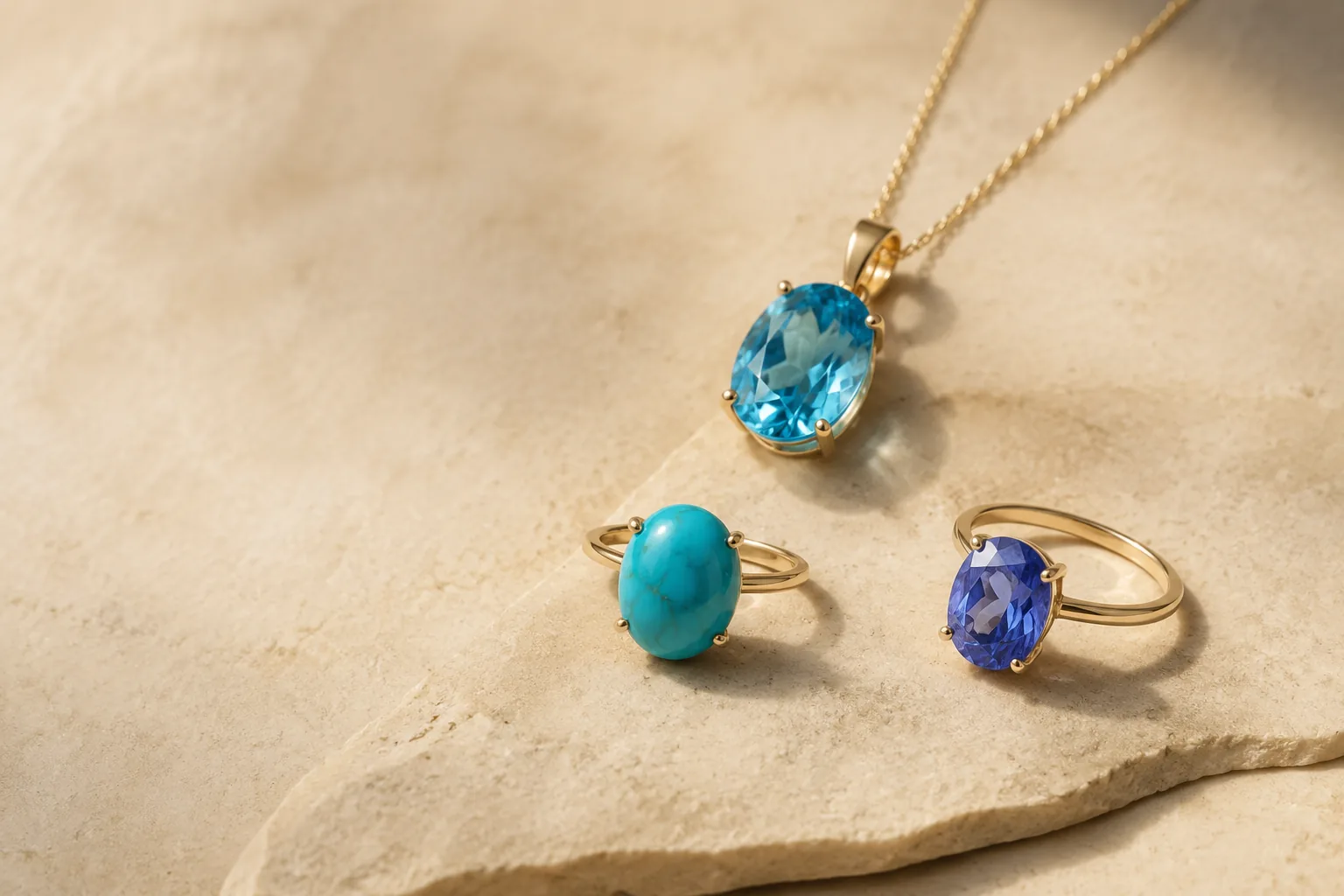
If you are buying December birthstone jewelry, the first decision is not color alone. It is whether you want a piece that matches a brand’s December edit, a traditional birthstone reference, or a specific gemstone identity such as turquoise, tanzanite, or blue topaz.
That distinction matters because December is unusually inconsistent across retailers. Some brands center blue topaz. Others present turquoise. Others use tanzanite, or mix several blue stones in the same collection language. GIA, by contrast, lists December birthstones as turquoise, tanzanite, and zircon. Blue topaz is common in retail, but it is not one of GIA’s listed December birthstones. That is the core tension in this category: merchandising language and gemstone convention are not always the same thing.
Why December Birthstone Jewelry Is Not Consistent Across Brands
December is one of the easiest birthstone months to misread if you shop by color first. Blue is the visual thread, but the stone identity behind that color can change from brand to brand.
Based on the official pages in the source set, the current December presentations differ like this:
- Mejuri presents December as Blue Topaz, and uses Swiss Blue Topaz in product naming.
- Pandora presents December as Turquoise and describes its birthstones as 100% man-made stones.
- Astrid & Miyu presents December as Tanzanite and also mixes tanzanite and CZ wording on the collection page.
- Missoma centers Turquoise, while also referencing tanzanite, zircon, and turquoise magnesite in December-related content.
- Blue Nile frames December as Blue Topaz, but also acknowledges turquoise, tanzanite, and zircon as historical associations.
- James Allen presents a Blue Topaz December collection with rings, pendants, stud earrings, and charms.
That spread is not a mistake. It reflects different commercial choices. Some brands are using a traditional birthstone name. Some are using a color story. Some are selling a collection that is symbolically December-adjacent rather than strictly aligned with a single gemological standard.
For readers, the practical takeaway is simple: the word “December” on a product page does not, by itself, tell you what the stone actually is.
What Each Brand Calls the December Birthstone
The best way to shop this category is to separate three things: the brand’s label, the stone identity, and the kind of wearer the piece suits.
Mejuri and James Allen: Blue Topaz as the retail answer
Mejuri’s December collection presents Blue Topaz and uses Swiss Blue Topaz in product naming. James Allen also presents a Blue Topaz December birthstone collection across multiple jewelry types.
That makes both brands useful for shoppers who want a clean, vivid blue look and are comfortable with a commercially common December option even though GIA does not list blue topaz as a December birthstone.
Pandora: Turquoise with a man-made framing
Pandora’s December birthstone page presents Turquoise and describes the birthstones as 100% man-made stones. That is an important distinction. It means the page should not be read as a straightforward natural-stone reference.
For a buyer, that framing may be useful if the goal is color and gifting symbolism rather than natural gem identity. It also means you should not assume the product content matches a natural turquoise standard.
Astrid & Miyu: Tanzanite, with some wording ambiguity
Astrid & Miyu presents December as Tanzanite, but the collection page also includes product naming that mixes tanzanite and CZ wording. CZ usually means cubic zirconia, a lab-created gem material used as a diamond simulant or decorative stone. That mixed wording is exactly why SKU-level verification matters.
A collection page can signal theme without fully resolving composition.
Missoma and Blue Nile: broader December language
Missoma’s December edit centers Turquoise but also references tanzanite, zircon, and turquoise magnesite. Blue Nile frames December as Blue Topaz and describes it as the most commonly purchased December birthstone while acknowledging turquoise, tanzanite, and zircon as historical associations.
Those pages show how retail language often works in practice: one brand may lead with the most commercially familiar blue stone, while another keeps the month open to a wider set of December-linked gems.
Turquoise: The Traditional Blue-to-Green Option
Turquoise is one of the three December birthstones listed by GIA. GIA describes it as blue to green, semi-translucent to opaque, porous, and commonly treated or stabilized, with a Mohs hardness of 5 to 6.
Those details matter because turquoise is not just a color. It has a structure and care profile that affects how it behaves in jewelry.
The most useful things to know are:
- Color range: turquoise can read blue, green-blue, or greenish.
- Transparency: it is commonly opaque rather than glassy or highly transparent.
- Porosity: it can absorb substances more readily than harder, denser gems.
- Treatment: it is commonly treated or stabilized.
- Hardness: at Mohs 5 to 6, it is less hard than many everyday gemstones.
For a buyer, that usually means turquoise is a better choice when you value its classic look and symbolic fit over the idea of an ultra-low-maintenance stone. It can work well in pendants, earrings, and pieces that are not exposed to the same abrasion as a daily ring.
That is analysis, not a universal rule. Turquoise jewelry can vary widely by setting, treatment, and construction, so the safest advice is to follow the specific care instructions for the piece you buy.
Tanzanite: A Violet-Blue December Birthstone
Tanzanite is also on GIA’s December birthstone list. GIA describes it as zoisite from Tanzania, violet-blue to violet-purple, pleochroic, often heat treated, and Mohs hardness of 6 to 7.
“Pleochroic” means the gem can show different colors from different viewing angles. That is one reason tanzanite can look more dynamic than many other blue stones.
For shoppers, the practical implications are:
- Color: tanzanite usually reads violet-blue rather than pure sky blue.
- Appearance: it can shift tone with angle and lighting.
- Treatment: heat treatment is common.
- Hardness: it is moderately hard, but still deserves careful wear.
Tanzanite tends to suit someone who wants a richer, more jewel-toned December look. It often feels more saturated and slightly more formal than turquoise or blue topaz. In buying terms, it is a good match for gifts where the color story is the point and the wearer is likely to treat the jewelry with some care.
Blue Topaz: Popular in Retail, but Different in Status
Blue topaz is the most commercially familiar December stone in many jewelry stores, and several brands in the source set present it that way. But GIA does not list blue topaz as a December birthstone.
That distinction matters for clear shopping language. Blue topaz can be an appropriate December gift choice. It can also be a better fit for buyers who want a bright blue stone with a more standardized retail presence. But it should not be described as the official GIA December birthstone without qualification.
Commercial blue topaz is often color enhanced or heat treated. That does not make it less valid as jewelry. It does mean the buyer should understand that the color may come from treatment rather than a naturally vivid blue body color.
In plain terms, blue topaz usually sits in the category of “looks like December, sells like December, but is not the same thing as the stones GIA lists for December.”
How to Choose by Color, Wear Context, and Gift Meaning
There is no universal best December stone. The right choice depends on what problem you are actually solving.
Choose turquoise if you want tradition and a softer blue-green look
Turquoise is the strongest fit if you want a stone with a classic December association and a color that can lean blue, green-blue, or green. It is also a sensible option if you are drawn to an opaque, organic look rather than a bright faceted blue.
Best for: symbolic gifting, vintage-leaning style, and buyers who like blue-green tones.
Less ideal for: people who want the hardest-wearing option or a transparent, highly sparkly gem.
Choose tanzanite if you want a richer violet-blue
Tanzanite is the strongest fit if the goal is color depth. Its violet-blue to violet-purple range gives it a distinct look that reads more distinctive than generic blue.
Best for: a more elevated color story, dressier pieces, and gifts where the gem identity itself matters.
Less ideal for: buyers who want the most casual wear profile or the simplest care routine.
Choose blue topaz if you want a bright, accessible blue
Blue topaz is the clearest fit if you want a retail-friendly blue stone that is easy to find in December collections. It is a practical match for buyers who care most about the color impression and the brand’s merchandising category, not strict birthstone convention.
Best for: vivid blue color, easy gifting, and shoppers comparing many December collections quickly.
Less ideal for: readers who want to match GIA’s listed December birthstones as closely as possible.
Choose man-made or color-led options if composition matters less than appearance
Pandora’s presentation is a good example of how December collections can be built around a stone look rather than natural-gem identity. If your priority is the visual story, not the geological one, that can be perfectly reasonable.
The key is not to mistake a man-made presentation for a natural-stone claim.
What to Check Before Buying December Birthstone Jewelry
The main risk in this category is not picking the “wrong” blue stone. It is assuming the label tells you more than it really does.
Before buying, check these points:
- Exact stone name: blue topaz, turquoise, tanzanite, zircon, or a color-led description.
- Natural or man-made status: especially relevant for Pandora’s birthstone framing.
- Treatment disclosure: stabilized turquoise, heat-treated tanzanite, or color-enhanced blue topaz.
- Product-level material details: do not rely only on the collection page if the SKU page gives more specificity.
- Care instructions: especially important for porous stones and treated stones.
- Setting and wear context: rings take more abrasion than pendants or earrings.
- Return policy and regional rules: return rights, hallmarking, and labeling rules vary by country.
This is where a careful buyer gets the most value. A product title may say “December birthstone,” but the actual purchase decision should be based on the stone’s identity, treatment, and how the piece will be worn.
Jewelry care recommendations vary by material, treatment, and setting. Always follow brand or jeweler care instructions for your specific piece. This content provides shopping and educational information, not medical advice. Consult a qualified clinician or dermatologist about persistent irritation or reactions. Return rights, hallmarking, and product-labeling rules vary by country. Check current seller policies and local regulations before purchase.
Frequently Asked Questions
Is blue topaz a December birthstone?
It is common in retail December collections, but GIA lists December birthstones as turquoise, tanzanite, and zircon. So blue topaz is best treated as a commercial December choice, not as the only authoritative answer.
Is turquoise always natural turquoise?
No. The source set does not support that assumption, and Pandora explicitly frames its birthstones as 100% man-made stones. You need SKU-level material disclosure to know what a specific product contains.
Is tanzanite harder than turquoise?
Yes, based on GIA’s published Mohs ranges, tanzanite is harder than turquoise. But hardness is only one part of wearability; setting, treatment, and daily use also matter.
Can I choose by color alone?
You can, but color alone does not tell you the stone identity. A blue piece may be blue topaz, turquoise, tanzanite, a man-made stone, or something else entirely. If the identity matters to you, check the product details.
Conclusion
If you are shopping December birthstone jewelry, the right starting point is not “Which blue stone is best?” It is “Which stone identity am I actually buying?”
Turquoise is the most traditional blue-green option in the authoritative set. Tanzanite offers a deeper violet-blue look and a more distinctive color profile. Blue topaz is the most common retail answer, but it is a commercial convention rather than GIA’s listed December birthstone. The safest purchase comes from matching the stone name, treatment, and wear context to the recipient, instead of trusting a month label alone.
That approach keeps the gift meaningful and the expectations realistic.