



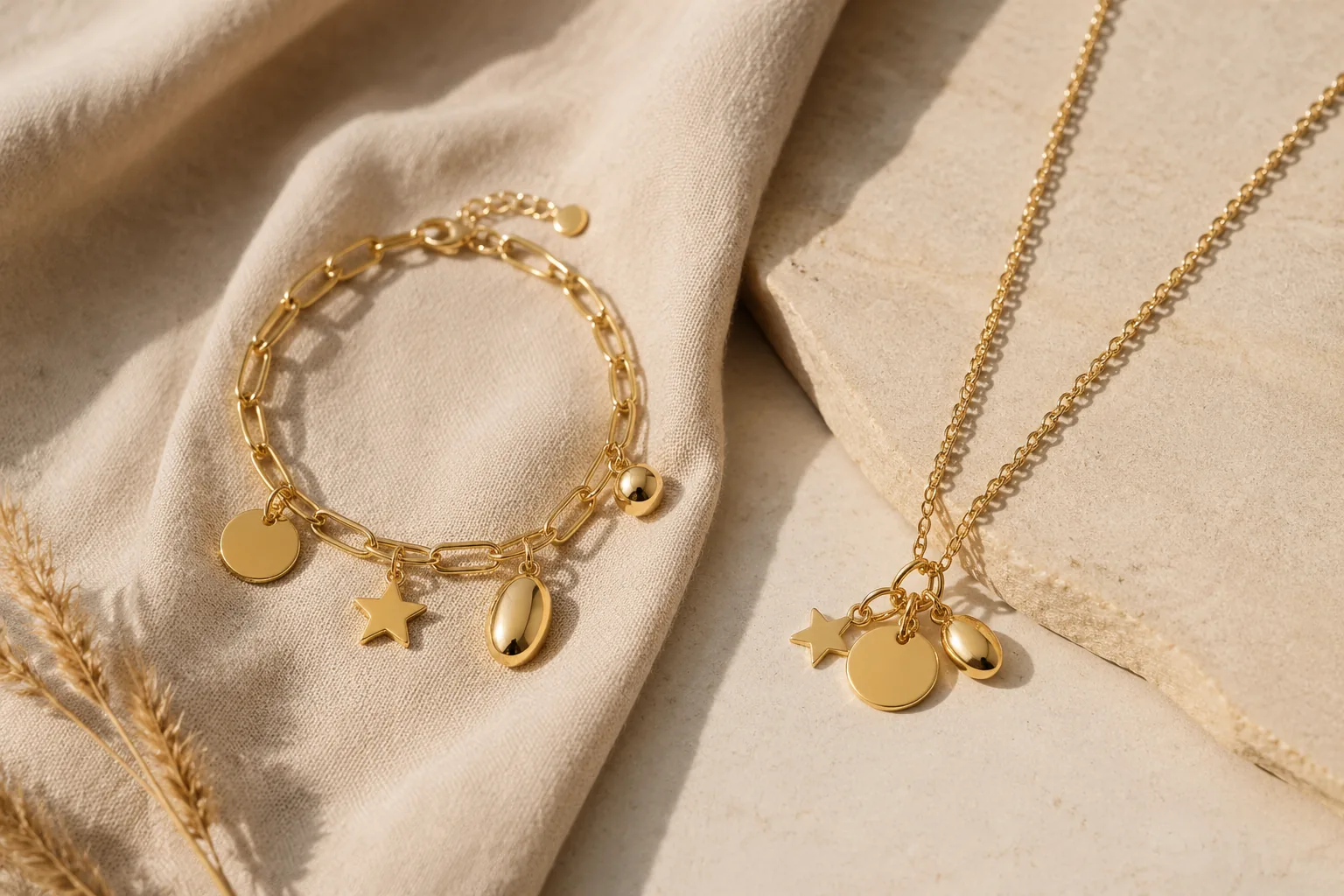
If you want charm jewelry but are not sure where to begin, the practical question is not only which piece looks prettier. It is which format creates the least regret once you consider sizing, daily comfort, outfit compatibility, gifting risk, and whether you actually want to build a collection over time.
For many first-time buyers, the lower-risk starting point is often a charm necklace or pendant-on-chain format. That is editorial guidance, not an official claim from any brand. A necklace can be easier to size, easier to wear away from the hands, and easier to style as a single personal piece. A charm bracelet makes more sense if the appeal is the classic collecting experience: adding meaningful charms over time, seeing them on the wrist, and accepting the extra decisions around bracelet fit, charm compatibility, movement, and sound.
A third option is worth considering before you buy either: one personal charm, pendant, symbol, initial, birthstone-style piece, zodiac-style motif, or engravable design, depending on what is currently offered by the seller. This can give you the emotional effect of charm jewelry without locking you into a whole bracelet system or multi-charm necklace setup immediately.
The official brand sources identified for this guide are Pandora’s US jewelry page, Monica Vinader’s US shop, Astrid & Miyu’s US Icons collection, and Mejuri’s shop-all collection. These pages should be treated as starting points for verification, not as proof that any specific charm, chain, bracelet, pendant, engraving option, price, material, size, or return term is currently available. Always check the exact product page before buying.
Start With the Format That Matches the Risk You Can Accept
The simplest way to decide between a charm bracelet vs charm necklace is to ask what kind of risk you are most willing to manage.
Choose a charm necklace first if your main priorities are lower sizing risk, easy daily styling, and a piece that can work as a standalone item. A necklace still has fit considerations, including chain length and neckline compatibility, but it usually does not require the same precision as a bracelet fitted around the wrist. It also stays away from keyboards, coat cuffs, desk surfaces, and handwashing routines, which may matter if you want low-interruption daily wear.
Choose a charm bracelet first if your main priority is traditional charm collecting. Bracelets are closely associated with the idea of adding pieces over time: milestones, travel memories, initials, symbols, or gifts from different people. The tradeoff is that the bracelet itself becomes a system. You need to think about wrist size, bracelet type, clasp, charm movement, weight, whether charms are compatible with that bracelet, and how the bracelet feels during typing, commuting, cooking, or wearing sleeves.
Choose a single personal charm, pendant, or symbol first if you want meaning without too much infrastructure. This route can suit gift buyers especially well, because the piece can feel personal without requiring the recipient to continue collecting. Exact options must be verified on current official product pages, because collection names, personalization eligibility, motifs, materials, and availability can change.
Charm Bracelet vs Charm Necklace: Quick Comparison
| Decision factor | Charm bracelet | Charm necklace |
|---|---|---|
| Sizing risk | Usually higher, because wrist fit matters more directly | Often lower, especially when chain length is adjustable, but still needs length checking |
| Daily comfort | Can move, rotate, catch, or feel noticeable during hand-heavy tasks; this is a practical consideration, not a tested claim | Usually away from the hands, though pendant weight, chain length, and tangling can matter |
| Visibility | Highly visible when hands are in view | Visible near the face and neckline; may be more prominent in photos or conversation |
| Styling flexibility | Works well with watches, cuffs, bangles, and bracelet stacks if proportions cooperate | Works well with necklines, layered chains, and simple outfits, but length matters |
| Modularity | Strong if the bracelet is designed as a charm system | Flexible if charms or pendants can be changed, but compatibility must be confirmed |
| Gifting risk | Higher if wrist size, metal preference, and charm-system interest are unknown | Often lower if the design is simple and the chain length suits the recipient |
| Collection-building potential | Strong for traditional charm collecting | Good for curated pendant or charm layering, depending on compatibility |
| Verification needs | Bracelet size, charm fit, clasp, included pieces, materials, return terms | Chain length, pendant fit, included chain, bail size, materials, return terms |
The key point is that neither format is automatically better. A charm bracelet is more purpose-built for collecting. A charm necklace is often easier as a first purchase. The better starting point depends on whether the buyer values modularity more than ease.
When a Charm Bracelet Makes More Sense
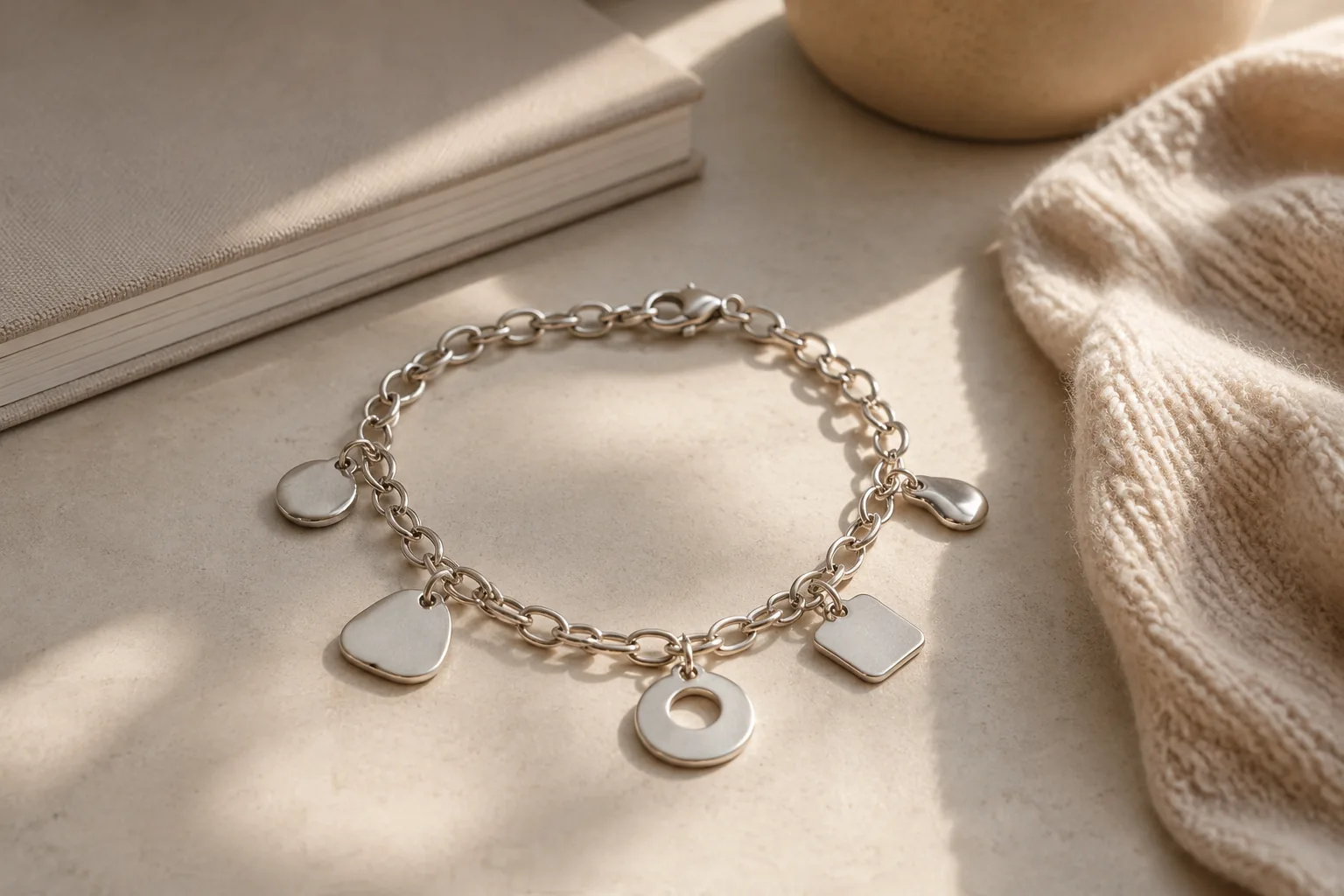
A charm bracelet makes the most sense when you want the jewelry to become a visible record over time. If the appeal is collecting symbols gradually, rearranging them, or receiving new charms for birthdays and milestones, a bracelet can feel more intentional than a single necklace.
It is also a good fit for someone who already enjoys wrist jewelry. If the recipient wears watches, bangles, cuffs, tennis bracelets, or chain bracelets regularly, they may be more comfortable with jewelry that moves with the hand. That does not guarantee comfort, but it gives you a useful style clue.
Bracelets can also make sentimental gifting easier over multiple occasions. One person might give the starter bracelet, then future gifts can build on it. This is where charm bracelets can be emotionally strong, but also where compatibility becomes important. Do not assume that any charm will fit any bracelet. Some charm systems are specific, and even charms that look similar may differ in opening, threading, connector, bail, or attachment style.
The drawbacks are practical. A bracelet lives in a busy place on the body. It may contact desks, laptop edges, sleeves, bags, and other bracelets. Charms may move, clink, rotate, or catch depending on their shape and how the bracelet is worn. Hands-on comfort testing was not performed for this article, so these should be read as buying considerations rather than measured performance results.
A charm bracelet is usually the better first choice if:
- You specifically want a traditional charm-collecting format.
- The wearer already likes wrist jewelry.
- You know the bracelet size or can verify sizing carefully.
- You are willing to check charm compatibility before every add-on.
- You like visible movement and a more interactive piece of jewelry.
- You accept that the bracelet may feel more noticeable during desk work or hand-heavy routines.
It is usually not the safest first choice if the purchase is a surprise gift and you do not know wrist size, metal preference, bracelet habits, or whether the recipient wants to build a charm collection.
When a Charm Necklace Makes More Sense
A charm necklace or pendant-on-chain format often makes more sense for a first charm purchase because it can reduce several common sources of regret. The fit is still important, but necklace sizing is usually more forgiving than bracelet sizing. A slightly adjustable chain, where offered and confirmed on the product page, may help the wearer adapt the piece to different necklines.
A necklace also has an advantage for low-maintenance styling. It stays away from the hands and wrists, so it is less likely to interfere with typing, writing, carrying bags, or wearing a watch. That does not mean every necklace will be comfortable. Pendant weight, chain texture, clasp placement, and tangling risk still matter. But for many shoppers, a simple charm or pendant necklace is easier to integrate into daily outfits than a charm bracelet.
Necklaces can also be more visible in a controlled way. A small pendant can sit close to the face and work with a T-shirt, knit, blouse, or slip dress. A longer chain can create a different mood. A shorter chain can layer with other necklaces. These are styling suggestions, not rules. The exact result depends on chain length, pendant size, neckline, personal style, and whether the wearer already layers necklaces.
A charm necklace is usually the better first choice if:
- You want a personal piece that works on its own.
- You are buying a gift and do not know wrist size.
- The wearer prefers subtle jewelry near the neckline.
- You want to avoid wrist movement during office work or commuting.
- You care about layering with existing chains.
- You do not want the first purchase to require a full charm system.
The main caution is compatibility. Do not assume a pendant fits every chain. Do not assume the chain is included. Do not assume a charm can be moved from bracelet to necklace unless the exact product page confirms it. Product-category words such as charm, pendant, necklace, chain, connector, and carrier can mean different things across brands and collections.
The Lower-Commitment Alternative: One Personal Charm, Pendant, or Symbol
If the choice feels too binary, start with one personal symbol instead of a full charm format. This might be an initial, engraved piece, birthstone-style motif, zodiac-style motif, meaningful shape, small pendant, or single charm-compatible design, depending on what the brand currently offers.
This approach works because it separates the emotional purpose from the collecting system. The reader may want a piece that says something personal, but not necessarily a bracelet filled with add-ons or a necklace that requires swapping pendants. A single symbolic piece can be enough.
For gift buyers, this can reduce decision pressure. You can choose a motif that has meaning without guessing whether the recipient wants a long-term charm bracelet. It may also help with budget control, because the first purchase is not automatically the start of a larger system. That said, prices, materials, engraving eligibility, motif availability, and return terms must be checked on the exact product page before purchase.
This option is especially useful when:
- You want personalization but not a multi-piece system.
- You are unsure whether the recipient likes charm bracelets.
- You want a piece that can be worn immediately without add-ons.
- You prefer a subtle symbol over a visibly collectible format.
- You need a gift that feels considered but not overly specific.
Be careful with personalized or engraved pieces. Personalization may add emotional value, but return and exchange rules can vary by seller, product, region, and customization type. Check the current seller policy before ordering, especially for engraved, made-to-order, final-sale, or customized items.
Which Is Safer for Gifting?
For most surprise gifts, a charm necklace is often the safer editorial recommendation. The main reason is sizing. If you do not know the recipient’s wrist size, bracelet fit can be difficult. A bracelet that is too tight may be uncomfortable, while one that is too loose may move more than intended. A necklace still requires length judgment, but a simple pendant on a commonly wearable chain length, especially if adjustable and confirmed on the product page, may be easier to get right.
A charm bracelet becomes safer as a gift when you have more information. If the recipient already wears bracelets, has mentioned wanting a charm bracelet, owns compatible pieces, or has given you sizing guidance, the risk drops. It can also be an excellent gift when the plan is to build a collection together over time.
The highest-risk gift is not necessarily a bracelet or necklace. It is a personalized item with unverified details. If you choose initials, engraving, birthstone-style designs, zodiac-style motifs, or any customized option, verify spelling, symbol, metal color, size, chain or bracelet inclusion, delivery timing, and return rules before buying.
Before gifting either format, check:
- Does the recipient wear necklaces, bracelets, or both?
- Do they prefer gold-tone, silver-tone, mixed metal, or another finish?
- Do they like visible sentimental jewelry, or do they prefer subtle pieces?
- Is the chain length or bracelet size listed clearly?
- Are charms, chains, bracelets, or connectors sold together or separately?
- Is the piece personalized, engraved, made to order, final sale, or subject to special return terms?
- Are return rules different for your country or shipping destination?
Return rights, hallmarking, and product-labeling rules vary by country. Seller policies also change. Check current seller policies and local regulations before purchase rather than relying on a general rule.
Compatibility Checks Before You Buy
Charm jewelry is easy to misunderstand because the pieces can look interchangeable online. The safest habit is to treat every charm, pendant, chain, bracelet, connector, and carrier as product-specific until the official product page says otherwise.
Use this checklist before buying:
| What to verify | Why it matters |
|---|---|
| Charm compatibility | A charm may fit only a specific bracelet, necklace, carrier, connector, or system |
| Pendant and chain fit | A pendant may not fit the intended chain unless the bail or connector is compatible |
| What is included | A product image may show styling props or layered pieces that are sold separately |
| Chain length | Necklace fit depends on length, adjustability, pendant size, and neckline |
| Bracelet size | Wrist fit affects comfort, movement, and whether charms sit as intended |
| Clasp and closure | Closures affect ease of use, security, and whether the wearer can put it on alone |
| Materials and finishes | Metal, plating, vermeil, solid gold, sterling silver, and coatings have different care needs |
| Dimensions and weight | Larger charms or pendants may feel or look different than expected |
| Personalization eligibility | Engraving, initials, symbols, and custom options may be limited to certain products |
| Return terms | Personalized, sale, final-sale, or region-specific purchases may have different rules |
| Availability and price | Both can change, especially across regions and promotions |
Do not rely only on a collection landing page. Landing pages can be useful for browsing, but they may not show every product-level detail. The exact product page is where you should verify current names, categories, materials, sizes, included components, compatibility language, personalization options, prices, availability, and policy notes.
Jewelry care recommendations vary by material, treatment, and setting. Always follow brand or jeweler care instructions for your specific piece.
How to Decide by Use Case
The right first format becomes clearer when you choose by use case instead of by category.
Everyday Minimalist Wear
Choose a charm necklace or single pendant-style piece if you want something simple, visible, and easy to repeat. A small personal symbol can work with casual and work outfits without requiring a stack or collection.
Choose a bracelet only if you already like wrist jewelry and do not mind the possibility of movement during daily tasks.
Office, Typing, and Desk Work
A necklace is often the lower-interruption suggestion because it stays away from the hands. A bracelet can still work, especially if it is simple and well-fitted, but charms may feel more noticeable at a keyboard or desk. This is practical guidance, not a tested performance claim.
Commuting and Travel
For commuting or travel, the simpler format is usually easier to manage. A single pendant or charm necklace has fewer moving parts than a bracelet with multiple charms. If you choose a bracelet, consider whether the clasp, fit, and charm arrangement feel secure enough for the wearer’s routine, and verify care and storage guidance from the seller.
Statement Styling
A charm bracelet can be more expressive if you like visible collecting and wrist movement. A charm necklace can also be a statement if the pendant is larger, layered, or symbolic. The better choice depends on where the wearer likes visual focus: wrist or neckline.
Necklace Layering
A charm necklace is the natural choice if the wearer already layers chains. Check chain length, pendant size, and clasp placement so the piece does not duplicate an existing necklace too closely. Avoid assuming that any pendant can move between chains.
Bracelet Stacking
A charm bracelet is the stronger choice if the wearer already stacks bracelets or pairs jewelry with a watch. Consider proportion. A charm bracelet with several add-ons can compete with bangles, cuffs, or a watch, while a simpler charm bracelet may be easier to combine.
Sentimental Gifting
Both formats can work. A necklace may be safer if you do not know wrist size. A bracelet may feel more meaningful if the gift is intended as the start of an ongoing collection. For personalized gifts, verify every spelling, motif, product option, and return condition.
Future Collecting
Choose a bracelet if the main goal is a traditional modular collection. Choose a necklace if the goal is occasional pendant changes or a curated layered look. Choose one symbolic piece if you are unsure whether collecting will matter later.
Budget Control
A single charm necklace, pendant, or personal symbol can help control the first purchase because it does not require immediate add-ons. A bracelet system can be rewarding, but it may invite future purchases. That is not a flaw, but it should be part of the decision.
Brand Pages to Verify Before Buying
The research package for this article identifies four official brand sources that should be checked before making current product claims:
- Pandora US Jewelry is the official Pandora US jewelry URL listed for verification.
- Monica Vinader US Shop is the official Monica Vinader US shop URL listed for verification.
- Astrid & Miyu US Icons Collection is the official Astrid & Miyu US Icons collection URL listed for verification.
- Mejuri Shop All is the official Mejuri shop-all URL listed for verification.
Use these pages as gateways, then check exact product pages before stating that a brand currently offers a specific charm, pendant, bracelet, necklace, chain, initial, birthstone-style design, zodiac-style motif, engraving service, material, size, clasp, chain length, return window, or price.
This distinction matters because brand marketing language can be broader than a shopper’s practical needs. Words such as personalized, collectible, iconic, layering, or buildable may help describe a collection, but they do not prove comfort, durability, compatibility, low maintenance, gifting safety, or return flexibility.
Also remember the evidence limits here. No hands-on comfort testing was performed for this article. Current product names, prices, availability, materials, measurements, return policies, and personalization rules were not verified from live product pages in the research package. Those details should be checked before publication or purchase.
Conclusion: Which Should You Start With?
Start with a charm necklace or pendant-style piece if your priority is lower sizing risk, flexible daily wear, and a first purchase that can stand alone. This is the most practical default for many beginners and gift buyers, especially when wrist size and charm-collecting interest are unknown.
Start with a charm bracelet if your priority is the traditional charm experience: a visible, modular piece that can gather meaning over time. It is the better choice for someone who already enjoys wrist jewelry, wants a collection, and is willing to verify bracelet size and charm compatibility carefully.
Choose one personal charm, pendant, symbol, or engravable-style piece if you want sentiment with fewer commitments. This route can be especially useful when you like the idea of personalization but do not yet know whether a full charm bracelet or charm necklace system will suit your routine.
The safest first purchase is not the one with the most add-ons. It is the one that matches the wearer’s habits, has verified compatibility, and still works beautifully if no second charm is ever bought.