



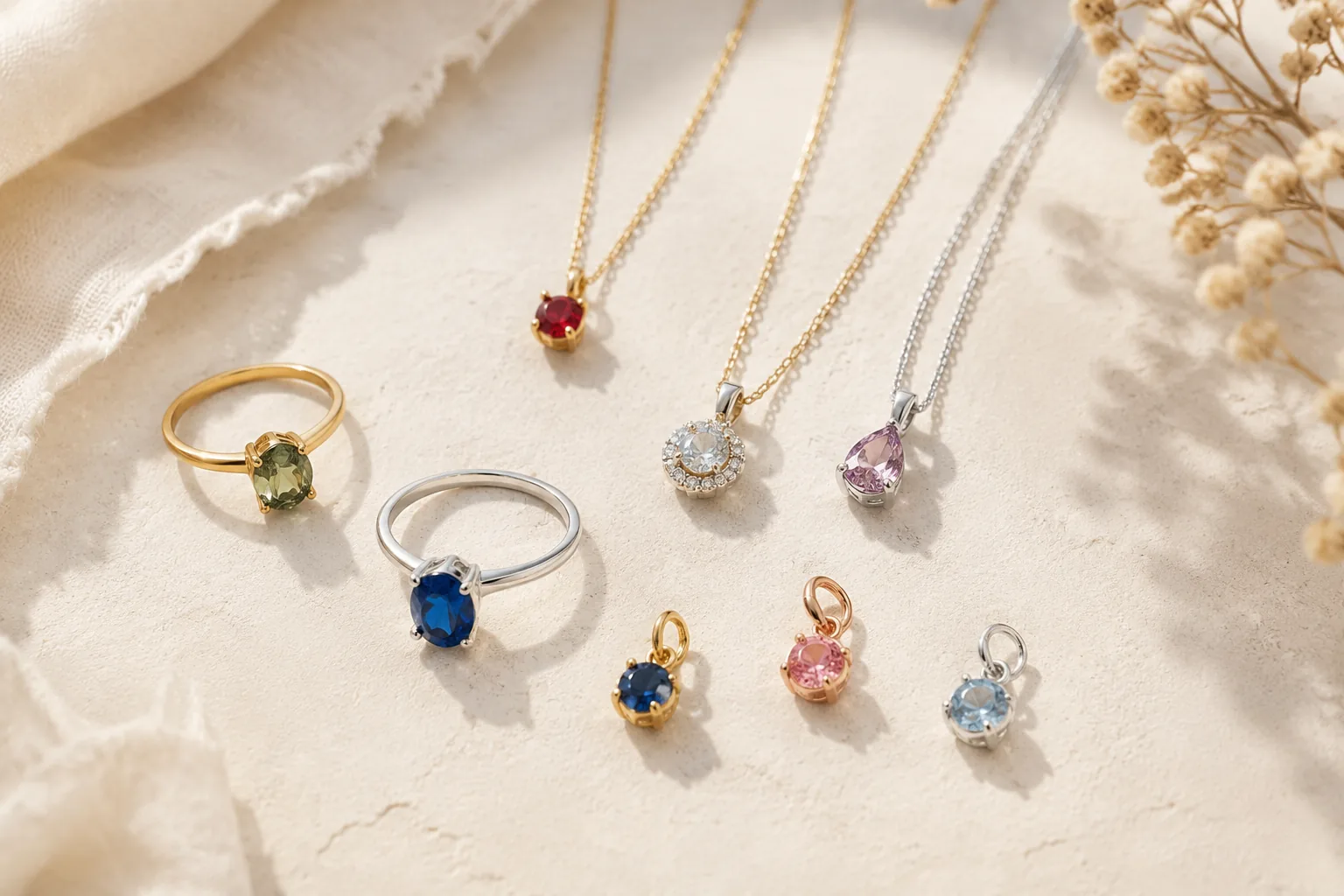
You found a birthstone necklace, ring, charm, or pair of earrings that looks right for the month. The harder question is what the listing actually means. Is it the traditional gemstone for that month? A lab-grown version of that gem? A different stone chosen for a similar color? A crystal, cubic zirconia, enamel detail, or other man-made material used to represent the birthstone color?
That distinction matters for expectations. A January piece marketed around deep red may be garnet, lab-created ruby, red cubic zirconia, glass, crystal, enamel, or another material. Some buyers care most about symbolism and color. Others want the traditional gemstone identity. Some want a durable everyday ring. Others need a low-risk gift where returns, sizing, and engraving rules matter more than gem origin.
This birthstone jewelry guide separates three ideas that are often blurred together: gemstone identity, gemstone origin, and color symbolism. The goal is not to rank natural, lab-grown, and color-inspired options as universally better or worse. The goal is to help you read a listing carefully enough to know what you are buying.
What Birthstone Jewelry Actually Means
A birthstone listing usually starts with a month. That month may point to a traditional gemstone association, but the month label alone does not prove the material in the jewelry.
The Gemological Institute of America, known as GIA, lists standard birthstone associations and notes that some months have multiple accepted birthstones, including March, June, October, and December. That means a month can be represented by more than one gem tradition. For example, a June birthstone product might be interpreted differently depending on whether the seller is using pearl, moonstone, or alexandrite as the relevant association. The exact list should be checked against the reference or seller page being used, but the important buying point is simple: a month is not a mineral name.
A product page may be doing one of several things:
| Listing language | What it may mean | What to verify |
|---|---|---|
| “March birthstone” | A month-themed piece | Exact stone name and material |
| “Aquamarine necklace” | A named gemstone design | Natural, lab-grown, treated, or simulated |
| “Lab-created sapphire” | A lab-grown gem material, if accurately disclosed | Whether the term appears immediately with the stone name |
| “Blue stone charm” | A color-themed stone or material | Whether the material is disclosed at all |
| “Crystal birthstone” | A crystal product representing a color or month | Whether it is being presented as a gemstone substitute |
In analysis terms, the safest way to read any birthstone listing is to separate the romance from the receipt. The month gives the symbolic frame. The stone name gives the identity. The origin language tells you whether it is natural, laboratory-grown, or something else. The material disclosure tells you what is physically set in the jewelry.
Natural, Lab-Grown, Synthetic, and Simulated Stones
Birthstone listings often use words that sound similar but mean different things. A careful seller should not leave you guessing.
A natural gemstone is formed in nature. The product page may still need to disclose treatments, because many gemstones in jewelry can be treated to affect appearance. The research package for this article does not provide product-level treatment details for the brands discussed, so treatment should be checked on the specific product page or with the seller.
A lab-grown gemstone, also called laboratory-grown or laboratory-created, is not mined from the earth. GIA defines synthetic gem material as lab-made material that shares virtually all chemical, optical, and physical characteristics of its natural counterpart. In other words, a lab-grown ruby is not the same category as red glass if the material is truly synthetic ruby.
A simulated or imitation stone is different. Under U.S. Federal Trade Commission guidance, simulated or imitation stones must be disclosed as not mined or lab-created equivalents. The same FTC guidance says laboratory-created gemstones should be identified with terms such as “laboratory-grown” or “laboratory-created” immediately before the stone name. This is U.S.-specific guidance, not a universal global rule.
A color-inspired stone or material may be used to represent the look of a birthstone without being that gemstone. It may still be attractive, sentimental, and giftable, but it should not be assumed to be the traditional gem unless the listing says so clearly.
Why the distinction matters
The distinction affects value expectations, care, durability, and symbolism.
If you want a December gift because the recipient loves blue, a color-inspired blue charm may be completely appropriate. If you want turquoise, tanzanite, blue zircon, or another specific December birthstone association, a generic “blue stone” label is not enough. If you want a lab-grown emerald because you prefer the appearance and disclosure, the product page should say laboratory-grown, laboratory-created, or similar language directly with the stone name.
Analysis: when a listing leads with month and color but does not state the material, treat the product as symbolic jewelry until the seller gives a specific stone identity.
How Major Brands Frame Birthstone Jewelry
The official brand pages in the research package show why shoppers can become confused. Different brands use birthstone language in different ways, and a single category page can include natural gemstones, lab-grown gemstones, diamonds, alternative stones, or color-themed man-made materials.
The clearest sourced examples are Pandora and Brilliant Earth. Pandora’s birthstone page frames its offerings as birthstones with color-themed products and states that the birthstones are 100% man-made stones. Pandora’s listings include month-themed product names such as True Red, Spring Green, and Blue Stone, which supports a color-inspired presentation rather than a mined-stone presentation.
Brilliant Earth describes its gemstone collection as including both lab and natural gemstone jewelry and provides birthstone filtering by month. It also lists natural diamond and lab diamond filters alongside gemstone categories such as sapphire, emerald, pearl, aquamarine, topaz, and opal.
James Allen and Mejuri require more caution based on the supplied research. The research report associates James Allen’s birthstone page with natural gemstone birthstone jewelry and traditional month-to-stone associations, but it also says the live birthstone URL redirected during verification. The Mejuri research snapshot contains mixed material signals, including lab-grown ruby, lab-grown blue sapphire, lab-grown emerald, lab-grown white sapphire, natural diamond, lab-grown diamond, garnet, peridot, pearl, opal, citrine, carnelian, rutilated quartz, dyed jade, and prasiolite. However, the research report also says Mejuri’s direct collection page returned conflicting or empty results during verification.
For publication or purchase, that means brand-level claims about Mejuri and James Allen should be rechecked on current live pages and, ideally, on individual product detail pages.
Pandora: A Clear Example of Color-Inspired Man-Made Stones
Pandora is useful because the supplied research includes an explicit disclosure. Pandora’s birthstone page states that the birthstones are 100% man-made stones. Its page also uses color-themed names such as True Red, Spring Green, and Blue Stone.
That does not make the jewelry inherently less meaningful. It does change what the buyer should expect. A Pandora “birthstone” piece, based on the cited page, should be read as a birthstone-themed, color-inspired product unless the individual product page provides a more specific material identity.
Analysis: Pandora is a good option to study when you want to understand the difference between birthstone symbolism and traditional gemstone identity. The month and color can carry the gift meaning, while the disclosed man-made material prevents the buyer from assuming the piece is a mined garnet, emerald, sapphire, ruby, or other traditional gem.
A shopper considering this type of piece should ask:
| Question | Why it matters |
|---|---|
| Does the page name a specific gemstone? | A color name is not the same as a gem identity. |
| Does the page say the stones are man-made? | This sets expectations about origin and category. |
| Is the buyer choosing for color, month, or traditional gem identity? | Different priorities may point to different products. |
| Is the recipient likely to care about natural or lab-grown gemstones? | Some recipients care strongly; others mainly want the symbol. |
Brilliant Earth: Natural and Lab Options on One Collection
Brilliant Earth’s gemstone collection shows another common pattern: one category can contain both natural and lab options. The supplied research says Brilliant Earth describes the collection as including both lab and natural gemstone jewelry and provides birthstone filtering by month. It also lists filters for natural diamond and lab diamond alongside gemstone categories including sapphire, emerald, pearl, aquamarine, topaz, and opal.
The practical lesson is that a category page is not enough. A filter can help you browse, but it does not necessarily answer every product-level question. If a collection contains both lab and natural options, the buyer needs to inspect the product page for the specific ring, necklace, earrings, or bracelet.
Look for:
| Product-page detail | What it clarifies |
|---|---|
| Exact gemstone name | Whether the piece is sapphire, emerald, pearl, opal, topaz, or another gem |
| Origin language | Whether the gem is natural, lab-grown, or otherwise described |
| Accent stone details | Whether smaller stones are diamonds, lab diamonds, gemstones, or another material |
| Metal description | Whether the piece is solid gold, platinum, silver, vermeil, plated, or another metal |
| Care guidance | Whether the gem or setting has special care limits |
Analysis: Brilliant Earth’s framing can serve a buyer who is open to either natural or lab-grown gemstone jewelry, but it asks more of the shopper. You need to compare individual listings, not just rely on the collection title.
Mejuri and James Allen: Verify the Current Product Page
The research package gives useful but incomplete signals for Mejuri and James Allen.
For James Allen, the supplied research says the birthstone page is associated with natural gemstone birthstone jewelry and shows traditional month-to-stone associations in the search-crawled research report. However, the same research notes that the live birthstone URL redirected during verification. That creates a publication and buying risk: the current destination, page owner, catalog, or content may not match the earlier snapshot.
For Mejuri, the research snapshot includes a broad mix of material signals, including lab-grown ruby, lab-grown blue sapphire, lab-grown emerald, lab-grown white sapphire, natural diamond, lab-grown diamond, garnet, peridot, pearl, opal, citrine, carnelian, rutilated quartz, dyed jade, and prasiolite. That range suggests the collection may use a mix of traditional gems, lab-grown gems, diamonds, and alternative or color-related stones. But the research also says the direct Mejuri collection page returned conflicting or empty results during verification.
The buyer-facing advice is straightforward: do not treat a saved search result, old category page, or third-party snippet as enough. Open the current product detail page and check the material line, stone description, care notes, and seller terms.
Recommendation: if the product page has changed, redirects, or lacks clear stone-origin language, pause before buying if gemstone identity matters. If the purchase is mostly symbolic and the design is the priority, unclear origin may matter less, but the seller should still disclose what the jewelry is made from.
Birthstone Associations Are Not Always One-to-One
A common mistake is assuming each month has exactly one correct birthstone. GIA lists standard birthstone associations and notes that some months have multiple accepted birthstones, including March, June, October, and December.
That matters for gifts. A recipient born in October might expect opal, tourmaline, or a specific color depending on the tradition they know. A December recipient might see several blue gemstones associated with the month. A June recipient may think of pearls, but another buyer may be thinking of moonstone or alexandrite.
Analysis: birthstone jewelry works best as a gift when the giver chooses the interpretation deliberately. If the recipient has a known favorite stone, use that. If the recipient mostly likes the month symbolism, a color-inspired design may be enough. If the buyer wants the traditional gem, the listing should name that gem clearly.
For months with multiple accepted birthstones, a good product page should make the choice visible. “June pearl pendant” is clearer than “June birthstone pendant.” “October opal ring” is clearer than “October stone ring.” “December blue zircon earrings” is clearer than “December blue earrings.”
How to Assess Everyday Wear and Care
A birthstone ring faces different wear than a pendant. A bracelet may be knocked against desks, bags, and hard surfaces. Earrings and necklaces usually face less direct impact. That is why durability should be part of the buying decision, especially for daily wear.
GIA states that durability depends on hardness, toughness, and stability. Hardness is resistance to scratching. Toughness is resistance to breaking, chipping, or cracking. Stability refers to how a gem handles light, heat, chemicals, or environmental exposure. GIA also notes that softer or less tough gems may be better suited to earrings or necklaces than rings or bracelets.
This does not mean a softer or more delicate birthstone should never be worn. It means format and lifestyle matter.
For everyday rings and bracelets, consider:
| Factor | Why it matters |
|---|---|
| Gem durability | Rings and bracelets receive more impact and abrasion. |
| Setting protection | Bezels and lower-profile settings may protect some stones better than exposed prongs. |
| Stone treatment | Treatments can affect care instructions and sensitivity to heat, chemicals, or cleaning methods. |
| Metal choice | Plated, vermeil, silver, gold, and platinum pieces wear differently. |
| Care instructions | Manufacturer guidance should override generic cleaning advice. |
For earrings and pendants, you may have more flexibility with delicate stones because the jewelry usually sees less direct contact. Still, you should check care instructions for pearls, opals, treated gems, plated metals, adhesives, and settings. Jewelry care recommendations vary by material, treatment, and setting. Always follow brand or jeweler care instructions for your specific piece.
Analysis: if you are choosing a birthstone for a daily ring and the stone is known to be more delicate, consider whether the same birthstone meaning would work better as a pendant or studs. This is a wearability suggestion, not a universal rule.
A Practical Birthstone Jewelry Buying Checklist
Use this checklist before buying, especially if the piece is a gift or the listing language is vague.
1. Identify the exact stone or material
Look for the precise material name. “Emerald” is more specific than “green birthstone.” “Lab-created sapphire” is more specific than “blue stone.” “Crystal” is not the same as sapphire, aquamarine, topaz, or diamond.
If the page only gives a month and a color, assume it is symbolic until the seller states the material.
2. Check origin language
For gemstone identity, origin matters. Is it natural? Laboratory-grown? Laboratory-created? Simulated? Imitation? Crystal? Cubic zirconia? Enamel? Glass? Another material?
U.S. FTC guidance says laboratory-created gemstones should be identified with terms such as laboratory-grown or laboratory-created immediately before the stone name. It also requires simulated or imitation stones to be disclosed as not mined or lab-created equivalents. Because this is U.S. guidance, shoppers outside the United States should also check local rules and seller disclosures.
3. Confirm the birthstone association
If the month has multiple accepted birthstones, check whether the piece matches the stone you expect. GIA notes multiple accepted birthstones for March, June, October, and December. A product may be perfectly valid as one interpretation while still not being the stone the recipient had in mind.
4. Match the stone to the jewelry type
For rings and bracelets, pay closer attention to hardness, toughness, stability, setting protection, and care. For pendants and earrings, delicate gems may be more practical, but they still need appropriate care.
5. Read the metal description
Birthstone jewelry can be set in solid gold, sterling silver, gold vermeil, gold plating, platinum, or other metals. Vermeil is a layer of gold over sterling silver, while gold plating can be applied over different base metals. The research package here is focused on stone disclosure, so metal details must be checked on the individual listing.
6. Look for treatment and care notes
Do not assume a cleaning method is safe for every gemstone. Treatments, coatings, adhesives, plating, pearls, opals, and delicate settings can change care requirements. Avoid universal cleaning advice and follow the seller or jeweler instructions for that specific piece.
7. Check gift-risk details
For gifts, verify ring size, chain length, earring style, bracelet fit, engraving rules, resizing options, return windows, final-sale terms, and personalized-item exceptions. Return rights, hallmarking, and product-labeling rules vary by country. Check current seller policies and local regulations before purchase.
Questions to Ask Before You Buy
Does the listing name the gemstone, or only the month?
If it only names the month, the listing may be using birthstone symbolism without identifying the material. Look for a material line, gemstone section, or product details area.
What does “man-made birthstone” mean?
It depends on the seller’s wording. A man-made stone may be a lab-grown gemstone, but it may also be a simulated, crystal, glass, cubic zirconia, enamel, or other color-inspired material. Do not assume. Pandora’s cited page is clear that its birthstones are 100% man-made stones and uses color-themed names, so those products should not be read as mined birthstones based on the supplied research.
Is lab-grown the same as simulated?
No. GIA defines synthetic gem material as lab-made material that shares virtually all chemical, optical, and physical characteristics of its natural counterpart. A simulated or imitation stone is different and should be disclosed as such under U.S. FTC guidance.
Can a category page prove the origin of every stone?
Usually, no. A category page may contain mixed products. Brilliant Earth’s cited gemstone collection includes both lab and natural gemstone jewelry and provides birthstone filtering by month, so the individual product page remains important.
What if the brand page redirects or looks different from older information?
Use the current product page as the controlling source. The research package notes verification risks for Mejuri and James Allen, including conflicting or empty Mejuri collection results and a redirected James Allen birthstone URL. That means any current purchase decision should be based on live product detail pages, not archived assumptions.
Is a birthstone ring always suitable for daily wear?
No universal claim is reliable. GIA explains that durability depends on hardness, toughness, and stability, and that some softer or less tough gems may be better suited to earrings or necklaces than rings or bracelets. For daily rings, check stone durability, setting design, treatments, and care guidance.
Conclusion: Choose the Meaning, Then Verify the Material
Birthstone jewelry can mean several things: a traditional natural gemstone, a lab-grown version of a gem, a diamond or gemstone design filtered by month, an alternative stone, or a color-inspired man-made material. None of those categories is automatically wrong. The problem is buying one while assuming it is another.
The practical process is to choose what matters most first. If you want the traditional gemstone, the listing should name the gem clearly. If you want lab-grown material, the product page should say so directly next to the stone name. If you mainly want the month color and sentiment, a clearly disclosed man-made or color-inspired piece may fit the purpose. If the item is for everyday wear, especially as a ring or bracelet, durability and care deserve as much attention as color.
Before purchase, check the exact stone or material, origin language, treatments, metal, setting, care instructions, and seller terms. For gifts, also check sizing, engraving, returns, and final-sale rules. This content provides shopping and educational information, not medical advice. Consult a qualified clinician or dermatologist about persistent irritation or reactions. Hands-on testing is claimed only when the article documents the testing process and evidence.
Sources
- Pandora US, “Birthstone Jewelry | Birthstone Pendants & Charms”
- Brilliant Earth, “Shop Gemstone Jewelry”
- James Allen, “Birthstone Jewelry”
- Mejuri, “Birthstone Jewelry”
- GIA, “Birthstones”
- FTC, “In the Loupe: Advertising Diamond, Gemstones and Pearls”
- GIA, “Synthetic Gem Materials”
- GIA 4Cs, “More than the Mohs Scale | Understanding Gem Durability”