



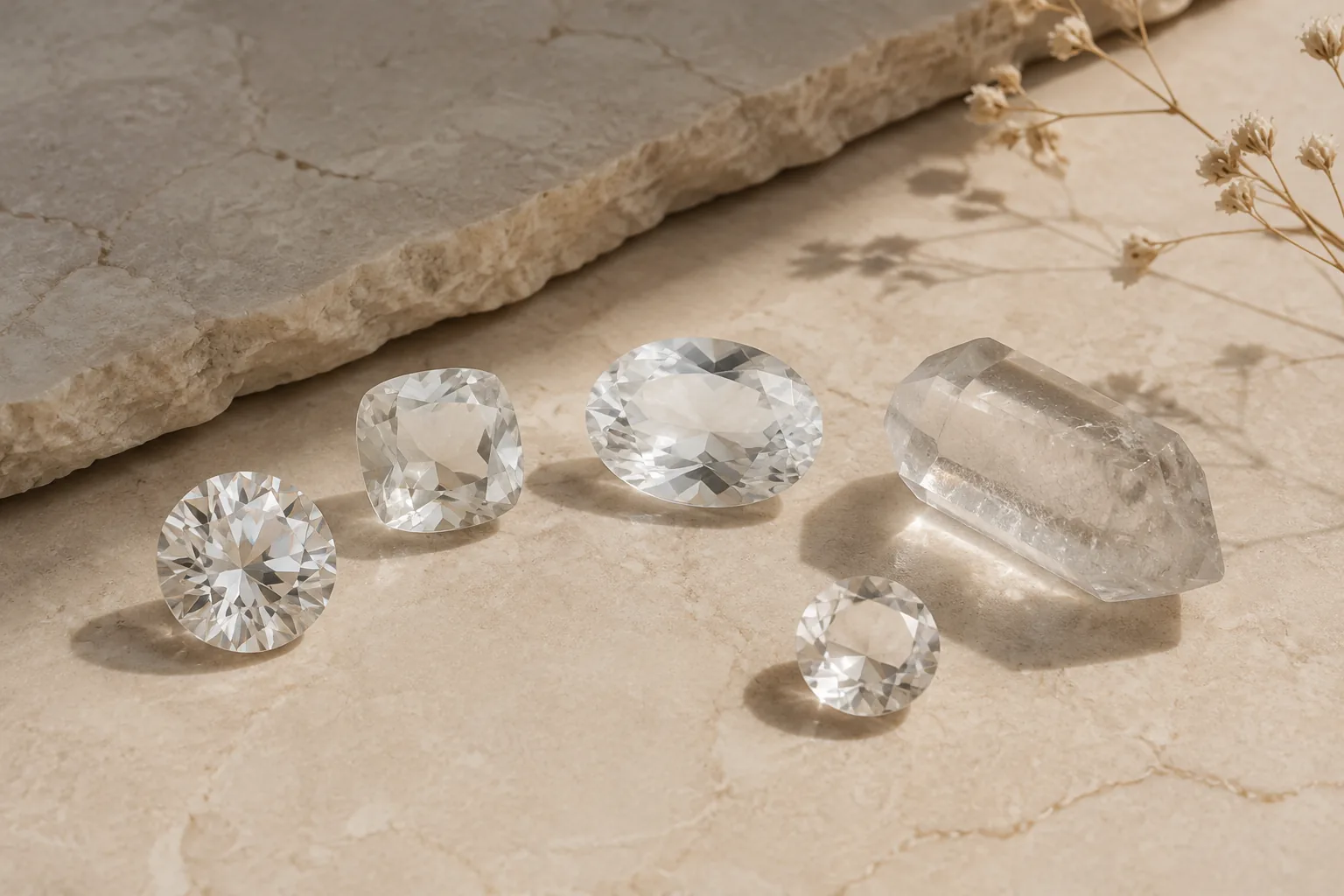
If you are shopping for April birthstone jewelry and keep seeing diamond, white sapphire, white topaz, crystal quartz, and clear man-made stones used almost interchangeably, the first job is to separate three different things: the traditional April birthstone, the stone actually named on the listing, and the look the brand is trying to sell.
The short version is straightforward. Diamond is the traditional April birthstone in authoritative gemological sources. Some brands then use white sapphire, white topaz, crystal quartz, or a clear man-made stone as an April option for style, symbolism, or price positioning. That can be reasonable, but it is not the same thing as a strict April birthstone definition.
What April Birthstone Actually Means
Authoritative gemological sources identify diamond as the April birthstone. Diamond is also the hardest commonly used gemstone reference point in the cited sources, with a Mohs hardness of 10. That matters because many shoppers use “April birthstone” as shorthand for a clear or white stone, but the month association itself is narrower than the styling language some retailers use.
That distinction is the main source of confusion. A retailer may be selling a clear-looking ring or pendant and still call it an April piece, even when the stone is not diamond. In practical terms, that means you should read the listing in layers:
- Month association.
- Stone identity.
- Manufacturing method or treatment, if disclosed.
Those layers do not always line up. A product can be April-themed without being a diamond, and a clear-looking birthstone can be marketed as inspired by diamond without actually being one.
Synthetic diamonds add one more layer. GIA states that synthetic diamonds are still diamonds, but they are not the same as natural diamonds, and only a gemological laboratory can authoritatively determine whether a diamond is natural or synthetic. So if a listing says “diamond,” that still leaves open questions about origin unless the seller discloses more.
How The Main Alternatives Differ
When people compare April birthstone alternatives, they usually care about three practical things: how the stone looks, how much wear it can handle, and whether the listing is precise enough to avoid gift disappointment.
Diamond
Diamond is the traditional April birthstone and the hardest stone in this group. In practical buying terms, that makes it the safest choice for a person who wants the canonical month stone and expects strong everyday wear performance. The tradeoff is that diamond is usually the least ambiguous option and often the most expensive of the group, so it is not the default fit for every budget or gifting brief.
White sapphire
White sapphire is often the closest durable-looking alternative among the options reviewed here. GIA guidance rates sapphire at Mohs 9, which places it below diamond but still in the highly durable range. Mejuri also describes its lab grown white sapphire as ranking just below diamond on the hardness scale, although that is a brand claim rather than an independent gemological classification.
As a result, white sapphire works best for shoppers who want a bright, clear stone with a restrained, diamond-adjacent appearance and a strong durability profile. It is less ideal if the recipient expects the actual April birthstone to be diamond specifically.
White topaz
GIA guidance places topaz at Mohs 8, which makes it less durable than sapphire and diamond. Monica Vinader has an April birthstone product explicitly labeled white topaz, and Astrid & Miyu also uses white topaz language in April listings.
For practical shopping, white topaz is a valid mineral alternative when the goal is a clean, light look at a more accessible price position. The main caveat is wear resistance. It is a reasonable option for occasional wear or for buyers who understand they are selecting a softer stone than sapphire or diamond.
Crystal quartz
Missoma’s April birthstone edit presents crystal quartz or diamond as April options and also mentions white sapphire. That broadens April from a single stone to a family of visual choices. Quartz can be useful when the buying goal is appearance and symbolism rather than strict mineral fidelity.
The limitation is evidence. The research package does not fully source quartz-specific durability or care guidance from a primary gemological reference, so quartz should be treated cautiously. In practical terms, crystal quartz is best described as an appearance-based or styling-led option, not as the default answer for a buyer who wants the most durable April stone.
Clear man-made stones
Pandora is the clearest example here. It states that its birthstones are 100% man-made stones, and it describes April as clear and inspired by diamonds rather than naming a natural mineral birthstone for that month. That is a very different positioning from a traditional birthstone chart.
This category is best understood as a design choice. The appeal is the colorless look and the month symbolism, not the claim that the stone is a natural diamond, sapphire, topaz, or quartz. For gift buyers, that can be a smart option if the recipient likes the visual effect more than the gemological identity.
What The Brands Actually Say
The brand pages in the research set show how much April language can vary across retailers.
Mejuri’s official birthstone collection includes a listing for lab grown white sapphire. That is precise about the stone type, but it also shows how one retailer may use a diamond-adjacent material as an April option rather than naming diamond itself.
Missoma’s April birthstone edit is broader. It presents crystal quartz or diamond as April options and also mentions white sapphire. That is useful if you want choices, but it also means the page is doing more editorial grouping than strict gemstone labeling.
Monica Vinader has an April birthstone product explicitly labeled white topaz. That is the clearest example in the set of a retailer naming a specific non-diamond mineral for the month.
Pandora takes the most symbolic route. Its birthstones are 100% man-made stones, and April is described as clear and inspired by diamonds. In other words, it leans into the look and the monthly association rather than a natural-stone claim.
Astrid & Miyu surfaces both white topaz and lab grown white sapphire language in its April listings, which shows that a single retailer may use multiple stone types within the same month category.
James Allen needs more caution. The crawl surfaced an April-is-diamond snippet, but the live page was not directly confirmed in the report. That makes it a weaker evidence point than the other brand pages and a good candidate for a careful qualifier rather than a firm claim.
Conclusion
The safest conclusion is simple: if you want the traditional April birthstone, choose diamond. If you want the closest durable alternative, white sapphire is the strongest substitute in this set. If you want a lighter-price mineral option and can accept less durability, white topaz is reasonable. If you care more about a clear look or symbolic April styling than mineral identity, crystal quartz or a clear man-made stone can also fit.
The main decision is not just which stone looks best. It is whether you want the traditional birthstone, a close visual substitute, or a design-led clear stone that uses April symbolism more loosely. Once you separate those categories, the listings become much easier to read, and the risk of gift regret drops sharply.
How To Choose The Right One
The right answer depends on what problem you are solving.
If the recipient wants the traditional April birthstone, choose diamond. That is the most direct and least confusing interpretation of the month.
If the recipient wants a diamond-like look with strong everyday durability and a clearer budget buffer, white sapphire is the most practical alternative in this evidence set.
If the goal is a lower-pressure price point and the wearer is comfortable with a softer stone, white topaz is workable. It is a better fit for occasional wear, lower-risk gifting, or shoppers who value the name and the look more than maximum hardness.
If the main goal is the visual impression of clear jewelry and the wearer does not care whether the stone is a specific mineral, crystal quartz or a clear man-made stone can make sense. That is especially true when the retailer is being transparent that the piece is inspired by diamond rather than pretending to be diamond.
If the gift is for someone who is picky about material identity, avoid loose wording. A listing that says “clear,” “diamond-inspired,” or “birthstone” is not enough to prove the stone is diamond, natural, lab-grown, or a specific mineral. Ask what the stone actually is before buying.
Care And Expectation Checks
Care depends on the exact stone, setting, treatment, coating, and manufacturing method. Jewelry care recommendations vary by material, treatment, and setting, and you should follow the brand or jeweler instructions for the specific piece.
As a general buying rule, harder stones are more forgiving in everyday jewelry, while softer stones need more caution around knocks, abrasion, and cleaning. Diamond and sapphire sit at the more durable end of the sources reviewed here. Topaz is lower on the scale. Quartz is not fully sourced in this package, so it should not be oversold.
This content provides shopping and educational information, not medical advice. If a piece causes persistent irritation or a reaction, that is a matter for a qualified clinician or dermatologist rather than a jewelry guide. Likewise, return rights, hallmarking, and product-labeling rules vary by country, so check the seller’s current policies and local regulations before purchase.
The same caution applies to “clear” birthstone language. A clear stone can mean different things on different sites. It may be glass, crystal, cubic zirconia, or another material, and this research package does not confirm every live product’s exact composition. Treat the label as a starting point, not a final answer.
Source Notes
Facts in this draft are based on GIA, the American Gem Society, and the cited brand pages from Mejuri, Missoma, Monica Vinader, Pandora, Astrid & Miyu, and James Allen. Brand descriptions are treated as retailer claims unless independently verified.