



A lab-grown diamond product page can make an online ring purchase look simpler than it is. You may see an appealing image, a carat weight, a price, a metal choice, and a label such as “certified.” Those details are useful, but they do not always describe the same thing. The page could be showing a loose diamond, a setting-only price, a finished preset ring, or one step in a build-a-ring configuration.
The practical skill is separating four evidence layers:
- The retailer’s presentation of the item.
- The facts in the grading report for the exact center stone.
- The specifications for the finished setting and ring size.
- The current terms that apply when you place the order.
This approach is useful whether you are browsing Blue Nile, Brilliant Earth, or James Allen. Their shopping paths are not identical, and no category page can establish the exact details of an individual ring in your cart. Before comparing diamonds, first establish what the listing actually sells and what the displayed price includes.
Start by Identifying What the Listing Actually Sells
Do not compare carat weights, metal choices, or prices until you know the commercial structure of the page. A product title and a polished ring image can conceal an important distinction: are you buying the center stone and setting together, or are you looking at only one component?
Blue Nile’s engagement-ring shopping page presents a design-your-own process that can begin with a setting, diamond, or gemstone. Brilliant Earth likewise provides routes to start with a setting, natural diamond, lab-grown diamond, gemstone, or bridal set on its official engagement-ring catalog. Those routes make a component-by-component reading essential.
Setting-only listing
A setting-only listing describes the ring mount: the metal, ring style, center-stone shape compatibility, side stones where applicable, and sometimes the starting price. It does not necessarily include a center diamond.
Look for direct wording such as “setting,” “start with this setting,” “select a diamond,” or an empty center-stone selection area. A visible price may be the price of the mounting before a center stone is added. Treat it as a starting component price until the cart or configuration summary says otherwise.
This matters especially when comparing styles. A solitaire setting and a pavé setting may appear close in price before a center stone is selected, while their completed-ring totals can differ substantially depending on the chosen diamond and setting specifications.
Loose diamond listing
A loose-diamond listing should identify an individual stone or a selectable stone from inventory. Its key evidence is the exact grading report, not just the search filters used to find it.
Record the report number, laboratory, carat weight, shape, measurements, and the report date before moving to the setting. If the retailer permits you to pair the stone with a ring, the loose diamond is still a separate purchase component until the selected setting and final configuration are shown together.
Preset or ready-to-ship ring
A preset ring is presented as a completed item, typically with a defined center diamond and setting. That can simplify the shopping flow, but it does not eliminate verification.
A supplied official James Allen ready-to-ship listing indicates that preset rings can be described as certified and offered with natural or lab-grown diamonds. The related page also exposes filters such as main shape, total carat, diamond, metal, price, and shipping date. Confirm whether “total carat” refers to the center stone alone or total diamond weight across the ring, and check whether the ring size, metal, and exact center stone are fixed or selectable.
For a broader comparison of these shopping structures, see James Allen vs Blue Nile vs Brilliant Earth engagement-ring buying processes.
Check Whether the Price Covers the Complete Ring
The most common product-page reading error is treating a visible price as the final cost of a completed ring. In build-a-ring shopping, it may represent the setting alone, the selected loose diamond alone, or a partially completed configuration.
Read price labels literally
Start with the label adjacent to the price. “Starting at,” “from,” “setting price,” and similar language are signals to pause rather than compare totals. A price attached to a metal option can also change when you switch metal, ring size, or setting configuration.
Blue Nile’s official engagement-ring page includes setting-price context, while Brilliant Earth’s page supports separate setting and center-stone selection. These are legitimate ways to shop, but they mean a listing grid is not necessarily an apples-to-apples completed-ring comparison.
Use this sequence:
- Identify whether a center stone is included.
- Confirm the selected diamond remains in the configuration.
- Check the setting metal and any accent-diamond details.
- Add the ring size.
- Review the configuration summary and cart.
- Verify the final checkout total before relying on it.
Keep checkout costs separate from product price
The supplied retailer category pages do not establish the exact return window, delivery date, inventory status, tax or duty total, or completed checkout price for an individual ring. Those details can change by item, destination, configuration, and time of purchase.
For buyers outside the United States, do not assume that a price shown on a U.S.-facing page includes the same taxes, duties, shipping arrangements, or consumer terms that apply in the UK, Canada, or Europe. Check the live destination-specific checkout information before treating a listing as comparable.
A lower visible price is meaningful only after you confirm that it represents the same purchase: the same type of item, an included center stone where relevant, comparable setting details, and applicable transaction costs.
Read the Retailer Page as Presentation, Not as the Full Evidence Record
Retailer pages are useful. They help you narrow choices by shape, style, metal, ready-to-ship availability, and price range. Blue Nile presents navigation around shapes, lab-grown diamonds, settings, and ready-to-ship rings; Brilliant Earth presents shape, design, metal, and other filters; the supplied James Allen page exposes filtering for diamond and shipping date.
Those tools can help you form a shortlist. They do not replace the report for the exact diamond.
What a listing can help you evaluate
Use the listing to assess the purchase format and the finished ring’s visible design:
- Whether the page identifies the center stone as laboratory-grown.
- Whether the ring is preset, configurable, setting-only, or a loose diamond.
- The advertised metal options and setting style.
- The listed shape and stated carat information.
- Whether the retailer provides images, video, or a 360-degree viewing feature.
- Whether the product is described as ready to ship or subject to configuration.
Visual media can help you understand a setting’s proportions and design, but it should not be treated as proof of the exact center diamond’s appearance unless the page explicitly establishes that the media depicts that specific stone. A render, stock image, or representative video can be useful context without being exact-stone evidence.
For more detail on assessing that type of presentation, consult James Allen’s 360-degree diamond shopping explained.
What retailer copy cannot establish by itself
Do not infer growth method, post-growth treatment, fluorescence, girdle inscription, exact measurements, or a cut-grade field from marketing copy alone. Nor should terms such as “certified,” “premium,” or “excellent value” substitute for access to the document supporting the stone’s reported characteristics.
The distinction is straightforward:
| Evidence source | Best used to confirm |
|---|---|
| Retailer listing | Product format, setting style, stated options, visible price context |
| Exact grading report | Exact diamond identity, report number, laboratory, measurements, reported quality details |
| Cart and checkout | Selected components, final price, shipping, tax, duty, availability |
| Policy pages | Current return eligibility, resizing conditions, warranty scope and exclusions |
This is not a judgment that retailer pages are unreliable. It is a way to assign each source the job it can actually do.
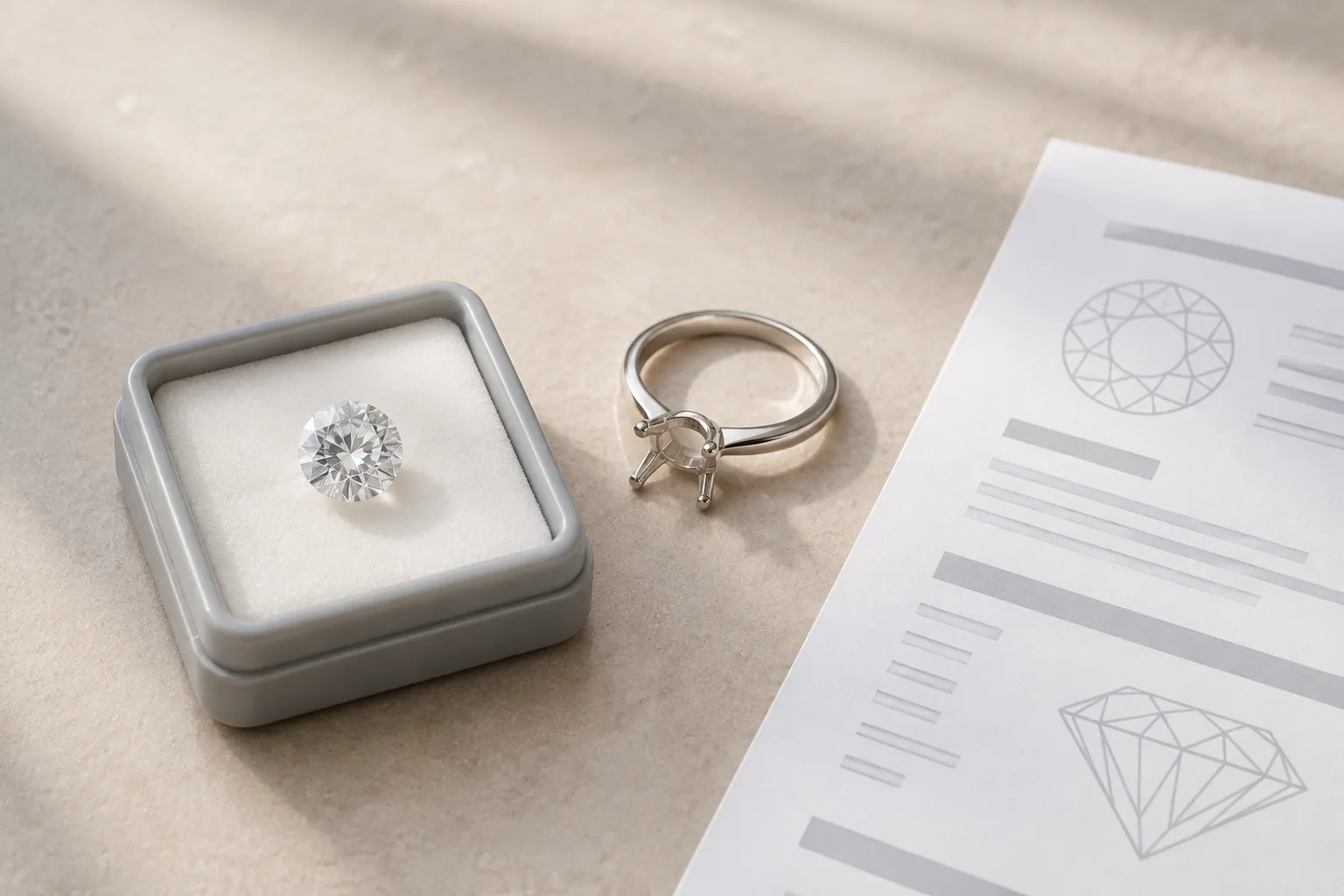
Verify the Exact Diamond Through Its Grading Report
Once you have identified a specific lab-grown diamond, the grading report becomes the central document for evaluating that stone. Blue Nile’s engagement-ring page tells buyers to verify GIA or IGI certification. More broadly, the International Gemological Institute’s diamond-report information confirms that IGI offers laboratory-grown diamond reports and report verification.
Ask for or open the report tied to the exact report number. Do not rely on a generic sample report or an example report for a comparable diamond.
Start with identity and report verification
Match the report to the listing line by line:
- Report number.
- Issuing laboratory.
- Report date.
- Laboratory-grown origin language.
- Shape and carat weight.
- Measurements.
- Any laser inscription information shown on the report.
- The retailer’s stone identifier, if provided.
The diamond’s report number should connect the listing to a specific document. If you cannot access the report before purchase, treat that as an unresolved information gap, not as a detail to fill in from the product title.
Verify the report with the issuing laboratory where that option is available. IGI states that it screens gemstones to determine whether they are natural, laboratory-grown, or simulants, which reinforces why origin should be confirmed through the report rather than inferred from appearance.
Read the quality fields that the document actually provides
The report may present information about color, clarity, cut or proportions, measurements, fluorescence, and other identifying characteristics. Read the fields present on that particular document rather than assuming every lab or report type uses the same format.
GIA’s Laboratory-Grown Diamond Report materials state that the report can offer growth-method and post-growth-treatment options. Whether those details appear for the exact diamond is a document-level question. Do not assume a lab-grown diamond is untreated, or assume CVD or HPHT origin, unless the report itself provides that information.
When comparing two stones, use the report details alongside the setting. A diamond’s measurements influence its physical spread and proportions, while the setting affects how the finished ring sits, protects the stone, and looks on the hand. A strong listing review accounts for both rather than treating the center stone as the whole purchase.
For a decision framework on when the document matters most, see when to prioritize a diamond grading report.
Interpret GIA and IGI Lab-Grown Reports by Date and Report Type
“GIA versus IGI” is not a one-question comparison. The useful question is: which laboratory issued this document, when was it issued, what report type is it, and what fields does it display?
GIA’s October 2025 service update
GIA announced that, effective October 1, 2025, its D-to-Z laboratory-grown diamond service changed to an overall Premium or Standard quality assessment based on clarity, color, and cut. GIA said this replaced its natural-diamond color-and-clarity nomenclature for that updated service.
The GIA announcement on updated laboratory-grown diamond services also states that diamonds outside its minimum Standard criteria do not receive a Premium or Standard assessment under that service. Its girdle inscription includes “Laboratory-Grown” and the quality assessment or report number.
The practical takeaway is not that one format is automatically better for every buyer. It is that older and newer GIA documents may be presented differently. Read the actual report date and terminology before trying to compare it with another report.
Avoid forcing GIA and IGI into one template
IGI offers laboratory-grown diamond reports and report verification, but you should still inspect the exact document rather than assuming its fields match a GIA document field for field.
When you compare reports, note:
- Laboratory name and report type.
- Report date.
- The origin disclosure.
- The terminology used for quality characteristics or assessment.
- Measurements and any proportions shown.
- Growth-method or treatment information when the report provides it.
- The report-number verification result.
This report-first approach prevents a common mistake: comparing a retailer’s simplified product labels as though they were laboratory conclusions. Retailer filters may be helpful for browsing, but report language governs what the exact document says about the exact stone.
Treat Lab-Grown Disclosure and Brand Claims as Verification Prompts
Clear disclosure matters because a buyer should not need to infer whether a diamond is mined or laboratory-grown. The U.S. Federal Trade Commission’s guidance on diamond advertising says laboratory-created diamond advertising should clearly and conspicuously disclose that the product is not mined, with qualifying language immediately before the word “diamond.”
That is U.S. business guidance. It should not be presented as a universal rule for UK, Canadian, European, or other transactions. Wherever you shop, the practical standard remains useful: the listing should make the stone type easy to identify, and the grading report should confirm the exact stone’s origin.
Check the disclosure before reading the marketing language
Look for “laboratory-grown diamond,” “lab-grown diamond,” or comparable clear wording in the item title, specification area, and report. If the listing says only “diamond,” investigate further before assuming its origin.
A term such as “certified” can indicate that documentation exists, but it does not tell you the report’s date, issuer, type, or contents. Treat it as a prompt to locate the actual report number.
Separate broad brand positioning from product evidence
Brilliant Earth’s official engagement-ring page positions the brand around diamond transparency, repurposed gold, and collections described with renewable-energy or blockchain-related language. These may be meaningful areas to research, but the supplied catalog page does not establish the methodology or product-level scope behind sustainability, carbon-capture, blockchain, sourcing, or renewable-energy claims.
Apply the same discipline to all retailer language. Ask:
- Does the claim identify the exact product or collection?
- Is there a claim-specific official explanation?
- Does it define the method, scope, or limitation?
- Does the claim change your buying decision, or is it simply brand context?
This is an evidence check, not a reason to dismiss every claim. It keeps a broad positioning statement from becoming a technical conclusion about the exact diamond in your cart.
Confirm the Terms That Can Change the Buying Decision
A good product page is only one part of the purchase. Before paying, verify the live terms that apply to your exact configuration and delivery destination.
Blue Nile’s engagement-ring page exposes footer links for topics including returns, a limited lifetime warranty, secure shipping, an upgrade program, packaging, and a tax/duty calculator. Their presence is useful navigation context, but it does not establish the terms for the ring you have selected.
Review the current policy pages
Open the policies that apply to your intended purchase and check:
- Whether the exact item and configuration are eligible for return.
- Return deadlines, condition requirements, and exclusions.
- Resizing availability, timing, fees, and limitations.
- Warranty coverage and exclusions.
- Shipping method and estimated delivery timing.
- Whether an upgrade program applies to your purchase.
- Destination-specific tax and duty information.
Do not rely on a category page, search result, or old comparison article for these terms. The supplied research does not establish exact return windows, resize conditions, final taxes, delivery dates, or warranty exclusions for an individual product.
Recheck the cart before ordering
The cart is where the retailer’s page presentation becomes an order. Confirm that it displays the intended center stone, report number where provided, setting, metal, ring size, and total price.
This final check is especially important in build-a-ring flows, where switching a diamond, metal, or ring size can alter the configuration. It also helps prevent a mismatch between the stone you researched and the stone attached to the final order.
For policy-oriented comparison questions, use this comparison of resizing, repairs, and upgrade programs as a starting point, then confirm every relevant term on the retailer’s current pages.
A Before-You-Buy Lab-Grown Diamond Listing Checklist
Use this checklist after finding a listing you are seriously considering:
- [ ] I know whether the page is for a loose diamond, setting-only SKU, preset ring, ready-to-ship item, or build-a-ring configuration.
- [ ] I can tell whether the visible price covers the setting, center stone, completed ring, or only part of the configuration.
- [ ] The exact listing clearly identifies the center stone as laboratory-grown.
- [ ] I have opened the exact grading report and matched its report number to the diamond.
- [ ] I have checked the report issuer, report date, report type, carat weight, measurements, and the fields actually shown.
- [ ] I have not inferred growth method, treatment, fluorescence, inscription, or cut information from retailer copy alone.
- [ ] I understand that GIA and IGI lab-grown reports may use different terminology and formats.
- [ ] I have reviewed the setting’s metal, design, compatible stone shape, side-stone details where applicable, and selected ring size.
- [ ] I have treated imagery and 360-degree media as presentation unless the page confirms they show the exact center stone.
- [ ] I have looked for claim-specific evidence before relying on sourcing, renewable-energy, blockchain, or sustainability language.
- [ ] I have checked the live return, resizing, warranty, shipping, tax, duty, and final checkout terms for my location.
- [ ] I have confirmed the completed configuration in the cart before placing the order.
Conclusion
A lab-grown diamond product page is a starting point for evaluation, not the complete purchase record. Use the retailer page to identify what is being sold, understand the setting, and build a shortlist. Use the exact grading report to verify the diamond’s documented characteristics. Then use current policy and checkout pages to confirm the terms that can change the practical cost or risk of the purchase.
That sequence makes comparisons more accurate across Blue Nile, Brilliant Earth, and James Allen because it does not assume their page structures, labels, media, or pricing conventions mean the same thing. The goal is not to find the most persuasive listing. It is to make sure the finished ring, exact diamond, documentation, and transaction terms all match what you intend to buy.
Related Guides
- Blue Nile’s lab-grown diamond FAQ translated for first-time buyers
- Blue Nile vs Brilliant Earth for diamond certification needs