



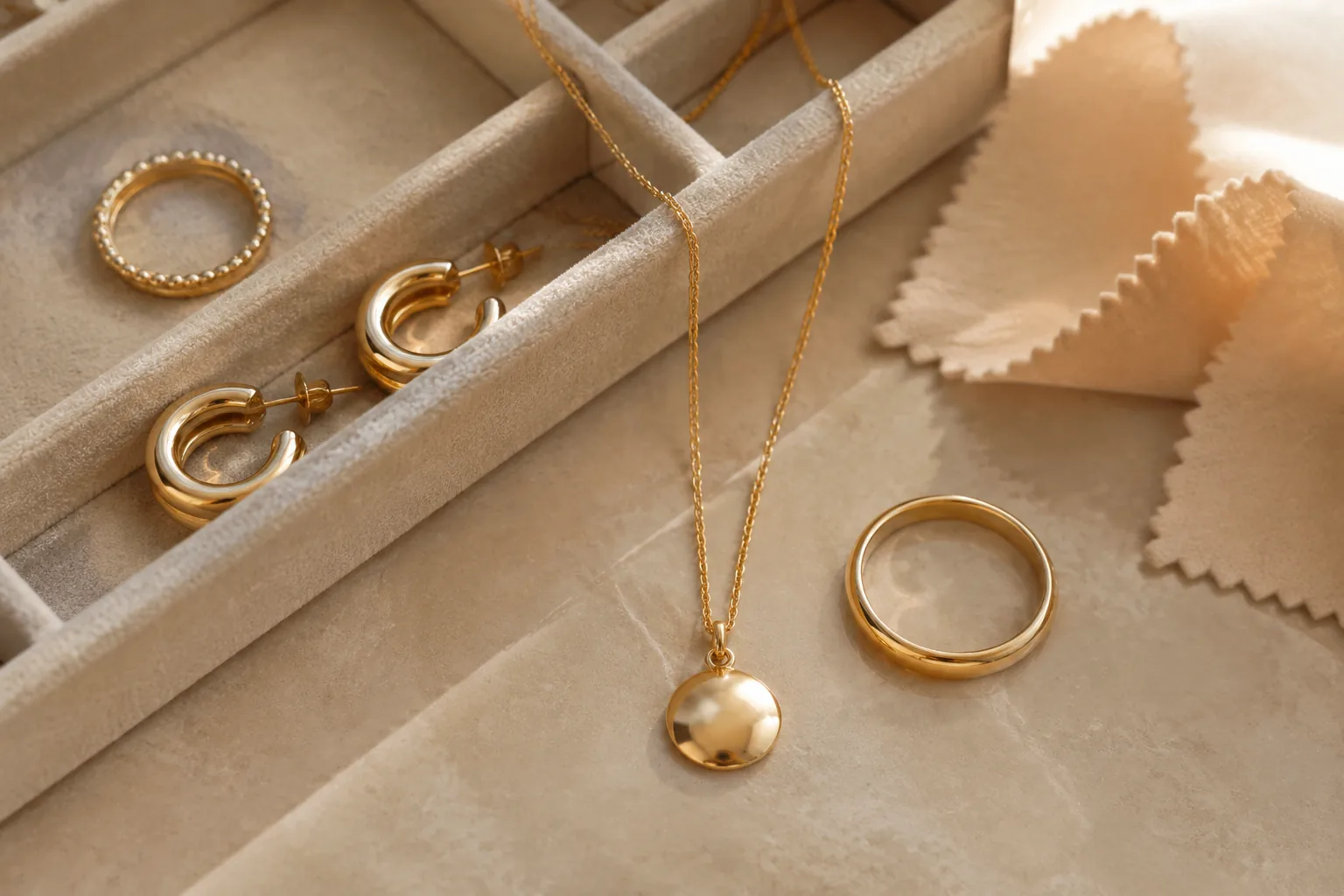
Gold vermeil can be a smart middle ground for buyers who want the look of gold jewelry without moving straight into solid gold. It is also easy to misunderstand. The word sounds premium, many pieces are designed for everyday styling, and some brands describe vermeil as longer lasting than regular gold plating. But vermeil is still a plated surface over another metal, which means moisture, friction, storage, cleaning habits, and warranty wording matter.
This gold vermeil jewelry buying guide focuses on ownership risk rather than a basic definition alone. The practical question is not just “what is vermeil?” It is “will this piece match the way I actually wear jewelry?”
Based on the reviewed FTC consumer guidance, U.S. vermeil labeling rule, and official care or warranty pages from Mejuri, Monica Vinader, and Missoma, the safest expectation is this: gold vermeil can suit careful everyday-style wear, occasional wear, and buyers who are willing to remove and store jewelry properly. It is less suited to buyers who want never-remove rings, bracelets, anklets, or necklaces that stay on through showers, workouts, perfume, lotion, sleep, and travel.
Gold Vermeil Is Still a Plated Surface, Not Solid Gold
For a U.S.-focused buyer, the baseline definition comes from the U.S. Jewelry Guides. Under the eCFR rule on misuse of the word “vermeil,” a product may be described as vermeil if it has a sterling silver base and is plated or coated on all significant surfaces with gold or gold alloy of at least 10 karat fineness, with reasonable durability, and with a minimum thickness equivalent to 2.5 microns of fine gold. The rule also says the word should not be used in a way that misrepresents a product’s composition.
That definition matters because vermeil is not simply any gold-colored jewelry. It is also not solid gold. Its identity depends on both the base metal and the gold layer.
The reviewed brand sources line up with that general idea. Mejuri lists Gold Vermeil as one of its metal types and describes it as a thick layer of solid gold over sterling silver. Mejuri also states that its gold vermeil is 18k solid gold layered on sterling silver. Monica Vinader states that its gold vermeil is a thick layer of 18k gold over sterling silver. Missoma states that its 18k gold vermeil starts with a sterling silver base electroplated with 2.5 microns of solid gold.
The sterling silver base is also relevant to care. FTC consumer guidance states that sterling silver is 92.5% pure silver. Mejuri states that gold vermeil naturally tarnishes over time and can be affected by air pollution, moisture, and sulfur-containing items. That does not mean every piece will behave identically, but it does mean tarnish and surface change should not be treated as impossible.
The important ownership point is simple: vermeil gives you a gold surface over sterling silver, not a solid gold object all the way through. FTC consumer guidance says gold plating eventually wears away depending on how the item is worn and the thickness of the plating. That principle is central to buying vermeil wisely.
The Buyer Checklist: What to Confirm Before You Buy
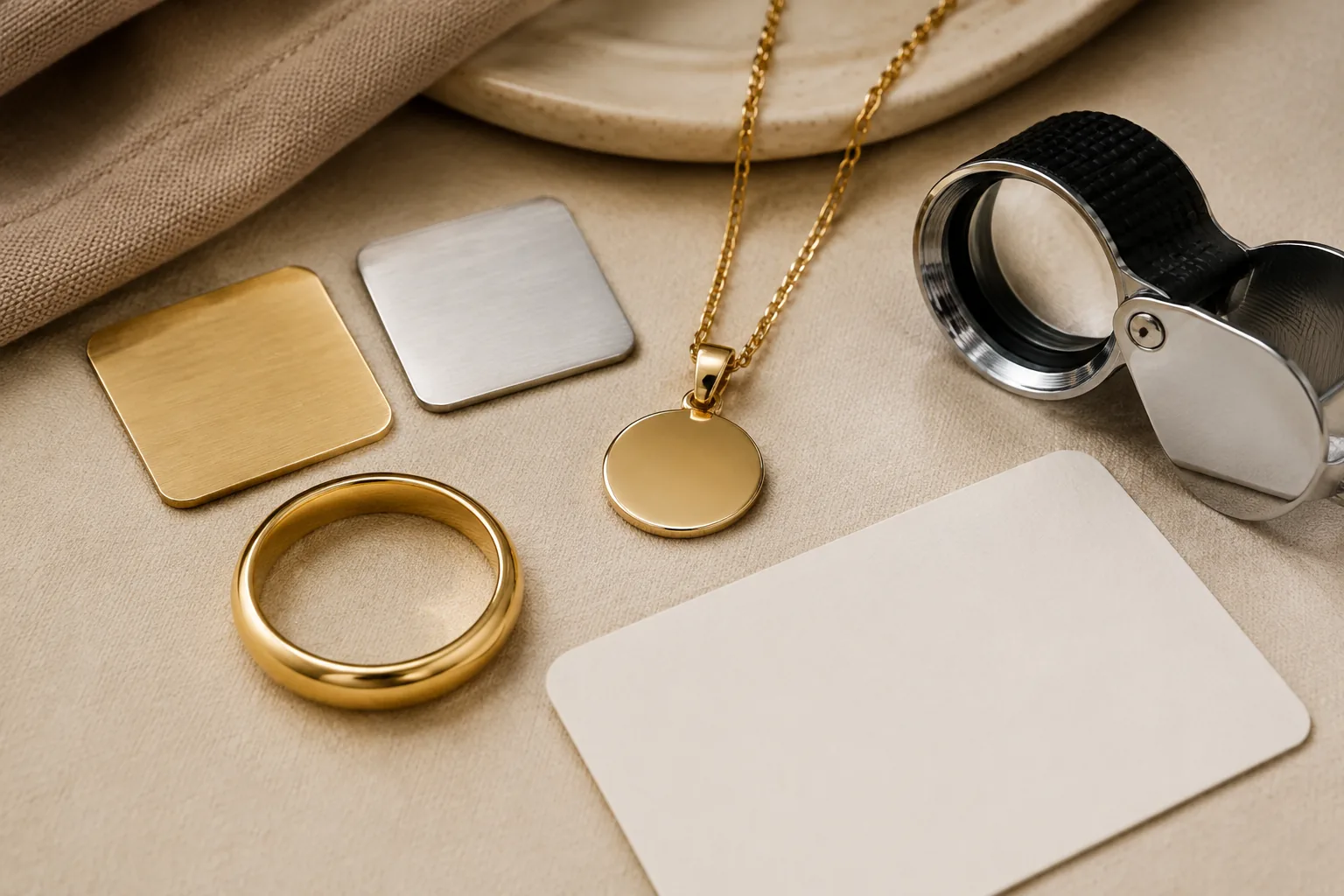
Before buying a vermeil piece, check the product page and policy pages for specific material and service details. This is especially important online, where “gold,” “gold plated,” “gold vermeil,” “gold-tone,” and “gold-plated brass” can appear near each other in the same brand catalog.
Start with the base metal. For U.S. vermeil terminology, the eCFR standard requires a sterling silver base. Missoma’s materials page is a useful example of why this matters: Missoma distinguishes its 18k gold vermeil from its 18k gold-plated jewelry on brass. It also states that its gold-plated jewelry on brass has two microns of gold on rings, pendants, and bracelets, and one micron on earrings. That is different from its 18k gold vermeil construction on sterling silver.
Next, check the gold fineness and thickness language. The U.S. vermeil rule refers to gold or gold alloy of at least 10 karat fineness and a minimum thickness equivalent to 2.5 microns of fine gold. Missoma explicitly states 2.5 microns for its 18k gold vermeil. Mejuri and Monica Vinader, in the reviewed sources, describe 18k gold over sterling silver, but the briefed facts do not provide a universal product-by-product thickness statement for every item from those brands.
Then check whether the page is describing vermeil, gold electroplate, or gold-filled construction. FTC consumer guidance states that gold electroplate is at least 10 karat gold and at least 0.175 microns thick. The FTC also describes gold filled, gold overlay, and rolled gold plate as a layer of at least 10 karat gold mechanically applied to base metal, with fraction or weight disclosure when the gold layer is under 1/20 of the total metal weight. These are different constructions with different expectations.
A practical pre-purchase checklist should include:
- Does the product page say “gold vermeil,” not just “gold plated” or “gold-tone”?
- Does it identify sterling silver as the base metal?
- Does it disclose gold karat, such as 18k?
- Does it disclose plating thickness, especially if durability is part of the buying decision?
- Does the brand separate vermeil from brass-based plated jewelry?
- Does the warranty cover manufacturing defects only, or does it address tarnish, fading, color loss, repair, or replating?
- Does the warranty exclude scratches, water, chemicals, improper care, normal wear, or third-party modifications?
- Is there a repair or replating pathway, and is it clearly stated for vermeil?
Where Vermeil Works Best and Where It Wears Faster
Gold vermeil is usually most reasonable when the piece has lower friction, is removed before wet or chemical exposure, and can be stored separately. The best fit is often a piece you wear often but not continuously: a pendant necklace removed at night, earrings stored dry after wear, or a ring worn for office and social settings but taken off for handwashing-heavy tasks, workouts, cleaning, showering, and sleeping.
Higher-friction use cases deserve more caution. This is analysis based on the FTC’s statement that gold plating eventually wears away depending on how the item is worn and the thickness of the plating. Rings can rub against hard surfaces, bags, phones, desks, weights, other rings, and household objects. Bracelets and bangles can knock against tables and keyboards. Anklets can experience shoe friction, sweat, sunscreen, and movement. Stacked necklaces, charms, and pendants can rub at contact points. These are not automatic deal-breakers, but they make surface wear more likely than a low-contact piece.
Mejuri states that gold vermeil lasts longer than regular gold plating. That is a brand comparison claim and can be useful context, but it should not be stretched into a promise that vermeil is permanent. Mejuri also states that gold vermeil naturally tarnishes over time and can be affected by air pollution, moisture, and sulfur-containing items.
For buyers, the key question is not whether vermeil is “good” or “bad.” It is whether the construction matches the wear pattern. A vermeil cocktail ring worn carefully may be a better fit than a vermeil band expected to survive constant hand contact, lotion, sanitizers, water, gym sessions, and sleep.
Water, Sweat, Perfume, Lotion, and Humidity: What the Brands Actually Warn About
The reviewed brand guidance does not support treating gold vermeil as waterproof or safe for never-remove wear.
Monica Vinader’s care guidance says to remove jewelry when bathing, swimming, or intensely exercising. It also says to keep jewelry away from extreme temperatures, humidity, sunlight, perfume, creams, and liquids. Mejuri’s warranty excludes damage from improper care, including chemicals, water, and excessive force, and also excludes scratches, tarnishing, fading, and normal wear and tear. Missoma says gold vermeil and silver should be kept dark, cool, and dry.
Those details point in the same practical direction: showering, swimming, heavy workouts, perfume, lotion, humidity, and liquids are risk factors for vermeil ownership. The sources do not prove that one accidental exposure ruins a piece, and the article should not claim that. But they do show that moisture and chemicals are not the conditions brands are asking buyers to assume as normal care.
A careful routine is more realistic:
- Put vermeil on after perfume, lotion, sunscreen, and hair products have dried.
- Remove vermeil before swimming, bathing, and intense exercise.
- Avoid storing vermeil in humid bathrooms.
- Take rings off before cleaning, heavy hand use, or activities involving repeated water and chemical exposure.
- Treat travel pouches as temporary protection, not a license to store pieces tangled together.
For someone who wants jewelry that stays on through sleep, showers, workouts, and product application, solid gold may be the more practical construction to consider. That is not an investment claim or a promise that solid gold is indestructible. It is a materials-based suggestion: a solid gold piece does not depend on a finite gold surface layer in the same way plated constructions do.
Storage Rules That Mejuri, Monica Vinader, and Missoma Mostly Agree On
Storage is one of the clearest areas of agreement across the reviewed brand guidance.
Mejuri recommends storing gold vermeil in a safe, dry place and using an anti-tarnish pouch, case, or strip. Monica Vinader recommends storing jewelry in a soft pouch or jewelry case. Missoma recommends storing pieces individually, preferably in its soft-lined box or pouch, so they do not rub, scratch, or tangle. Missoma also says gold vermeil and silver should be kept dark, cool, and dry.
This gives buyers a practical standard: dry, protected, separated storage is part of owning vermeil. It is not an optional luxury if you want to reduce avoidable wear.
Individual storage matters because surface contact is a wear factor. Chains can tangle. Pendants can rub against other pendants. Hoops can scratch against rings. A charm bracelet can create repeated contact points. A pouch, lined box, or divided tray helps reduce that contact.
Dry storage matters because moisture is repeatedly identified as a concern. Mejuri states that gold vermeil can be affected by moisture. Monica Vinader warns against humidity and liquids. Missoma says gold vermeil should be kept dark, cool, and dry. That makes a bathroom counter, shower shelf, gym bag pocket, or open dish near cosmetics a poor default storage setup.
A reasonable storage setup does not need to be elaborate. Separate pouches, a lined jewelry box with dividers, anti-tarnish strips where appropriate, and a habit of closing clasps before storage can do more than a decorative tray where everything touches.
Cleaning Gold Vermeil Without Overpromising
Gold vermeil cleaning should stay conservative because the surface is plated and because pieces may also include stones, pearls, enamel, glue, delicate chains, textured finishes, or mixed materials not covered by a single rule.
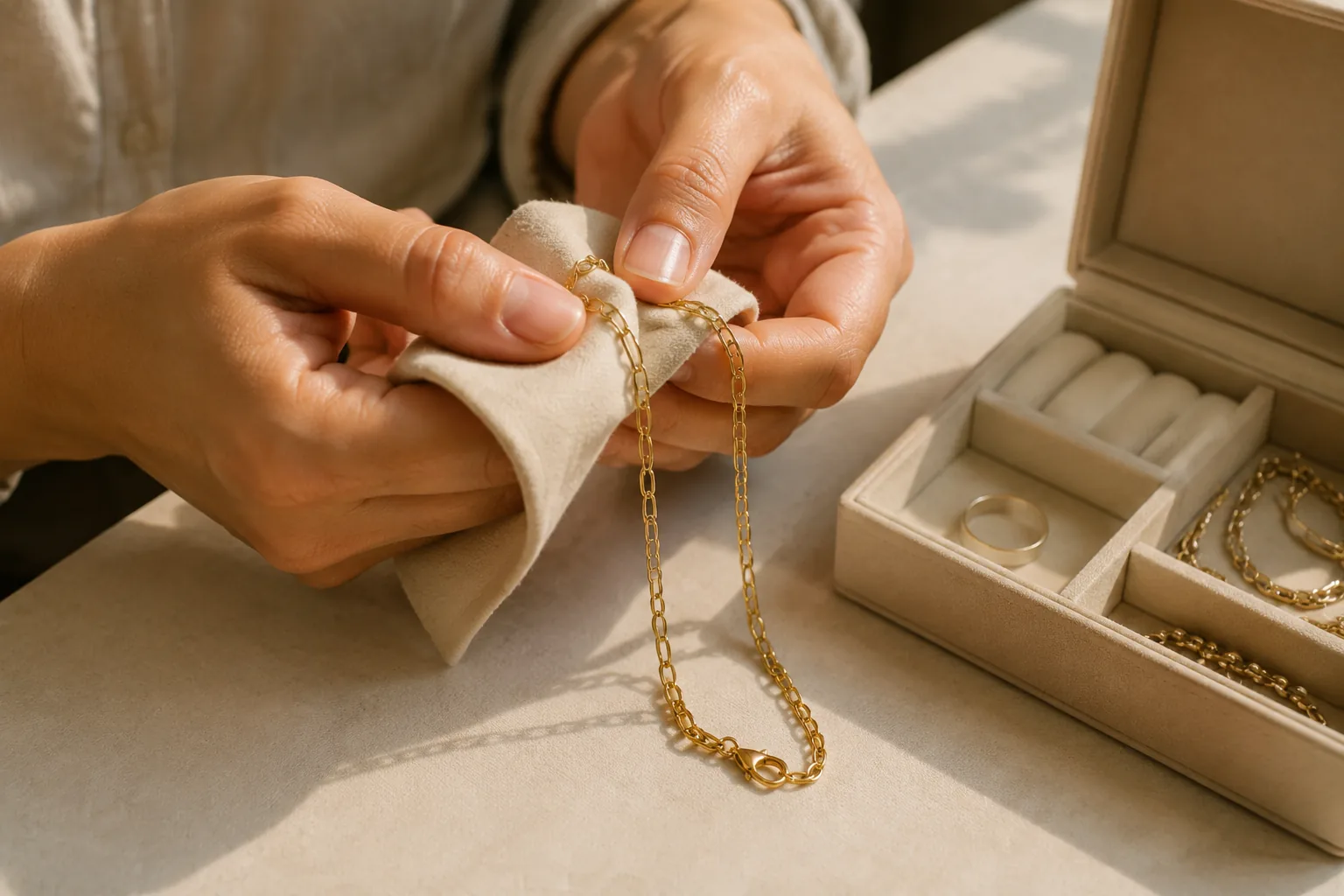
Mejuri recommends cleaning gold vermeil with a soft dry cloth, polishing gently, and not using steam or ultrasonic cleaners. Monica Vinader states that its care kit can be used on gold vermeil, sterling silver, and solid gold. Those are brand-specific instructions, not proof that every cleaner, machine, or at-home method is appropriate for every vermeil piece.
The lowest-risk general habit is gentle dry wiping after wear, especially before storage. This can help remove residues from skin contact, but it should not be described as restoring worn plating or preventing all tarnish. If a piece has stones, pearls, opals, enamel, glued components, heavy scratching, or a complex setting, care should follow the product-specific instructions rather than a generic metal-only method.
Avoid assuming that stronger cleaning is better. Steam and ultrasonic cleaners are specifically excluded in Mejuri’s gold vermeil care guidance. Aggressive polishing can also be a concern because the surface layer is finite. If a vermeil piece looks dull, darkened, or uneven in color, that may be tarnish, residue, plating wear, or a combination. Without inspecting the piece, it is better to describe careful next steps than to diagnose the cause.
A cautious cleaning sequence is:
- Wipe gently with a soft dry cloth after wear.
- Store separately in a dry pouch, case, or lined compartment.
- Avoid steam and ultrasonic cleaning for Mejuri gold vermeil.
- Check brand care instructions before using any care kit or liquid product.
- Ask the brand or a qualified jeweler about pieces with stones, pearls, enamel, glued parts, or visible plating loss.
Replating and Warranty: Mejuri vs Monica Vinader vs Missoma
Replating is where buyers need brand-specific evidence. It is not safe to assume that all gold vermeil brands offer the same support.
Mejuri offers a two-year warranty for workmanship defects. Its warranty excludes lost items, normal wear and tear, scratches, tarnishing, fading, damage from improper care including chemicals, water, excessive force, and third-party modifications. Mejuri states that approved warranty claims receive a same-item replacement if in stock or store credit if unavailable. The reviewed Mejuri pages do not clearly state that gold vermeil replating is included.
Monica Vinader gives the clearest replating commitment in the reviewed sources. It states that it offers a five-year warranty and a lifetime repairs service. It also states that if vermeil loses color over time, it will replate it. Monica Vinader further states that no-proof-of-purchase cases can still use lifetime repair for a small fee, triggering a new five-year warranty.
Missoma offers a two-year warranty on all jewelry covering manufacturing defects such as breakage or tarnishing, and excludes loss or theft. That is meaningful warranty language, but the reviewed Missoma FAQ does not state whether tarnished or worn vermeil is repaired, replaced, replated, denied as wear, or handled case by case. Missoma should therefore not be described as clearly promising vermeil replating based on the reviewed pages alone.
The practical comparison is:
| Brand | Reviewed material evidence | Reviewed warranty or service evidence | Replating clarity in reviewed sources |
|---|---|---|---|
| Mejuri | Gold vermeil described as 18k solid gold layered on sterling silver | Two-year warranty for workmanship defects; exclusions include normal wear, scratches, tarnishing, fading, chemicals, water, excessive force, and third-party modifications | No clear reviewed promise of gold vermeil replating |
| Monica Vinader | Gold vermeil described as a thick layer of 18k gold over sterling silver | Five-year warranty and lifetime repairs service | Clear statement that if vermeil loses color over time, it will replate it |
| Missoma | 18k gold vermeil described as sterling silver electroplated with 2.5 microns of solid gold | Two-year warranty covering manufacturing defects such as breakage or tarnishing; excludes loss or theft | No clear reviewed statement explaining whether worn vermeil is replated |
Warranty wording matters because plating wear, tarnish, fading, water exposure, chemical exposure, scratches, and improper care may be treated differently. A buyer should read the warranty before purchase, not after the surface has changed.
When Gold Vermeil Is a Good Buy and When to Skip It
Gold vermeil is a good candidate when you want a gold look, prefer sterling silver as the base over brass-based plating, and are comfortable with a plated surface that needs careful wear. It can make sense for earrings, pendants, occasional rings, dress bracelets, and trend-led pieces where solid gold would exceed the buyer’s practical budget or commitment level.
It is also a good fit for buyers who already remove jewelry before showering, swimming, applying products, sleeping, cleaning, and intense workouts. If you keep jewelry in separate pouches or a lined case, avoid bathroom storage, and do not expect every surface mark to be covered by warranty, vermeil can be a reasonable purchase.
Gold vermeil is less suitable if you want never-remove jewelry. This is especially true for rings, bracelets, anklets, stacked pieces, and charms that rub frequently. FTC consumer guidance says gold plating eventually wears away depending on how the item is worn and the thickness of the plating. Mejuri states that gold vermeil naturally tarnishes over time and can be affected by moisture. Monica Vinader advises removing jewelry when bathing, swimming, or intensely exercising and avoiding perfume, creams, liquids, and humidity. Mejuri’s warranty exclusions also make water, chemicals, fading, tarnishing, scratches, and normal wear important buyer considerations.
In analysis, solid gold is likely the more practical choice for buyers who want a piece to live on the body with minimal removal. Solid gold still needs care and can scratch, bend, or be damaged depending on design and karat, but it does not rely on a gold layer over sterling silver. That distinction matters most for everyday rings, wedding-adjacent bands, signature chains, and sentimental pieces the wearer does not want to baby.
Gold-filled or rolled-gold constructions may also be worth comparing when available, because FTC consumer guidance describes them separately from electroplate and vermeil. However, the best choice depends on the specific product’s construction, disclosure, design, and service terms.
Information Gaps to Be Honest About
The reviewed evidence supports clear buying cautions, but it does not support precise predictions for every piece.
The sources do not provide a reliable universal month-or-year estimate for how long gold vermeil plating will last. Wear depends on item type, plating thickness, contact points, storage, body chemistry, environment, moisture, cosmetics, and how often the piece is worn. FTC guidance supports the general principle that plating wears away depending on wear and thickness, but it does not give a universal timeline.
The reviewed sources also do not provide public product-by-product real-world wear-test results for Mejuri, Monica Vinader, or Missoma vermeil jewelry. This article should not imply hands-on testing or long-term wear experience.
Current repair or replating pricing is another gap. Monica Vinader gives the clearest official replating statement and describes a lifetime repairs service, including small-fee repair access in no-proof-of-purchase cases, but the reviewed evidence does not establish complete current pricing for every item and situation. Mejuri’s reviewed pages do not clearly state that gold vermeil replating is included. Missoma’s reviewed FAQ does not explain exactly how tarnished or worn vermeil is handled.
Product eligibility is also not universal from the reviewed sources. The evidence does not establish that every product from these brands uses the same construction or qualifies for the same service. It also does not establish that pieces with stones, pearls, enamel, glued components, delicate chains, complex textures, heavy scratches, or third-party modifications are always eligible for replating.
Finally, the reviewed sources do not establish that gold vermeil is hypoallergenic for all wearers. Some buyers may prefer sterling silver-based constructions over brass-based plated jewelry, but skin reactions are individual and should not be turned into a guarantee.
Conclusion: Buy Vermeil for the Right Wear Pattern
Gold vermeil is best understood as a higher-spec plated construction, not a solid gold substitute. In U.S. terminology, vermeil requires a sterling silver base, gold or gold alloy of at least 10k on significant surfaces, and a minimum thickness equivalent to 2.5 microns of fine gold. Brand examples from Mejuri, Monica Vinader, and Missoma show that many mid-to-premium vermeil pieces use 18k gold over sterling silver, but buyers still need to check each product page.
The clearest ownership rule is that gold vermeil rewards careful habits. Store it dry and separately. Keep it away from moisture, humidity, perfume, creams, and heavy exercise where brand guidance warns against those exposures. Clean gently and avoid unsupported cleaning methods. Expect a finite gold surface, especially on rings, bracelets, anklets, stacks, and contact-heavy designs.
For replating, do not generalize across brands. Monica Vinader gives the clearest reviewed commitment to replate vermeil if it loses color over time. Mejuri and Missoma provide useful warranty and care information, but the reviewed pages should not be described as clearly promising vermeil replating.
Gold vermeil can be a good buy when the price, design, and care routine make sense. It is worth skipping, or comparing against solid gold, when the buyer wants jewelry that stays on through water, workouts, sleep, products, and constant friction.
Sources
- Mejuri: Jewelry Care
- Mejuri: Gold Vermeil Jewelry
- Mejuri: Warranty
- Monica Vinader: Warranty
- Monica Vinader: Jewellery Care
- Missoma: Help and FAQs
- Missoma: Our Metals
- Electronic Code of Federal Regulations: 16 CFR 23.4, Misuse of the Word “Vermeil”
- Federal Trade Commission: Buying Platinum, Gold, and Silver Jewelry
Internal Linking Suggestions
- Link to a materials hub for gold vermeil, gold plating, solid gold, sterling silver, and gold-filled jewelry.
- Link to a care guide on how to store jewelry to reduce tarnish, scratching, and chain tangling.
- Link to a comparison guide on solid gold vs gold vermeil for everyday jewelry.
- Link to brand comparison pages for Mejuri, Monica Vinader, and Missoma where warranty and material disclosure are discussed in more detail.