




Choosing between James Allen, Blue Nile, and Brilliant Earth is not only a question of price, carat size, or which homepage feels more polished. For an engagement ring shopper, the more useful question is: which buying process helps you make the decision with the least confusion?
This comparison looks at the workflow each brand emphasizes. Based on the provided source set, James Allen is most useful to discuss as an inspection-control and design-your-own workflow, with an important current-site caveat. Blue Nile is strongest as a broad filtering and education-led browsing experience. Brilliant Earth is most relevant for shoppers who want sourcing, traceability, and values-led language to be central to the purchase journey.
This is not a hands-on ring review, a customer-service ranking, or a claim that one retailer is universally better. It is a source-backed process comparison for shoppers deciding where to start.
Quick Verdict: Which Buying Process Fits Which Shopper?
If you want close diamond inspection and design-your-own control, start your research with James Allen’s documented workflow. The provided research says James Allen supports design-your-own engagement ring paths that can begin with a setting, diamond, lab-grown diamond, or gemstone, and that its source supports 360-degree HD diamond viewing, up to 40x zoom, and real-time inspection with a gemologist. The caveat is important: the crawl also reported that opening JamesAllen.com redirected to Blue Nile and showed Blue Nile navigation with a James Allen Collection inside Blue Nile. Treat James Allen as the inspection-control reference point, but verify the current live path before you build your whole shortlist around it.
If you want broad filters, multiple starting paths, and education-led browsing, Blue Nile is the most straightforward starting point. The provided research says Blue Nile’s diamond engagement-ring page had filters for gender, style, collection, size, diamond type, shape, gemstones, metal, width, price, sale, engraving, and shipping date. It also offered paths labeled Start With A Setting, Start With A Diamond, Start With A Gemstone, and Creative Studio. That makes Blue Nile a practical starting point if you want to narrow a large assortment by visible criteria before getting attached to one ring.
If you want sourcing and traceability language to be front and center, Brilliant Earth is the clearest values-led starting point. Its 2025 Mission Report discusses supplier standards, listed origin, cutting and manufacturing countries, Beyond Conflict Free Diamonds language, blockchain verification, lab-diamond supplier audits, repurposed precious metals, Fairmined gold, packaging, and lifecycle or circularity language. That does not prove one specific ring is more ethical than another retailer’s ring, but it does mean Brilliant Earth gives sourcing-minded shoppers more brand-level material to read.
What This Comparison Can and Cannot Prove
This article can compare documented buying paths, inspection features, filters, education language, and sourcing-positioning claims from the supplied research package. It can also use GIA and FTC sources as guardrails for diamond terminology and advertising claims.
It cannot prove current prices, discount depth, real-time inventory, finished-ring craftsmanship, prong quality, durability, customer-service outcomes, repair handling, resizing experience, shipping reliability, warranty outcomes, return exceptions, or affiliate terms. Those topics would require separate current evidence.
One example matters for freshness: the research package says Blue Nile’s diamond engagement-ring page displayed 1,207 results at crawl time. That is a useful snapshot, not a current inventory promise. Inventory and filters can change.
The James Allen status also needs careful wording. The research package includes James Allen source material supporting design-your-own and diamond-viewing features, but it also reports that opening https://www.jamesallen.com/ redirected to Blue Nile during the crawl. That means readers should check the current path themselves before assuming the standalone James Allen experience operates exactly as legacy descriptions may suggest.
Ethics and sustainability language also needs limits. The FTC has warned that diamond advertising should clearly disclose when a stone is lab-created or simulated, with disclosures close to product descriptions. FTC guidance also warns against broad, unqualified eco-friendly, eco-conscious, or sustainable jewelry claims because they can imply specific environmental benefits that sellers must substantiate. In this article, brand claims are attributed as brand claims, not treated as independently verified conclusions.
James Allen Buying Process: Best for Inspection-Control Shoppers
James Allen is the best fit in this comparison for the shopper who wants to inspect an individual diamond closely before committing to a setting. According to the provided research, James Allen’s homepage source supports design-your-own engagement ring paths that can start with a setting, diamond, lab-grown diamond, or gemstone. That structure suits shoppers who want to control the sequence of the purchase rather than pick only from finished ring listings.
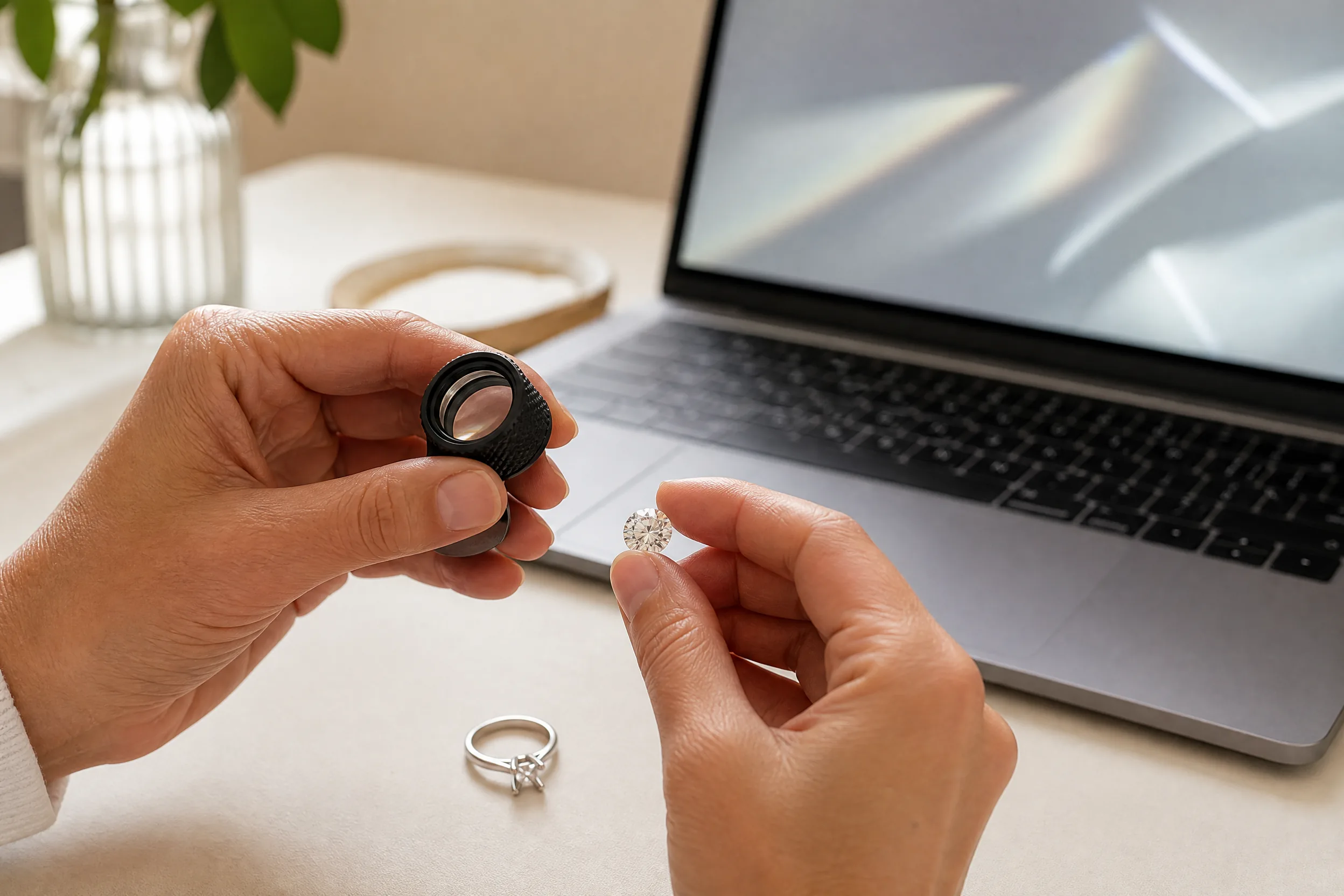
The strongest documented James Allen differentiator is inspection. The research package says the James Allen source supports 360-degree HD diamond viewing, up to 40x zoom, and real-time inspection with a gemologist. For an online engagement-ring buyer, that kind of workflow can make the selection process feel more granular: you are not only filtering by carat, shape, or clarity grade, but also looking closely at an individual stone’s visible characteristics.
That said, inspection tools have limits. A 360-degree viewer or high magnification can help you examine a stone online, but it does not prove how the finished ring will look in person, under every lighting condition, or on the wearer’s hand. It also does not verify setting craftsmanship, prong finishing, long-term durability, or post-purchase service.
James Allen’s diamond education source also matters for certification. The research package says James Allen’s education page explains that a diamond certificate verifies color, carat, clarity, and cut and names GIA, AGS, and IGI as well-known grading labs. That is useful beginner education, but shoppers should still read the actual grading report attached to a specific stone and understand whether the diamond is natural or lab-grown.
The current-site caveat is unavoidable. Because the crawl reported a redirect from JamesAllen.com to Blue Nile, shoppers should confirm the current James Allen path before assuming the same standalone workflow, checkout path, services, or product pages are available in the same way. Analysis: if your top priority is inspection control, James Allen remains the most relevant workflow to investigate, but do that investigation with the live site open, not from memory or old screenshots.
Blue Nile Buying Process: Best for Broad Filters and Education-Led Browsing
Blue Nile is the strongest fit for shoppers who want a large, filterable engagement-ring browsing experience. The provided research says its diamond engagement-ring page included filters for gender, style, collection, size, diamond type, shape, gemstones, metal, width, price, sale, engraving, and shipping date. That kind of filter set is useful when you are still learning what tradeoffs matter.
Blue Nile also supports multiple starting points. The research says the page offered shopping paths labeled Start With A Setting, Start With A Diamond, Start With A Gemstone, and Creative Studio. This matters because engagement-ring shoppers do not all think in the same order. One person may already know they want a yellow gold solitaire and need a diamond. Another may know they want an oval diamond but has not chosen a setting. Another may want a gemstone-centered design or a more custom studio-style path.
The research package says Blue Nile’s page displayed 1,207 results at crawl time. That supports the idea that the page presented a broad assortment during the crawl, but it should not be repeated as a current live count. Treat it as evidence of the page’s assortment-led design, not as a promise about today’s inventory.
Blue Nile’s education and certification language also deserves attention. The research says Blue Nile uses GIA reports for natural diamonds and IGI reports for lab-grown diamonds at Blue Nile. That is a useful distinction for shoppers comparing natural and lab-grown options, especially because grading report terminology and lab practices should not be treated as interchangeable across every diamond type.
The research also says Blue Nile’s engagement-ring page used ethically sourced and certified wording. That wording should be read carefully. It may be part of the brand’s positioning, but this article cannot independently verify the sourcing status of a specific diamond or ring. Analysis: Blue Nile is the better first stop if you want to compare many designs and narrow by visible shopping criteria before moving into final diamond-report review.
Brilliant Earth Buying Process: Best for Sourcing and Traceability-Focused Shoppers
Brilliant Earth is the best starting point in this comparison for shoppers who want sourcing language, traceability, and values-led documentation to shape the buying journey. The provided research says Brilliant Earth’s engagement-ring shop supports a design-your-own process by choosing a setting, metal, natural or lab-grown diamond, shape, carat, and ring size, then visualizing before adding to bag.
That workflow overlaps with the broader online engagement-ring model: choose the setting, choose the stone, adjust key specifications, and review the ring before checkout. What makes Brilliant Earth different in this source set is not only the build process, but the amount of official sourcing and mission material attached to the brand.
The research package says Brilliant Earth’s 2025 Mission Report discusses supplier standards, listed origin, cutting and manufacturing countries, Beyond Conflict Free Diamonds language, blockchain verification, lab-diamond supplier audits, repurposed precious metals, Fairmined gold, packaging, and lifecycle or circularity language. It also says the report includes metrics of 99.5% repurposed gold and 96.4% repurposed silver.
Those are brand-level statements and reported metrics from the official source. They are relevant for a sourcing-focused shopper, but they need qualification. The same research package says Brilliant Earth’s 2025 Mission Report includes limitations that some metrics may be estimates, standards are developing, supplier codes are not guarantees, and forward-looking sustainability goals may not be achieved.
That limitation is not a small footnote. It is central to how readers should interpret values-led jewelry claims. Analysis: Brilliant Earth is the right starting point if you want to read sourcing documentation before falling in love with a ring design. It is not evidence, by itself, that every Brilliant Earth ring is categorically more ethical, sustainable, traceable, or responsible than every ring from James Allen or Blue Nile.
Diamond Education and Certification: Where Retailer Language Needs Guardrails
Diamond education is useful, but it should not be treated as neutral just because it appears next to a shopping tool. Retailer education pages can help you learn vocabulary, but independent sources are still important for terminology and disclosure.
The research package says GIA states that it invented the 4Cs and the International Diamond Grading System. That makes GIA a relevant guardrail for explaining cut, color, clarity, and carat in a consumer diamond article. The research also says James Allen’s education page describes diamond certificates as verifying color, carat, clarity, and cut and names GIA, AGS, and IGI as well-known grading labs.
For Blue Nile, the research says the brand uses GIA reports for natural diamonds and IGI reports for lab-grown diamonds at Blue Nile. That distinction should push shoppers to compare like with like. A natural diamond with one type of report and a lab-grown diamond with another reporting framework are not simply interchangeable because both have grades attached.
Freshness matters especially for lab-grown diamonds. The research package says GIA announced on June 2, 2025 that it would move lab-grown diamonds away from natural-diamond color and clarity nomenclature toward descriptive categories such as premium and standard while continuing to identify lab-grown diamonds. Analysis: shoppers should expect lab-grown diamond language to evolve, and should check the grading report and retailer disclosure on the specific stone they are considering.
FTC guidance adds another boundary. The research package says FTC guidance warns that diamond advertising must clearly disclose when a stone is lab-created or simulated, with disclosures close to product descriptions. For readers, the practical takeaway is simple: do not rely only on a headline, product tile, or romantic ring name. Confirm whether the stone is natural, lab-grown, or simulated in the product details and report documentation.
Sourcing, Ethics, and Sustainability Claims: How to Read the Fine Print
Sourcing language can be meaningful, but it can also become too broad if repeated without qualification. In this comparison, Blue Nile and Brilliant Earth both appear in the research package with values-related language, but the evidence supports different levels of detail.
For Blue Nile, the research says its engagement-ring page used ethically sourced and certified wording. That can be noted as brand language, but it does not establish independent proof about any specific ring, diamond, or supplier path.
For Brilliant Earth, the research package contains more detailed official sourcing material. Its 2025 Mission Report discusses supplier standards, origin and manufacturing-country listings, Beyond Conflict Free Diamonds language, blockchain verification, lab-diamond supplier audits, repurposed precious metals, Fairmined gold, packaging, and circularity language. It also includes reported metrics for repurposed gold and silver.
However, the report’s own limitations matter. The research says some metrics may be estimates, standards are developing, supplier codes are not guarantees, and forward-looking sustainability goals may not be achieved. FTC guidance also warns against broad unqualified eco-friendly, eco-conscious, or sustainable jewelry claims because they can imply specific environmental benefits that sellers must substantiate.
Analysis: a careful shopper can give Brilliant Earth credit for making sourcing and traceability documentation more central to the shopping experience without turning that into an absolute ethics ranking. The stronger question is not “which brand is completely ethical?” It is “which brand gives me the type of sourcing information I want to evaluate, and where are the limits of that information?”
Side-by-Side Workflow Comparison
| Workflow factor | James Allen | Blue Nile | Brilliant Earth |
|---|---|---|---|
| Best fit | Inspection-control shoppers | Broad filtering and education-led browsers | Sourcing and traceability-focused shoppers |
| Starting path | Research says design-your-own paths can start with a setting, diamond, lab-grown diamond, or gemstone | Research says paths include Start With A Setting, Start With A Diamond, Start With A Gemstone, and Creative Studio | Research says design-your-own includes setting, metal, natural or lab-grown diamond, shape, carat, and ring size |
| Diamond inspection | Research says 360-degree HD viewing, up to 40x zoom, and real-time inspection with a gemologist | Source set emphasizes filters and assortment browsing more than a James Allen-style inspection claim | Source set emphasizes visualization and sourcing documentation |
| Filters and browsing | Not the strongest documented point in this research package | Research confirms filters including gender, style, collection, size, diamond type, shape, gemstones, metal, width, price, sale, engraving, and shipping date | Research confirms customization choices, not the same broad filter list supplied for Blue Nile |
| Certification education | Research says James Allen explains certificates and names GIA, AGS, and IGI | Research says Blue Nile uses GIA reports for natural diamonds and IGI reports for lab-grown diamonds | Source set focuses more on sourcing and mission language than grading-lab education |
| Sourcing language | Not the main documented differentiator in this package | Research says Blue Nile used ethically sourced and certified wording | Research says Brilliant Earth discusses supplier standards, traceability, repurposed metals, Fairmined gold, and related mission topics |
| Main caution | Crawl reported JamesAllen.com redirected to Blue Nile |
Crawl-time result count is not current inventory proof | Mission claims need their stated limitations and FTC-style advertising caution |
How to Choose Your Starting Point
Choose James Allen first if your decision process starts with the stone. This is the best fit if you want to rotate, zoom, and inspect individual diamonds before deciding which setting deserves your budget. It is also useful if you want a design-your-own sequence and are comfortable verifying the current live-site path because of the reported redirect to Blue Nile.
Choose Blue Nile first if your decision process starts with narrowing a wide field. If you are comparing metals, shapes, gender categories, gemstone options, engraving, diamond type, and shipping-date filters, Blue Nile’s documented page structure gives you a practical way to reduce the noise. It is especially useful for shoppers who do not yet know whether they want to start with the setting, diamond, gemstone, or a creative studio-style option.
Choose Brilliant Earth first if your decision process starts with sourcing questions. If you want to read mission-report language, supplier standards, traceability positioning, lab-diamond audit language, repurposed-metal metrics, and related limitations before choosing a ring, Brilliant Earth gives you the most values-led material in this source set. The key is to treat those claims as attributed brand documentation, not independent proof of categorical superiority.
For many shoppers, the practical recommendation is to use more than one workflow. Analysis: you might start with Blue Nile to learn shapes and setting styles, use James Allen-style inspection thinking to understand how closely you want to evaluate a diamond, and read Brilliant Earth’s mission material to decide what sourcing disclosures matter to you. Then compare specific stones, reports, settings, and policies before purchase.
FAQ
Which retailer should I start with if I want design-your-own control and close diamond inspection?
Start with James Allen’s documented workflow, but verify the current live experience first. The research says James Allen supports design-your-own paths and 360-degree HD diamond viewing with up to 40x zoom and real-time inspection with a gemologist. The caveat is that the crawl also reported a redirect from JamesAllen.com to Blue Nile, so do not assume every standalone path works exactly as expected today.
Which retailer should I start with if I want a broad engagement-ring assortment?
Start with Blue Nile. The research says Blue Nile’s page included many filters and displayed 1,207 results at crawl time. That count should be treated as a snapshot, not a current promise, but it supports Blue Nile’s role as the broad-assortment browsing option in this comparison.
Which retailer should I start with if I care most about sourcing and traceability?
Start with Brilliant Earth if sourcing documentation is central to your decision. The research says its 2025 Mission Report discusses supplier standards, origin and manufacturing countries, blockchain verification, lab-diamond supplier audits, repurposed metals, Fairmined gold, and related topics. Read the limitations too, because the same research says some metrics may be estimates and supplier codes are not guarantees.
Can I compare GIA, IGI, AGS, 4Cs language, natural reports, and lab-grown reports the same way?
No. The safer approach is to compare the specific report attached to the specific stone and understand whether the diamond is natural or lab-grown. The research says GIA invented the 4Cs and International Diamond Grading System, Blue Nile uses GIA reports for natural diamonds and IGI reports for lab-grown diamonds, and GIA announced a 2025 change toward descriptive categories for lab-grown diamonds.
Can this comparison say one brand is more ethical or sustainable than the others?
No. The supplied evidence supports comparing brand language and documentation, not declaring one retailer categorically more ethical, sustainable, conflict-free, or responsible. FTC guidance also warns against broad unqualified environmental claims in jewelry advertising.
What information is missing before making a final purchase?
The source set does not verify current prices, discount validity, real-time inventory, finished-ring quality, customer-service outcomes, shipping reliability, resizing results, warranty handling, return exceptions, or affiliate terms. Check those details directly on the current product and policy pages before buying.
Conclusion: Pick the Workflow Before You Pick the Ring
The most useful way to compare James Allen vs Blue Nile vs Brilliant Earth is to start with your buying behavior, not with a universal winner.
James Allen is the most relevant starting point for inspection-control shoppers who want close diamond viewing and design-your-own flexibility, with the important caveat that the crawl reported a redirect to Blue Nile. Blue Nile is the clearest starting point for shoppers who want broad filters, multiple paths, and an education-led assortment experience. Brilliant Earth is the strongest fit for buyers who want sourcing, traceability, and mission-report language to be part of the decision from the beginning.
The final choice should come down to the specific diamond, report, setting, policy terms, and disclosures in front of you. Use each retailer’s workflow for what it does best, and keep marketing claims separate from independently verified facts.