



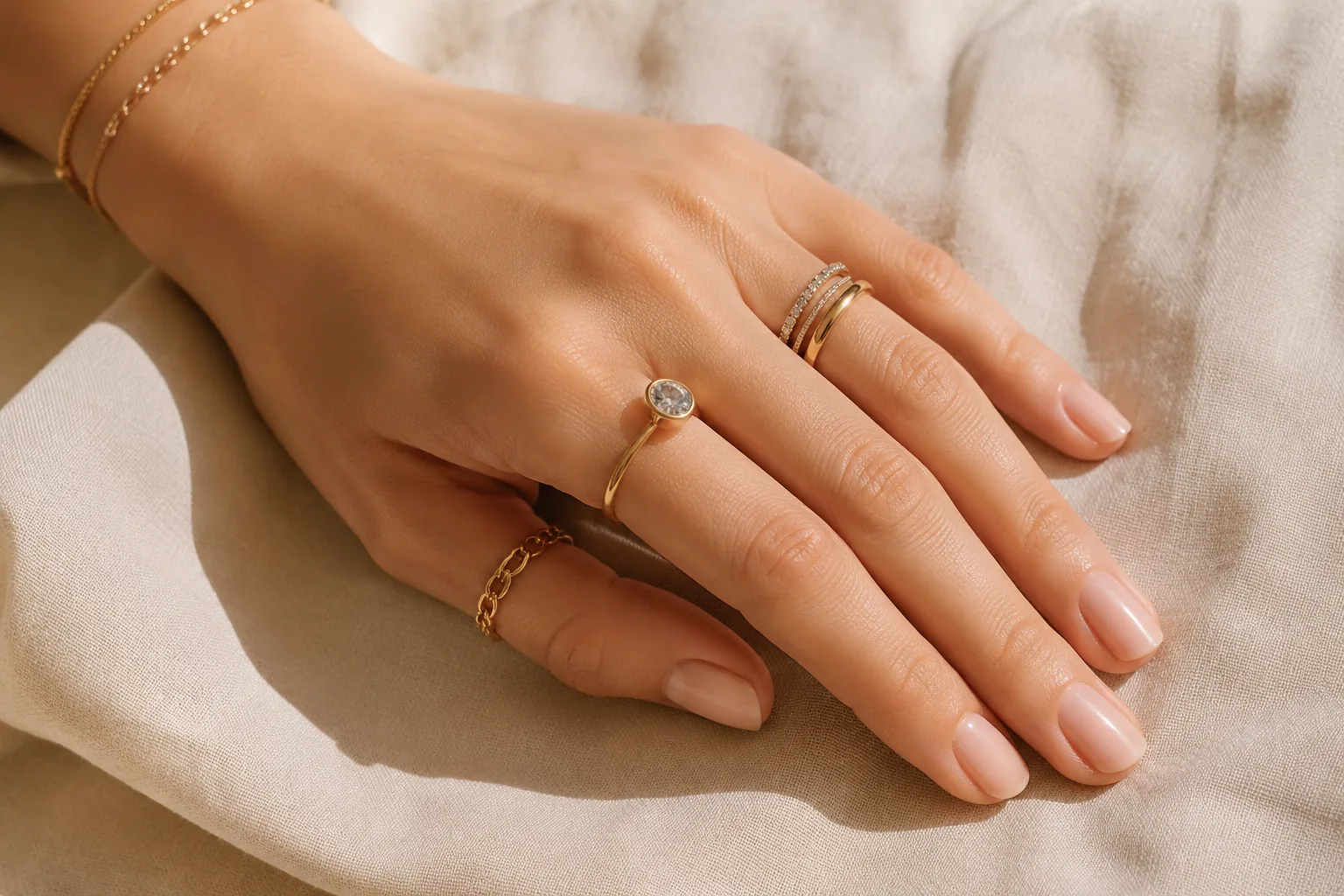
A good daily ring stack starts with a simple question: do you want the rings to feel barely there, visibly styled, or intentionally bold? The answer affects how many rings you wear, which fingers you use, whether you stack several bands on one finger, and how much width or height your hand can comfortably carry through a normal day.
Ring stack styling is not a fixed formula. The Gemological Institute of America describes ring stacking as mixing rings across one or more fingers, and its guidance presents three to five rings per hand as a balanced starting range, not a rule for everyone. GIA also cautions that over-stacking can create discomfort and visual clutter, and that multiple rings on one finger can make the fit feel tighter.
Use that as the working principle: start with the hand, not the ring tray. A stack should look intentional from across the room, feel comfortable while typing or carrying a bag, and leave enough space that each piece still has a job.
Start With the Daily-Wear Decision: Count, Fingers, and Comfort
Before choosing metals or gemstones, decide how much presence you want.
For a minimal daily stack, try two or three rings total: perhaps one slim band on the index finger, one focal ring on the ring finger, and a small band or signet on the pinky. This keeps the hand styled but not crowded.
For a balanced everyday stack, three to five rings per hand is a useful starting point because it gives you enough pieces to create rhythm without automatically filling every finger. This aligns with GIA’s stacking guidance, but it should stay flexible. If your rings are wide, raised, or textured, three may look fuller than five very slim bands.
For a bolder stack, use more width or more fingers, but avoid adding both at the same time without checking the result. A hand with several chunky rings, tall stones, mixed textures, and no negative space can quickly read as heavy. That may be the style you want for an outfit, but it is usually harder to wear comfortably all day.
For daily wear, the best ring count is the lowest number that gives the visual effect you want while still letting your fingers move naturally. Styling should come after comfort, not before it.
How Many Rings Should You Wear in a Daily Stack?
There is no universal ideal number of rings. The better question is how much total ring surface your hand can carry.
A daily stack often works well when you think in “visual weight” rather than ring count. One 6 mm band can look and feel more substantial than three very fine bands. Pandora states that wider bands fit more snugly than slim styles, and Brilliant Earth says wide bands over 4 mm may require sizing up at least half a size. Those are sizing facts, but they also matter visually: width adds both physical pressure and design weight.
Here is a practical way to scale the count:
| Daily Stack Goal | Good Starting Point | Why It Works |
|---|---|---|
| Minimal | 2 to 3 rings | Clean, low-effort, easier to fit around daily tasks |
| Balanced | 3 to 5 rings | Enough rhythm without filling every finger |
| Bold | 5+ rings or wider pieces | More expressive, but needs more spacing and comfort checks |
If you are wearing mostly thin bands, you can usually add more pieces before the hand looks crowded. If you are wearing signets, dome rings, pavé bands, cocktail-style stones, or thick sculptural shapes, reduce the count and give the dominant ring room.
Suggestion: take a quick mirror check with your hand relaxed at your side, not just held up for a close look. If all the rings blur into one block of metal, remove one piece or move a ring to the other hand.
Stack Vertically or Spread Rings Across Several Fingers?
Vertical stacking means wearing multiple rings on one finger. Spread-out stacking means distributing rings across several fingers. Both can work for daily ring stack styling, but they solve different problems.
Vertical stacking looks clean when the rings are slim, relatively low in height, and close enough in style to feel connected. Blue Nile frames rings as wearable singly or stacked, and its ring education supports thinner bands for stackable styling and pairing them with focal rings. A slim metal band above or below a gemstone ring can make the focal piece feel more considered without adding much width across the hand.
The tradeoff is fit. GIA notes that multiple rings on one finger can make the fit feel tighter. That matters most when the stack sits near the base of the finger, where several bands together can behave like one wider band.
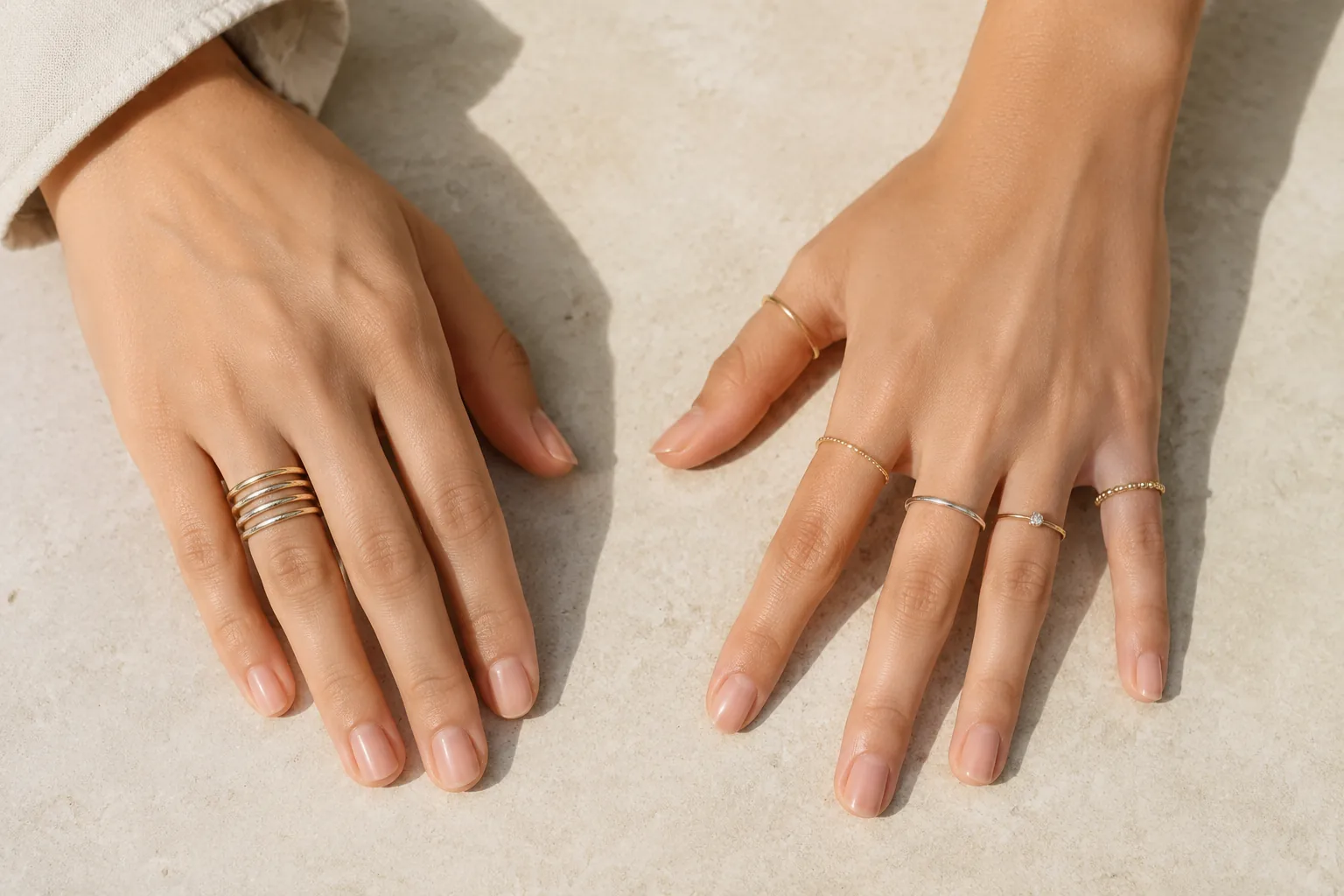
Spreading rings across several fingers can feel easier for daily wear because no single finger carries the full stack. It also gives you more negative space. For example, you might wear a focal ring on the middle finger, a slim band on the ring finger, and a pinky ring. The empty spaces help the stack look styled rather than packed.
Vertical stacking is strongest when you want a neat, modular look. Spread-out stacking is often better when your rings are wider, your fingers swell during the day, or you want the hand to look balanced from multiple angles.
Balance Band Width, Height, Texture, and Negative Space
The fastest way to make a ring stack look intentional is to vary one element at a time.
Band width controls weight. Slim bands create line and repetition. Wider bands create emphasis. If every ring is wide, the hand can look visually blocked. If every ring is extremely slim, the stack may look delicate but less anchored. A useful daily mix is one wider or more solid piece, plus two or three slimmer supporting bands.
Ring height controls interruption. A raised setting, gemstone, dome, or sculptural form draws the eye and may catch more easily on clothing, gloves, bags, or hair. That is a practical observation rather than a tested claim for specific products. For daily styling, raised rings usually need more space around them. Let one tall ring be the peak, then keep nearby pieces lower.
Texture creates contrast. GIA supports stacking approaches that mix textured or organic styles, combine vintage and modern pieces, mix metals, and evaluate the finished stack visually. Texture can include ribbing, hammered surfaces, pavé, beading, engraving, rope edges, or organic shapes. Use it to stop a stack from feeling flat, but avoid using every texture at once.
Negative space is not empty styling. It is what lets the eye understand the stack. Leaving one finger bare, or leaving a gap between a focal ring and a wider band, can make the whole hand look more deliberate.
Suggestion: if your stack feels crowded, remove the second-loudest ring, not necessarily the largest one. The largest ring may be the anchor; the competing piece is often what makes the stack feel busy.
Choose One Focal Piece and Let the Rest Support It
A daily stack becomes easier when one ring is clearly in charge.
The focal piece can be a gemstone ring, signet, diamond band, wider plain metal band, sculptural ring, or heirloom-style piece. Blue Nile mentions ring options including gemstones, diamond bands, plain metal rings, classic styles, trendy styles, and customized options. For styling purposes, any of these can act as the anchor if it has the most visual presence on the hand.
Once you choose the focal piece, give the remaining rings supporting roles:
| Ring Role | What It Does | Examples |
|---|---|---|
| Focal ring | Anchors the stack | Signet, gemstone ring, wide band, sculptural ring |
| Bridge ring | Connects styles | Slim mixed-metal band, textured band, small stone band |
| Quiet ring | Adds balance without competing | Plain metal band, very slim band |
| Space-maker | Keeps the hand from looking full | Bare finger or lower-profile ring |
If your focal ring has a colored stone, keep nearby rings simpler unless you want a deliberately maximal look. Who What Wear’s 2026 jewelry trend report identifies colored stones as prominent, and British Vogue describes ring stacks as a personal way to layer mixed metals, colored gemstones, and pieces from different eras. Those are useful trend signals, not technical rules.
Colored stones and mixed eras can make a stack feel personal, but they need a structure. Repeat one element, such as metal tone, shape, or scale, so the stack looks chosen rather than accidental.
Mix Metals and Styles Without Making the Stack Look Accidental
Mixed metals work best when the mix appears at least twice. One yellow gold ring in an otherwise all-silver stack can look like a mistake; two yellow gold notes make it look intentional. The same principle applies to rose gold, blackened finishes, or two-tone pieces.
A simple mixed-metal formula is:
| Formula | How to Use It |
|---|---|
| Dominant metal with accent metal | Let one metal lead and use the second as an accent |
| Bridge piece | Use one ring that already combines both tones |
| Finger grouping | Keep one finger mostly one tone and another finger mixed |
| Texture repeat | Repeat a ribbed, beaded, or hammered texture across different metals |
Style mixing follows the same logic. If you combine a vintage-inspired ring with modern bands, repeat either the metal, shape, or finish. GIA supports combining vintage and modern pieces in stack styling, but the final hand still needs visual editing.
Trend coverage can be helpful here. British Vogue reported double, triple, and quadruple-finger rings as a 2026 trend, while Who What Wear described curated ring stacks as bold, chunky, mixed-metal, sculptural, and personal. For daily wear, the durable takeaway is not that every stack needs to be oversized. It is that personality, mixed metals, and sculptural shapes can work when the hand still has balance and comfort.
Daily Comfort Checks Before You Leave the House
A ring stack that looks good for five minutes may not feel good after several hours. Before wearing a stack all day, check fit and movement.
Missoma advises accounting for cold and heat because fingers can shrink in cold weather and swell in heat, and it recommends measuring ring size at the end of the day. Brilliant Earth similarly recommends measuring more than once at different times because ring size can fluctuate with temperature, activity, and hydration. These facts matter because daily ring stacks often feel tighter later in the day than they did in the morning.
Use this pre-wear checklist:
| Check | What You Want |
|---|---|
| Knuckle clearance | Brilliant Earth says a ring should pass over the knuckle with gentle resistance |
| Base fit | Snug enough not to slide off, not so tight that it pinches |
| Wider bands | Extra caution, because Pandora says wider bands fit more snugly and Brilliant Earth notes wide bands over 4 mm may require sizing up at least half a size |
| Stacked finger | Multiple rings should not make the finger feel compressed |
| Finger swelling | Leave room for normal daily fluctuation |
| Adjacent-finger rubbing | Rings should not scrape or press uncomfortably against neighboring fingers |
| Typing and gripping | Try normal tasks before committing to the stack for the day |
| Ring spin | If a top-heavy ring rotates constantly, pair it differently or wear it on another finger |
Pandora recommends sizing up when the wearer is between ring sizes, and it includes guidance for choosing a size for stacking rings, indicating that stacking can change how rings feel. Brilliant Earth also says to measure the actual hand and finger because dominant and nondominant hands can differ, and recommends measuring both the knuckle and base when the knuckle is larger.
These sizing sources support caution, not a single adjustment rule. A wider or stacked set may need a different fit than one slim ring, but the right answer depends on finger shape, knuckle size, band width, and how the ring behaves during the day.
Care, Wear, and Resizing Limits for Ring Stacks
“Everyday” does not mean “never remove.” The supplied Mejuri URL is an official Mejuri everyday jewelry collection page, so it can support general brand and collection context, but it should not be used to claim that every item is suitable for continuous wear. Daily styling still has care limits.
Blue Nile recommends precious metals for lasting quality, but it also advises removing rings or avoiding exposure during activities involving chemicals, cosmetics, harsh blows, cooking, exercising, swimming, and strenuous activity. That guidance is especially relevant for stacks because rings can rub against each other.
GIA notes that stacked rings can raise scratch or wear risk between rings, especially when metals differ in hardness. This does not mean mixed-metal stacks are off-limits. It means they should be worn with awareness, especially if one ring is sentimental, difficult to replace, plated, textured, stone-set, or more delicate than the others.
Resizing also matters. Blue Nile warns that some designs and metals, including eternity bands, may not be resizable. Brilliant Earth notes that regional ring sizing systems vary, so shoppers should be cautious when converting sizes across markets. If you are building a long-term stack, avoid assuming every ring can be adjusted later.
Jewelry care recommendations vary by material, treatment, and setting. Always follow brand or jeweler care instructions for your specific piece.
Which 2026 Ring Stack Trends Are Worth Borrowing?
The strongest 2026 trend signals point toward bolder, more personal ring stacks. British Vogue reported double, triple, and quadruple-finger rings as a 2026 trend and described ring stacking as a personal way to layer mixed metals, colored gemstones, and pieces from different eras. Who What Wear described curated ring stacks as bold, chunky, mixed-metal, sculptural, and personal, and identified colored stones as prominent.
These sources are useful for style direction, not fit or durability advice. Borrow the ideas that translate into daily wear:
| Trend Signal | Daily-Wear Translation |
|---|---|
| Chunky rings | Use one chunky piece, then keep the rest slimmer |
| Multi-finger rings | Try the look for occasions first; daily comfort may vary |
| Mixed metals | Repeat each metal at least twice |
| Colored stones | Let one color lead, then keep nearby rings quieter |
| Sculptural shapes | Give raised or curved pieces more negative space |
| Vintage-modern mixing | Repeat one detail so the mix feels connected |
Suggestion: treat trends as a styling vocabulary. You do not need the full runway or editorial version to make the idea work. A single sculptural ring, a colored stone, or a mixed-metal bridge band can update a daily stack without making it harder to wear.
A Simple Everyday Ring Stack Formula
For daily ring stack styling, start small and build in layers:
- Choose one focal ring.
- Add one slim supporting band on the same finger or a neighboring finger.
- Add one ring on another finger to balance the hand.
- Leave at least one finger bare or visually quiet.
- Check the hand from a distance.
- Test comfort while typing, gripping, and moving through normal tasks.
- Remove the ring that competes most with the focal piece.
If you want a minimal stack, stop at two or three rings. If you want a balanced stack, use three to five rings as a starting range. If you want a bold stack, increase either ring count or ring width, then add negative space to keep the hand readable.
Conclusion
A good daily ring stack is not about wearing the maximum number of rings. It is about proportion, placement, and comfort. Start with one focal ring, use thin bands to build rhythm, add wider or taller rings only where you want focus, and leave enough bare space for the stack to read clearly.
Mixed metals, colored stones, texture, and sculptural shapes can all work for everyday ring stack styling when they are edited around the hand, not just the jewelry tray. The final test is practical: if the rings look intentional and feel comfortable during ordinary daily movement, the stack is doing its job.
Sources
- Mejuri Everyday Jewelry Collection
- Missoma Ring Size Guide
- Pandora Ring Size Chart and Measuring Guide
- Blue Nile Rings Education
- Brilliant Earth Free Ring Sizer Guide
- GIA Guide on How to Stack Rings
- British Vogue Double Ring Trend 2026
- Who What Wear Jewelry Trends 2026