



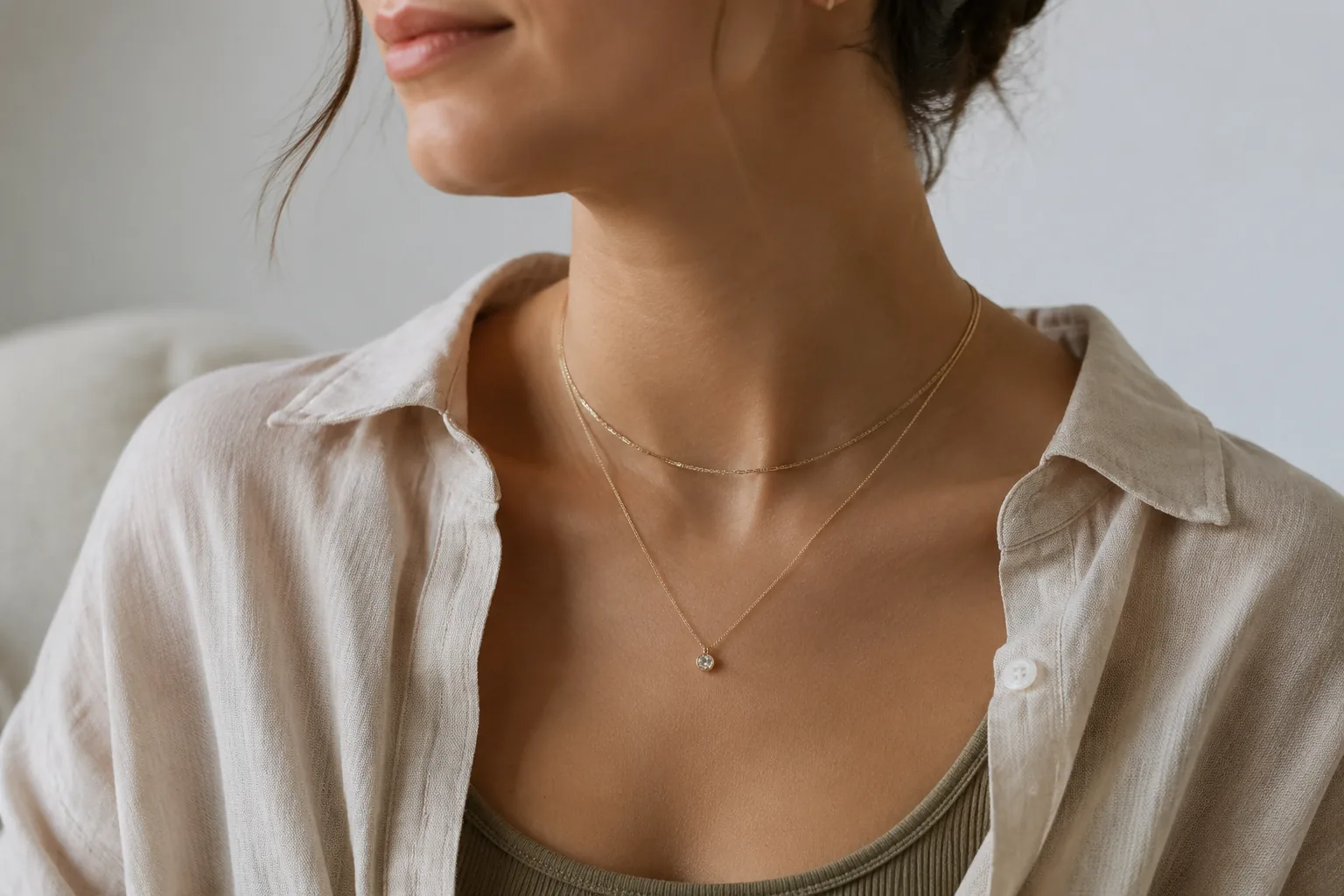
If you want to know how to layer necklaces for everyday wear, the real decision is not “Which necklace is prettiest?” It is “Which pieces can sit together all day without fighting for space, twisting into knots, or making a simple outfit look overworked?”
The most wearable necklace layers usually come from proportion, not quantity. A short chain, a pendant, and a longer anchor can look intentional. Three pendants at nearly the same length can look crowded and may tangle more easily. A dainty chain can work beautifully, but it may not be the right partner for a heavier pendant. Mixed metals can look modern, but they should be treated as a styling choice, not a durability claim.
This guide turns sourced brand signals from Mejuri, Missoma, Pandora, Monica Vinader, and Blue Nile into a practical everyday framework. Brand pages can change, so current product availability, material details, care instructions, and policies should be checked on the specific product page before purchase.
Start With the Everyday Layering Rule: Two Pieces First, Three Only With a Clear Role
For a low-maintenance everyday look, start with two necklaces. That is editorial guidance, not a universal rule, but it works because each piece has room to do one job.
A simple two-piece stack might be:
| Layer | Role | Example |
|---|---|---|
| Short layer | Frames the neck | Plain chain, fine curb chain, small station chain |
| Longer layer | Adds focus | Pendant, charm, locket, initial, or slightly heavier chain |
A three-piece stack can work, but each necklace should have a distinct role: a short base, a middle focal point, and a longer anchor. If all three pieces have similar lengths, similar shine, and competing pendants, the stack becomes harder to read and more likely to feel busy.
The everyday direction is supported by how brands frame their jewelry categories. Mejuri positions its everyday jewelry around “jewelry for every day” and says it is working to transform fine jewelry into everyday moments, with product types including hoops, bracelets, necklaces, and rings. Blue Nile’s Everyday Wins page uses the phrase “Worth Wearing Every Day” and defines everyday jewelry in its FAQ as comfortable, versatile pieces such as delicate charms, stackable bracelets, simple chains, and bezel studs that pair with anything and are easy to layer.
The practical takeaway: begin with two pieces you can repeat, then add a third only when the stack still has clear spacing, one main focal point, and comfortable movement.
Use Length Gaps to Keep Layers Intentional
The strongest sourced anti-tangle rule in this research package is simple: Mejuri’s necklace sizing guide says to vary necklace lengths by at least 2 inches to avoid tangling. It also lists common necklace lengths including 14, 16, 18, 20, and 22 inches.
That gives you a useful starting map:
| Everyday Stack | Lengths to Try | Why It Works |
|---|---|---|
| Minimal two-chain layer | 16 + 18 inches | Close enough to feel subtle, spaced enough to read separately |
| Pendant layer | 16 + 18 or 18 + 20 inches | Keeps the pendant from sitting directly on the upper chain |
| Longer open-neckline layer | 18 + 20 or 20 + 22 inches | Works when clothing leaves more vertical space |
| Three-piece stack | 14 + 16 + 18 or 16 + 18 + 20 inches | Each necklace has its own lane |
Mejuri’s guide also says 16-inch necklaces work with every neckline, 18-inch necklaces are good for charms and pendants, and 20- to 22-inch necklaces work with open necklines and longer layered looks.
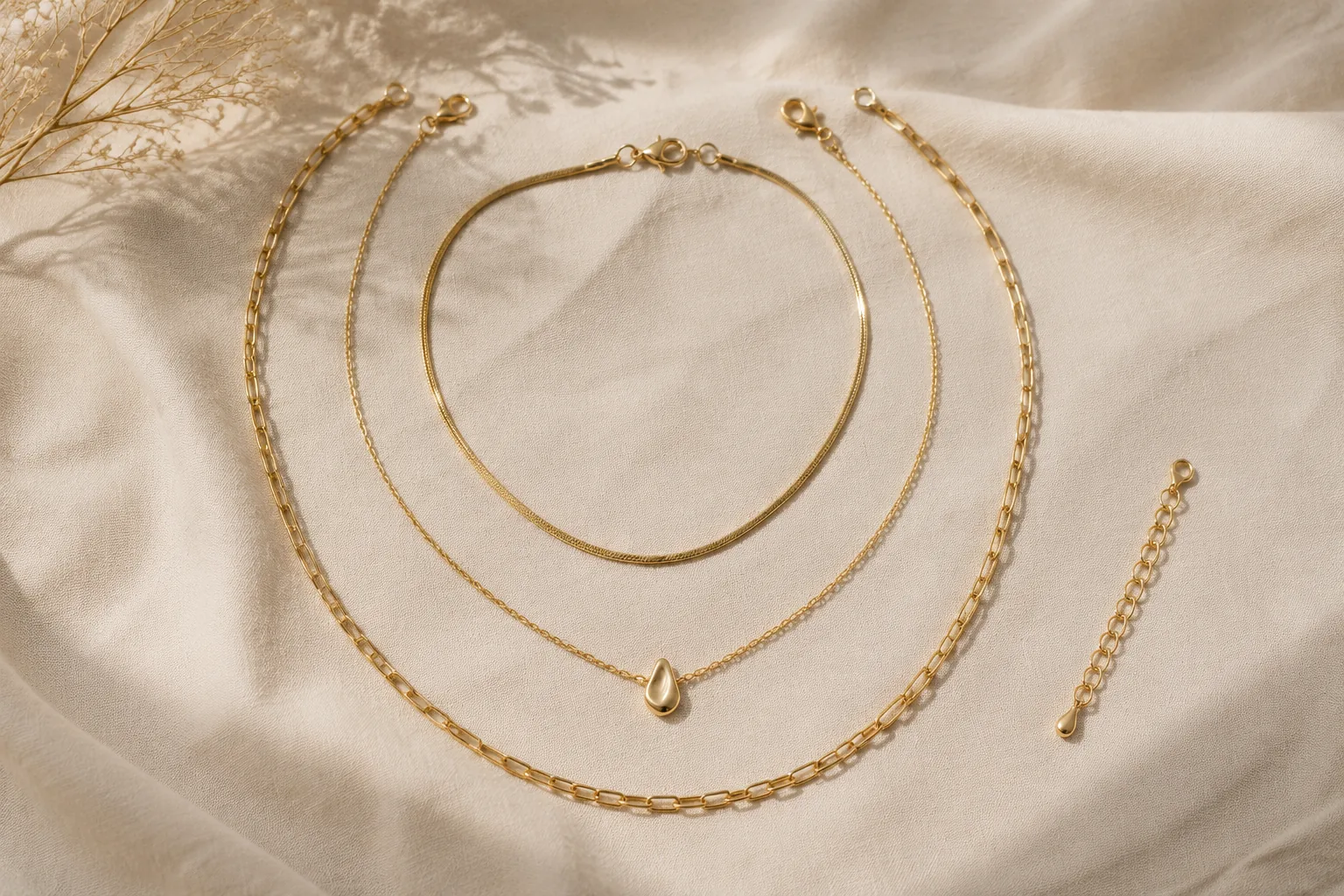
If your necklaces land too close together on your body, an extender can help. Mejuri says extenders add flexibility for adjusting length and playing with layers. In practical terms, an extender is most useful when a chain is almost right but needs a little extra drop to avoid overlapping another piece.
Choose One Focal Point Before Adding Pendants or Charms
Pendants and charms are often what make a necklace layer feel personal, but they also create the quickest path to overcrowding.
Mejuri’s sizing guide says larger pendants need sturdier chains, lighter pendants pair best with finer chains, and pendants are heavier and more likely to tangle when worn on multiple chains. That does not mean you cannot layer pendants. It means an everyday stack should usually have one obvious focal point.
A clean formula is:
| If You Want | Try This | Avoid This |
|---|---|---|
| Minimal polish | Two chains, no pendant or one tiny charm | Three shiny chains at the same length |
| Personal detail | One pendant on the middle or longer chain | Multiple pendants competing at the collarbone |
| Charm-forward styling | One charm necklace plus a quieter supporting chain | Several charm-heavy necklaces stacked tightly |
| A bolder look | One larger pendant on a sturdier chain | Heavy pendant on an unsupported fine chain |
Pandora’s supplied official page is specifically for sterling silver charm bracelets, but it also shows category and filter signals around charms, charm bracelets, necklaces, pendant necklaces, chain necklaces, charm necklaces, initial necklaces, sterling silver, gold, rose gold-plated, and gold-plated options. Monica Vinader’s jewelry shop page also includes necklaces, pendant necklaces, chain necklaces, charms, pendant charms, initial charms, gemstone charms, lockets, and chain-choice navigation. Blue Nile’s Everyday Wins page shows products including lab-grown diamond pendants, initial charms, huggie earrings, diamond studs, and gemstone bracelets, often in 14k gold.
Those are sourced product-category signals, not proof that every charm combination will wear comfortably. The styling suggestion is to separate charm-forward looks from minimal chain layering. If the charm is the story, let the other necklace support it.
Mix Chain Texture and Weight, Not Just Length
Length spacing helps, but texture and weight also matter. Mejuri’s necklace sizing guide recommends mixing chain textures or weights to reduce tangling.
This is where a layered look can become more deliberate. Instead of stacking three nearly identical fine chains, try combining a fine cable chain with a slightly weightier curb, rope, paperclip, box, or bead-style chain. The visual difference helps each layer stand apart, and the weight difference may help reduce the feeling that all chains are moving as one.
The pendant should also match the chain’s visual and practical weight. Mejuri says larger pendants need sturdier chains, while lighter pendants pair best with finer chains. Without product-specific evidence, it is better not to assume a delicate chain can comfortably support a substantial pendant just because the colors match.
As an editorial styling rule, use contrast in one or two ways at a time:
| Contrast Type | Everyday Example |
|---|---|
| Length | 16-inch chain with 18-inch pendant |
| Texture | Smooth snake-style chain with fine cable chain |
| Weight | Fine upper chain with medium lower chain |
| Metal tone | Silver chain with gold pendant necklace |
| Shape | Round charm with elongated link chain |
If every element contrasts at once, the stack may feel less versatile. For repeat wear, choose one focal contrast and keep the rest quiet.
Match Necklace Layers to Necklines You Actually Wear
A necklace layer only works if it fits the clothes you wear most often. Mejuri’s necklace sizing guide gives useful neckline guidance: longer chains for crew necks and turtlenecks, a pendant inside the V for V-necks, and 16- to 18-inch or bold shorter styles for button-downs.
Use that as your outfit map:
| Neckline | Layering Approach |
|---|---|
| Crew neck | Let chains sit above the collar or use longer chains over the fabric |
| Turtleneck | Longer chains usually read more clearly than tight short layers |
| V-neck | Place a pendant inside the V so the necklace follows the neckline |
| Button-down | Try 16- to 18-inch chains or a stronger short style near the open collar |
| Scoop or open neckline | 18-, 20-, and 22-inch combinations have more room to fall cleanly |
| Blazer or cardigan | Keep the stack simple if lapels or fabric edges already add visual lines |
The analysis here is straightforward: your most-worn neckline should decide your most-worn necklace lengths. If you buy only for how a stack looks on a blank mirror selfie, it may not work with your actual wardrobe.
Compare Materials Without Overclaiming Durability
Material matters for comfort, care, color, weight, and budget, but this guide should not pretend that every metal finish behaves the same.
Mejuri’s everyday jewelry page includes material language and examples such as 18k gold vermeil, sterling silver, 10k yellow gold, 14k yellow gold, 14k white gold, mixed metal, lab-grown stones, sapphire, diamond, and gemstones. Missoma describes itself as a demi-fine and fine jewelry specialist and lists material categories including 9k solid gold, 14k solid gold, 18k gold vermeil, 18k gold plating, sterling silver, silver plated, stainless steel, and mixed metals. Monica Vinader’s shop page includes gold vermeil, sterling silver, 14k solid gold, rose gold vermeil, diamonds, lab-grown diamonds, pearls, and gemstones.
The important point is that material terms must be read brand by brand. Missoma says its 18k gold vermeil uses a sterling silver base with 2.5 microns of solid gold. Monica Vinader describes gold vermeil more broadly as a thick layer over sterling silver and says its silver jewelry is crafted from recycled silver. Missoma defines its sterling silver as 92.5% silver and 7.5% copper with rhodium plating, and says its gold-plated jewelry uses brass as the base.
Do not transfer one brand’s specification to another. A “gold vermeil” necklace from one seller may not have the same disclosed construction as a “gold vermeil” necklace from another. A plated piece, a vermeil piece, a sterling silver piece, and a solid gold piece can all be valid choices, but they should not be described as having equivalent durability or care needs without specific evidence.
For everyday layering, the practical analysis is:
| Material or Finish | How to Think About It for Layering |
|---|---|
| Sterling silver | Useful for silver-tone stacks; may need tarnish-aware storage and care |
| Gold vermeil | Gold-tone look over sterling silver; check each brand’s exact disclosure |
| Gold plating | Often more budget-accessible; check base metal and care guidance |
| Solid gold | Often chosen for long-term fine jewelry wardrobes, but still needs appropriate care |
| Mixed metals | A styling choice, not automatically a different durability category |
| Diamonds and gemstones | Check setting, stone type, treatment, and brand care instructions before assuming daily suitability |
Keep Everyday Wear Separate From 24/7 Wear
“Everyday jewelry” should mean repeat daytime wear, not automatic approval for showering, swimming, sleeping, exercising, or applying perfume while wearing the piece.
Missoma recommends avoiding water, perfumes, and chemicals and removing jewelry during water or chemical exposure for longevity. Monica Vinader’s shop page lists care signals including lifetime repairs, a recycling program, and a care kit, but current regional policy and product pages should be verified before citing exact repair or service terms. Pandora says storage can prevent tangles and tarnish, recommends compartments or pouches, and says hanging necklaces can prevent knotting and tangling.
That leads to a practical daily routine:
| Moment | Suggestion |
|---|---|
| Getting dressed | Put necklaces on after lotions, fragrance, and hair products have dried |
| Commuting or desk work | Check that pendants are not hitting buttons, zippers, or badges |
| Exercise or swimming | Remove pieces unless the specific brand and product guidance supports that use |
| Sleeping | Consider removing layered necklaces to reduce twisting and pressure |
| Storage | Use compartments, pouches, or hanging storage to reduce tangles |
Jewelry care recommendations vary by material, treatment, coating, gemstone, adhesive, and setting. Always follow the brand or jeweler care instructions for your specific piece.
Handle Sensitive-Skin Questions Carefully
Skin sensitivity needs cautious language. The American Academy of Dermatology says nickel is a common cause of allergic contact dermatitis. It recommends nickel-free, hypoallergenic, surgical-grade stainless steel, 18k yellow gold, 22k yellow gold, 24k yellow gold, pure sterling silver, or platinum for people avoiding nickel exposure.
That does not mean every necklace described with one of those terms will be suitable for every wearer. Product alloys, plating, clasps, charms, and undisclosed components can matter. This article does not verify any featured brand or specific product as hypoallergenic.
If you have serious or persistent irritation, consult a qualified clinician or dermatologist. This content provides shopping and educational information, not medical advice.
Build Everyday Necklace Layer Formulas by Style
Here are practical formulas that apply the sourced length, pendant, chain, and everyday-wear guidance.
Minimalist Two-Chain Layer
Try a 16-inch plain chain with an 18-inch slightly different chain. Keep both pendant-free or add one tiny charm to the lower chain. This is the easiest starting point because the 2-inch gap follows Mejuri’s sourced spacing rule, and the simple shapes keep the look repeatable.
Pendant-and-Chain Layer
Use a short chain as the frame and an 18- or 20-inch pendant as the focal point. Mejuri’s guide says 18-inch necklaces are good for charms and pendants, while 20- to 22-inch necklaces work with open necklines and longer layered looks.
Charm-Forward Layer
Choose one charm necklace as the main piece, then add one quieter supporting chain. Pandora and Monica Vinader both show strong charm and pendant category signals, while Blue Nile’s everyday page includes initial charms. The editorial recommendation is to let one charm carry the sentiment instead of stacking several focal charms at similar lengths.
Mixed-Metal Layer
Use one metal as the base and the other as the accent. For example, wear a silver short chain with a gold-tone pendant necklace, or a gold chain with a silver charm. Missoma lists mixed metals as a material category, but mixed-metal styling should be treated as a visual choice, not a performance claim.
Open-Neckline Layer
For scoop necks, open shirts, or lower necklines, try 18 + 20 inches or 18 + 20 + 22 inches. Longer lengths have more visible space to separate. If the pendant sits too high or too close to another chain, use an extender.
Low-Maintenance Capsule Layer
Build around two reliable pieces: one short chain and one pendant necklace. Add a third only for outfits with enough neckline space. Store each necklace separately or hang necklaces to reduce knotting and tangling, following Pandora’s storage guidance.
Quick Checklist Before You Leave the House
Before you commit to the stack, check eight things:
| Check | What to Look For |
|---|---|
| Length gap | Are necklaces spaced by at least 2 inches where possible? |
| Pendant count | Is there one clear focal point? |
| Chain texture | Are the chains different enough to read separately? |
| Chain weight | Is a larger pendant on a sturdier chain? |
| Neckline | Does the stack fit the shirt you are actually wearing? |
| Movement | Do the pendants swing into each other when you walk? |
| Exposure | Are you avoiding water, perfume, and chemicals where the brand recommends it? |
| Storage plan | Will the necklaces be separated, pouched, or hung after wear? |
Conclusion
The easiest way to layer necklaces for everyday wear is to start with two pieces, keep at least a 2-inch length gap where possible, vary chain texture or weight, and choose one focal pendant or charm. Three necklaces can work, but they need distinct roles and enough space to move.
For materials, compare the actual disclosures: sterling silver, solid gold, gold vermeil, gold plating, mixed metals, diamonds, and gemstones all come with different construction and care considerations. Treat “everyday” as repeat wear, not 24/7 wear, and follow the jeweler’s care instructions for your specific piece. A necklace layer should feel intentional before it feels impressive; if it is comfortable, spaced, and easy to repeat, it is far more likely to become part of your real wardrobe.
Sources
- Mejuri, “Jewelry For Every day”
- Missoma, “Our Metals”
- Pandora US, “Sterling Silver Charm Bracelets”
- Monica Vinader, “Jewellery”
- Blue Nile, “Everyday Wins”
- Mejuri, “Necklace Sizing 101”
- Pandora US, “Jewelry Storage Ideas”
- American Academy of Dermatology, “Nickel Allergy”