



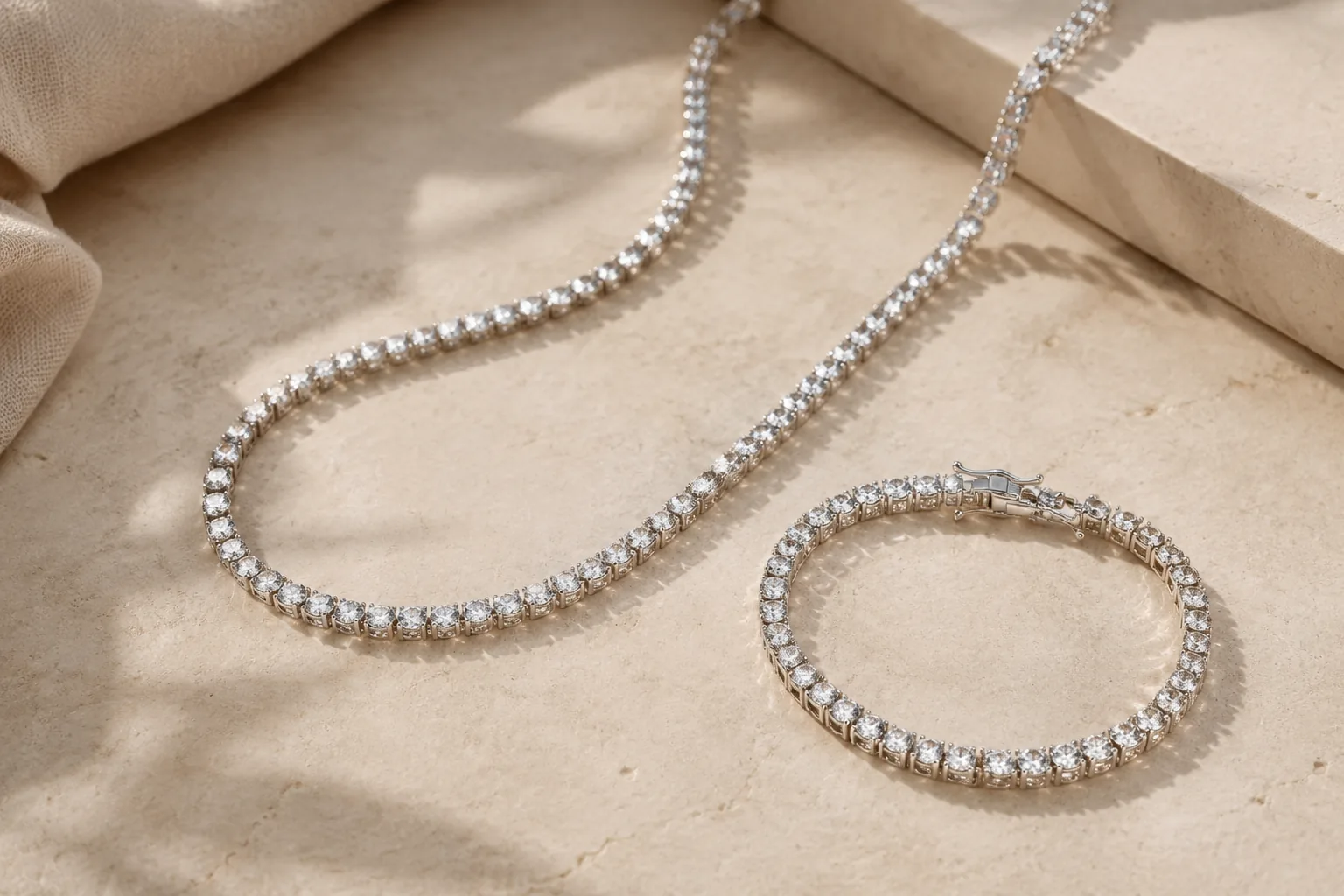
Choosing between a tennis bracelet, a tennis necklace, a half-tennis piece, and a tennis-inspired chain is mostly a format decision. The question is not only “Which one sparkles more?” It is also “Where will I wear it, how much attention do I want it to draw, how precise does the fit need to be, and what exactly am I paying for?”
A full diamond tennis necklace can be a high-impact formal piece. A tennis bracelet can feel classic and easier to wear often. A half-tennis necklace or partial-coverage bracelet can give the look with less all-around sparkle. A tennis-style chain may be mainly a fashion choice, especially when it uses plated metal, crystal, cubic zirconia, or another simulated stone instead of diamonds.
This tennis bracelet and tennis necklace buying guide explains the format differences, the label checks that matter, and the practical questions to ask before buying. The brand examples below are based on official pages from Brilliant Earth, Blue Nile, James Allen, Mejuri, and Astrid & Miyu, plus terminology guidance from the Federal Trade Commission and diamond-quality context from GIA.
What Tennis Jewelry Means
“Tennis” jewelry usually refers to a flexible line of stones set in a repeating pattern. The classic version is a bracelet: a continuous row of diamonds or gemstones around the wrist. Brilliant Earth describes tennis bracelets as continuous rows of diamonds or gemstones and shows classic straight-line, bezel or prong, flexible bangle, half or full coverage, mixed-shape, and gemstone designs on its tennis bracelet page. Blue Nile defines a tennis bracelet as a bracelet with a uniform gemstone pattern extending through the piece in an eternity-style setting.
The same idea also appears in necklaces. Blue Nile describes tennis chains as continuous strands of diamonds around the necklace. James Allen describes tennis necklaces as continuous symmetrical diamond patterns and shows lab-grown diamonds, natural diamonds, and gemstones in its tennis necklace assortment. In simple shopper terms, a full tennis necklace is the necklace version of the all-around stone line: stones continue around the neck rather than appearing only in a pendant or front station.
That definition gets less tidy when retailers use “tennis” for partial-coverage and fashion-inspired pieces. Brilliant Earth’s tennis necklace page includes full tennis necklaces, petite or 1/3 coverage tennis necklaces, bezel tennis necklaces, black diamond styles, riviere tennis necklaces, and high-carat statement diamond necklaces. Its bracelet page also includes half or full coverage styles. These designs can share the tennis look, but a half-tennis or 1/3 coverage piece is not the same as a continuous all-around stone line.
A tennis-inspired chain is another category to separate. Astrid & Miyu’s Icons page showed a “Gleam Bold Tennis Chain Bracelet in Gold” labeled 18k gold plated, alongside other crystal, cubic zirconia, and plated pieces in the reported crawl. That can be a valid style choice, but it should not be evaluated as if it were the same material tier as a platinum or solid-gold diamond tennis piece.
The most important label distinction is the stone language. Under FTC guidance, simulated or imitation diamonds must be disclosed as not diamonds immediately before the word “diamond.” FTC guidance also says lab-created diamonds must be disclosed as not mined diamonds, and “laboratory-grown” terminology should be used only when the product has essentially the same optical, physical, and chemical properties as mined diamond. In practical terms: diamond, lab-grown diamond, cubic zirconia, crystal, and “diamond-like” are not interchangeable labels.
How To Choose The Right Format
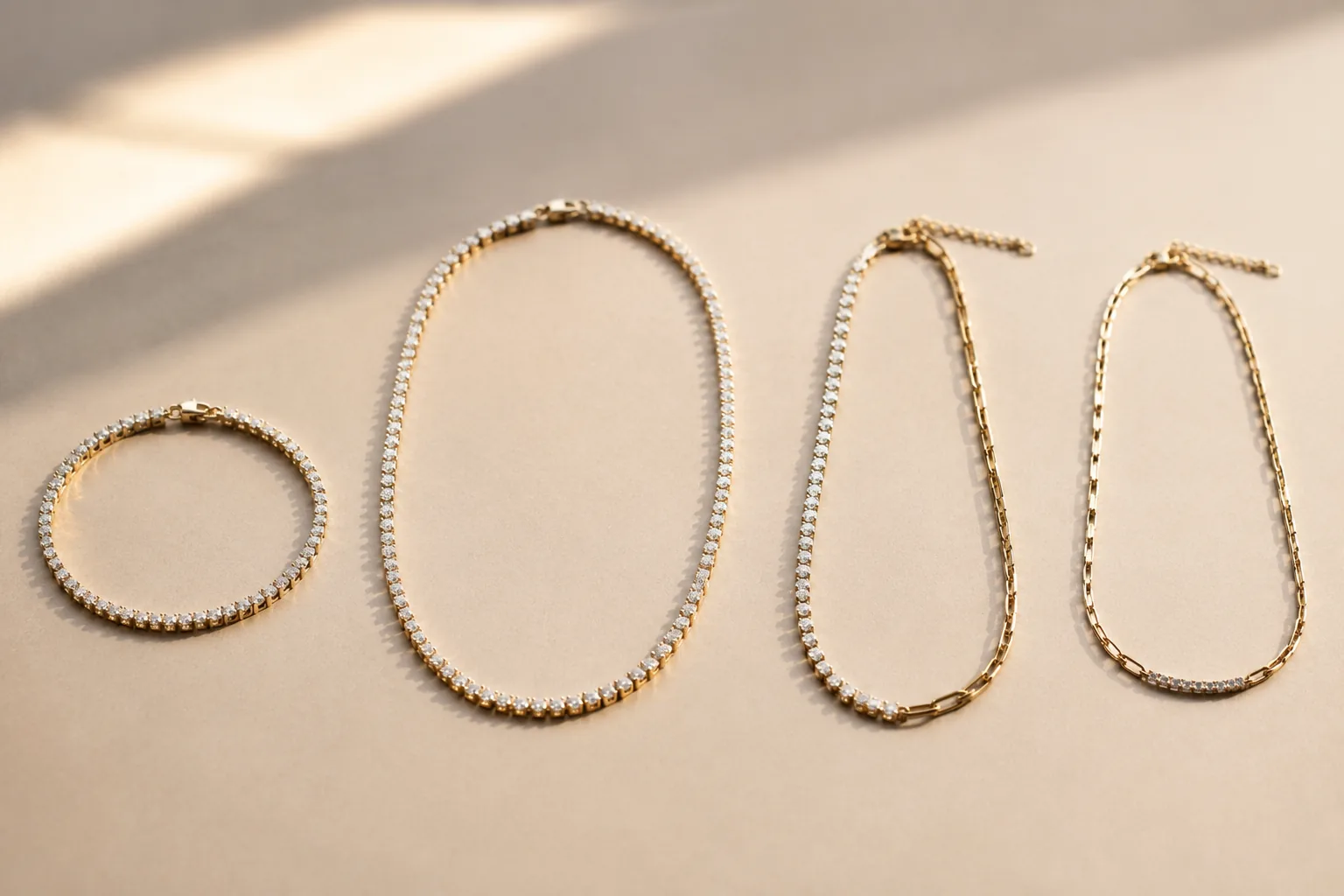
The right tennis jewelry format depends on wear frequency, visibility, fit precision, and gift risk. Here is a practical way to narrow the choice.
| Format | Best Fit Analysis | Main Checks Before Buying |
|---|---|---|
| Full tennis bracelet | Classic wrist sparkle, often easier to style than a full necklace | Wrist length, one-finger fit, clasp, safety catch or arms, stone type, metal |
| Full tennis necklace | High-visibility sparkle for formalwear or a major gift | Necklace length, neckline, weight, clasp, stone size, total carat weight |
| Half-tennis or partial coverage | Less all-around sparkle, often easier to dress down | Coverage area, chain section, stone placement, whether stones stay centered |
| Tennis-inspired chain | Look-focused fashion choice when fine-jewelry construction is not the priority | Plating, base metal, crystal/CZ/simulant language, care limits |
Choose a Tennis Bracelet for Classic Sparkle With Lower Neckline Risk
A bracelet is usually the most straightforward first tennis piece. It does not have to match a neckline, and the sparkle reads as classic rather than necessarily formal. Blue Nile’s tennis bracelet guidance discusses gold or platinum, natural and lab-grown diamonds, total carat weight, secure chains, possible safety catches, and a one-finger fit guideline. James Allen also says shoppers should consider color, clarity, carat weight, secure clasp, and flexible fit.
Analysis: a tennis bracelet is often the lower-risk gift compared with a full tennis necklace, as long as wrist sizing is handled carefully. It is still not risk-free. Too tight can feel restrictive; too loose can rotate, catch, or sit awkwardly. The one-finger guideline is useful as a starting point, but shoppers should still check the seller’s size options and return or resizing terms before purchase.
Choose a Full Tennis Necklace When Visibility Is the Point
A full tennis necklace is more prominent. It frames the neckline and can change the tone of an outfit quickly. Blue Nile’s tennis necklace page mentions common 16-inch or 18-inch lengths and men’s 20-inch to 24-inch guidance. Mejuri’s Diamond Tennis Necklace product page shows 15.5-inch and 17.5-inch length options for that specific product.
Analysis: full tennis necklaces are more personal than bracelets because length, neckline, collarbone position, stone size, and sparkle level all affect whether the piece feels effortless or too dressy. As a gift, a full tennis necklace may work best when the recipient already wears statement necklaces, enjoys visible sparkle, or has given clear style signals.
Choose Half-Tennis or Partial Coverage for a Softer Version
Half-tennis, 1/3 coverage, 1/5 coverage, and similar styles use tennis-style stone setting across part of the piece rather than all the way around. They can reduce the visual intensity and may feel easier for daily styling. They also create a different design problem: the stone-set section should sit where the wearer expects it to sit.
Analysis: partial coverage is not simply “full tennis, but smaller.” If the chain rotates, the stones may move off center. If the stone section is short, it may read more like a station necklace or bracelet than a traditional tennis line. That can be desirable, but the product photos and measurements matter.
Choose Tennis-Inspired Chains When the Look Matters More Than Fine-Jewelry Specs
Some shoppers want the tennis silhouette without paying for solid gold, platinum, or diamond construction. Tennis-inspired fashion chains can make sense for trend wear, occasional styling, or budget-conscious gifting when the buyer understands the materials.
The key is not to blur categories. Astrid & Miyu’s reported Icons example was labeled 18k gold plated, and its care page distinguishes 14k solid gold from recycled sterling silver and plated pieces. The same care page recommends avoiding water, sweat, and perfumes for plated jewelry.
Analysis: plated tennis-style pieces should be bought as plated fashion jewelry unless the selected product page states otherwise. That does not make them a poor choice; it changes the expectations around wear, care, and long-term appearance.
What The Brand Assortments Show
The reviewed brand set for this guide is Brilliant Earth, Blue Nile, James Allen, Mejuri, and Astrid & Miyu. Their official pages show that “tennis jewelry” spans multiple tiers: fine-jewelry diamond pieces, lab-grown diamond options, gemstone designs, partial-coverage pieces, and plated tennis-inspired styles.
This is not a ranking. The pages reviewed do not provide enough uniform data to compare every brand on stone grading, clasp engineering, repair terms, plating thickness, long-term wear, or country-specific returns. The safer reading is assortment evidence: what types of tennis jewelry each brand’s official pages show.
Brilliant Earth
Brilliant Earth’s tennis bracelet page describes tennis bracelets as continuous rows of diamonds or gemstones and shows styles including classic straight-line, bezel or prong, flexible bangle, half or full coverage, mixed-shape, and gemstone designs. The same page shows options using metals such as platinum, 14K or 18K gold, and select stainless steel, with both natural and lab-grown diamond options.
Brilliant Earth’s tennis necklace page shows lab or natural diamonds across different carat weights and metals. It includes full tennis necklaces, petite or 1/3 coverage tennis necklaces, bezel tennis necklaces, black diamond styles, riviere tennis necklaces, and high-carat statement diamond necklaces.
Analysis: Brilliant Earth’s assortment is useful for seeing how broad the tennis category can be. It also shows why shoppers should read each product page closely: full coverage, partial coverage, lab diamond, natural diamond, gemstone, and metal options may sit near each other in the same shopping theme.
Blue Nile
Blue Nile defines tennis bracelets as uniform gemstone patterns extending through the piece in an eternity-style setting. Its diamond tennis bracelet page discusses gold or platinum, natural and lab-grown diamonds, total carat weight, secure chains, possible safety catches, and a one-finger fit guideline.
For necklaces, Blue Nile defines tennis chains as continuous strands of diamonds around the necklace and describes options in platinum, white gold, yellow gold, and rose gold with natural and lab-grown diamonds. Its tennis necklace page mentions common 16-inch or 18-inch lengths and men’s 20-inch to 24-inch guidance.
Analysis: Blue Nile’s pages are helpful for fit and construction checkpoints: total carat weight, length, metal, stone origin, and clasp security. Those are the details that make two similar-looking tennis pieces meaningfully different.
James Allen
James Allen’s tennis bracelet page showed an assortment with lab-grown and natural options, platinum, yellow gold, white gold, and rose gold options, carat-weight filtering, and product names such as “Tennis Bracelet With 3 CTW Lab-Grown Diamonds In 14K White Gold” in the report. The page also says shoppers should consider color, clarity, carat weight, secure clasp, and flexible fit.
James Allen’s tennis necklace page describes tennis necklaces as continuous symmetrical diamond patterns and shows lab-grown diamonds, natural diamonds, and gemstones. It also says necklaces can be customized by diamond size, diamond quality, and metal.
Analysis: James Allen’s assortment reinforces that tennis jewelry is not one fixed specification. A product family may vary by diamond origin, metal, carat weight, diamond size, and diamond quality. The shopper needs to evaluate the selected variant, not only the category page.
Mejuri
The requested Mejuri shop-all URL returned an internal error in the reported crawl, so broad Mejuri assortment claims should be limited. The accessible Mejuri Diamond Tennis Necklace product page shows a 1.8 mm Diamond Tennis Necklace in 14k yellow gold with natural diamonds, 15.5-inch and 17.5-inch length options, a 4.47 to 5.07 ct minimum carat weight range, 14k solid gold, 94% recycled gold, and 94% traceable diamonds.
That product page also includes product-specific water-resistant and hypoallergenic claims and clasp instructions involving safety handles, side safety arms, an inner tongue, and a release button.
Analysis: Mejuri’s reviewed product page is a good example of why product-specific details matter. Its water-resistant and hypoallergenic language should be treated as claims for that listed product page, not as a blanket statement about every Mejuri item or every tennis necklace.
Astrid & Miyu
Astrid & Miyu’s Icons page showed a “Gleam Bold Tennis Chain Bracelet in Gold” at $130 labeled 18k gold plated in the report, along with other crystal, cubic zirconia, and plated pieces. Its jewellery care page distinguishes 14k solid gold from recycled sterling silver and plated pieces, and it recommends avoiding water, sweat, and perfumes for plated jewelry. The same care page says its lab-grown diamonds have the same physical, chemical, and visual properties as natural stones.
Analysis: Astrid & Miyu is useful here as a reminder that tennis styling can appear in fashion and demi-fine contexts, not only in diamond fine jewelry. When the label says plated, crystal, cubic zirconia, or another non-diamond material, evaluate it on those terms.
Material And Label Checks Before You Buy
Before comparing styles, confirm what the piece is made from. Similar product photos can hide large material differences.
Check the Stone Label First
Start with the exact stone wording. Look for “natural diamond,” “lab-grown diamond,” “lab-created diamond,” “gemstone,” “cubic zirconia,” “crystal,” “simulated diamond,” or “imitation diamond.” FTC guidance requires simulated or imitation diamonds to be disclosed as not diamonds immediately before the word “diamond.” FTC guidance also says lab-created diamonds must be disclosed as not mined diamonds.
GIA identifies color, clarity, cut, and carat weight as key diamond report elements, and presents independent grading reports as a way to verify diamond quality. For tennis jewelry, this should be used carefully. Many tennis pieces contain numerous small stones, and the reviewed pages do not establish that every small stone in every bracelet or necklace comes with an individual grading report.
Analysis: if diamond quality is central to the purchase, look for disclosed color, clarity, cut information, total carat weight, and any grading report language on the exact product page. If the page does not disclose those details, do not assume them.
Understand Total Carat Weight
Total carat weight, often abbreviated as CTW or TCW, refers to the combined weight of the stones in the piece. It does not tell you the size of each individual stone by itself. A bracelet with many small stones and a necklace with fewer larger stones can have very different visual effects even when total carat weight appears similar.
FTC guidance says fractional diamond weights need clear disclosure that the weight is not exact. Analysis: shoppers should treat carat weight as one input, not the whole value story. Stone size in millimeters, stone count, setting style, length, graduation, and whether the stones go all the way around can all affect how the piece looks.
Verify the Metal Tier
Tennis jewelry can appear in platinum, 14K or 18K gold, sterling silver, vermeil, plated metal, stainless steel, and other materials depending on the brand and product. Brilliant Earth’s reviewed tennis bracelet page shows platinum, 14K or 18K gold, and select stainless steel options. Blue Nile’s tennis necklace page describes options in platinum, white gold, yellow gold, and rose gold. Astrid & Miyu’s care page distinguishes 14k solid gold from recycled sterling silver and plated pieces.
Analysis: do not compare a plated tennis-style bracelet to a solid-gold diamond tennis bracelet only by appearance. Metal tier affects care expectations, possible repair paths, and how the item should be valued. The reviewed research does not establish plating thickness or long-term wear evidence for plated tennis-inspired styles, so avoid assuming how the finish will age.
Treat “Everyday” Language as Product-Specific
Retailer language about wearability can differ by product and material. The research report notes a conflict: Blue Nile says tennis bracelets can be worn in the shower with cautions, while James Allen recommends removing tennis bracelets before showering. Astrid & Miyu’s care page recommends avoiding water, sweat, and perfumes for plated jewelry. Mejuri’s water-resistant claim appears on the specific Diamond Tennis Necklace page reviewed.
The practical rule is simple: follow the care guidance for the exact piece, material, stone, setting, and finish. Do not turn one product page’s care language into a universal rule for all tennis jewelry.
Care, Fit, And Purchase Limits
A tennis bracelet or necklace has many repeated settings and a closure that carries real practical importance. The sparkle may attract attention first, but fit and security determine whether the piece feels wearable.
Clasp and Safety Features
Blue Nile’s tennis bracelet page discusses secure chains and possible safety catches. James Allen advises shoppers to consider a secure clasp and flexible fit. Mejuri’s Diamond Tennis Necklace page gives clasp instructions involving safety handles, side safety arms, an inner tongue, and a release button for that specific product.
Analysis: before buying, inspect product photos and written details for the clasp type, side safety arms or safety catches, and how the clasp opens. If the clasp construction is not clear, ask the retailer before purchase, especially for higher-budget pieces. The reviewed pages do not establish exact clasp engineering or long-term reliability across all brands.
Bracelet Fit
For bracelets, Blue Nile’s one-finger fit guideline is a useful starting point. A tennis bracelet should usually have enough movement to sit comfortably, but not so much looseness that it constantly rotates or catches.
Analysis: gift buyers should treat bracelet length as a real sizing issue. If the recipient’s wrist size is unknown, check return, exchange, and resizing terms before buying. Country-specific return rights and seller policies were not established for all retailers in the reviewed research, so they should be checked before purchase.
Necklace Length and Neckline
For necklaces, length changes the entire look. Blue Nile mentions common 16-inch or 18-inch lengths and men’s 20-inch to 24-inch guidance. Mejuri’s reviewed Diamond Tennis Necklace page shows 15.5-inch and 17.5-inch length options for that product.
Analysis: a shorter tennis necklace may sit close to the collarbone and feel dressier. A longer one may integrate more easily with open necklines or layering, depending on the wearer’s proportions and wardrobe. For gifts, necklace length is often easier to estimate than bracelet length, but sparkle level and personal style risk can be higher.
Information Gaps to Accept Before Comparing Brands
The available official pages do not answer every buying question. Stone-by-stone grading details are not consistently available. Independent grading report availability for every small stone is not established. Exact clasp engineering, repair policies, warranty coverage, country-specific return terms, plating thickness, and long-term wear evidence are not consistently disclosed across the reviewed pages.
That does not make the pages unusable. It means the comparison should stay honest. You can compare disclosed materials, stone labels, total carat weight, length, coverage style, clasp descriptions, and care instructions. You should not invent missing durability, repair, grading, or return details to make a brand-to-brand chart look more complete.
A Practical Buying Framework
Use this framework after you understand the labels.
If you want everyday sparkle with classic styling, start with a tennis bracelet. Verify wrist size, clasp security, safety features, metal, stone label, and total carat weight. This is often the most familiar tennis jewelry format and may be easier to dress up or down than a full necklace.
If you want a major visual statement, consider a full tennis necklace. Check length, neckline fit, stone size, total carat weight, metal, clasp, and whether the stones are natural diamonds, lab-grown diamonds, gemstones, or something else. For gifting, this works best when the recipient already wears visible necklaces.
If you want the tennis look with less intensity, look at half-tennis or partial-coverage pieces. Confirm how much of the piece is stone-set and whether the design may rotate during wear. These styles can be a useful middle ground, but they should not be expected to look identical to full all-around tennis lines.
If you want a trend-led or budget-conscious look, evaluate tennis-inspired chains by their actual materials. Plated metal, cubic zirconia, crystal, and simulated stones can be appropriate when the goal is style rather than diamond fine jewelry. Read the care instructions closely, especially around water, sweat, perfume, and plating.
If you are buying as a gift, reduce risk by choosing a format that matches what the recipient already wears. A bracelet may be safer for someone who wears wrist stacks. A partial tennis necklace may suit someone who likes delicate chains. A full tennis necklace is better reserved for someone who enjoys high-visibility jewelry. When size, care, or return terms are uncertain, check policies before purchase.
Conclusion
The best tennis piece is the one whose format, materials, fit, and care expectations match the way it will actually be worn. A tennis bracelet is the classic starting point. A full tennis necklace is the most visible option. A half-tennis or partial-coverage design softens the look. A tennis-inspired chain can deliver the style at a different material tier, as long as the label is clear.
Before buying, verify five things on the exact product page: stone type, metal type, total carat weight or stone size, coverage style, and clasp or safety mechanism. Treat “diamond,” “lab-grown diamond,” “simulated diamond,” “cubic zirconia,” and “crystal” as distinct labels. Treat solid gold, platinum, sterling silver, vermeil, and plated metal as distinct material categories. Follow the care instructions for the specific piece, not a general assumption about tennis jewelry.
The safest purchase is not necessarily the brightest one. It is the piece whose sparkle, size, construction, and maintenance demands make sense for the wearer.
Sources
- Brilliant Earth Shop All Jewelry
- Brilliant Earth Tennis Bracelets
- Brilliant Earth Tennis Necklaces
- Blue Nile Jewelry
- Blue Nile Diamond Tennis Bracelets
- Blue Nile Tennis Necklaces
- James Allen Fine Jewelry Gifts
- James Allen Tennis Bracelets
- James Allen Tennis Necklaces
- Mejuri Shop All
- Mejuri Diamond Tennis Necklace
- Astrid & Miyu Icons
- Astrid & Miyu Jewellery Care
- FTC: In the Loupe: Advertising Diamond, Gemstones and Pearls
- FTC Jewelry Guides
- GIA: How GIA Grades Diamonds