



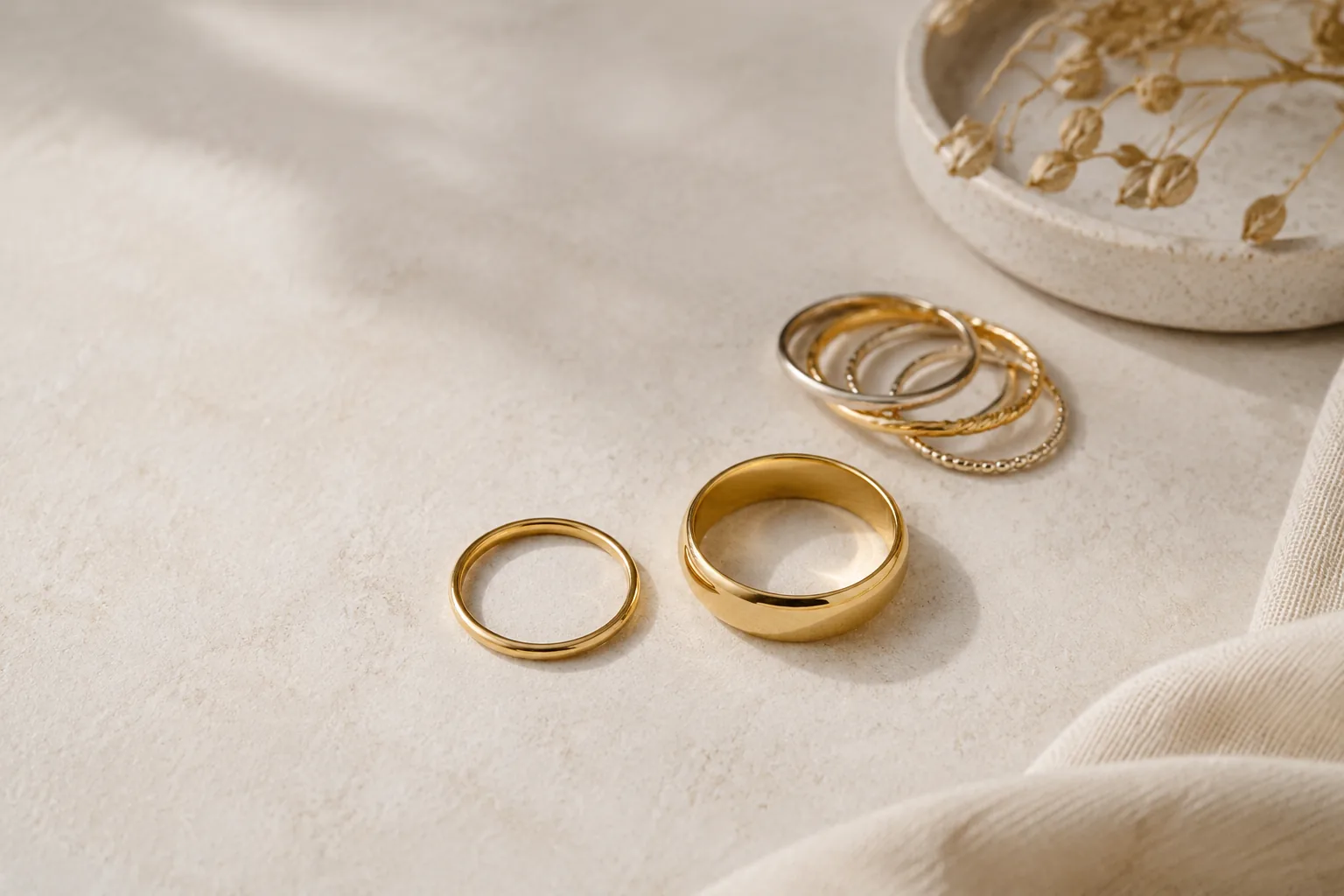
If your usual ring size fits in a slim band, it is reasonable to wonder whether that same size will work in a wide band, dome ring, chunky ring, or stacked ring look. The short answer is: sometimes yes, sometimes no. Width changes how much of your finger the ring covers, and a stack can behave differently from one slim ring even when every individual ring is technically the same size.
For online shoppers, the practical decision is not simply “go up” or “stay the same.” The better question is: how wide is the ring, how does the brand size that style, how much your fingers fluctuate, and how flexible the return, exchange, or resizing route will be if the fit is wrong?
Official brand guidance supports a cautious, style-specific approach. Pandora says wide bands can fit more snugly than slim styles and suggests considering one size up. Brilliant Earth says wider bands over 4 mm should be sized up by at least half a size. Mejuri says its thick bands take up more space, but that Mejuri accounts for this in design, so shoppers should stick with their usual size for those pieces. Blue Nile says wider bands cover more surface area and may feel snugger, while its stacking guide gives separate guidance for wider stacks. Missoma’s cited ring size guide gives general measuring advice, but not a specific wide-band or stack size-up rule.
That mix of guidance is the point: wide band ring sizing is brand-specific, style-specific, and finger-specific.
Why your usual ring size may feel different in a wide band
A ring size describes the ring’s internal measurement, but it does not describe how the ring feels across your finger. A narrow band touches a smaller strip of skin. A wide band spreads across more of the finger, which can make the same nominal size feel tighter.
Pandora states that wide bands fit more snugly than slim styles because they have fuller surface coverage, and advises shoppers to consider going one size up. Blue Nile similarly says wider bands cover more surface area, feel more substantial, and may feel snugger at the same size. Blue Nile’s ring stacking guide also notes that stacked coverage can feel tighter even when finger size has not changed.
That does not mean you measured incorrectly. It means the reference point may be different. If your “usual size” comes from a delicate 1.5 mm ring, that size may not predict the comfort of a 6 mm statement band, a high dome ring, or five slim bands worn together.
From a practical fit perspective, wider coverage can affect three things:
- Compression: more of the finger is under the ring at once.
- Movement: a narrow ring may tilt or shift more freely, while a wider ring may feel more fixed.
- Removal: the ring may need to pass over the knuckle while maintaining contact across a larger area.
Analysis: this is why shoppers often describe a wide band as “the same size but tighter.” The number may be familiar, while the sensation is not.
What counts as wide, and why width is not the same as thickness
Blue Nile’s band-width guide defines band width as the edge-to-edge measurement in millimeters. Width is not the same as thickness. Width is how much finger the ring covers from one edge of the band to the other. Thickness is how high or substantial the ring feels from the inside to the outside surface.
Blue Nile lists common width categories as:
| Width range | Blue Nile’s category context |
|---|---|
| 1.5-1.9 mm | Thin or dainty |
| 2-4 mm | Women’s standard |
| 4-6 mm | Men’s standard |
| 6 mm and above | Wide or statement |
These categories are useful context, not universal law. A 4 mm wedding band, a 6 mm cigar band, and a sculptural dome ring can all feel different depending on the ring’s profile, edge shape, inner contour, and how close the fit is at the base of your finger.
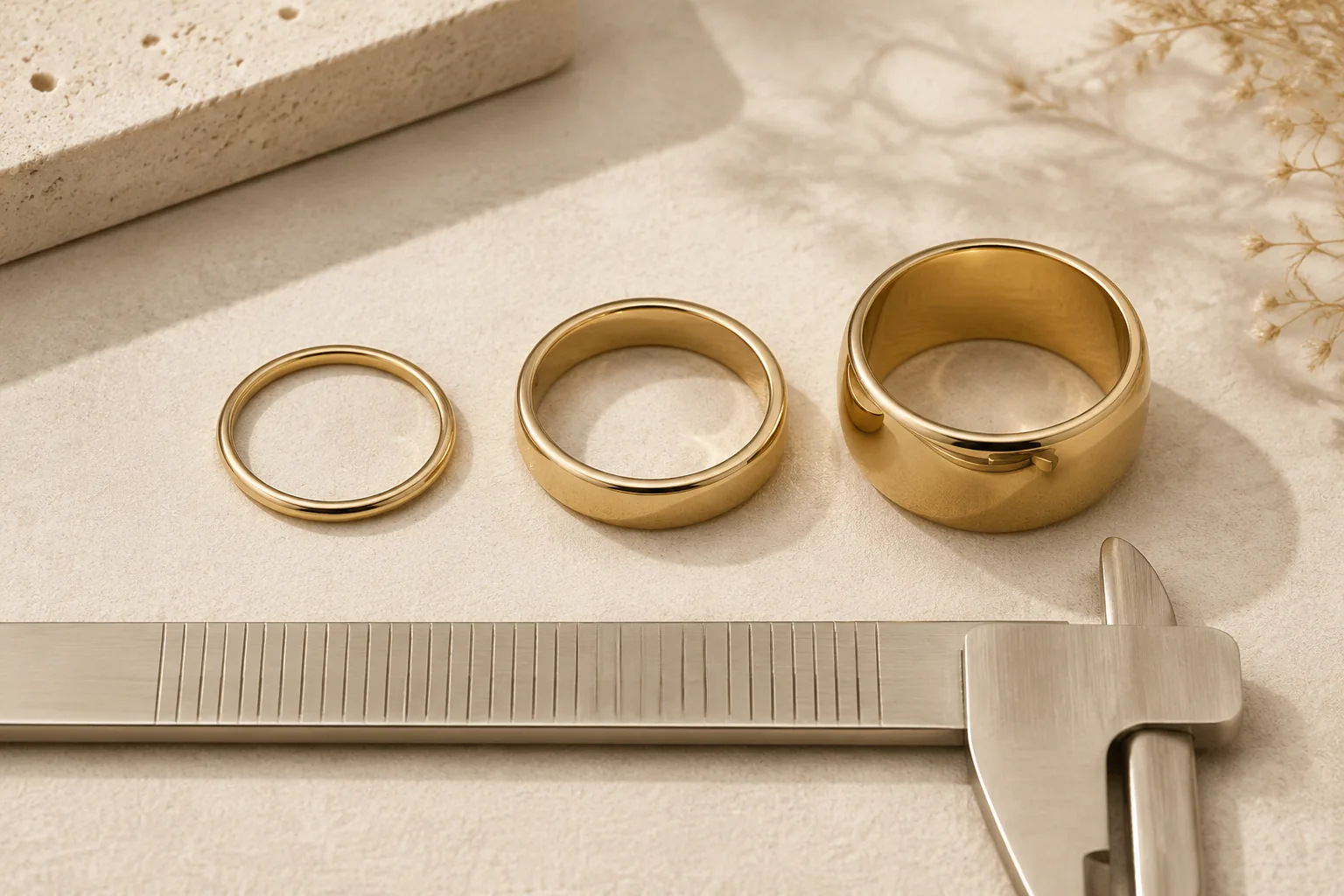
The product page matters here. If a listing does not show band width in millimeters, it is harder to apply width-based sizing advice. Photos can also mislead because a ring may look wider or slimmer depending on hand size, camera angle, and styling.
Suggestion: when buying online, look for the actual millimeter width first. If the brand does not list it, ask customer service before ordering, especially for bridal, expensive, personalized, final-sale, or hard-to-resize styles.
What official brand sizing guides say about wide bands
The most useful way to read brand sizing advice is not as a universal rule, but as guidance for that brand’s sizing system and product design.
| Brand source | What the cited source says |
|---|---|
| Missoma Ring Size Guide | Missoma advises measuring an existing ring that mirrors the desired fit, using internal diameter, choosing the larger size when between sizes, accounting for fingers shrinking in cold and swelling in heat, and measuring at the end of the day. The cited source does not provide a specific live-page rule for wide bands, dome rings, chunky rings, or stacks. |
| Pandora Ring Size Guide | Pandora advises measuring circumference or diameter and choosing the next size up when between sizes. Pandora also states that wide bands fit more snugly than slim styles because of fuller surface coverage and says shoppers should consider going one size up. |
| Brilliant Earth Free Ring Sizer | Brilliant Earth advises measuring the exact hand and finger, says dominant and non-dominant hands can differ, and recommends measuring multiple times toward the middle or end of the day. It says wider bands over 4 mm should be sized up by at least half a size. |
| Blue Nile Ring Education and Band-Width Guides | Blue Nile recommends using a ring size guide or free sizers and says stores can provide expert assistance. Its general ring education page does not provide specific wide-band size-up increments. Its band-width guide says wider bands cover more surface area and may feel snugger at the same size. |
| Mejuri How To and Ring Sizing 101 | Mejuri’s How To hub links to Ring Sizing 101. Mejuri Ring Sizing 101 advises measuring with paper and a ruler or an existing ring, repeating measurements, and sizing up when between sizes. It says thick bands take up more space, but Mejuri accounts for that in design, so shoppers should stick with their usual size. Mejuri also says it does not offer half sizes and recommends sizing up when between sizes. |
The disagreement is useful. Pandora and Brilliant Earth provide size-up guidance for wider bands. Mejuri gives brand-specific advice to stay with your usual size for its thick bands because it says the design accounts for the extra space. Blue Nile confirms the snugger feel but is more specific about stack width in its stacking guide than on its general ring education page. Missoma’s cited guide is helpful for measuring habits, but not for a wide-band-specific adjustment.
Analysis: when brand recommendations differ, the safest interpretation is that rings are not standardized only by size number. Internal shape, design decisions, available sizes, and brand-specific fit expectations all matter. For a specific ring, the seller’s current product page and size guide should carry more weight than a general rule from another brand.
Why ring stacks are a separate fit problem
A ring stack is not always the same fit problem as one wide ring. It can create the same general issue, more finger coverage, but in a different way.
Pandora states that stacking rings changes how rings feel. Mejuri says stacked rings fit and feel different than a single thin band, and also says thin bands are ideal for stacking and have some natural movement. Blue Nile’s ring education page says stackable styles often use thinner bands, and Blue Nile’s ring stacking guide says most stacks use thinner bands so sizing can stay consistent.
The complication comes when a stack becomes wide in total. Blue Nile’s stacking guide says stacks over three rings, or stacks reaching higher toward the first knuckle, may justify sizing up. It also recommends sizing up a quarter size for 5-6 mm stacks and half a size for stacks over 7 mm.
That is more specific than most general ring-size advice, but it still should be applied carefully. A stack of three smooth, fine bands may feel different from three rings with raised settings, squared edges, beads, or decorative details. Multiple separate edges can press differently than one smooth wide band. A stack can also shift during wear, creating small gaps or pressure points that a single band would not have.
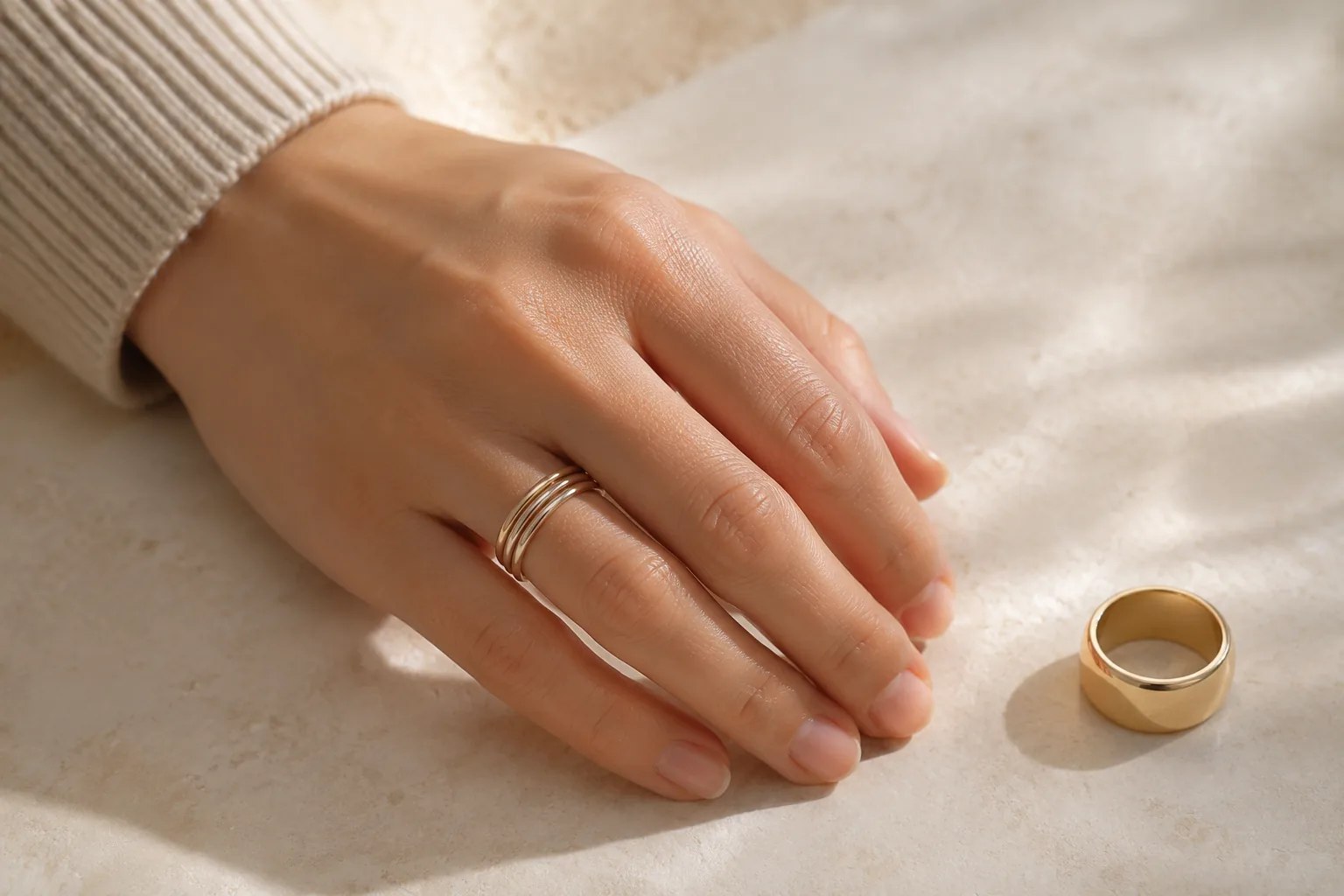
Analysis: think of a stack as a small system, not a single ring. The total width matters, but so do edge shape, ring movement, finger taper, and how high the stack sits toward the knuckle.
When to keep your usual size, size up, or measure again
There is no single size choice that works for every wide band or stack. Use this as a decision framework before ordering.
Keep your usual size when the brand tells you to
If the brand specifically says its thick or wide ring is designed to fit in your usual size, that guidance is relevant for that brand. Mejuri Ring Sizing 101 says thick bands take up more space, but Mejuri accounts for that in design, so shoppers should stick with their usual size.
This does not prove the same choice will work at another retailer. It is brand-specific guidance.
Consider sizing up when the brand advises it
Pandora says shoppers should consider going one size up for wide bands. Brilliant Earth says wider bands over 4 mm should be sized up by at least half a size. Mejuri, Pandora, and Missoma all provide some form of “size up when between sizes” guidance in their cited sizing information, though the details and size availability differ by brand.
If a brand does not offer half sizes, the decision can become less precise. Mejuri says it does not offer half sizes and recommends sizing up when between sizes. That is a Mejuri-specific buying constraint, not a general rule for all brands.
Measure again when your reference ring is slim
Missoma advises measuring an existing ring that mirrors the desired fit. That is especially important for wide bands and stacks. A slim ring you already own can be a helpful starting point, but it may not be the best reference for a chunky ring.
Suggestion: if possible, compare against a ring with similar width and similar internal feel. If you cannot, use the brand’s size guide, request a sizer where available, or visit a jeweler for measurement before buying a wide, expensive, bridal, or hard-to-resize ring.
Be more cautious when resizing may be limited
Blue Nile’s ring education page warns that certain metals and designs, including eternity bands, are not always resizable. Brilliant Earth states that resizing and exchange policies have restrictions.
That makes the fit decision more important before purchase. Eternity bands, engraved rings, personalized rings, alternative-metal designs, made-to-order styles, and some intricate settings may have different restrictions depending on seller policy and construction.
Suggestion: before buying, check the current product page and policy language for the exact ring, not only the general size chart.
How finger shape, knuckles, and daily swelling affect fit
Wide-band sizing is not only about the ring. It is also about your finger shape.
Brilliant Earth advises measuring the exact hand and finger, and notes that dominant and non-dominant hands can differ. It also says a sizer should pass the knuckle with gentle resistance and recommends measuring multiple times toward the middle or end of the day.
If your knuckle is larger than the base of your finger, Brilliant Earth advises measuring both the knuckle and the finger base, then choosing a size between those measurements. This helps explain a common fit problem: a ring may need enough room to pass the knuckle, but that same size may feel loose once it reaches the narrower base of the finger. The opposite can also happen: a ring may feel good at the base but be difficult to remove.
Temperature and timing matter too. Missoma advises accounting for fingers shrinking in cold and swelling in heat, and measuring at the end of the day. Mejuri Ring Sizing 101 recommends measuring at the end of the day with warm hands and says cold can shrink fingers up to half a size. Mejuri also says alcohol, salt, and hormonal changes can cause temporary finger swelling.
Analysis: if your fingers fluctuate noticeably, a very snug wide band may feel fine at one time of day and uncomfortable later. A ring that is slightly loose in cold conditions may be more comfortable during warmer periods. This is one reason repeated measurements are more useful than a single quick measurement.
This content provides shopping and educational information, not medical advice. If you have persistent swelling, pain, irritation, or skin reactions, consult a qualified clinician or dermatologist.
What to check before buying a wide band or stack online
Before ordering a wide band, dome ring, chunky ring, or planned stack, check these details:
| What to check | Why it matters |
|---|---|
| Band width in millimeters | Blue Nile defines width as edge-to-edge measurement. Without this number, it is harder to judge whether wide-band or stack guidance applies. |
| Thickness, profile, and edge shape | The cited sources do not fully resolve how dome height, squared edges, hollow backs, comfort-fit interiors, or internal contour change size choice, so treat these as product-specific uncertainties. |
| Brand-specific size guide | Pandora, Brilliant Earth, Mejuri, Blue Nile, and Missoma do not all give the same wide-band advice. Follow the current seller guidance for the ring you are buying. |
| Half-size availability | If half sizes are unavailable, you may need to choose between a slightly snugger or slightly looser fit. Mejuri says it does not offer half sizes. |
| Return and exchange terms | Brilliant Earth states that resizing and exchange policies have restrictions. Policies may vary by product and seller. |
| Resizing limits | Blue Nile warns that certain metals and designs, including eternity bands, are not always resizable. |
| Personalization or final-sale status | Engraved, personalized, made-to-order, or altered rings may have stricter return or exchange terms depending on the seller. |
| International size conversion | Brand charts and country systems may not be interchangeable. Check the brand’s own chart for the region where you are buying. |
Suggestion: for a low-cost fashion stack with flexible returns, you may be comfortable using the brand chart and ordering the nearest likely size. For an engagement ring, wedding band, eternity band, or expensive statement ring, a jeweler measurement or brand-provided sizer is usually the more careful path.
Return rights, hallmarking, and product-labeling rules vary by country. Check current seller policies and local regulations before purchase.
Quick answers for common wide-band sizing questions
Should I order my usual size for a wide band or size up?
It depends on the brand and ring. Pandora says to consider one size up for wide bands. Brilliant Earth says wider bands over 4 mm should be sized up by at least half a size. Mejuri says its thick bands are designed so shoppers should stick with their usual size. Follow the current guidance for the specific brand and ring.
Why can a wide band feel tighter than a slim ring in the same size?
Pandora and Blue Nile both point to surface coverage: wider bands cover more of the finger, which can make the same nominal size feel snugger. That is a comfort and coverage issue, not necessarily a measuring mistake.
Does a ring stack fit like one wide ring?
Not exactly. A stack can create wide coverage, but multiple separate bands also add edges, movement, and spacing. Mejuri says stacked rings fit and feel different than a single thin band. Blue Nile says stacked coverage can feel tighter even when finger size has not changed.
How much should I size up for a stack?
Blue Nile’s stacking guide says most stacks use thinner bands so sizing can stay consistent, but stacks over three rings or stacks reaching higher toward the first knuckle may justify sizing up. It recommends sizing up a quarter size for 5-6 mm stacks and half a size for stacks over 7 mm. Treat that as Blue Nile’s stack guidance, not a universal rule for every brand.
What should I do if I am between sizes?
Several cited brand guides support sizing up when between sizes. Missoma advises choosing the larger size when between sizes. Pandora advises choosing the next size up. Mejuri Ring Sizing 101 says to size up when between sizes and notes that Mejuri does not offer half sizes.
Can I rely on a slim ring I already own to size a chunky ring?
Use it as a starting point, not as proof. Missoma advises measuring an existing ring that mirrors the desired fit. For a chunky ring, a similar-width ring is more relevant than a slim reference ring.
Which brand sizing guidance should I follow when advice differs?
For a specific purchase, prioritize the current size guide and product information from the brand selling that ring. Different brands may design their wide bands differently, offer different size increments, and apply different exchange or resizing policies.
Conclusion: choose the size for the ring you are buying, not only the size you usually wear
Wide bands and ring stacks can feel tighter because they cover more of the finger, and official brand sources do not reduce that to one universal size-up rule. Pandora suggests considering one size up for wide bands. Brilliant Earth gives a half-size-plus rule for bands over 4 mm. Mejuri says its thick bands are designed for your usual size. Blue Nile confirms that wider coverage may feel snugger and gives separate stack-width guidance. Missoma supports careful measuring habits but does not give a specific wide-band rule in the cited source.
The practical takeaway is simple: compare like with like, measure the exact finger more than once, check the brand’s own sizing advice, and be especially careful when the ring is wide, expensive, bridal, personalized, hard to resize, or restricted for returns. A wide band or stack does not automatically mean you chose the wrong size, but it does mean your usual slim-ring size may not tell the whole fit story.
Sources
- Missoma Ring Size Guide
- Pandora Ring Size Chart | How to Measure Ring Size
- Brilliant Earth Free Ring Sizer
- Blue Nile Ring Buying Guide
- Mejuri How To Guide
- Mejuri Ring Sizing 101
- Blue Nile Choosing Your Ring Band Width: The Complete Guide
- Blue Nile Ring Stacking Guide