



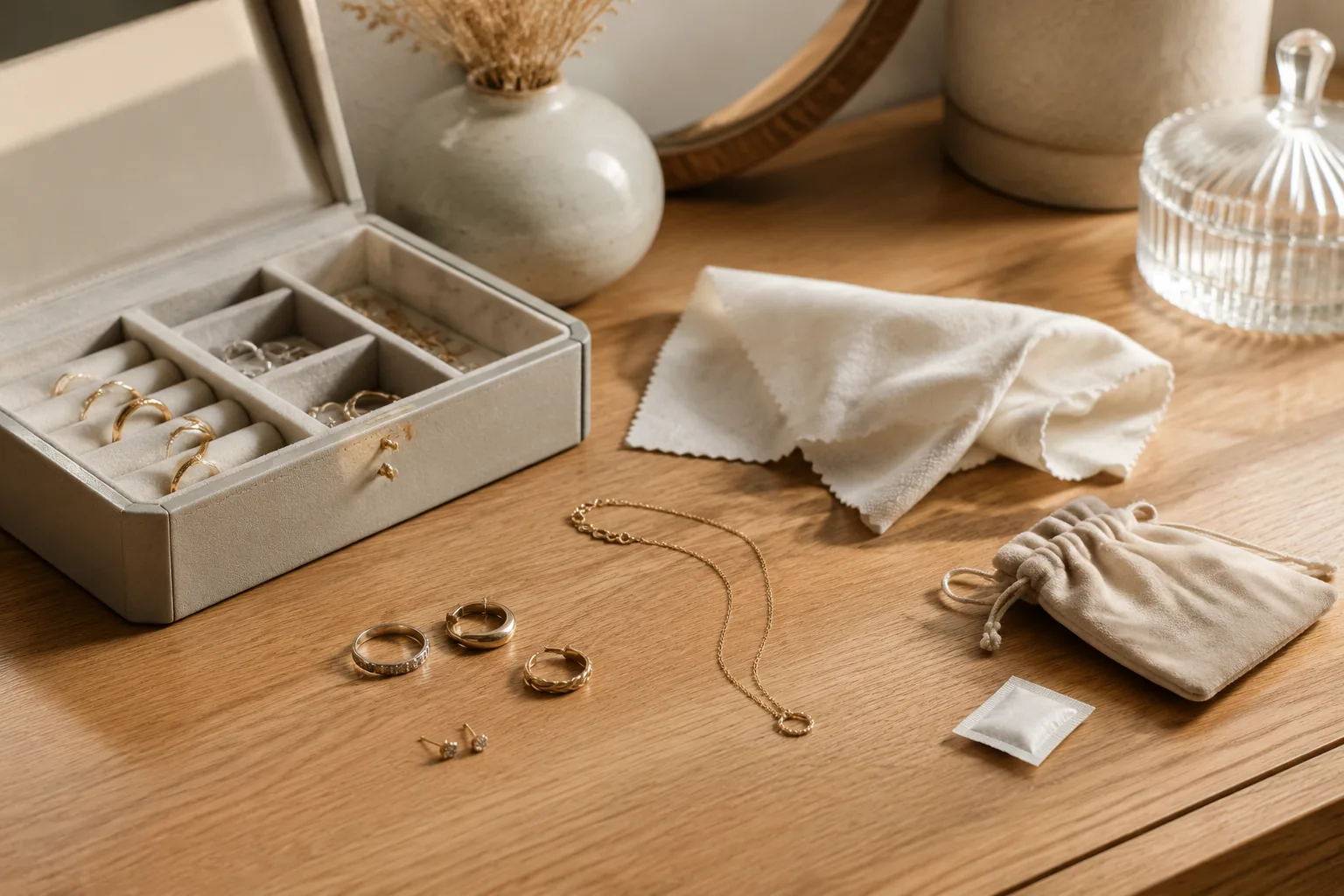
If your ring, necklace, bracelet, or earrings are darkening, dulling, or losing shine, the first step is not the strongest cleaner you can find. The safer first step is to work out what kind of change you are seeing, then reduce the everyday exposures that may be contributing.
Tarnish prevention is not one universal routine. Sterling silver, gold vermeil, plated brass, solid gold, pearls, gemstones, coatings, adhesives, and delicate settings can all react differently to moisture, chemicals, rubbing, and storage. Official care pages from Missoma, Pandora, Monica Vinader, and Astrid & Miyu repeatedly point to similar risk factors: perfume, skincare, cosmetics, sweat, water, swimming, chlorine, cleaning products, humidity, sunlight, and air exposure. Independent guidance from the Canadian Conservation Institute and GIA also supports a cautious, material-aware approach.
This guide explains how to prevent jewelry tarnish in daily life, where brand guidance agrees, where it needs context, and which cleaning shortcuts are too broad to treat as safe general advice.
Start by checking what kind of darkening you are seeing
Darkening is not always simple tarnish. It may be tarnish, dirt buildup, oxidation, plating loss, coating wear, corrosion, cosmetic residue, or physical damage. That distinction matters because a polishing cloth may help one problem and make another worse.
Pandora says tarnish occurs when jewelry is exposed to air over time, which is a useful starting point for silver-toned pieces and other tarnish-prone materials. The Canadian Conservation Institute gives the material-science explanation for silver: silver tarnish is tied to silver sulfide formation from sulfur-containing gases in air. It also says silver tarnishes faster as relative humidity rises and is best stored below 50% relative humidity.
But darkening on a plated or vermeil piece may not behave like ordinary silver tarnish. Monica Vinader says silver cleaner may be used on sterling silver but not on 18ct rose or yellow gold vermeil. The same brand also says its sterling silver has an anti-tarnish solution that may wear over time. Astrid & Miyu says sterling silver and plated brass should avoid water, sweat, and perfumes because they can cause tarnish or oxidation.
The practical suggestion: before cleaning, identify the material and construction as closely as possible. Look for the product page, order confirmation, hallmark or stamp, brand care page, or jeweler’s notes. If the piece has plating, pearls, gemstones, glued components, enamel, a coating, or a delicate setting, assume it needs more caution than a plain solid-metal band.
The everyday exposures most brands warn about
Across the reviewed brand guidance, the most repeated prevention theme is simple: reduce contact with moisture, chemicals, and beauty products.
Missoma advises keeping jewelry away from perfume, deodorant, hairspray, nail polish remover, suntan lotion, body oils, and swimming. Pandora advises putting jewelry on after skincare and cosmetics. Monica Vinader advises avoiding perfume, creams, liquids, bleach, cleaning products, and other chemicals. Astrid & Miyu says sterling silver and plated brass should avoid water, sweat, and perfumes because they can cause tarnish or oxidation.
GIA adds an important warning for fine jewelry settings: chlorine can damage metals in some gold-alloy settings. That does not mean every piece will visibly fail after one exposure, but it supports conservative habits around pools, hot tubs, and chlorine-based cleaning products.
Common tarnish and finish-risk triggers
| Exposure | Why it matters | Practical prevention |
|---|---|---|
| Perfume, hairspray, cosmetics, skincare | Brand care pages repeatedly flag beauty products as risk factors | Apply products first, let them dry, then put jewelry on |
| Sweat and exercise | Moisture and body chemistry can affect some metals and finishes | Remove vulnerable pieces before heavy exercise |
| Showering and bathing | Water, soap, shampoo, heat, and residue can affect finishes and stones | Remove jewelry unless the maker specifically says otherwise |
| Swimming | Chlorine, saltwater, and prolonged moisture increase risk | Remove jewelry before pools, hot tubs, and the sea |
| Household cleaners | Bleach and other chemicals can be harsh on metals and finishes | Take rings off before cleaning tasks |
| Humidity and air exposure | Silver tarnish is linked to air exposure and is faster in higher humidity | Store dry, protected, and separated |
This is prevention guidance, not a guarantee. The reviewed sources do not quantify exactly how fast jewelry will tarnish under real daily wear.
When to remove jewelry during the day
A useful routine is: jewelry goes on after beauty products and comes off before high-moisture or high-chemical activities.
Pandora advises putting jewelry on after skincare and cosmetics, removing jewelry before exercise or showering, and removing rings before cooking or washing hands. Monica Vinader advises removing jewelry before showering, bathing, heavy exercise, swimming in the sea, or swimming in chlorinated pools. Astrid & Miyu advises putting jewelry on last in the morning and taking it off first at night.
That routine is especially relevant for sterling silver, gold vermeil, gold-plated jewelry, plated brass, pearls, and gemstone pieces. It may feel conservative for some solid gold jewelry: Astrid & Miyu positions its solid 14k and 9k gold as suitable for all-day or everyday wear, with cleaning by polishing cloth or soap and warm water. That is brand-specific guidance for those products, not proof that every solid gold or everyday-labeled piece should be worn through every activity.
For most owners, the lowest-regret daily habits are:
- Put jewelry on after perfume, sunscreen, lotion, makeup, hair products, and skincare.
- Remove jewelry before showering, bathing, swimming, hot tubs, and heavy exercise.
- Take rings off before cleaning, cooking messy foods, or using chemicals.
- Avoid sleeping in delicate chains, pearls, plated jewelry, or pieces with fragile settings.
- Wipe suitable pieces gently after wear if they picked up sweat, oils, or residue.
- Store pieces instead of leaving them on bathroom counters, windowsills, or damp trays.
Astrid & Miyu also says wearing sterling silver often can help with oxidation because of skin oils. That should be read as brand guidance for sterling silver care, not as a reason to ignore water, perfume, sweat, or humid storage risks.
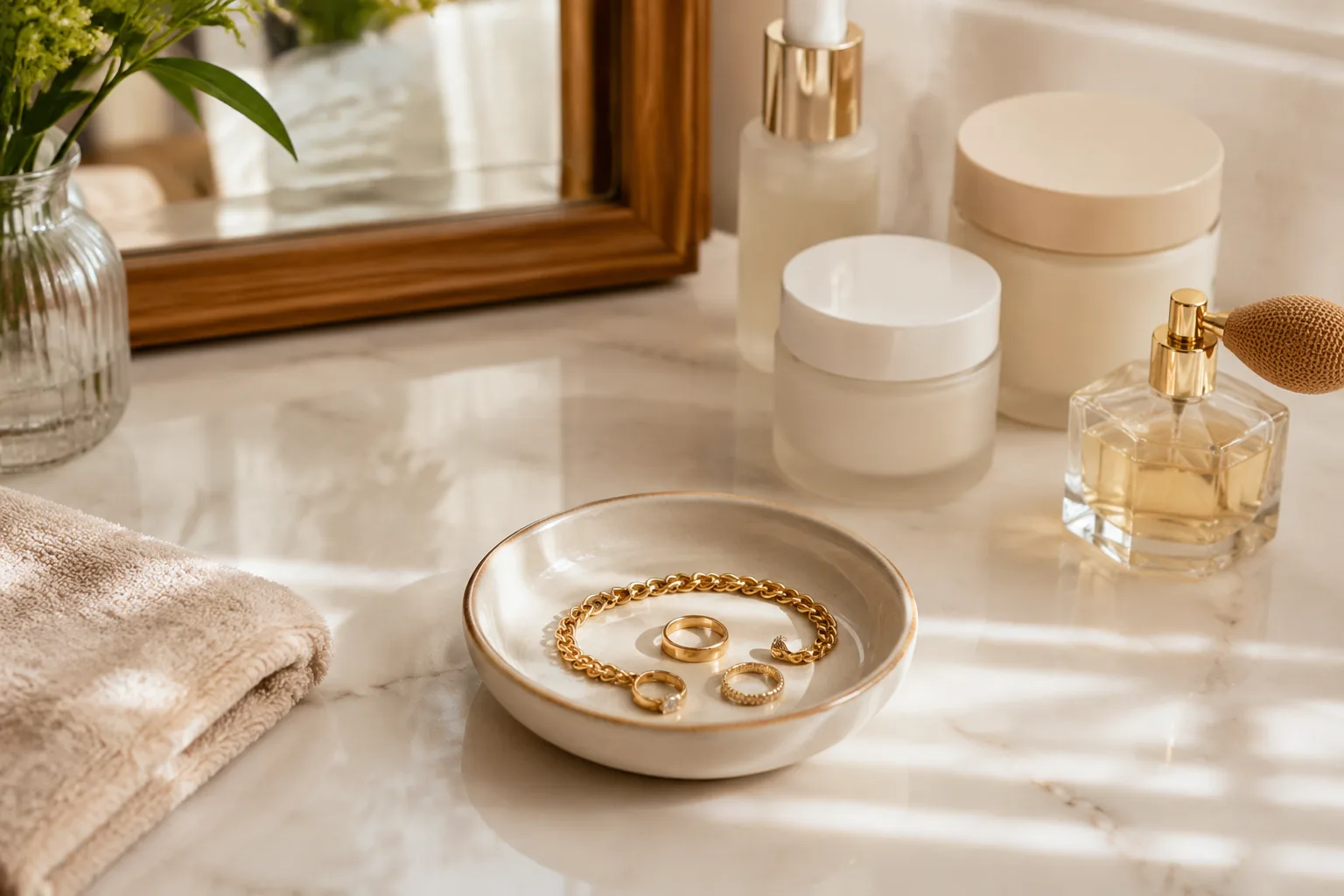
How to store jewelry to reduce tarnish risk
Storage is one of the strongest prevention levers because jewelry often spends more time unworn than worn.
Missoma recommends storing jewelry in a roll, case, or box to prevent scratching and tangling, and keeping pieces dark, cool, and dry. Missoma also recommends using a desiccant in humid environments. Monica Vinader recommends original packaging, a lined box, or a soft pouch, with pieces stored separately, and also recommends a desiccant in humid climates. Astrid & Miyu says jewelry should be stored in original boxes or airtight jewelry cases.
The Canadian Conservation Institute adds useful detail for silver. It says silver tarnish is chemically tied to silver sulfide formation from sulfur-containing gases in air, and that silver tarnishes faster as relative humidity rises. It also lists rubber bands, some adhesives, wool or felt, and some woods as possible sources of tarnishing gases for silver.
A practical storage setup:
- Use a dry jewelry box, lined case, original pouch, roll, or airtight case.
- Store pieces separately so chains do not tangle and harder pieces do not scratch softer ones.
- Keep jewelry out of the bathroom, shower area, laundry room, and sunny windowsill.
- Add a desiccant in humid climates or damp rooms, following the storage product’s instructions.
- Avoid rubber bands and questionable storage materials around sterling silver.
- Keep pearls and some gemstones away from prolonged direct sunlight when brand or gem guidance says to do so.
For silver-heavy collections, airtight storage plus humidity control is more defensible than leaving pieces exposed on open trays. For pieces with pearls or delicate stones, balance airtight tarnish prevention with the maker’s specific care guidance.
Prevention advice by material and construction
Sterling silver
Sterling silver is commonly associated with tarnish, and the Canadian Conservation Institute’s explanation of silver sulfide formation supports reducing air exposure and humidity. Store sterling silver dry, separated, and protected. For some plain sterling silver pieces, a polishing cloth may be appropriate, but check the maker’s instructions first.
Do not assume a silver-colored piece is plain sterling silver. It may be plated, coated, rhodium-finished, set with stones, or treated in a way that changes the cleaning risk.
Gold vermeil
Gold vermeil usually means a layer of gold over sterling silver. Because the surface layer is gold, aggressive silver cleaning can be a poor fit. Monica Vinader specifically says silver cleaner may be used on sterling silver but not on 18ct rose or yellow gold vermeil. For vermeil, prevention should focus on minimizing perfume, sweat, water, abrasion, and harsh cleaners.
Gold-plated jewelry and plated brass
Astrid & Miyu says sterling silver and plated brass should avoid water, sweat, and perfumes because they can cause tarnish or oxidation. With plated jewelry, the key risk is not only tarnish but also finish wear. If the surface layer is thinning or missing, a tarnish cleaner will not restore the original plating. A jeweler or the brand may need to advise on repair or replating options.
Solid gold
Solid gold is generally less tarnish-prone than sterling silver or plated brass, but “solid gold” does not mean no care is needed. GIA says chlorine can damage metals in some gold-alloy settings, so pools, hot tubs, and chlorine cleaners still deserve caution. Astrid & Miyu positions its solid 14k and 9k gold as suitable for all-day or everyday wear, but that should not be generalized to every alloy, setting, stone, or brand.
Pearls
Pearls need a gentler routine. Pandora says pearls should not be soaked or rubbed harshly and should be kept away from acids, solvents, ultrasonic cleaning, high temperatures, and prolonged direct light. Astrid & Miyu advises keeping pearls away from water where possible, notes that cosmetics may mark or fade pearls, and recommends sealed-pouch storage and microfiber wiping. GIA says pearls are very soft, can be damaged by chemicals and acids including hairspray, perfume, cosmetics, and perspiration, and should never be cleaned in ultrasonic or steam cleaners.
For pearl jewelry, prevention matters more than aggressive cleaning. Put pearls on after cosmetics and perfume, wipe gently after wear, and avoid soaking.
Gemstones, lab-grown diamonds, and delicate settings
Pandora states that lab-grown diamonds and natural pearl materials require extra gentleness compared with some other jewelry categories. Missoma says color-sensitive gemstones such as amethyst, rose quartz, chalcedony, and smoky quartz should be kept away from direct sun. Astrid & Miyu advises gemstones to avoid water and perfume, to be stored away from direct sun, and to be wiped with microfiber. Monica Vinader says natural gemstones can absorb dirt and chip, settings may loosen, and hot water, harsh chemicals, and cleaners should be avoided.
The cautious interpretation: stones, treatments, coatings, and settings change the care plan. A plain metal chain and a gemstone ring should not automatically receive the same cleaning method.
Cleaning methods to avoid as general advice
Some cleaning tips circulate because they work on certain objects in certain conditions. That does not make them safe for general jewelry care.
GIA warns that ultrasonic cleaning can loosen stones or damage treated or fracture-filled diamonds. GIA’s ultrasonic cleaner guidance also says many gems, organic materials, treated stones, coatings, and fragile settings are not suitable for ultrasonic cleaning. GIA warns that abrasives, including toothpaste, can scratch gold and other metals.
That means ultrasonic cleaners, steam, toothpaste, abrasive powders, baking soda scrubs, harsh chemical dips, bleach, chlorine, vinegar, ammonia, and household cleaners should not be presented as universal jewelry care. Monica Vinader’s warning to avoid bleach, cleaning products, and harsh chemicals supports the same conservative approach, and its silver-cleaner limitation shows why even a jewelry-specific cleaner can be wrong for a different finish.
Brand care kits should also stay brand- and material-specific. Pandora may provide care guidance for Pandora jewelry categories, but that does not make a Pandora cleaner automatically appropriate for unknown jewelry, gold vermeil, pearls, treated stones, coatings, adhesives, or another brand’s construction.
A safer prevention checklist before you clean
Before using any cleaner stronger than a soft cloth, run through this checklist.
- Identify the material: sterling silver, gold vermeil, gold-plated, plated brass, solid gold, pearls, gemstones, diamonds, coatings, enamel, glue, or unknown construction.
- Check the maker’s care instructions for that exact piece or the closest current product category.
- Decide whether the issue looks like surface tarnish, dirt, cosmetic residue, plating loss, coating wear, loose stones, scratches, or damage.
- Reduce the likely triggers first: perfume, lotion, sweat, water, chlorine, household cleaners, humidity, and open-air storage.
- Improve storage with dry, separated pouches, boxes, rolls, lined cases, airtight cases, or desiccants where appropriate.
- Start with low-risk care only where suitable. Missoma recommends gentle cleaning with a provided polishing cloth or mild dish soap and warm water, but that should still be checked against the material and stones in your piece.
- Stop and ask the brand, jeweler, or repair professional if the piece is valuable, sentimental, unknown, damaged, loose-set, pearl, gemstone-heavy, plated, vermeil, antique, or treated.
This approach is slower than grabbing a household cleaner, but it better matches the way jewelry is actually made: layered finishes, mixed materials, stones, settings, and brand-specific treatments.
What the evidence does not prove
The reviewed sources support practical prevention habits, but they do not prove guaranteed outcomes.
They do not quantify exactly how long a sterling silver necklace, plated brass ring, vermeil bracelet, pearl strand, or gemstone pendant will stay bright under specific humidity, sweat, perfume, or storage conditions. They do not independently verify broad marketing language such as “everyday wear” or “all-day wear” across all use cases. They do not make any ultrasonic cleaner, silver dip, care kit, polishing cloth, or soap-and-water method universally safe.
The strongest conclusion is narrower and more useful: official brand guidance and independent care sources consistently support reducing moisture, chemical, cosmetic, sweat, chlorine, sunlight, humidity, and open-air exposure, while matching cleaning and storage to the actual material and construction.
Conclusion
The most practical way to prevent jewelry tarnish is to change the routine around the jewelry before reaching for stronger cleaning. Put pieces on after perfume, skincare, cosmetics, and hair products. Remove vulnerable jewelry before showering, swimming, heavy exercise, cleaning, and high-chemical tasks. Store pieces dry, separated, protected, and away from humid bathrooms or direct sun.
For sterling silver, air exposure and humidity are central concerns. For vermeil and plated jewelry, finish wear can be mistaken for tarnish, so avoid aggressive silver cleaners unless the maker says they are suitable. For pearls, gemstones, treated stones, coatings, adhesives, and delicate settings, conservative care is especially important.
Jewelry care recommendations vary by material, treatment, and setting. Always follow brand or jeweler care instructions for your specific piece. This article provides shopping and educational information, not medical advice; consult a qualified clinician or dermatologist about persistent irritation or reactions. Hands-on testing is claimed only when the article documents the testing process and evidence.
Sources
- Missoma, “How to Care for Your Jewelry”
- Pandora US, “How to Clean Jewelry”
- Monica Vinader, “Jewellery Care Guide”
- Astrid & Miyu, “Jewellery Care”
- Canadian Conservation Institute, “Understanding silver tarnish”
- GIA, “How to Keep Your Diamond Sparkling”
- GIA, “Pearl Care and Cleaning Guide”
- GIA, “What Gems Are Safe in Ultrasonic Cleaners?”

1 Comment
Pingback: How to Store Jewelry Without Scratches or Tangles