



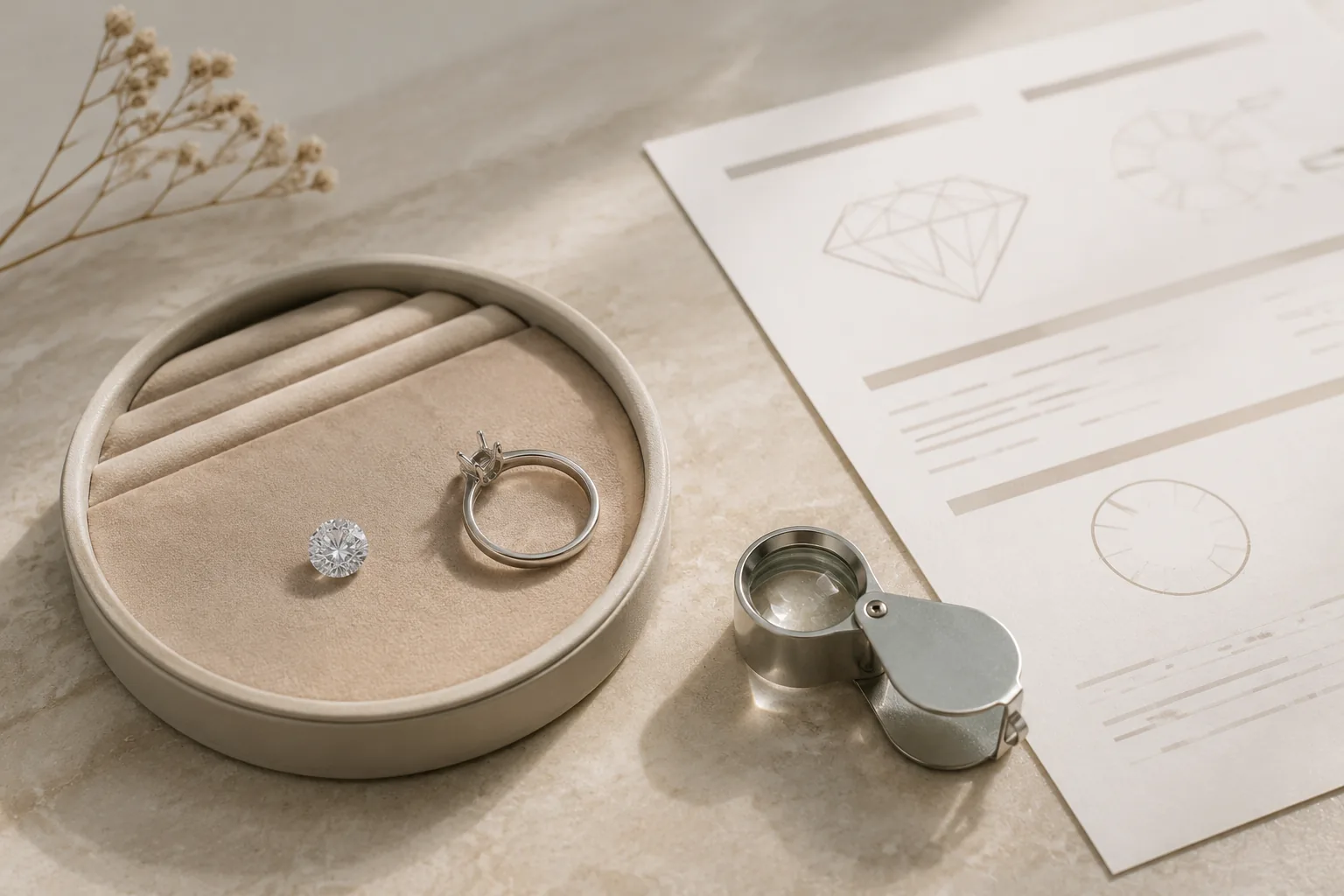
If you are buying a diamond, the practical question is not “Should every tiny diamond have its own paperwork?” It is “Which stone carries enough value, risk, or decision weight that I should insist on an individual diamond grading report?”
For a loose diamond, an engagement-ring center stone, or a larger individual lab-grown diamond, a grading report from a recognized lab can be one of the most useful documents in the purchase. It records the diamond’s measured characteristics, helps you compare stones more consistently, and gives you a report number to verify with the issuing lab.
For pavé, halo, petite, cluster, and other small finished-jewelry diamonds, individual reports may be less practical or not offered. In those cases, the buying decision shifts toward product-page disclosures, brand policies, diamond origin, total carat weight, color and clarity ranges, treatment disclosure, warranty terms, and return options.
The goal is not paperwork for its own sake. The goal is to reduce uncertainty where it matters most.
The Short Answer: Prioritize the Value-Bearing Diamond
A diamond grading report matters most for the diamond that drives the value and the decision. In most purchases, that means the loose diamond, the center stone, or another substantial individual diamond whose grade strongly affects price and comparison.
Blue Nile is a useful official example. On its diamond certification education page, Blue Nile states that its loose diamonds are analyzed and graded by leading labs such as GIA or IGI, and that every loose diamond product page has a GIA grading report. Blue Nile also states that smaller diamonds, such as pavé or halo stones, typically do not have reporting available. Those statements describe Blue Nile’s own model, not a universal rule for every seller, but the distinction is useful.
Missoma gives a finished-jewelry example. On its diamonds page, Missoma states that certificates are typically issued for larger individual stones, usually around 0.50 carats or more, or about 5 mm. It also states that its pavé diamonds are about 0.8 mm each and are not individually certified, while color, clarity, and total carat weight are disclosed on individual product pages. That 0.50 ct reference should not be treated as a universal industry cutoff; it is Missoma’s explanation of its own jewelry.
| Purchase type | Report priority | What to focus on |
|---|---|---|
| Loose diamond | High | Individual grading report, report lookup, 4Cs, origin, treatments, measurements |
| Engagement-ring center stone | High | Individual report, visual inspection, setting quality, return and warranty terms |
| Larger individual lab-grown diamond | High | Lab-grown origin, report details, growth method if disclosed, treatment comments |
| Pavé or halo accent stones | Usually lower | Total carat weight, color and clarity range, origin disclosure, seller policy |
| Petite diamond jewelry | Often lower | Product-page disclosures, warranty, return terms, construction, stone security |
| Cluster jewelry with many small stones | Mixed | Ask whether any main stone has a report; rely on disclosures for small accents |
If one diamond is the reason you are paying a premium, make the report a priority. If the piece uses many tiny stones, the more realistic standard is clear seller disclosure rather than individual lab paperwork for every stone.
What a Diamond Grading Report Is
A diamond grading report is a lab document describing a diamond’s assessed characteristics. Retailers and shoppers often use words such as “certificate,” “certified diamond,” and “diamond certification,” but terminology matters.
Blue Nile uses consumer-facing language including “diamond certification” and “diamond grading report” on its official education page. IGI states more directly that what is commonly called a certificate is actually a grading report. For careful shopping, “diamond grading report” is the more precise term because the lab is documenting observed and measured characteristics, not promising that the diamond is beautiful, fairly priced, or the right choice for you.
GIA states that its natural Diamond Grading Report includes the 4Cs, a clarity plot, and a proportions graphic. GIA also states that reports include a scientific assessment of the 4Cs, test authenticity, and disclose known treatments. IGI states that its loose diamond reports identify natural or lab-grown origin and document the 4Cs, and that it screens gemstones to determine natural, lab-grown, or simulant origin and detect treatments or enhancements.
A grading report is not the same as an appraisal. Blue Nile states that custom-built rings, pendants, or earrings come with an appraisal including retail replacement value for insurance. That makes the appraisal a valuation document, often relevant to insurance planning. It should not be treated as a substitute for an independent grading report on a value-bearing diamond.
A grading report is also different from a warranty, authenticity card, product description, or receipt. Those documents can matter, but they answer different questions. A report is strongest when you need a more standardized description of a specific diamond.
What Grading Reports Usually Tell You
A grading report is valuable because it organizes diamond information in a way that can be checked and compared. Exact formats vary by lab and report type, so shoppers should verify current terminology directly with the issuing lab before purchase.
Common report information may include:
- Carat weight: the diamond’s weight.
- Color grade: a grading of body color.
- Clarity grade: an assessment of internal features called inclusions and surface features called blemishes.
- Cut grade: for certain diamonds, especially round brilliants, a grade related to proportions, symmetry, polish, and light performance factors. GIA states that round brilliant D-to-Z diamonds receive a GIA Cut grade.
- Measurements: the diamond’s dimensions, which help match the stone to the report.
- Proportions: information such as table, depth, crown, pavilion, and girdle details depending on report type.
- Clarity plot: a diagram marking clarity characteristics, included on GIA’s natural Diamond Grading Report.
- Proportions graphic: a visual representation of diamond proportions, also included on GIA’s natural Diamond Grading Report.
- Origin: whether the diamond is natural or lab-grown where the report type covers that distinction.
- Treatment disclosure: known treatments or enhancements when detected and reported.
- Inscription: a laser inscription on the girdle when present, which can help connect the physical diamond to the report.
For lab-grown diamonds, the report may include different or additional details. Blue Nile states that many institutions, including GIA and IGI, grade lab-grown diamonds and that reports may include growth process details such as CVD or HPHT. CVD means chemical vapor deposition, and HPHT means high pressure high temperature; both are lab-grown diamond growth methods. IGI states that its loose diamond reports identify natural or lab-grown origin and document the 4Cs.
The report does not replace your eyes. Two diamonds with similar grades can look different in person or in high-quality imagery. But the report gives you a structured baseline so you are not relying only on marketing language.
When to Insist on an Individual Report
Place high priority on an individual diamond grading report when the purchase depends heavily on the identity and grade of one stone.
Loose diamonds are the clearest case. Because the stone is not yet hidden or visually influenced by a setting, the report can be matched more directly to the diamond’s measurements, inscription if present, and visible characteristics. Blue Nile states that its loose diamonds are analyzed and graded by leading labs such as GIA or IGI and that every loose diamond product page has a GIA grading report. That does not mean every retailer follows the same policy, but for loose diamonds, asking for a report is a reasonable baseline expectation.
For an engagement ring, the center stone often carries most of the cost and comparison pressure. If you are choosing between color grades, clarity grades, carat weights, diamond origins, and cut proportions, an individual report helps you understand what you are paying for. A report is especially useful when the listing uses narrow grade claims, such as a specific color and clarity grade, rather than broad ranges.
A pendant, stud earring pair, solitaire necklace, tennis bracelet with substantial stones, or right-hand ring may also justify individual reports, depending on stone size, price, and seller model. The research package does not establish a universal size threshold, so the better question is practical: would a one-grade difference in color, clarity, origin, or treatment materially affect your willingness to buy? If yes, ask whether each major stone has its own report.
Lab-grown diamonds do not need a different buying philosophy, but they do need origin-aware report checks. The report should clearly identify the diamond as lab-grown when that is the case. If growth method or treatment details are supplied, check those against the report and the seller’s product page. Blue Nile states that lab-grown diamond reports may include growth process details such as CVD or HPHT. Pandora states that Pandora Lab-Grown Diamonds are made, not mined, that it uses CVD for its lab-grown diamonds, and that its collection features IGI-certified stones.
If a seller is asking you to pay a premium for a specific color, clarity, cut, carat weight, origin, or treatment status, the report becomes more important. A broad product-page statement may be acceptable for tiny accent stones, but it is less satisfying when one diamond’s grade is central to the price. If you are comparing two diamonds mainly by grade, ask for the lab name, report number, report date, and a copy or direct link to the report.
When Individual Reports May Be Less Practical
Small finished-jewelry diamonds are where shoppers often get confused. Pavé, halo, petite, and cluster pieces may contain many very small stones. It is common for those stones to be sold with product-level disclosures instead of individual grading reports.
Blue Nile states that smaller diamonds, such as pavé or halo stones, typically do not have reporting available.
The reason is practical. When a piece contains dozens of tiny stones, individual grading for every stone may be disproportionate to the role those stones play in the piece. The setting can also make mounted stones harder to assess fully, because metal may obscure measurements, inclusions, color viewing angles, inscriptions, or damage.
This does not mean small diamonds do not matter. It means the documentation standard changes. Total carat weight, for example, means the combined weight of all diamonds in the piece. It does not mean each individual stone weighs that amount, and it does not imply that every stone has been individually graded.
What to Ask For When Small Stones Are Not Individually Reported
When small diamonds do not have individual reports, the product page and seller support have to work harder. The Federal Trade Commission Jewelry Guides state that marketers must truthfully represent type, kind, grade, quality, quantity, metallic content, size, weight, cut, color, treatment, origin, price, value, preparation, production, manufacture, and distribution. The FTC Jewelry Guides also cover lab-created and imitation substitutes.
For a pavé ring, halo setting, petite necklace, diamond huggie, cluster ring, or charm with tiny diamonds, ask for these details:
- Total carat weight: Confirm whether the listed carat weight is total carat weight and whether it includes the center stone, accent stones, or both.
- Diamond origin: Ask whether the diamonds are natural, lab-grown, or simulants. A simulant is a lookalike material, such as cubic zirconia, that is not diamond.
- Color and clarity range: For small stones, sellers may disclose a range rather than individual grades. Missoma states that color, clarity, and total carat weight are disclosed on individual product pages. Pandora states that its stones are VS+ or above and G-J near colorless.
- Cut information: Small accent stones may not receive the same cut reporting as a round brilliant center stone. Still, ask what cut description is used if the seller supplies one.
- Treatment disclosure: Ask whether any treatments or enhancements are disclosed. For small stones without individual reports, this may appear at the product or brand-policy level.
- Warranty, returns, and service: A warranty does not replace a grading report, but it matters for finished jewelry because settings, prongs, pavé beads, and stone security are part of the ownership risk.
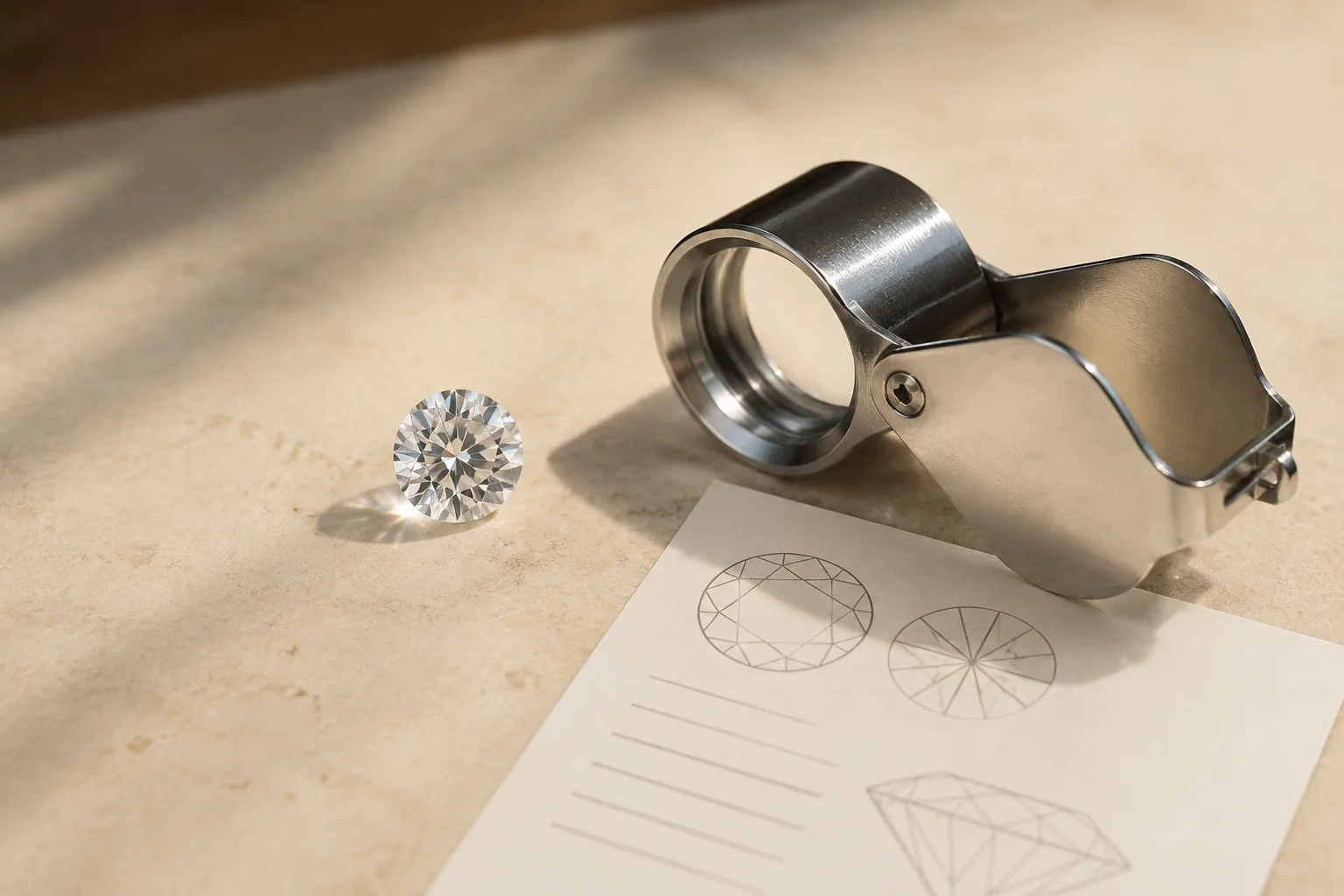
How Brand Examples Fit the Framework
Official brand disclosures can help you understand seller models, but they should be labeled carefully. They are not the same as independent verification of broader sourcing or sustainability claims.
| Brand | Official disclosure relevant to reports | How to use it as a shopper |
|---|---|---|
| Blue Nile | States that loose diamonds are graded by leading labs such as GIA or IGI, every loose diamond product page has a GIA grading report, and smaller pavé or halo stones typically do not have reporting available. | Treat as a clear example of high report priority for loose stones and lower practicality for small accent stones. |
| Brilliant Earth | States that it offers natural diamonds and lab diamonds, has offered lab-grown diamonds since 2012, and that diamonds receive certification from GIA, IGI, and GCAL. It also states that grading reports or certificates are provided on each diamond product page, with electronic copies available upon request. | Use the product page to confirm the lab and report for the specific diamond. Treat sourcing language as brand claims unless independently verified. |
| Missoma | States that it discusses natural diamonds, lab-grown diamonds, and cubic zirconia. It states its pavé diamonds are about 0.8 mm each and are not individually certified, while product pages disclose color, clarity, and total carat weight. | Use as a clear example of small-diamond disclosure replacing individual reports for pavé. Do not turn its size explanation into a universal cutoff. |
| Pandora | States that Pandora Lab-Grown Diamonds are made, not mined, that its collection features IGI-certified stones, and that it uses CVD for lab-grown diamonds. It also states stones are VS+ or above and G-J near colorless. | Check whether the specific item has an IGI report or collection-level disclosure. Treat renewable-electricity and recycled-metal language as Pandora claims unless independently corroborated. |
Brilliant Earth also states that its natural Beyond Conflict Free diamonds come from Botswana, Namibia, South Africa, and Canada. Pandora states that since 2022 its lab-grown diamonds have been grown, cut, and polished using only renewable electricity, and that its jewelry is crafted from 100% recycled silver and gold.
Those statements may be relevant to your buying values, but they should be treated as official brand claims or disclosures, not independently verified proof of broader ethical or sustainability outcomes.
How to Verify a Diamond Report Number
If a diamond comes with a grading report, verify it through the issuing lab’s official lookup tool. Do this before buying when possible, or during the return window if the seller only releases full details after purchase.
Common lookup tools include:
- GIA Report Check: https://my.gia.edu/report-check-landing
- IGI report services: https://www.igi.org/reports/
- GCAL Certificate Search: https://www.gcalusa.com/certificate-search.html
Use the lab shown on the report. Do not enter a GIA number into an IGI lookup or assume that one lab can verify another lab’s document.
When checking the report, compare the lab record with the seller’s listing and, where possible, the physical diamond:
- Report number
- Lab name
- Report date
- Shape and cutting style
- Measurements
- Carat weight
- Color grade
- Clarity grade
- Cut grade where applicable
- Polish and symmetry where provided
- Fluorescence where provided
- Natural or lab-grown origin
- Treatment or enhancement comments
- Growth method if disclosed for a lab-grown diamond
- Laser inscription where available
For lab-grown diamonds, confirm that the report and product page consistently identify the diamond as lab-grown. If the report includes CVD, HPHT, or post-growth treatment comments, compare those details with the listing.
Keep a copy of the report, receipt, appraisal if supplied, warranty terms, and product-page screenshots from the time of purchase. Product pages and policies can change.
What a Report Still Does Not Prove
A diamond grading report reduces uncertainty about documented characteristics. It does not answer every buying question.
A report does not prove that the diamond is beautiful. Cut grade and proportions help, especially for round brilliants where a cut grade is provided, but beauty also depends on how the diamond looks to you in real viewing conditions.
A report does not prove fair price. Price depends on the seller, market conditions, setting, services, return terms, warranties, brand positioning, and your alternatives at the time of purchase.
A report does not prove responsible sourcing or sustainability. Brilliant Earth, Missoma, and Pandora each make official claims or disclosures about sourcing, traceability, renewable electricity, recycled metals, or conflict-free status in the supplied source set. Those claims should be read as brand statements unless supported by additional independent evidence.
A report does not prove setting quality. Prongs, pavé beads, channel walls, metal choice, finishing, stone security, and repair support are not solved by the diamond report.
A report does not guarantee insurance approval. Blue Nile states that custom-built rings, pendants, or earrings come with an appraisal including retail replacement value for insurance, but insurance decisions depend on the insurer and policy terms.
A report does not guarantee resale value or make ordinary consumer jewelry an investment. It may help document a diamond, but future resale depends on many factors outside the report.
Decision Checklist Before You Buy
Use this checklist according to the type of diamond jewelry you are considering.
For a loose diamond, ask for the individual grading report, the issuing lab and report number, report lookup confirmation, full 4C details, measurements, fluorescence if provided, origin, treatment comments, and confirmation that the report details match the product page. Blue Nile’s official guidance is one example of a loose-diamond model where product pages include GIA grading reports, but you should verify the specific seller’s policy.
For an engagement-ring center stone, ask for an individual report for the center diamond, high-quality imagery or in-person viewing where possible, setting details, accent-stone disclosures, warranty terms, resizing terms, return policy, and appraisal if supplied. Prioritize the center stone report first. Then evaluate the ring as jewelry, not just as a diamond.
For pavé, halo, and petite diamond jewelry, ask for total carat weight, whether it includes all stones, natural or lab-grown disclosure, simulant disclosure if relevant, color and clarity range, cut information if supplied, treatment disclosure, warranty terms, service terms, and the return policy for the specific item. Blue Nile and Missoma provide useful examples of small diamonds relying on product-level disclosure rather than individual reports, but their policies are not universal rules.
For lab-grown diamond jewelry, ask for clear lab-grown disclosure, an individual lab report when the stone is large enough or important enough to justify one, consistency between the report and product page, growth method details such as CVD or HPHT if disclosed, and treatment or post-growth treatment comments if provided by the report. Pandora states that its collection features IGI-certified stones and that it uses CVD for its lab-grown diamonds. Blue Nile states that lab-grown reports may include growth process details such as CVD or HPHT. Check current report wording for the exact item.
For brand claims and product pages, separate lab-verified report details from product-page disclosures and broader brand claims.
Conclusion: Match the Report Standard to the Diamond’s Role
Not every diamond purchase needs an individual GIA, IGI, GCAL, or similar grading report for every stone. Prioritize a diamond grading report for the value-bearing diamond: loose stones, engagement-ring center stones, larger individual diamonds, and lab-grown diamonds where origin and report details materially affect the decision.
For pavé, halo, petite, and cluster jewelry, individual reports for every tiny stone may be less practical and may not be offered. That does not mean you should buy blind. It means you should shift your attention to transparent product-page disclosures: total carat weight, diamond origin, color and clarity range, cut information where supplied, treatment disclosure, warranty terms, return options, and seller accountability.
A report is useful because it reduces uncertainty about documented diamond characteristics. It does not prove beauty, fair price, responsible sourcing, sustainability, setting quality, insurance acceptance, or resale value. Use it as one important document in the buying decision, not as the whole decision.
Sources
- Blue Nile, “Diamond Certification: All About Diamond Grading”: https://www.bluenile.com/education/diamonds/certification
- Brilliant Earth, “What Are Brilliant Earth Diamonds? Your FAQs Answered”: https://www.brilliantearth.com/en-ca/news/what-are-brilliant-earth-diamonds/
- Missoma US, “Discover Our Diamonds”: https://us.missoma.com/pages/our-diamonds
- Pandora US, “What are lab-grown diamonds?”: https://us.pandora.net/en/blog/what-are-lab-grown-diamonds/
- GIA, “Sample Natural Diamond Reports”: https://www.gia.edu/gia-website/analysis-grading-sample-report-diamond
- GIA, “What kind of information is on a GIA diamond report and what does it mean?”: https://www.gia.edu/gia-faq/gia-faq-analysis-how-to-read-gia-report
- FTC, “Jewelry Guides”: https://www.ftc.gov/news-events/topics/tools-consumers/jewelry-guides
- IGI, “IGI Reports”: https://www.igi.org/reports/
- GIA Report Check: https://my.gia.edu/report-check-landing
- GCAL Certificate Search: https://www.gcalusa.com/certificate-search.html