



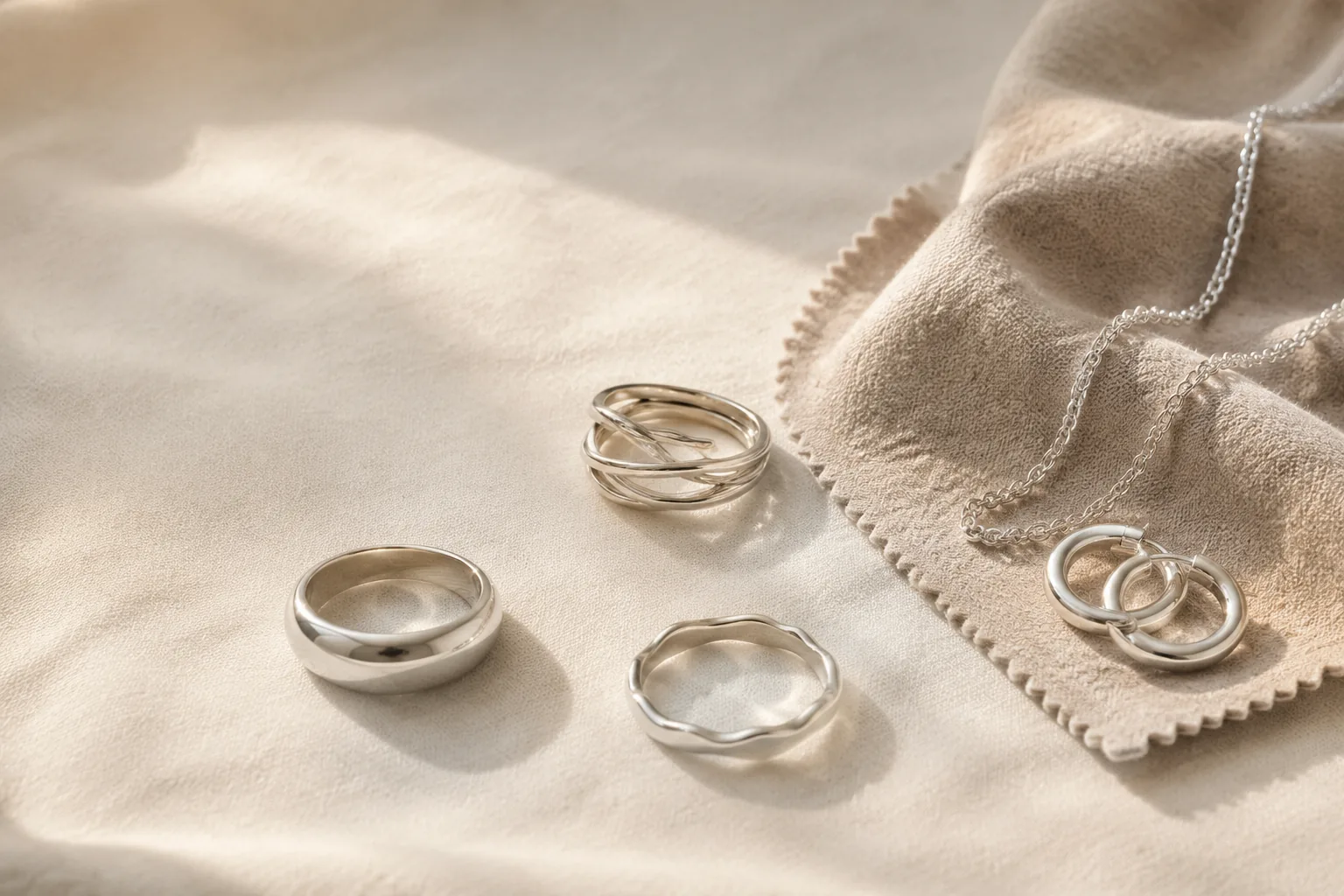
If you are comparing jewelry listings and one says “925 sterling silver” while another says “silver plated,” “silver tone,” “gold vermeil,” or “rhodium plated,” the difference is not just wording. It tells you whether the silver is the main precious-metal alloy, a surface layer, a color description, or part of a finish system.
The short answer: 925 sterling silver jewelry is real silver jewelry, but it is not pure silver. It is a silver alloy that meets a 92.5% silver threshold. The remaining 7.5% is made up of other metals, often copper when a source says so, but not something shoppers should assume in every listing.
This guide explains what “925” means, how it differs from plated and gold-tone jewelry, what stamps can and cannot prove, and how to read common online jewelry descriptions without treating any one brand claim or country rule as universal.
What 925 Sterling Silver Means
“925 sterling silver” means the metal is an alloy containing at least 925 parts silver per 1,000 parts metal. In plain terms, that is 92.5% silver.
In the United States, the Federal Trade Commission’s jewelry guidance says the terms “Sterling Silver,” “Sterling,” and “Ster.” should not be used unless the product is at least 925/1,000ths pure silver. That makes “925” a purity threshold, not just a decorative stamp or marketing phrase. Source: FTC jewelry guides
Blue Nile’s metal education page describes sterling silver as at least 92.5% pure silver, with the remaining 7.5% able to be any metal and typically copper. It also distinguishes pure silver as 99.9% silver and describes pure silver as softer than sterling silver. Source: Blue Nile
Brand examples show how this can appear in real product education pages:
- Mejuri says its sterling silver meets the 92.5% pure silver standard and that it intentionally blends in 7.5% copper. Source: Mejuri
- Missoma says its sterling silver is 92.5% pure silver and 7.5% copper. Source: Missoma
- Astrid & Miyu says its silver-based pieces use recycled sterling silver made from 92.5% pure silver before being plated in selected finishes. Source: Astrid & Miyu
The careful reading is important: Mejuri and Missoma disclose copper in their own sterling silver, while Blue Nile’s broader education language says the non-silver portion can be any metal and is typically copper. So, unless a seller states the alloying metal, “925” tells you the silver percentage, not the exact full recipe.
Is 925 Sterling Silver Real Silver?
Yes. 925 sterling silver is real silver jewelry because silver is the majority metal and the alloy meets the sterling silver threshold. It is not the same as fine silver, and it is not the same as silver-plated jewelry.
Here is the practical distinction:
| Listing term | What it usually tells you | Shopper caution |
|---|---|---|
| 925 sterling silver | The metal meets a 92.5% silver standard | It does not identify every alloying metal unless disclosed |
| Fine silver | Blue Nile describes pure silver as 99.9% silver | Softer than sterling silver, according to Blue Nile |
| Silver plated | A base material is coated or plated with silver | FTC guidance says coated or plated items should be qualified as such |
| Silver tone | A color description, not proof of sterling silver | Ask for material details before treating it as silver |
| Gold vermeil | Sterling silver with a gold or gold-alloy coating meeting defined requirements under FTC guidance | Thickness and karat claims should be checked brand by brand |
| Gold plated brass | Brass base with gold plating | It is not sterling silver underneath unless the seller says so |
| Rhodium-plated sterling silver | Sterling silver with rhodium applied to the surface | FTC guidance says rhodium surface applications on precious-metal products must be disclosed |
Under FTC guidance, silver-coated or silver-plated products must be qualified as coated or plated instead of being described as sterling throughout. The same guidance treats vermeil as sterling silver coated or plated on significant surfaces with gold or gold alloy of at least 10 karat and a minimum 2.5 microns fine-gold equivalent. It also says rhodium surface applications on precious-metal products must be disclosed. Source: FTC jewelry guides
That means “sterling silver,” “silver plated,” and “silver color” are not interchangeable. For shoppers, the most reliable listing is one that clearly separates the base metal from the surface finish.
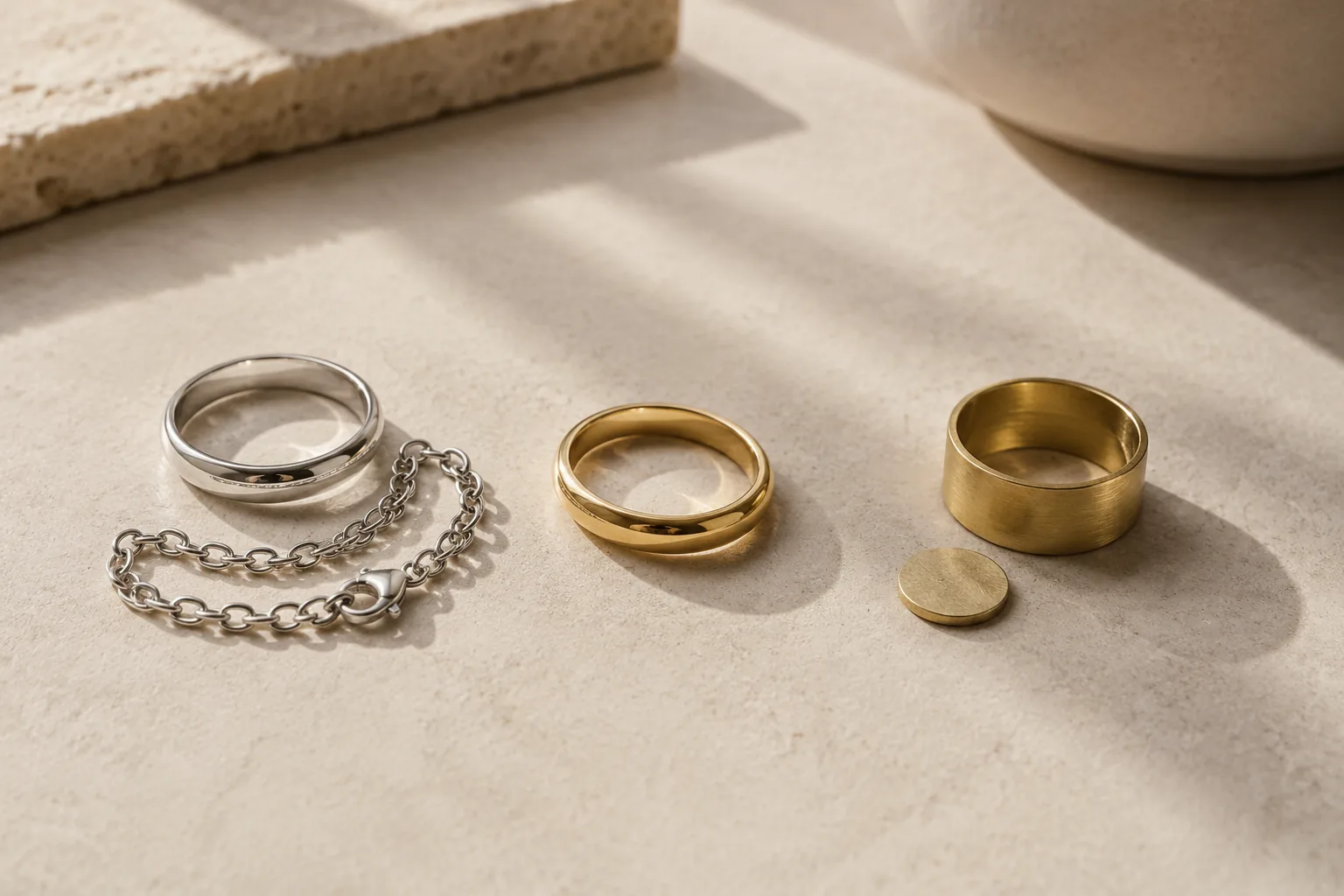
Why Silver Is Alloyed for Jewelry
Silver is valued in jewelry partly because of its bright appearance and precious-metal status, but pure silver is not the most practical choice for every jewelry design. Blue Nile distinguishes pure silver as 99.9% silver and describes it as softer than sterling silver. Sterling silver is alloyed to make it more useful for jewelry construction and everyday handling.
This does not mean every 925 sterling silver piece performs the same way. Durability depends on the design, chain thickness, clasp construction, stone setting, surface finish, plating, care, and wear pattern. A slim sterling silver chain and a heavy sterling silver ring can both meet the same 925 standard while feeling very different in use.
Some brands also add surface finishes. Missoma says its sterling silver has rhodium plating for durability and high shine. Astrid & Miyu says its silver-based pieces are plated in 18k yellow gold, 18k rose gold, or rhodium to help durability and minimize scratching. Blue Nile says sterling jewelry is often rhodium plated for a bright white finish and better scratch resistance. These are finish-specific claims or education points, not proof that all sterling silver jewelry is rhodium plated.
How to Read Common Sterling Silver Listing Terms
Online jewelry listings often combine purity, base metal, recycled-content claims, and finish language in one phrase. Read them in pieces.
“925” or “sterling silver”
This means the item is being described as meeting the sterling silver threshold. In the US context, FTC guidance says “Sterling Silver,” “Sterling,” and “Ster.” should not be used unless the product is at least 925/1,000ths pure silver.
“Solid sterling silver”
In shopping language, this usually suggests the piece is sterling silver through the relevant metal body rather than merely silver plated. Still, check whether any surface finish is also present, such as rhodium plating, gold plating, oxidation, enamel, or gemstone settings.
“Recycled sterling silver”
This is a sourcing or material-origin claim, not a different silver purity by itself. It should be read brand by brand. Mejuri says each sterling silver piece uses 95% recycled silver and 5% newly mined silver. Missoma says its pieces use 100% certified recycled gold and silver. Astrid & Miyu describes its silver-based pieces as recycled sterling silver. These claims should not be generalized to all sterling silver jewelry.
“Rhodium-plated sterling silver”
This means the underlying precious-metal alloy is sterling silver, with rhodium applied as a surface finish. FTC guidance says rhodium surface applications on precious-metal products must be disclosed. Blue Nile says sterling jewelry is often rhodium plated for a bright white finish and better scratch resistance.
“18k gold vermeil over sterling silver”
This points to sterling silver underneath with a gold layer on top. FTC guidance defines vermeil with sterling silver coated or plated on significant surfaces with gold or gold alloy of at least 10 karat and a minimum 2.5 microns fine-gold equivalent. Mejuri says its 18k gold vermeil is a 2.5-micron layer of solid gold over sterling silver, never brass. Missoma says its 18k gold vermeil is a 2.5-micron layer over sterling silver.
Those are strong brand examples, but they do not prove every vermeil listing from every seller has the same disclosure quality.
“Silver-plated brass” or “gold-plated brass”
This tells you the base metal is brass and the silver or gold is a surface layer. Missoma says its silver-plated pieces are silver over brass with an anti-tarnish coating, and its 18k gold-plated jewelry is over brass with different micron thicknesses depending on product type. Astrid & Miyu says plated brass is used for bolder jewelry and plated in 18k yellow gold, rose gold, or rhodium.
This can be a valid fashion-jewelry choice, but it is not the same material proposition as 925 sterling silver jewelry.
What 925 Stamps and Quality Marks Can and Cannot Tell You
A “925” stamp can be useful, but it is not a complete authenticity guarantee.
In the US, FTC guidance says a silver item with a quality mark should carry the maker or dealer name or trademark required by the National Stamping Act. In Canada, the Precious Metals Marking Regulations list silver quality terms and decimal quality marks for silver meeting 925 parts by weight in every 1,000 parts pure silver. The Canadian regulations also say that if a quality mark applies only to part of an article, that part must be identified. Source: Government of Canada
In the UK, GOV.UK and British Hallmarking Council guidance describes hallmarking as involving Assay Offices, Dealer’s Notices, precious-metal standards, official symbols, and exemptions. Source: GOV.UK
These systems are not identical. US FTC guidance, UK hallmarking rules, and Canadian marking rules should not be collapsed into one global rule. For EU shoppers, no single EU-wide hallmarking source was provided in the research package, so the cautious advice is to check the relevant country rules and seller disclosures.
Brand-specific marks are also not universal marks. Missoma says its sterling silver pieces are stamped “925.” Pandora says its standard maker’s mark is “ALE,” except on some of the smallest pieces, and that its sterling silver is marked “S925.” Pandora also warns that the presence of key markings does not guarantee authenticity, although checking markings is a first step. Source: Pandora Group
That is the right mindset for online shopping: markings help, but they should be considered alongside seller identity, documentation, return policy, and whether the listing language is internally consistent.
Brand Examples: Mejuri, Missoma, Pandora, Astrid & Miyu, Monica Vinader, and Blue Nile
Official brand pages are useful because they show how real jewelry companies disclose materials. They should be treated as brand-specific claims, not universal standards.
Mejuri says its sterling silver meets the 92.5% pure silver standard, intentionally uses 7.5% copper, and uses 95% recycled silver and 5% newly mined silver in each sterling silver piece. Mejuri also says its 18k gold vermeil is a 2.5-micron layer of solid gold over sterling silver, never brass.
Missoma says its sterling silver is 92.5% pure silver and 7.5% copper, with rhodium plating for durability and high shine. It says sterling silver pieces are stamped “925,” and that its pieces use 100% certified recycled gold and silver. Missoma also distinguishes 18k gold vermeil over sterling silver from 18k gold-plated jewelry over brass and silver-plated brass.
Pandora says its jewelry is primarily solid sterling silver and 14k or 18k gold with stones, pearls, and glass. Its brand-protection page identifies ALE and S925 as Pandora-specific marking examples, while also warning that markings alone do not guarantee authenticity.
Astrid & Miyu says its silver-based pieces use recycled sterling silver made from 92.5% pure silver and then plated in 18k yellow gold, 18k rose gold, or rhodium. It also says plated brass is used for bolder jewelry. Its care page gives specific guidance for plated jewelry, storage, gemstones, and pearls.
Monica Vinader’s supplied official about page supports broader brand-positioning claims: 100% recycled gold and sterling silver, supply-chain transparency, Product Passport, a 5-year warranty, lifetime repairs, and a recycling scheme. The supplied evidence does not verify a technical sterling alloy breakdown, vermeil thickness, plating details, nickel disclosure, or care specifics from that page.
Blue Nile provides broader metal education, including the 92.5% sterling silver threshold, the softer nature of pure silver compared with sterling silver, tarnish causes, and rhodium-plated sterling silver context.
The analysis for shoppers: the best listings are not necessarily the longest, but they are specific. They tell you the base metal, surface finish, stamp or hallmark context, care limits, and whether recycled-content or repair claims apply to the specific item.
Does Sterling Silver Tarnish?
Yes, sterling silver can tarnish. Tarnish is not proof that the piece is fake.
Blue Nile says tarnish occurs when silver reacts with sulfur or hydrogen sulfide in ambient air, and that chemicals, high humidity, and sulfur can tarnish sterling silver. That means darkening or discoloration can be a normal silver reaction rather than evidence that the jewelry is not sterling silver.
However, not every discoloration issue has the same cause. Analysis: depending on construction, visible changes may also come from plating wear, residue from products, chemical exposure, base-metal exposure on plated jewelry, or changes to a coating. Rhodium-plated sterling silver, gold vermeil, silver-plated brass, plain sterling silver, and jewelry with pearls or gemstones should not all be treated the same way.
Astrid & Miyu says sterling silver benefits from frequent wear because skin oils can help with oxidation. It also advises avoiding water, sweat, and perfumes for plated jewelry; storing pieces in boxes or airtight cases; and using gentler care for gemstones and pearls. Those are brand-specific care instructions, not universal rules for every sterling silver item.
Skin Sensitivity and Nickel: What Beginners Should Know
The supplied evidence does not prove that all 925 sterling silver is nickel-free or hypoallergenic. It also does not support a universal claim that 925 sterling silver is safe for every wearer.
What the evidence does support is more limited: 925 sterling silver is defined by silver content, and some brands disclose copper as the other 7.5% in their own sterling silver. Mejuri and Missoma state copper in their alloy descriptions. Astrid & Miyu describes recycled sterling silver made from 92.5% pure silver, but the supplied evidence should not be stretched into a universal nickel conclusion.
Practical suggestion: if you have known metal sensitivities, look for explicit nickel, alloy, plating, and coating disclosures from the seller. If irritation is serious, persistent, or worsening, consult a qualified clinician or dermatologist. This article is shopping and educational information, not medical advice.
925 Sterling Silver vs Plated, Vermeil, Stainless Steel, Solid Gold, White Gold, and Platinum
This comparison is a practical buying framework, not a universal ranking.
| Material or finish | What to know | Best-fit analysis |
|---|---|---|
| 925 sterling silver | Real silver alloy at the 92.5% threshold | Good for shoppers who want precious-metal content at a more accessible level than many gold or platinum pieces |
| Silver plated | Silver coating over another material | Can suit trend-led pieces, but the base metal and plating disclosures matter |
| Gold vermeil | Sterling silver with qualifying gold coating under FTC guidance | Useful when you want gold color over a sterling base, but finish wear and care still matter |
| Gold-plated brass | Gold layer over brass | Often more finish-dependent; check plating thickness and base-metal disclosure |
| Rhodium-plated sterling silver | Sterling silver with rhodium surface application | Can offer a bright white look; rhodium should be disclosed when applied |
| Stainless steel | Not covered by the supplied silver sources | Compare seller disclosures, finish, and skin-sensitivity information carefully |
| Solid gold | Not directly defined in the supplied silver facts | Usually evaluated by karat, construction, and budget rather than silver purity |
| White gold | Not directly defined in the supplied silver facts | Often compared by alloy, plating, care, and price, but verify current seller details |
| Platinum | Not directly defined in the supplied silver facts | Typically considered separately for density, price, and wear characteristics, using platinum-specific sources |
The main takeaway: do not compare only by color. A white metal could be sterling silver, rhodium-plated sterling silver, silver-plated brass, stainless steel, white gold, platinum, or a silver-tone base metal. The listing should tell you which one it is.
What to Check Before Buying 925 Sterling Silver Jewelry Online
Use this checklist before treating a listing as credible:
- Check whether the listing says “925,” “sterling silver,” “silver plated,” “silver tone,” “vermeil,” or “plated brass.”
- Look for separate base-metal and surface-finish disclosures.
- For vermeil, look for gold karat, sterling silver base, and thickness information when available.
- For rhodium-plated sterling silver, look for disclosure that rhodium is present.
- Ask whether “recycled sterling silver” refers to the specific item or a broader brand statement.
- Review close-up photos of marks, but do not treat a 925 stamp as proof of authenticity.
- Check seller identity, official brand pages, and whether the seller is authorized when buying branded jewelry.
- Read return policies before purchase, especially for earrings, personalized pieces, final sale items, or international orders.
- Check whether gemstones, pearls, enamel, adhesives, oxidized finishes, or plating change the care requirements.
- For UK, US, Canadian, or European purchases, check the relevant local marking or hallmarking context instead of assuming one country’s rules apply everywhere.
- Review warranty and repair language carefully. Monica Vinader’s supplied about page, for example, supports brand-specific claims about a 5-year warranty and lifetime repairs, but that does not describe every sterling silver seller.
How to Care for 925 Sterling Silver Jewelry
Care depends on the specific piece. Plain sterling silver, rhodium-plated sterling silver, gold vermeil, silver-plated brass, gemstone jewelry, pearl jewelry, enamel, adhesives, and oxidized finishes can need different handling.
Supported care facts from the supplied sources are limited but useful. Blue Nile says tarnish can occur when silver reacts with sulfur or hydrogen sulfide in ambient air, and that chemicals, high humidity, and sulfur can tarnish sterling silver. Astrid & Miyu advises avoiding water, sweat, and perfumes for plated jewelry; storing pieces in boxes or airtight cases; and using gentler care for gemstones and pearls. Astrid & Miyu also says sterling silver benefits from frequent wear because skin oils can help with oxidation.
Practical suggestion: follow the jeweler’s care instructions for your specific item. Be especially cautious with chemical dips, abrasive polishing, ultrasonic cleaning, or aggressive cleaning methods if the piece has plating, pearls, gemstones, coatings, adhesives, or delicate settings. The supplied evidence does not support treating any one cleaning method as universally safe.
Conclusion: How to Think About 925 Sterling Silver Jewelry
925 sterling silver jewelry is real silver jewelry, but it is not pure silver. The “925” refers to a 92.5% silver standard; the other 7.5% should not be assumed unless the seller or source discloses it.
For beginners, the most important skill is reading the whole listing. “Sterling silver,” “silver plated,” “gold vermeil,” “rhodium plated,” “gold-plated brass,” and “silver tone” describe different material situations. A 925 stamp is useful, but it is not a standalone authenticity guarantee, and country-specific marking or hallmarking rules vary.
The best buying approach is practical: confirm the base metal, confirm the finish, check brand or seller disclosures, understand care limits, and be cautious with universal claims such as tarnish-proof, waterproof, nickel-free, or hypoallergenic. Sterling silver can be a strong everyday jewelry choice, but the quality of the listing, construction, finish, and care guidance matters as much as the number “925.”